I have worked in hundreds of transmitter sites over the years; AM, FM, TV, HF, Two way, Paging, Cellular, etc. So many, I have lost count. The one thing that is always annoying is equipment that is suspended from the ceiling at just the wrong height, AKA: The Head Smasher. It does not matter if warning signs are posted, I’ve seen them marked with black and yellow caution tape, and so on. If it is installed low enough for somebody to hit their head, contusions will result.
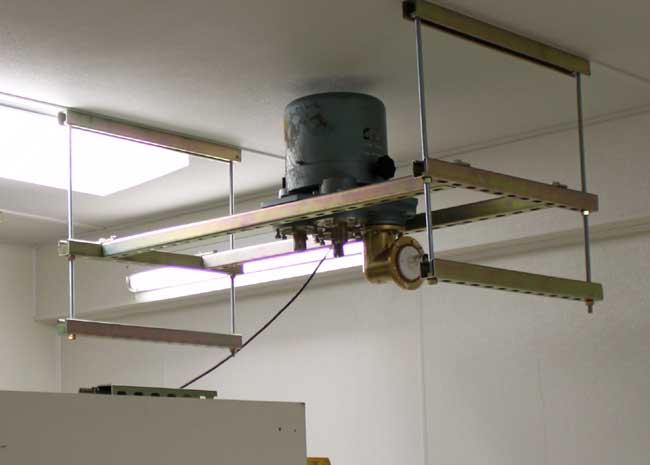
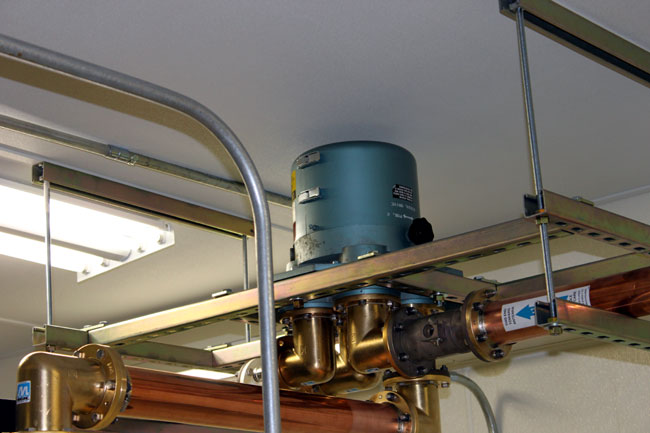
3 1/8 inch motorized coax switch mounted
Thus, when it came to installing this motorized 3 1/8-inch coax switch, there was only one way to do it. Installing it the other way would result in a head smasher behind the backup transmitter because the ceilings are low. The problem with this style of mounting is how to get to the motor and clutch assembly for servicing. There is but one inch of clearance between the top of the coax switch and the transmitter room’s ceiling. If servicing is needed, the entire switch would need to be removed, resulting in lots of extra work and off-air time.
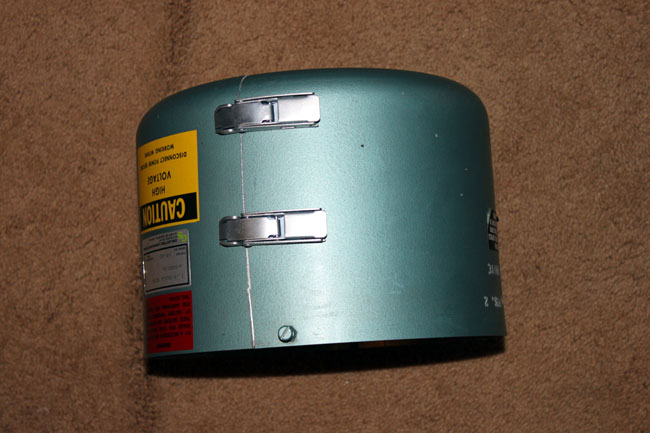
3 1/8 inch motorized coax switch cover
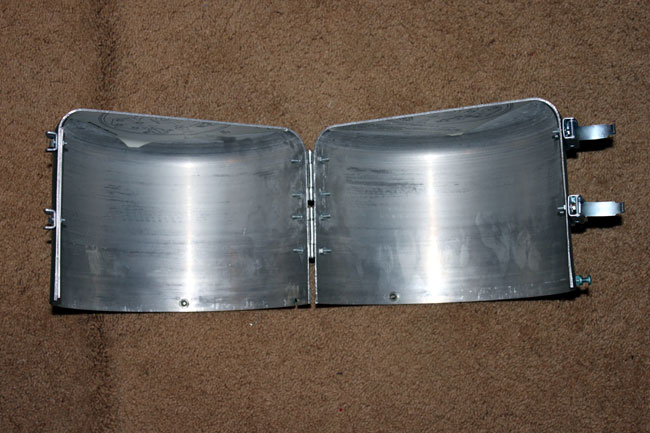
So, an idea was formed. Why not cut the switch cover in half and put some hinges on it. The cover itself is made of aluminum. I was able to carefully mark it out and cut it with a jig saw. Then, I attached a set of hinges on the back side and a set of latches on the front. It now opens like a clam shell.
3 1/8 inch coax switch cover modification
Now, when access is needed to either the motor or clutch, the cover can be opened up and removed. Unless the actual RF contact fingers burn out, there should be no need physically remove the switch for servicing.
3 1/8 inch coax switch cover, modified
Cover replaced. This will not have to be removed very often, in fact, I have known some coax switches that never need service. Still, having the ability to quickly get the cover off and do some basic repairs is a good thing.
It may be surprising to some, but the number of wires allowed in any given conduit is not “as many as can be jammed in there.” The National Electrical Code, AKA NEC or NFPA 70 gives specific guidance on the number of current-carrying conductors allowed in any specific size and type of conduit.
This is due to the fact that current-carrying conductors generate heat. Cables enclosed in a conduit need to dissipate that heat so that the insulation on the cable doesn’t melt, which would be a bad outcome.
Conduit fill tables are found in Chapter 9 of the NEC. There are several tables that give the number of conductors for each size and type of conduit. Then there is the general rule of thumb that for more than two cables, the maximum conduit fill is 40%. This comes in handy when several different size conductors are being run in the same conduit.
An example of this is when several circuits are going across the room to the same general location, in this case, a row of transmitters and racks. Instead of running individual conduits for all those units, one or two conduits from the electrical panel are run to a square wireway, then the individual circuits are broken out and wired from wireway to the individual loads. In this case, the following equipment is being connected:
Harris FM25K: 100 amp 3 phase high voltage power supply (#2 THHN), 30 amp 3 phase transmitter cabinet (#10 THHN)
Harris FM3.5K: 70 amp split phase (#6 THHN)
Harris MW1A: 30 amp split phase (#10 THHN)
Two equipment racks: 20 amp single phase (#12 THHN)
Coax switch: 15 amp single phase (#14 THHN)
Dummy Load: 15 amp single phase (#14 THHN)
Antenna switch/dissipation network for AM station: 15 amp split phase (#14 THHN)
Convenience outlets for the back wall: 20 amp single phase (#12 THHN)
Excluding grounding conductors, which will be addressed below, the total current carrying conductor count is thus:
#2 THHN: 3 each
#6 THHN: 3 each
#10 THHN: 7 each
#12 THHN: 6 each
#14 THHN: 6 each
Ampacities based on NEC table 310.16, THHN insulation in dry locations, maximum temperature rating is 90° C (194° F) based on the ambient temperature of 30° C (86° F)
Grounding conductors for each of those circuits, based on NEC Table 250.122 (all conductors are copper):
100 amp circuit: #8
70 amp circuit: #8
30 amp circuit: #10
20 amp circuit: #12
15 amp circuit: #14
The final conductor count is:
#2 THHN: 3 each
#6 THHN: 3 each
#8 THHN: 2 each
#10 THHN: 9 each
#12 THHN: 9 each
#14 THHN: 9 each
The plan is to use two 1 and 1/2-inch EMT conduits between the electrical service panel and the 4 x 4 square wireway. According to NEC Chapter 9, Table 4, the 40% cross-sectional size of this conduit is 526 mm2. It is easier to simply use metric measurements for this. The cross-sectional wire areas are found in Chapter 9, Table 5. Chart of various conductor sizes and areas:
Conductor
Area (mm2)
Total conductor
Total area (mm2)
#2 THHN
74.71
3
224.13
#6 THHN
32.71
3
98.13
#8 THHN
23.61
2
47.22
#10 THHN
13.61
9
122.49
#12 THHN
8.581
9
77.229
#14 THHN
6.258
9
56.322
Thus, in order to break this up into two 1 and 1/2-inch conduits, the #2, #6, and #8 (main transmitter HV power supply, backup transmitter, and grounds) are run in one conduit, the remaining circuits in the other. The idea is that the main transmitter and backup transmitter will not be running simultaneously for long periods of time. Those cable areas total 369.48 mm2, well within the 40% limit of 526 mm2 for 1 and 1/2 inch EMT. The rest of the circuit’s cable areas total 256.041 mm2. That leaves room for additional circuits in the second conduit if future needs dictate. The extra conduit area will make pulling the wires through easy.
From the square wireway to the HV power supply, 1 and 1/4 inch conduit will carry the three #2 and one #8 ground. 1 and 1/4 inch EMT has a cross sectional area of 387 mm2, the conductors contained within will be 271 mm2. Less room here, but still well within the 40% limit.
Blogging has been light due to workload being heavy, at the moment. We are engaged in moving transmitters out of this old house:
WINE 940 WRKI 95.1 former studio and transmitter site
Into this new transmitter building:
WINE WRKI transmitter building at base of tower
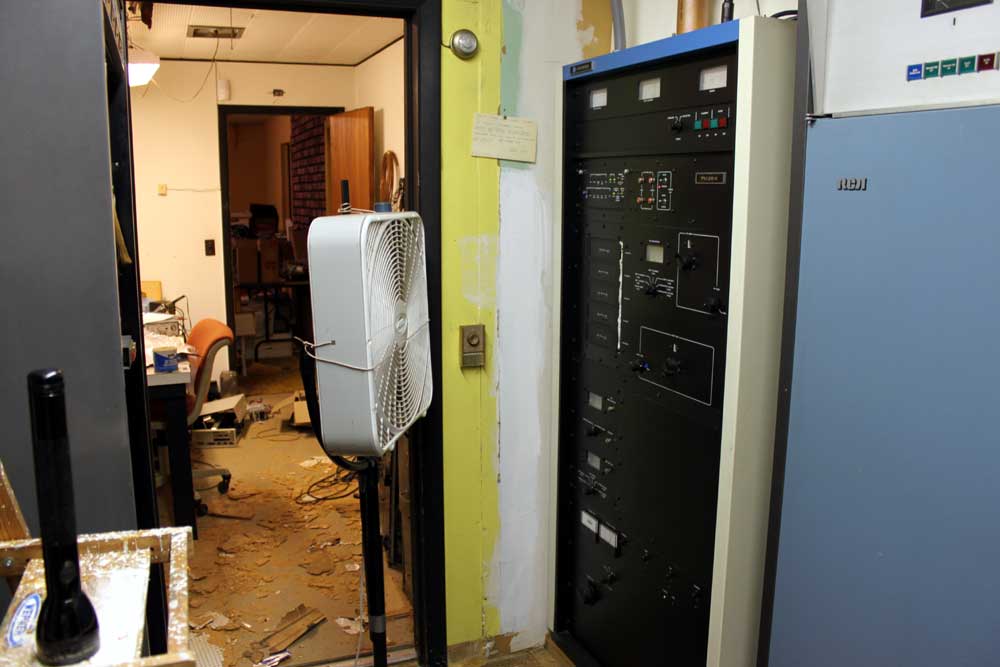
The former building was the original studio for WRKI, 95.1 MHz, which signed on in 1957. The co-located AM station, WINE 940 KHz, did not sign on until 1963. As such, the building is a little worn around the edges, so to speak. The FM transmitter has an auxiliary cooling device, for those hot summer days as the building itself is un-airconditioned:
WRKI Harris FM25K transmitter, circa 1986
The rest of the building is in similar condition. Ceiling tiles are falling off the ceiling and getting ground into the floor, junk is piled up in almost every corner, rodent feces, and the basement, don’t even get me started on the basement.
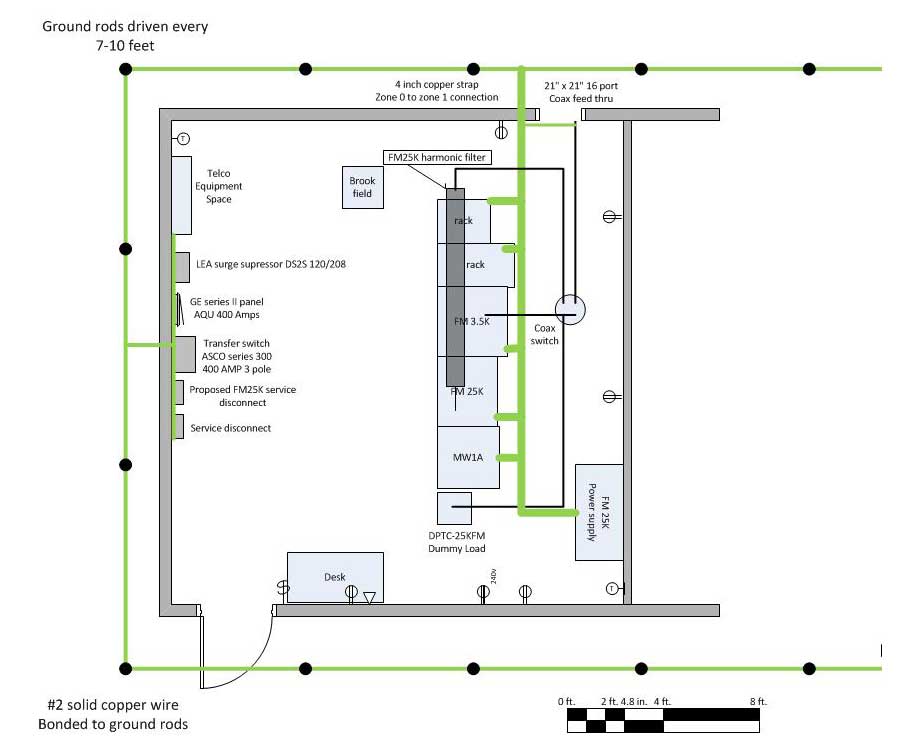
The basic floor plan for the new building is simple:
WRKI WINE transmitter room floor plan
Right now, the preliminaries are being done, mounting the coax switch, running conduit, pulling wires, etc.
A few design notes:
This building is much closer to the tower, which is sited on a high hill (715 feet, 218 Meters) and sticks up 500 feet (152.1 Meters) above that. Basically it is the area lightning rod, thus special attention will need to be paid to grounding and bonding. I decided to isolate the electrical ground in favor of the RF ground for lightning protection. This involves putting toroids on the electrical ground conductors.
The building itself is shielded with continuous steel plating, but that has been cut in a few areas to install air conditioners. Those areas will have to be repaired and the AC units bonded to the steel plate.
Back up cooling will be in the form of a large exhaust fan and intake louver.
The tower itself is AM radiator for WINE. It is 170 degrees tall, which means high RF fields at the base, therefore good RF bypassing is needed.
The transmitter room itself is fairly small for what needs to go in there. careful design and placement is required.
Here are some in-progress pictures:
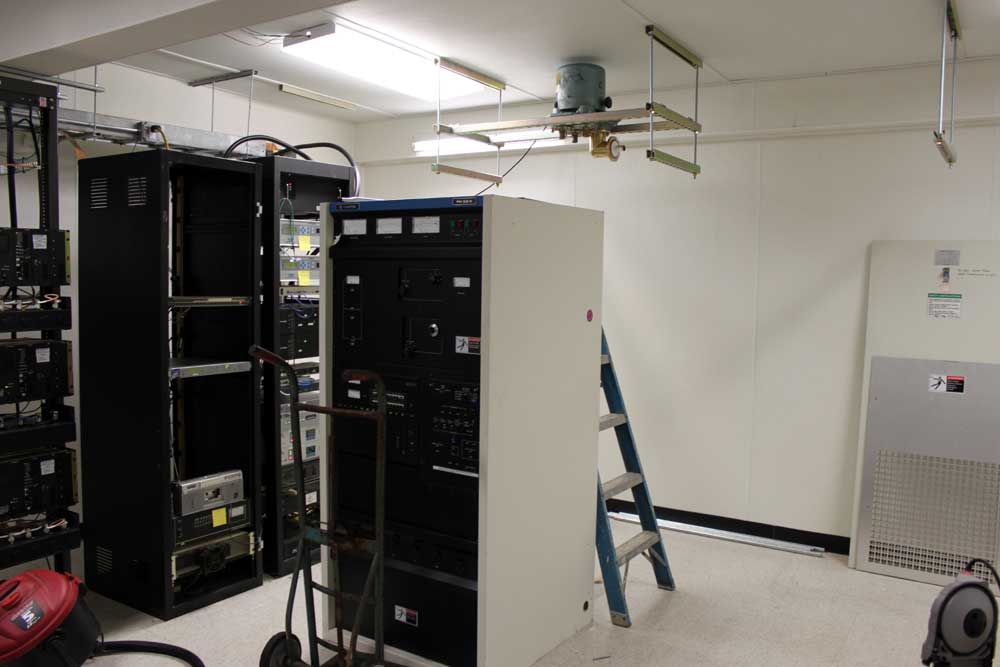
WRKI backup transmitter, Harris FM3.5K, coax switch in the background
The first order of business was retuning a Harris FM3.5K transmitter to function as the backup. The current backup transmitter is an RCA FM20E, which no longer runs. After the move is completed, that transmitter will likely be scrapped.
I attached super strut to the ceiling at four foot intervals. I used this strut to support the 4 port coax switch. All coax in the transmitter room is 3 1/8 inch hardline, which has a power rating of 40 KW. Since the transmitter power output is 20 KW, this leaves a lot of head room for problems. When working with a 3 1/8 inch coax, it is important to remember to cut the inner conductor 1 1/2 to 1 3/4 inches sorter than the outer conductor, otherwise the stuff doesn’t go together right.
The 30 KW air cooled dummy load was moved up from the other building and connected to the coax switch. This allowed the backup transmitter to be tested.
WRKI backup transmitter and dummy load
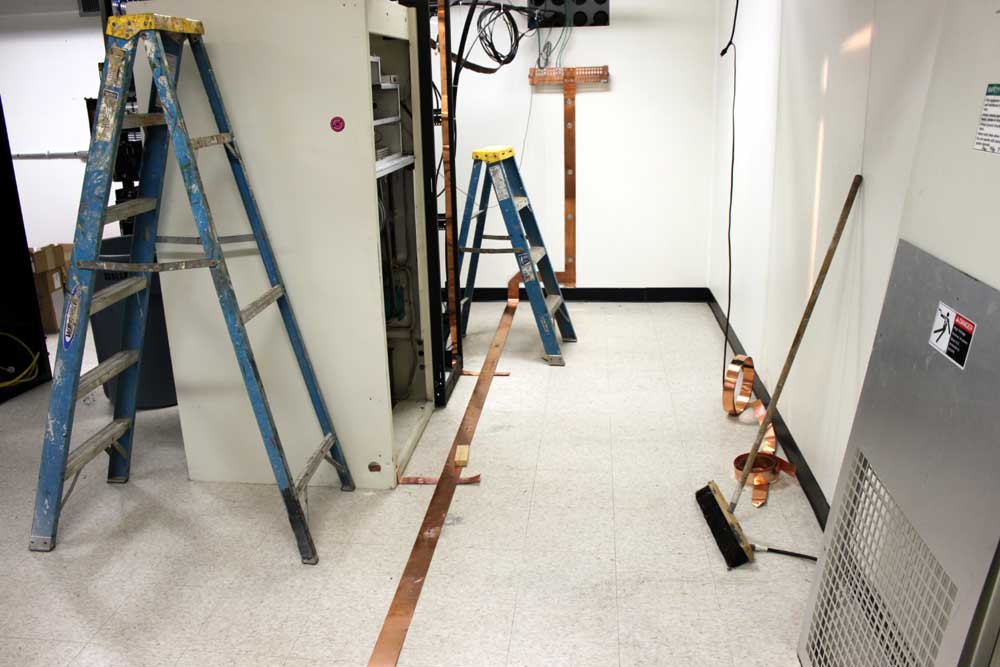
Three inch ground strap connects all the transmitters, racks, and dummy load to the station ground.
WRKI ground strap, new transmitter building
Electrical requirements are being met by a 400 Amp service backed up by a 120 KW generator. Once the conduit work is finished and all the wires pulled, the coax to the old building can be cut and brought into the new building, then the station can go on the air with the “new” backup transmitter.
As more and more things that use radio are invented, it is inevitable that the limited spectrum will be squeezed. We see this with BPL, which admittedly causes interference on the HF spectrum, however, proponents have deep pockets. Then there are the so-called “whitespaces” between active TV channels coveted by broadband providers. Not even the once-sacred GPS system is immune to interference by other radio systems being implemented by companies who “bought” the radio spectrum in question. Although it is quite beyond me exactly how one can buy or sell radio spectrum. I suppose next they will be selling sunlight and rain.
The next chunk of the RF spectrum being repurposed is in the 451-457 MHz range. This has already been eyed by the Department of Homeland Security for on-scene data communications networking. However, the latest interested party is the Alfred Mann Foundation, which builds bonic implants. In an interesting twist, one of the plans for the spectrum in question is something called the MMNS (medical micropower network systems). This network would be used to transmit commands from the patient’s spinal cord to prosthetic devices.
Many TV stations use 450-455 MHz band for IFB and cueing. Radio stations use that same spectrum for remote broadcast and telemetry return links from transmitter sites. RPU frequencies used to be very congested, as remote broadcasts were often an additional revenue stream for radio stations. These days, most stations to “cellphone” remotes, e.g. the disk jockey goes out to a store or event and calls it in on his or her cellphone. Some of the more fancy stations use POTS codecs like the Comrex blue box or matrix and very few still use ISDN. So the first question is how many broadcasters still use UHF (or even VHF) RPU gear (AKA The Marti)?
The second question is what type of damage or reaction could occur if a UHF RPU interfered with one of these MMNS devices? Some RPUs use fairly high power levels and directional antennas. But, according to FCC Report and Order on ET Docket 09-36, it is a done deal:
The rules we adopt will allow these new types of MedRadio devices to access 24 megahertz of spectrum in the 413-419 MHz, 426-432 MHz, 438-444 MHz, and 451-457 MHz bands on a secondary basis.
It goes on to say:
Each year, millions of Americans, including injured U.S. soldiers, suffer from spinal cord injuries, traumatic brain injuries, strokes, and various neuromusculoskeletal disorders. The devices that we anticipate will operate under our new rules are designed to provide artificial nervous system functions for these patients.
Which is nice. I suppose if someone is at the mall setting up the Marti for a remote and when it gets turned on, Grandpa starts break dancing, one should find another frequency. Do you think the DJs or promotions people remember that? No, me neither.
If this keeps up, eventually everything is going to interfere with everything else and nothing will work.