Higashi no kaze ame

Or “East wind rain,” which was the Japanese code words transmitted to their embassies indicated hostilities with the United States were imminent. While the Navy intercepted the first message to the embassies, outlining the various code words and instructions on what to do when or if they were used, they never actually intercepted the code word messages themselves.

This is not all that unusual, as the Japanese were using several different diplomatic, army, and naval codes at the outbreak of the war.  Many different stations and frequencies were in use, and it is quite possible that the message was sent and never intercepted.  According to the NSA, many, but not all of the Japanese Codes had been cracked and were being read regularly.  The diplomatic code, known as Purple as well as a similar code, J-19, and a lesser version, JNA-20 were being intercepted and forwarded to Washington for decoding.  Only JN-25 was intercepted and decoded at Pearl Harbor prior to December 7th.

In 1979 the NSA declassified over 2,000 intercepts.  They declassified more in 1994.  Those decrypts paint an interesting picture of the lead-up and aftermath of Pearl Harbor.  A good book is “And I was There,” by Edwin Layton.  It was completed in the late 1980s before the 1994 document dump.  Layton was indeed at Pearl Harbor on the morning of December 7th.  Layton does not come out and directly say that Washington knew of the attack, but rather that they should have known, warned Pearl Harbor but didn’t.

By the first week of December, the Japanese tipped their hand several times.

  • A bomb plot message was transmitted to the Naval Attache in Pearl on September 24th.  This message was sent in J-19 and requested information on shipping and locations within Pearl Harbor-based on a grid.  No other locations around the Pacific required such detailed analysis by the Japanese Navy.  This was intercepted in Pearl but sent to Washington for decoding.  No information from this message was shared with the military commanders in Hawaii.
  • Several spies (Russian, British, Korean) and diplomats (Germany, Peru, Mexico) warned the US that the Japanese intended to attack Hawaii before the end of the year
  • The Japanese striking force did not maintain radio silence during its transit from Japan to Hawaii, they sent 663 messages, many of which were duly intercepted by Hawaii and the Navy intercept stations in the Philippines and Guam.  The National Archives contains about 100 of those messages, however, the direction-finding information attached to each message has been removed or remains classified.  In addition to this, most of the JN-25 messages sent between December 1-7 remain classified.
  • All PYB (long-range flying boats) patrols from the Aleutians were discontinued in early December.  Their patrol area covered at least part of the northern route from Japan to Hawaii.
  • On the evening of December 6th, Roosevelt was shown the first of 13 parts of a Japanese Diplomatic message which was a declaration of war on the US.  The US code breakers and translators finished the decrypt and had it in the hand of the President hours before the first bombs were dropped on Pearl Harbor, even before the Japanese envoys had read it.

It is also well known that Roosevelt wanted Japan to attack the US as justification for the entry of the US into WWII.  In early 1941, Roosevelt sent a gunboat up from the Philippines nosing around the Chinese coast to see if it could stir up any trouble.  The Japanese failed to take the bait on that and several other occasions.

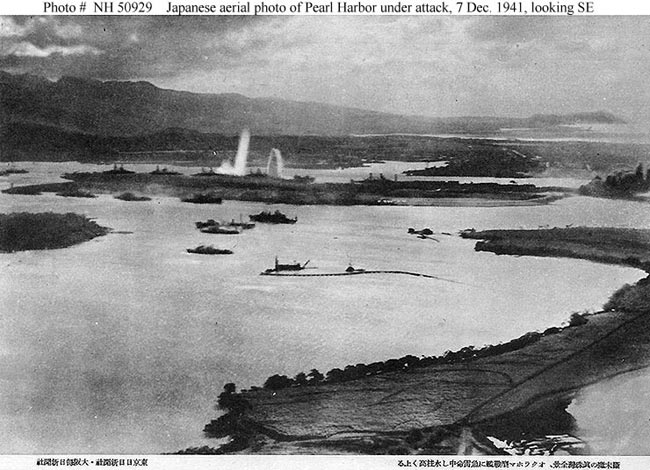
December 7th, 1941
December 7th, 1941

There is still quite a bit of controversy as to who knew what and when.  Whether information was deliberately withheld, or not transmitted due to some concern of compromised intelligence or some bumbling bureaucracy is hard to tell.  Certainly, the powers that be in Washington knew more than they let on.  The military commanders on Hawaii took the fall and several thousand lost their lives that morning.  Many more would die in the coming months and the Japanese tide rolled over the western Pacific basin.

By the end of World War II, over 74 million people had died, most of them civilians.  History, do not repeat thyself.

The Gates BFE-50C Amplifier

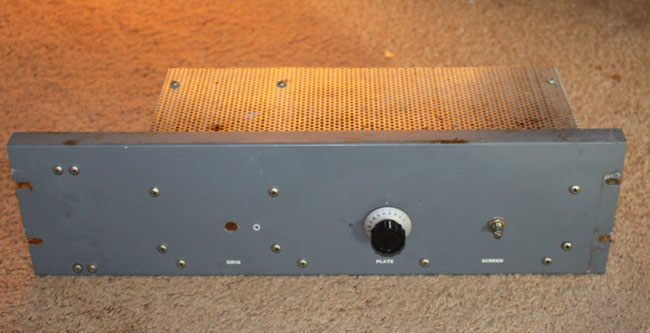
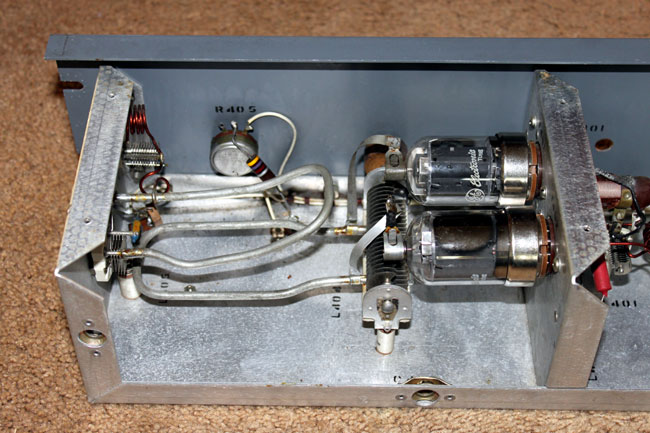
Found in a pile of junk in the corner of an older transmitter site, this Gates BFE-50C or otherwise known as an M5675 Amplifier. This was used as an IPA in a Gates FM 1C transmitter installed around 1960 or so.  The rest of the transmitter has long since departed, likely to the scrap yard, however, somebody thought to remove this and set it aside.

Gates BFE-50C 50 watt VHF amplifier
Gates BFE-50C 50 Watt VHF amplifier

This unit is missing it’s grid tune knob.  The grid tune capacitor is still there, however.  There is also some evidence of heating on R403 and R407/408 likely due to a prolonged overdrive condition.  Otherwise, it is in good shape.

Gate BFE-50C 50 Watt VHF amplifier back

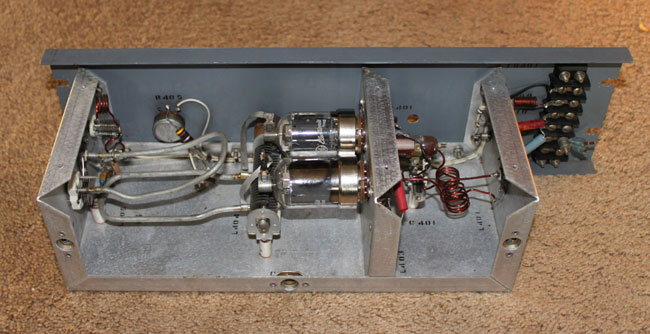
The design is pretty simple, a pair of 6146’s in push pull, three watts in nets about 50-60 watts out, according to the manual, which can be found here (.pdf).  The power supply voltages are fairly tame, 500 volts plate, 300 volts screen.  The one thing that this design does not have is any type of harmonic filtering.  When used with a larger transmitter, this makes sense because the transmitter output will have overall harmonic filters.  If this was to be used on it’s own for any reason, a good harmonic filter would need to be designed and installed.

Gates BFE-50C or M5675 50 watt VHF amplifier
Gates BFE-50C or M5675 50 Watt VHF amplifier

The schematic is straight forward.  Gates, the old Gates Radio of Parker Gates, designed good equipment.  Click on image for higher resolution.

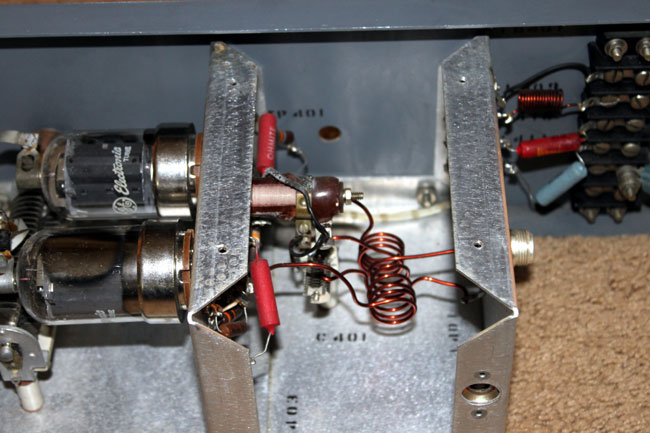
Gates BFE50-C input section

It is a bit hard to see in this picture; the input section consists of three turns of #14 gauge wire coupled to two 4 turn sections of 14 gauge wire on either side of it.  This is matched to the grids Screen1 of the 6146s with C401.  L412, C411 and L413 form a low pass filter.  L412 consist of one turn #14 gauge wire, L413 is five turns of #14 gauge wire.  All coils are 3/4 inch in diameter.

Gates BFE-50C output section

The output section is even simpler, using just one loop of small diameter copper tubing.  The plate tuning is accomplished by C407, loading is C406.  Power output is adjusted by varying the screen voltage using R405.

Advantages of this design:

  1. The 6146 tube is fairly rugged, at class AB the 50 to 60 watt output range is well within the plate dissipation for a push pull configuration.
  2. No special parts are needed, everything can be found or fabricated by hand
  3. The 500 volt supply is fairly tame, maximum PA current should be less than 0.2 amps for 50 watt output and 50% PA efficiency.
  4. Output tuning and load allow for tuning into less than ideal loads, if required.
  5. If operated as a stand-alone unit, some type of plate current meter should be used to aid tuning.  A harmonic Filter would need to be designed and built for the output.
All in all, a pretty cool little FM amp.

The BE FM20T transmitter

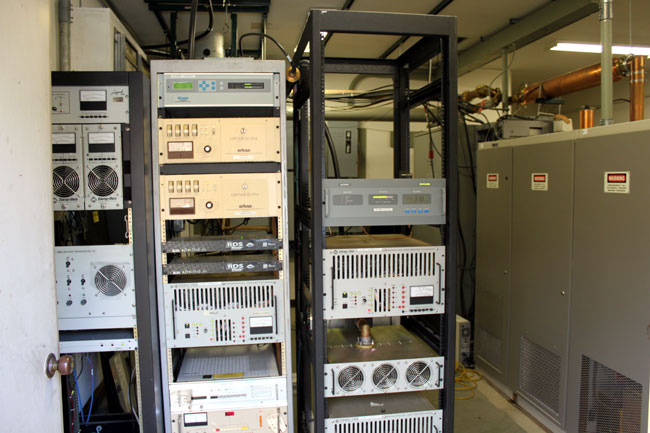
This is the main transmitter for WYJB in Albany, NY. The backup is the Harris FM20H3 on the right. I haven’t turned that unit on lately, but it normally makes quite a fuss the first time the Plate On button is pushed. The FM 20T on the other hand, is mellow and even-tempered.

WYJB 95.5 Mhz, class B, transmitter Albany, NY

One other thing of note; The FM20T is still on its original tube.  I looked up the maintenance records for this transmitter, it was installed in December of 2000.  Eleven years later, the 4CX15000A (ed note; 4CX12000A) is still cranking out 15 KW TPO, which is impressive.  I found that high-power ceramic vacuum tubes actually seem to last longer when run closer to their limits than those that are running at half power.

Judicious management of filament voltage is required to achieve this type of longevity.  There is a set procedure for installing a large ceramic vacuum tube:

  1. After the tube is in the transmitter, run it at a full filament voltage for at least an hour or so before turning on the plate voltage.  This allows the getter to absorb any stray gases in the tube.
  2. Once the plate voltage is applied, proper tuning should be completed as quickly as possible.  Tuning procedures vary from transmitter to transmitter, however, the general idea is to obtain the maximum power output for the least amount of plate current while keeping the PA bandwidth within acceptable limits.  Some transmitters can get narrow-banded at high efficiencies, which manifests itself as higher AM noise.
  3. After the tube has been in use for 90-100 hours, the filament voltage should be reduced gradually until a drop in the transmitter output power is noticed, then increased by 0.1 volts.

This maximizes the filament life for that particular transmitter and power output.  Once the filament can no longer boil off enough electrons, the tube power output drops and it is time to replace it.

This site also has two other radio stations, WZMR, 104.9  and WAJZ 96.3 , both class A using solid-state transmitters of less than 1,000 watts:

WAJZ and WZMR Energy Onix solid state transmitters
WAJZ and WZMR Energy Onix solid-state transmitters

Not the prettiest sight in the world, but it does stay on the air.  There is no money to go back and neaten up this work, unfortunately.

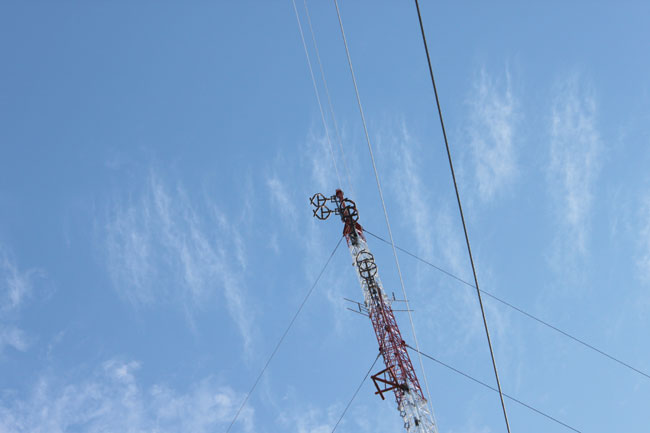
The tower supports all three antennas.  There was some discussion of a common antenna for all three stations, however, WZMR is a directional station, thus it would require its own antenna.  Doing a common antenna for the other two stations was cost prohibitive, so the tower supports three two bay antennas.

WYJB, WZMR, WAJZ FM antennas, New Scotland, NY

The stations are all located in the New Scotland, NY tower farm.  WYJB is licensed to Albany, WZMR is licensed to Altamont and WAJZ is licensed to Voorheesville.

A look at the new Facebook Data Center

Very good article on the new Facebook Data Center in Prineville, Oregon via Wired.com.  One of the interesting aspects of the data center design is the energy efficiency aspect.  In a data center that services 800 million users, shaving a few percentage points off of the energy bill represents huge savings.

According to the article, the location was chosen for its climate.  The area has low humidity, thus allowing the use of evaporative cooling system verses the conventional refrigeration cycle systems most often used.

Another area is in the servers themselves. Facebook decided to design their own servers, using a stripped-down platform, larger heat sinks, slower fan speeds, etc to reduce the amount of electricity used.

All in all the article is well worth reading, as the future of broadcasting will be centered on data centers such as this one.