I just finished a full alignment of my Kenwood R-2000 receiver and tonight I am treated with the pleasing tones of “Jazz from the Left,” on WRMI. Jazz from the left means the west coast sound, aka Smooth Jazz as I am given to understand. I spent some time on the west coast and beyond. I have fond memories of those years.
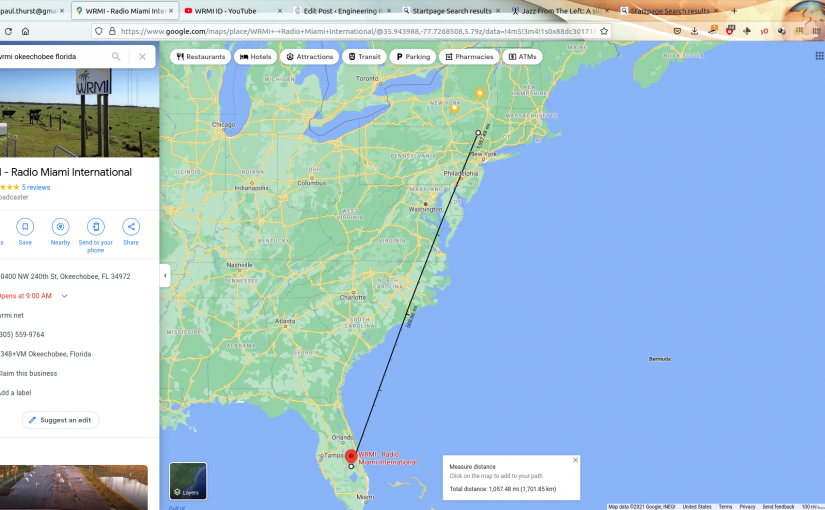
It is amazing to me still, that a simple AM receiver demodulating +/- 4.5 Khz audio bandwidth from 1,057 miles (1701 km) away can sound that good. That is being received directly; no Internet Service Provider, no satellite service, just a transmitter, and a receiver.
There is an art to all this, which is being forgotten. A few minutes with a manual, a volt meter, a tone generator, and a non-conductive screwdriver can bring something that was neglected back to life sounding as good as the day it left the factory 35 years ago. Try that with your very expensive iPhone 10,000,000x! Of course, you will need those tiny pentalobe tools to get the screws out. Apple would rather you return your expensive i device to their expensive i store so that their i geniuses can fix it for you.
I don’t know, maybe I am an old fart. Perhaps the right to repair the appliances that I purchased and therefore should own is an old-fashioned point of view. After all, all of these corporations have my best interests at heart, right?
I recommend you support your not-so-local shortwave stations by listening to and supporting their programmers. Even in 2021, there are still many shortwave broadcasts that are worth listening to!
There has been a lot of hand-wringing and ink spilled recently on the titled subject. The problem seems to be particularly acute when it comes to RF knowledge. I agree with those concerned that there are very few new (read also as young) people entering the field. There are a number of reasons for this; competing technical fields that pay more and are generally easier to work in, the very broad knowledge base required for Broadcast Engineering, and the lack of awareness by major stakeholders.
It seems obvious that for as long as there are radio and television stations, there will need to be those people who install and maintain the transmission systems. The question is, how to attract new people into that field? In order to answer that question, a follow on question would be, what exactly does a Broadcast Engineer do?
This can be broken down into three very broad areas:
Conversion of the art into electronic form. In other words, capturing sound and video with cameras and microphones. What are the various analog and digital formats, how are those signals routed, edited, stored, retrieved, and transmitted. What are the various bit reduction (e.g. compression) formats. How these live streams and stored files are mixed to generate the final program material.
Transmission of the program material. Meaning moving the program to the transmitter site and broadcasting it for public reception. This would involve knowledge of Studio To Transmitter (STL) systems which can vary greatly but often include satellite distribution, public internet, fiber, RF wireless microwave systems, etc. The next step is the actual transmitter, filters, combiners, transmission line, and antenna. Knowledge of all regulatory (in the US, FCC) obligations including EAS, Tower lighting and marking, transmitter operations; power level, interference, etc.
Physical plant systems. Broadly speaking; HVAC, electrical power, emergency generators, towers, fire suppression, etc.
These work categories can be further broken down into three functions; installation, maintenance, and replacement.
Since I have been more involved in the management side of things lately, I find that most of my problems are people problems. What may be a surprise to some is, Broadcast Engineers are people. What may be even more shocking; people have interests. Those interests are the reason why they chose to work in a technical field. Forcing the IT guy to go to the transmitter site to see why the generator won’t start is not a good use of resources.
Looking at the very large skill set that a competent Broadcast Engineer needs to function in a modern broadcast facility, the first part of the answer becomes obvious; more specialization. Break down these broad categories into separate skill sets. Since it seems that many things are headed toward the IP domain, Broadcast IT should become a thing separate from office IT. While the two are similar, Broadcast IT requires more knowledge of physical wiring, switch architecture, VLANs, subnets, IP streaming protocols, audio formats, video formats, transport streams, etc.
RF infrastructure has its own set of rules, including personal safety requirements. A solid electronics/engineering background is required to understand how transmitters work, what various failure modes are, and what can cause them.
Physical plant work most often can be contracted out to various vendors. However, that work needs to be supervised by a competent station representative.
The next item is the thing that nobody wants to talk about; the importance of work/life balance. This means not utilizing a broadcast engineer as a piece of equipment to be worn out and discarded when the performance level drops below expectations. I know several broadcast engineers who have left the industry because of this. Worse still, there are those who have died of heart attacks or committed suicide. Work/life balance also includes proper compensation, so those people can afford to pay for essentials, have a reliable vehicle, healthcare, etc.
Of course, many smaller operators cannot afford to hire an RF specialist and a Broadcast IT specialist plus pay contractors to do physical plant maintenance. This is where contracting can fill in the vacuum. If contracting becomes the new normal, then how does the next generation of Broadcast Engineers get trained? Broadcast transmitter manufacturers have some training courses available as does the SBE. However, there is no substitute for hands-on experience. While many Broadcast Engineering evolutions are similar, no two situations are the same, and thinking on your feet is a job requirement. How are new people coming into the field get the necessary experience? The situation is not untenable, however, it will require some creative thought.
As most of you may know, I live in New York State (Hudson Valley region). This is very close to the COVID-19 outbreak in Westchester County. There has been one confirmed case in my town. As such, we are experiencing the outbreak ahead of the curve from the rest of the country. School has been canceled for at least two weeks and perhaps indefinitely. All public gathering places are closed; restaurants, bars, movie theaters, malls, churches, etc. As a radio engineer, the COVID-19 virus has several implications:
Things are still going to break and will need attention. The good news is that most transmitter sites are unmanned. The only social interaction may be during the travel phase (getting fuel, food, etc).
Many studios and offices are being abandoned as well. Over the last few days, we have set up DJs to operate from their houses. Most sales and office staff have been told to work from home.
Broadcasters have been designated critical communications infrastructure, and The Department of Homeland Security has issued letters that allow travel and procurement of fuel during the national emergency for critical personnel.
I managed, prior to the store shelves being emptied this weekend, to procure some PPE. I don’t know how effective it will be, but anything is better than nothing.
Since Hurricane Sandy, I have had in place many emergency supplies and equipment needed to restore service in the event of a long-term interruption of basic services.
There are many long-term economic implications. For commercial radio stations, the loss of income is going to be extreme. As the virus has spread, businesses have canceled pretty much all advertising. During past disasters, radio was often the only means of getting information to the general population. I am not sure if this is still the case. How relevant is radio these days?
I have been working on an AM station lately. WBNR signed on in 1959 and follows the now familiar AM trajectory; after making bank in the ’60s, ’70s, and ’80s, revenue declined, maintenance deferred, yada, yada, yada…
After a stint with a news-talk format, the station changed to “Real Country,” a few years ago. WAT! Music on the AM? Actually, it is doing quite well. The perception is that AM sounds terrible and nobody listens to it. The stock AM radio in my Subaru (made by Pioneer) sounds pretty good on AM. I have noticed that when I first tune a station in, it sounds narrow-banded, slightly better than a telephone. However, after a second or two, the bandwidth opens up and it can sound quite good. I have also heard this station playing at several local businesses. When we turn it off to do maintenance, the phone starts ringing. Clearly, somebody is listening…
This station is part of a three-station simulcast. The AM station to the north got rid of its directional antenna and added an FM translator a few years ago. That has made a big difference. Thus a translator was acquired for this station as well.
The translator was held up by an informal objection filed by Prometheus, Et. Al. as part of a blanket filing against all new translator licenses by the LPFM advocate. In any case, the Construction Permit has been on hand for a while, so the owner felt it was time to move forward with building out the new FM signal.
Hoisting the Shively 6812 antenna
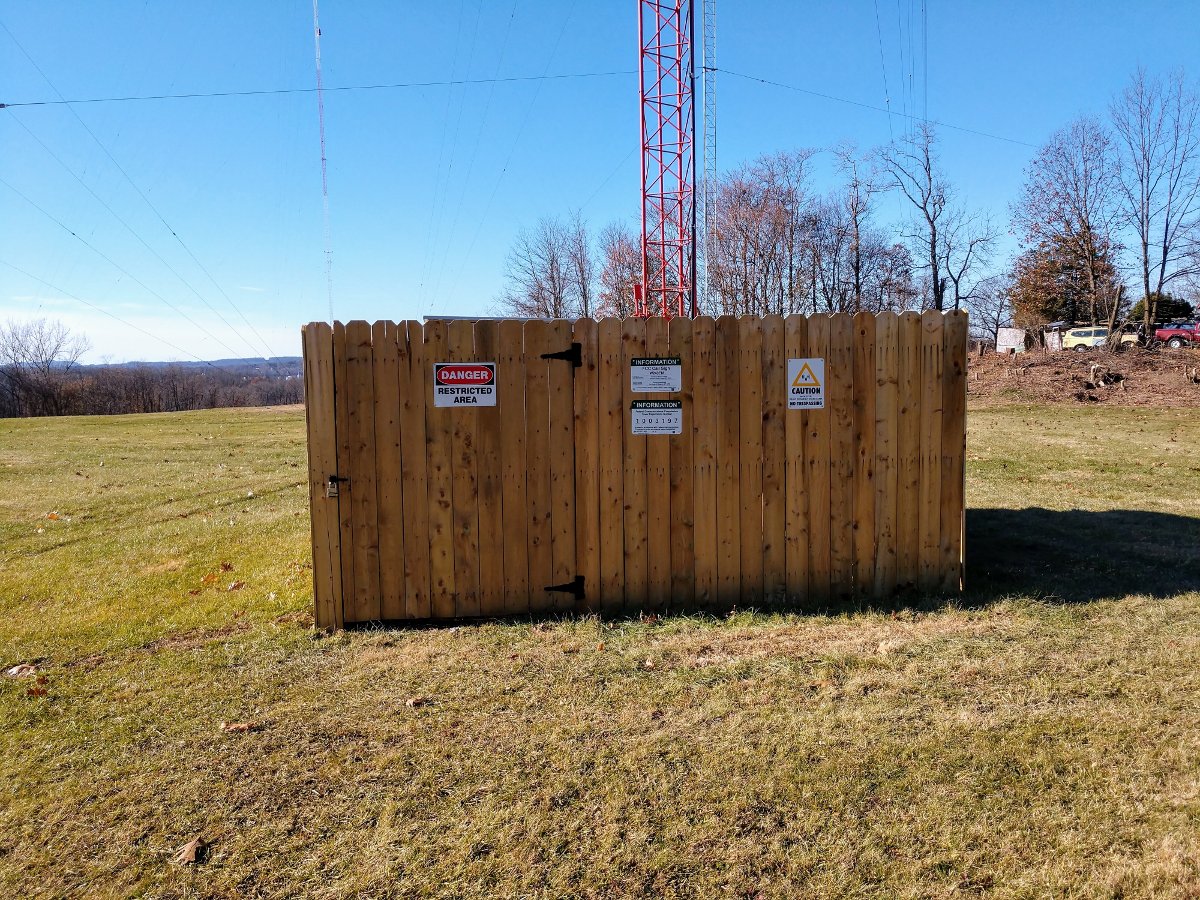
Installing the single-bay Shively 6812 antenna on the side of one of the nighttime towers triggered some other things. A bit of the deferred maintenance was addressed; new stockade fences around all the towers replaced the original fences put up in 1988. Those original fences were falling down.
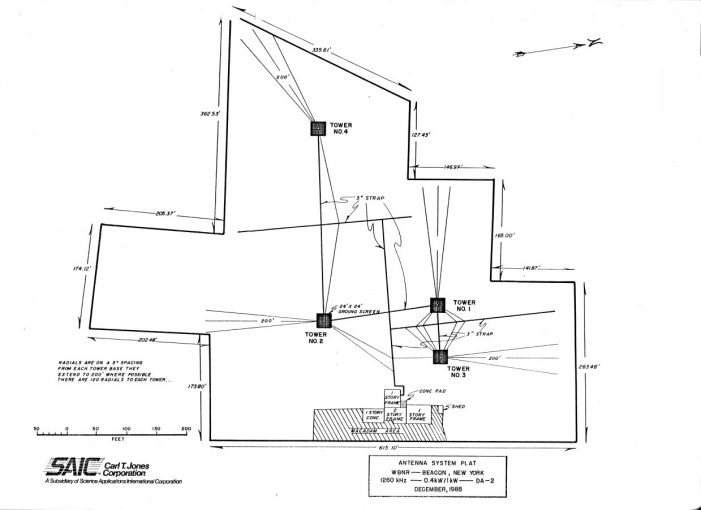
4 Tower antenna system, WBNR, Beacon, NY
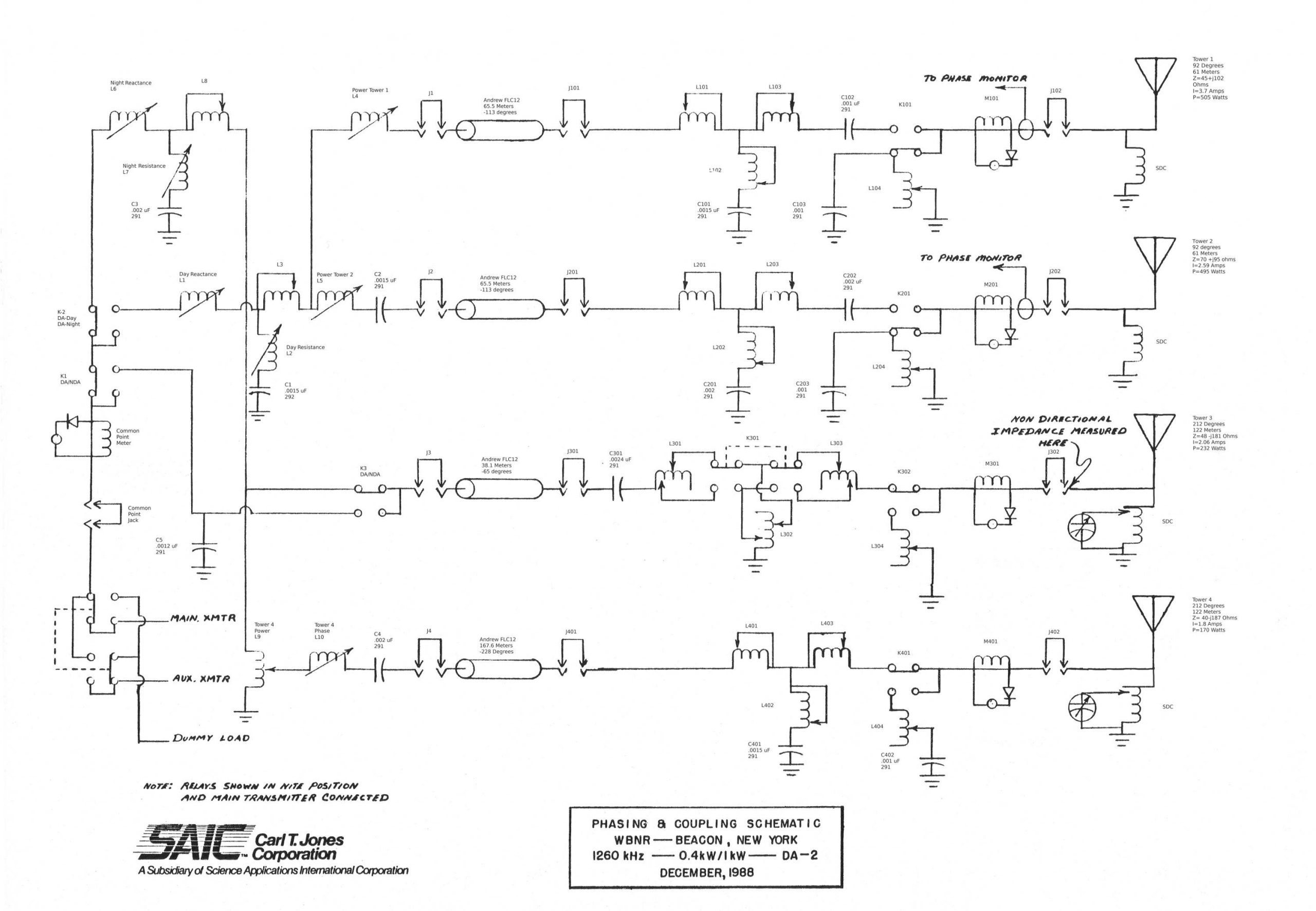
The antenna system for WBNR is actually quite elegant, perhaps even beautiful. A simple two-tower system for the daytime array and a separate two-tower system for the nighttime array. The nighttime towers are top-loaded, adding about 30.7 degrees in electrical height.
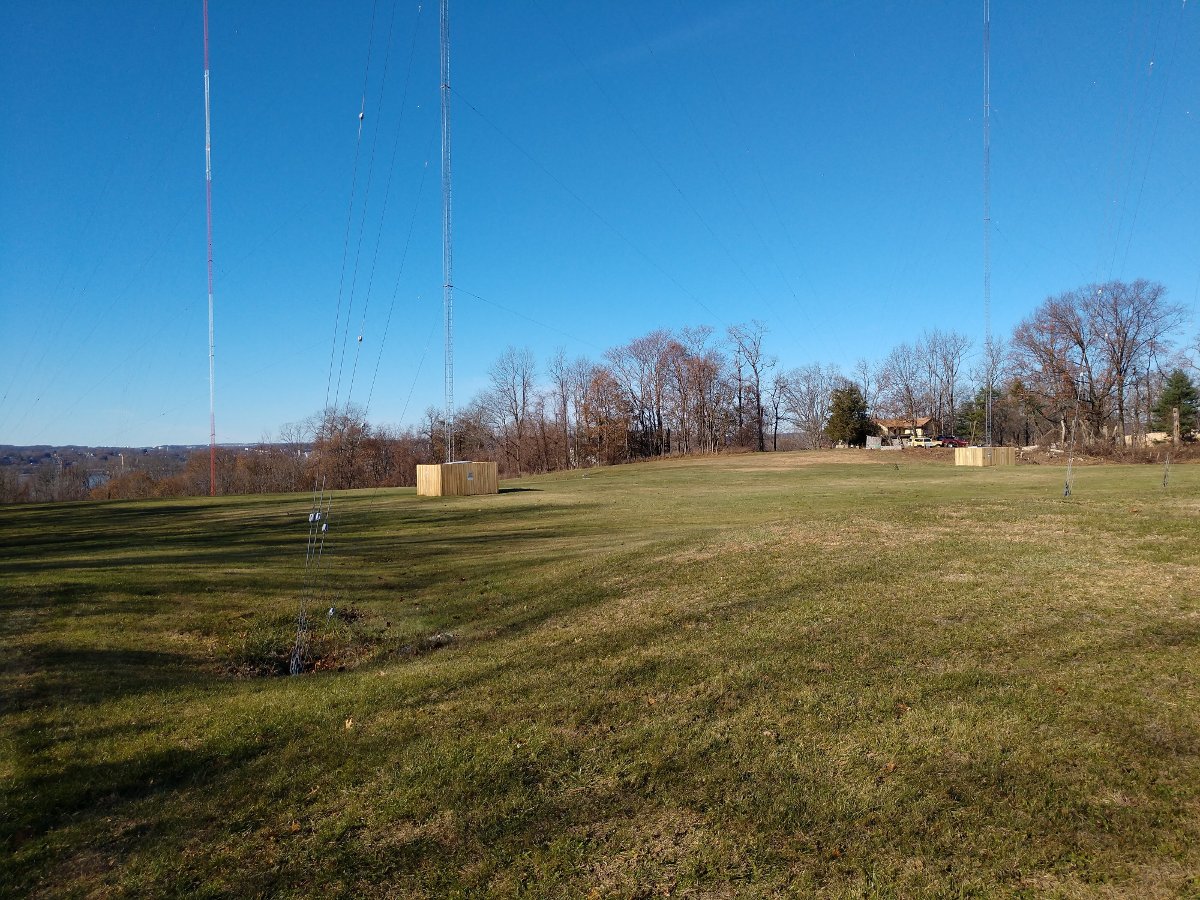
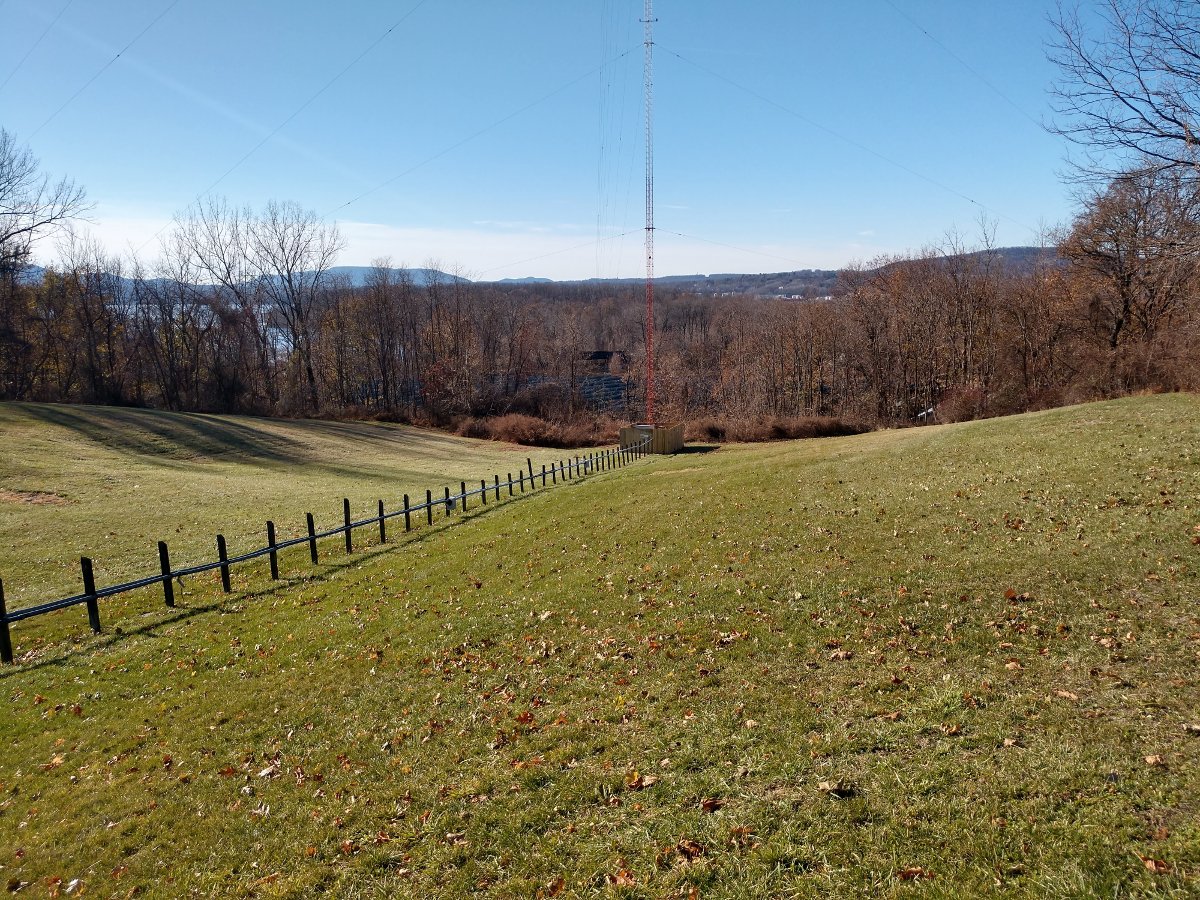
The far tower
The CP for the translator required some extra steps because of the mounting on the night tower of the AM array. Before and after impedance measurements need to be taken on the tower in question. Another requirement of the CP, is a set of before and after monitor points need to be taken.
WBNR tower, with translator antenna side mounted at 381 feet (116 Meters) AGL
While I was measuring the base impedance, I decided to measure all the towers instead of just the nighttime tower that has the translator antenna mounted on it. This is a good point of reference if any problems arise in the future. Often, this information can be found in the technical paperwork from the original license application. Those files can be a treasure trove of information. Unfortunately, it appears that a good portion of the original paperwork is missing.
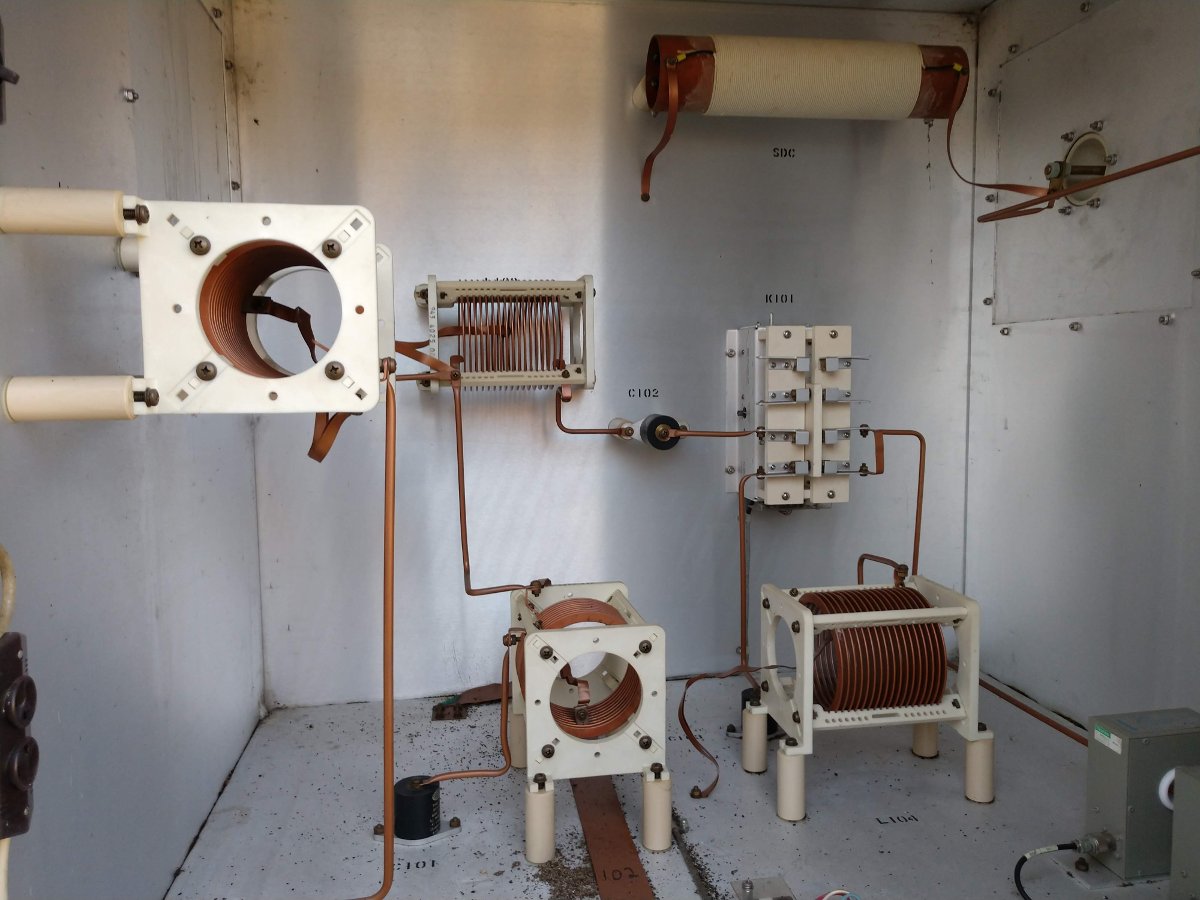
WBNR tower #1 Antenna Tuning Unit
The Phasor and ATUs are a late 80’s Harris product. They are actually in remarkable shape, all things considered. All of the RF contactors are Harris HS-4P motor-driven units. They are rated at 30 Amps, RF-RMS. I don’t think that they are supported by GatesAir. I have a small stock of spare finger stock and contact bars. I suppose, if I had to, I could make or adapt parts to repair.
Looking at the base currents and the base current ratios for both the day and night patterns (base current ratios are on the station license), the tower impedance has changed very little over thirty years. That is good news, especially with those 215-degree-tall nighttime towers.
The WBNR license application did contain an overall system diagram showing the Phasor and all the ATUs. It did not contain any component ids or other information. I scanned that in, created a vector graphics file, and expanded it to a 24 x 36 inch size. I was able to fit all the component values and other information on the diagram.
Schematic diagram WBNR day/night antenna systems
The other issue is the monitor point descriptions. They include statements such as “Point is marked with yellow and white paint on a tree,” or “In the northeast corner of the Texaco research facility parking lot.” Those references are long gone and I would prefer to use a set of GPS coordinates. Using the topographical maps from the proofs, I found each monitor point and then recorded a set of GPS coordinates for each. In the future, they will be much easier to find. If anyone is still doing monitor points, I would recommend this method.
Yet another problem; the phasor control system was damaged by lightning. The overly complicated Harris Phasor control card was replaced with something more straightforward and reliable. I designed a simple set of relays, one for daytime and one for nighttime, to change the antenna system over. The transmitter interlock goes through the relay contacts, so the transmitter PDM is killed while the power changes. Tally back from each of the towers is handled by a set of relays for each pattern, which is also interlocked with the transmitter. All of this prevents the RF contactors from switching hot, something that has caused some damage in the past.
W243EM is 100 ERP watts, non-directional with a 1 bay Shively 6812-1R antenna installed at 381 feet (116 Meters) AGL on one of the nighttime towers.
The transmitter is a BW Broadcast TXT-600. The power calculation is as follows:
ERP 100 Watts = 50 dBm
System gains and losses:
Transmission Line loss, 500 feet (152.4 Meters), RFS LCF78-50JA = -1.75 dB
Isocoupler loss, Kintronic ISO-170-FM = -0.8 dB
Antenna gain, Shively 6812-1R = -3.39dB
Total system losses and gains: -5.94 dB
TPO: 55.94 dB or 393 Watts
With all that work completed, the license application was filed to cover the construction permit. Once that was accepted by the FCC, program test authority was granted and the transmitter was turned on. Hopefully, with the translator on the air, the perceptions regarding listeners will change and the station can bill more.
I really enjoy working on Medium Frequency antenna systems. I don’t know why, but antenna systems in general are always fascinating to me.