Broadbanded AM antennas

Partly for my own edification, partly just because, here is some information about AM antenna systems and their bandwidth. An AM tower is a radiator that, simply by the physical constraints of the tower structure itself, is pretty narrow-banded, even under the best conditions. Add to that, antenna tuning units, transmission line phasing, antenna phasing units, diplexing units, and things can get very squished outside of the immediate carrier frequency. This seems to be a particular problem with directional antennas, which most AM stations employ.
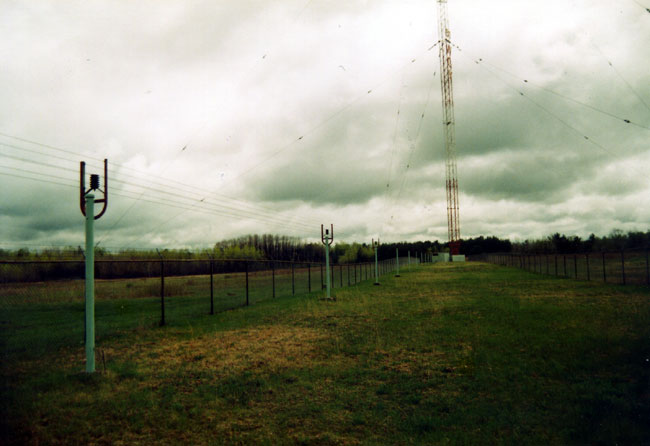
WGY 810 kHz, Schenectady, NY transmitting tower w/open feed line
WGY 810 kHz, Schenectady, NY transmitting tower with open transmission line

As an engineer, you can get some idea of how narrow an antenna system’s bandwidth is by looking at the base impedance measurement.  Every AM station is required to keep the latest impedance measurement on file.  When looking at these measurements, there will be one curve that indicates base resistance (R) and another curve that indicates reactance ( X, although often noted as + or -j).  If the resistance and or reactance curve is slopped steeply at the carrier frequency and out to 20-30 kHz, it is a narrow tower.  Add to that the different phase shifts of an ATU and or Phasor and things will be compounded.  That is why it takes a professional to design and tune up these things, a poor design will never sound right.

Another way to get some idea of bandwidth requires a field strength meter.  Modulate the transmitter with a 10 kHz tone at 50% modulation.  Then, away from the near field, measure the carrier and 10 kHz +/- the carrier frequency on the log scale.  The sidebands should be symmetrical and about 1/4 the carrier level.

Generally speaking, antenna systems need to be designed for low VSWR across the entire side band range (+/- 10 kHz from the carrier) as well as symmetrical distribution of radiated energy across the lower and upper sidebands.  Several factors influence these conditions:

  1. Electrical tower height is perhaps the hardest thing to change once a tower is constructed.  Short towers (less than 80 electrical degrees), or very tall towers, (taller than 200 electrical degrees) present problems.  If one were constructing an AM station and could choose any tower height, something between 120 to 190 electrical degrees would be ideal.  Existing towers can be top-loaded to add electrical height for an additional 30 degrees or so.  Beyond 30 degrees it becomes difficult to physically attain and therefore impractical in most situations.  Top loading and bottom loading of a tower can reduce bandwidth if done improperly.   Bottom loading an AM tower is almost never done due to the very high voltage and current as the electrical length approaches 180°.
  2. Antenna matching networks can greatly improve or degrade bandwidth, depending on how they are designed.  A T-matching network has more parts and is more expensive, however, it allows for optimum control over the R and jX phasing.  This becomes much more difficult with directional antenna where phase considerations are a part of the station’s antenna field pattern development.
  3. Phasors present the biggest challenge, particularly in the power divider sections.  A tank circuit power divider is the worst choice, and a shunt circuit power divider is the best bandwidth choice, however, it is the hardest to conceptualize.

Obviously, the more complicated the antenna system, the harder it will be to keep the bandwidth open over 20 kHz of spectrum.  This is especially true on lower-frequency AM signals, where the bandwidth is a much larger percentage of the frequency.   Multiple patterns, multiple tower DAs are a nightmare.  Single-tower non-directional stations are the easiest to modify.

As far as the circuit itself, higher Q circuits have smaller bandwidths.  Simply stated, in an alternating current circuit, Q=X/R.  The better the reduction of X, which also has a lot to do with the relationship of the current and voltage phasing, the better the Q will be.  This is why a T network is the best design for an ATU.  With a 90° or 180° tower, this is relatively straightforward.  In towers that are shorter or taller than that, it becomes more difficult as the value of R becomes less friendly.

In most cases, some sort of L/C network can be deployed to decrease the Q of an antenna system at the base of the tower.  Directional stations also need to have the phasing equipment looked at, because, as noted above, certain designs can create bandwidth bottlenecks.  All in all, it is usually an expensive proposition for a multi-tower directional station to broadband its antenna system.  This is another reason why IBOC on AM is destined to fail, many AM towers cannot pass the extended sidebands adequately.
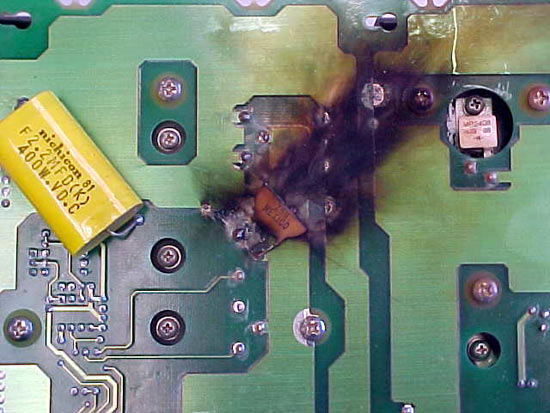
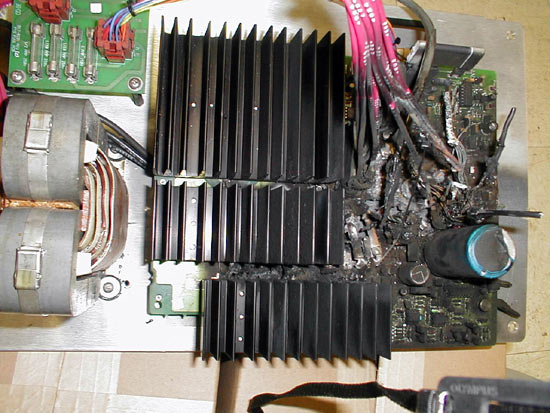
BE AM6A power supply

Another picture from my collection, this one is the back side of a power supply module from a Broadcast Electronics AM6A transmitter:

Bang!
Bang!

It happened during power up from 1 KW to 5 KW and it was quite loud, as I was standing right next to the transmitter.  The exploded part is a 0.1 uf capacitor that looks like an add-on.  In fact, some of the other power supplies don’t have it.  It also took out the 20 amp slow blow fuse.

I like the exploded look of the board, kind of like on The Road Runner, when Wyle E. Coyote looks into a box and something explodes.

This is the only problem I have had with this particular transmitter.

BE AM5E power supply problem

This is from my burned-out shit collection, pictures section:

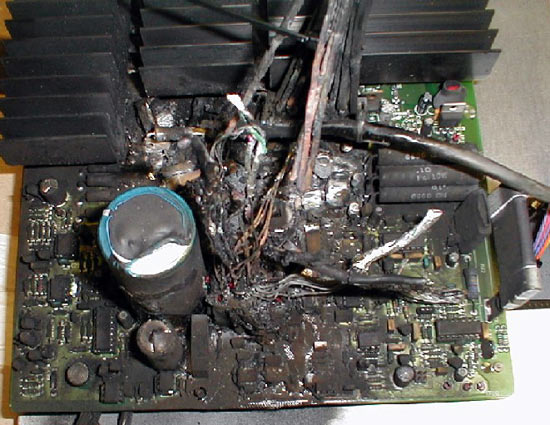
Broadcast Electronics AM5E power supply

It is a power supply from a Broadcast Electronics AM5E transmitter.  Here is another view:

Broadcast Electronics AM5E power supply mating connector

As you can see, there was a small fire started in the mating connector for the transmitter wiring harness.  I did not install this unit so I have no way to know for sure what happened, but I suspect that the mating connector was not pushed all the way in during installation.  In this business, really in all engineering fields, it is the little details that will catch up with you.

I know that one of the stations I used to work at had a fire at their electrical service panel at the FM transmitter site after they installed a new transmitter.  This happened after I departed for greener pastures.  In any case, it is very important to torque the connections on any service disconnect or circuit breaker to the panel manufacturer’s specifications.  I also check the lugs every so often with a Fluke 62 mini IR temperature meter. Any loose connections will show up as hot spots, which can be fixed before the fire breaks out.

All current-carrying electrical connections should be double-checked for solid connections before the transmitter is turned on, then check periodically thereafter for heat buildup and or heat damage.

My friend, the MW-50B

I began fooling around with radios when I was 10 years old or so. First, I built one of those shortwave radio kits from Radio Shack, which was back when they still sold radios.

Then I bought a small tube type AM transmitter at a garage sale.  The woman there said her son built it several years ago from a kit and it had the instruction manual.  I don’t even know who made the kit.  After some experimentation and changing out some tubes, I got the thing to transmit on about 1600 kHz, although it was a little hard to nail down as it drifted quite a bit until everything heated up.  I don’t know what power that thing put out, but it was certainly less than a watt.

All of this lead to a brief stint in the military as a radioman.  That was an interesting field, albeit different from what I thought it would be when I signed up.  It was during this time that I did some part time work at an AM/FM/TV station assisting the Chief Engineer.  Once it was established that I actually knew something, my responsibilities grew until I was assigned the AM/FM part of the deal.

After a year of that, I moved to a different city for family reasons and took the Chief Engineer job at a local AM/FM station.  The AM station was a 50,000 watt directional in the high end of the band which had a Harris MW-50B transmitter.  My previous station had a Bauer 10,000 D AM transmitter.  What could be so different? Plenty I learned, on my second day.

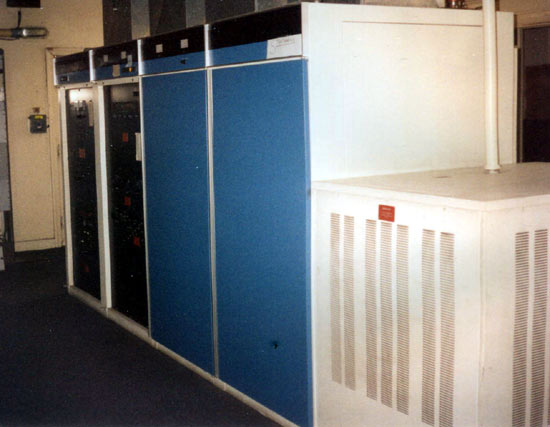
Harris MW50B transmitter with 50 KW air cooled power supply

We were subjected to a wicked lightning storm, which, Murphy being present, took out the main transmitter.  The backup was a GE BTA25 which was running at half power because of the age of the 5891  final tubes.

The symptoms of the MW-50 where as follows:  It would run along fine then there would be a big blue flash and a cannon shot boom, followed by the step start relays cycling and it would come back on the air.  There were no overload lights nor any other symptoms leading up to the overload or subsequent to it.

I began by killing the power and shorting out all the high voltage parts with a shorting stick.  I noticed that things inside this transmitter where a little unusual, so I got the manual out and started reading.  The most unusual aspect of this transmitter is the 25 KV isolated box that the PA stage occupies.  25,000 volts DC is a great big potential and what I found over the years is that this transmitter needs to be kept very clean.  Of course, this unit had not been, and that was a part of the problem.

The other unique aspect of this transmitter is the damper diode, which is required by PDM transmitters to conduct voltage during the negative modulation peaks.  If the damper diode breaks down for any reason, the PA supply voltage tries to go to infinity, which is a good deal larger than 25KV and all sorts of problems begin.

To make a long story somewhat shorter, this is the problem I had.  The solid state damper diode had one bad section, which was causing all sorts of corona problems during heavy negative modulation peaks.  It took a call the Harris factory to determine this.  The entire diode assembly needed to be replaced because every section is matched.  That cost a couple of thousand dollars as I recall.

While I was working on the MW-50B transmitter, I was not impressed.  It seemed a little cheap and flimsy.  Later, when I voiced my concerns with the station management, the Harris transmitter salesman stopped by and said I needed to get with the program if I wanted to work in that market.  This was a Harris town you see, if you start bad mouthing our products, you’ll be the one to suffer.  Well, he retired, I kept looking around for other AM transmitters.  Three years later I went to work for the competitor across town.  Today that station has a Nautel XL-60.

The MW50 went off the air once every 6 months for the entire time I worked at this station.  It was always something different, power supply rectifier, bad PDM board, bad directional coupler, arcing insulator on the isolated box, etc.  I began to feel it didn’t like me, and I know I didn’t like it.  In fact, you could say I have never really liked Harris transmitter products ever since.

Update: Okay, I left a few things out of the narrative:

The 50 KW air cooled power supply was the light weight version.  Most MW-50 transmitters had 100 KW oil cooled supplies.  The problem with the 50 KW power supply was it was designed with a zero safety factor.  All of the rectifier were running at or near maximum current and voltage.  It only took one of 144 diodes to go bad, either short or open, and the whole transmitter would crash.  Again, no overload lights or other indications of problems.  We later installed air flushing fans in the power supply cabinet to keep things cool and that helped out quite a bit.

The other thing was a DC feedback sample to the PDM card.  It seems that if the filaments were turned off before the bleeder resistors took the 25 KV supply to zero, the remaining voltage would be routed to the PDM card via the DC feedback sample, blowing the foil off of the circuit card.  We fixed this by installing a gas discharge tube with a series resistor at the connection point for the DC feedback sample.

Then there are the infamous 1N914 diodes in the directional coupler that Dave points out below.

I am sure I am forgetting something else, but you get the idea.