
Shortwave Pirate Broadcasting

And now, something completely different. It seems there is quite a kerfuffle going on in Shortwave (AKA HF) pirate land.  It seems there has been some FCC enforcement action of late, leading to at least one HF pirate being closed down, while some others are pointing fingers at another saying he is a rat, or a rabbit.  Or something.  I dunno, it gets a little hard to follow.

Anyway…

I have written about this in the past; Pirate Shortwave broadcasting. It is a very interesting phenomenon that compels a person to gather together all the parts necessary, usually at some expense, and assemble a station.  Further, keying the transmitter and broadcasting without the benefit of a license is a violation of federal law, which can bring heavy sanctions.  While most pirate broadcasters seem to get a slap on the wrist, this lax FCC attitude can change.  There have been several steep fines lately for repeat offenders in the FM band.  At least on the FM band and somewhat the AM band too, an unlawful broadcaster is assured of some public audience.  On the shortwave bands, a pirate broadcaster’s audience is limited to only those that are looking for them, which is a very narrow segment of the population.

What are they trying to accomplish?  Most of the shortwave pirate broadcasts that I have listened to are limited to a couple of songs from one particular genre, send an ID and then are off.  Some will send a QSL card via slow-scan TV.   What compels these operators to go through all the trouble for a few minutes of irregular operation?  Some of them have well-equipped studios to go along with the transmitting equipment.  Then there is the clandestine nature of the undertaking, often with mail drops and spoofed e-mail addresses.

Some seem to exult in sticking it to the man, that man is the FCC, big media corporations, or any authority that tells them they are doing wrong.  Acts of civil disobedience against authority are perceived (rightly or wrongly) as oppressive or evil.  Others seem to have some need to perform, no matter how small the audience may be.  Some are just fooling around and do it simply because they can. Finally, others like the challenge of building a low-power shortwave transmitter from scratch and seeing it through to its end.

If the so said station is broadcasting with any appreciable power, it will get noticed quickly, and sooner or later, the FCC will pay a visit.  That is a foregone conclusion.  The FCC has quite a few new tricks up its sleeve when it comes to direction finding and RF fingerprinting.  That’s right, RF fingerprinting, is exactly what it sounds like.  Super-resolution HFDF eliminates the need for triangulation, multiple vehicles, and wasting a lot of time driving around neighborhoods trying to figure out which residence an illegal broadcaster is using.

While I understand the compulsion to broadcast free radio; the need to inform under-served communities, the fact that what we used to rely on for information and news is gone, a once vibrant and exciting art form has been reduced to a hollow shell of its former self, however, we have not yet reached a Magna Carta moment. There are still some legal methods of getting the word out on the radio, both conventional and shortwave.  International Broadcasting stations WBCQ and WRMI offer time-brokered programming and are pretty liberal in the types of programs they accept.  Not all US shortwave broadcasters are thus, many allowing only religious programming.  Those shortwave stations have large coverage areas and existing audiences.  There are also many AM radio stations that will do block programming over the weekend, for a price, of course.  Then there is the possibility of setting up an internet station.  Eventually, the new Low Power FM (LPFM) rules will go into effect and interested groups will be able to apply for licenses in that service.

The point is, while the deck is stacked against the local or community radio broadcaster, it is still possible to get the word out in a legal way.  The cost of buying block programming will likely be the same or less than buying all the equipment to set up a pirate station.  Further, if the programming is compelling, you may get noticed and be able to flip the equation and actually get paid to do it.
Storm Preparation

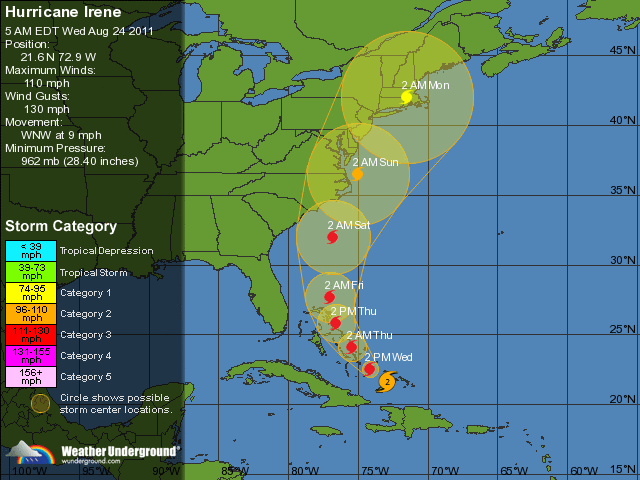
With Hurricane Irene taking aim at the northeast, now is the time to make preparations for bad weather.  This is the five-day forecast:

Hurricane Irene five day forecast

Now, five-day forecasts are notoriously inaccurate. There are too many variables to make it accurate and even the most seasoned meteorologist will admit, it is an educated guess.  However, the large semi-transparent disk is almost always accurate.  Therefore, it seems we may be in for a bit of a storm this weekend, with the eastern end of Long Island and Newport/Providence RI in the landfall area. The Bridgeport, CT stations will likely see the worst of it if the storm follows the predicted course.

Having a good disaster recovery program in place reduces much of the pre-storm work.  This includes backup equipment and personnel allocations to keep the stations on the air and provide valuable information during the event.  Wherever and whenever our clients allow us, we make sure that these systems are properly designed, installed, and working.  When trouble is milling about offshore in the form of a Hurricane, then we make a few final preparations, both personally and for the clients:

  1. Top off all generator fuel tanks and test them.  This includes my home generator.
  2. Make sure all loose items are secured.
  3. Make sure other redundant systems; backup transmitters, backup STLs, and backup transmitter sites are in order and ready to be deployed.
  4. Check the personal safety items; first aid kit, rain gear, flashlight batteries, work gloves, eye protection, hard hat, some type of energy food, and extra water are in the truck.
  5. Get out a clean sleeping bag and a set of clean dry clothes and put them in the truck.
  6. Gas up the chain saw and put it in the truck with extra gas, bar oil, and blade sharpener.

During the event, it is important to recognize when a situation is too dangerous to proceed and wait for the danger to subside. Examples of this are local flooding of roadways, downed power lines, high winds, and or electrical storms while working at transmitter sites.

Radio may have lost much of its relevance as an entertainment medium, however, there is still one thing it does very well; broadcast emergency communications and information to the public.

Update: As of 5 am 8/25 it looks as if the hurricane is making a b-line toward Bridgeport, CT.  Most of the computer models are now in agreement which means the forecast is getting a better handle on the variables and is becoming more accurate.  Strength is still somewhat debatable, but even a Category 1 storm could do significant damage.  We shall see.

Update 2: As of 5 pm 8/26, Irene is still on course for the greater NYC/Long Island sound area.  As much as possible, preparations are complete.  There are some things that cannot be helped, like the height above the mean sea level of the WICC and WEBE transmitter sites (10 feet) or the lack of a generator at WXPK studios, etc.  Estimates are for Hurricane-force winds by this time tomorrow, so the only thing left to do now is get a good night’s sleep. Tomorrow may be one of those long days.

Here is an interesting thing; several people have suggested that IBOC signals on both AM and FM NYC stations be turned off so that smaller local stations will be listenable to local residents in NJ and Long Island.  A secondary consideration would be the amount of power IBOC uses and the possibility of backup generators running out of fuel to run something that has little or no audience.  If that isn’t telling….

It should be interesting.

A tale of two air conditioners

It was a hot day, it was a cold day. The tube transmitter was running, the solid-state (HD-1) transmitter was off the air. The books show that the company has deep pockets, but the accountant has short arms.  And so it goes.  In a sordid, yet familiar tale of leaping three-quarters of the way across a river, the builders of this transmitter site seemed to think of everything except the cooling requirements for a 35 KW FM transmitter.

Instead of installing real commercial AC units, someone decided that 34,000 BTU window units were the way to go.  At one time, there were eight of those units, all single phase 240 volts sucking down gobs of power and freezing up when the outside temperature dropped below 40°F.  This was always a problem but became more so when we took over the maintenance of this site.  When there was a full-time engineer, his time, apparently, could be wasted running back and forth turning the window units on or off in the winter as required.  Now that a contract company is doing the work, it becomes cost prohibitive to require such things.

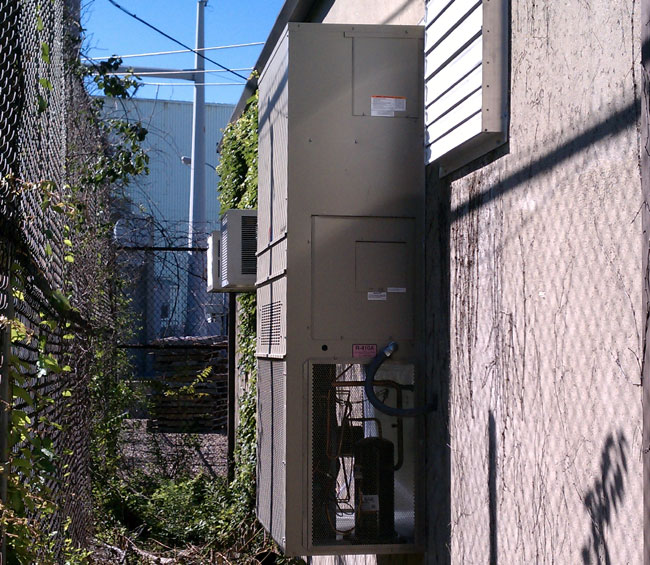
Therefore, the time had come to make a change.  To that end, six of the 34,000 BTU window units were removed from the building.  Two of the existing holes in the wall were used to create an emergency cooling system, consisting of a 4,292 CFM fan and a couple of shutters.  Two other holes were used for the new air conditioners and two holes were blocked up.  The remaining two window units were left in place in the combiner room, which is a separate cooling zone.

Bard 5 ton wall mount AC unit
Bard 5-ton wall mount AC unit and cooling fan shutter

The new ACs are five-ton wall-mount Bard units.  These are three phase and should be more than enough to keep the transmitters cool.  Here is how I arrived at that conclusion:

  • The entire building load when the main transmitter is running at full power, without the transmitter room air conditioning, is 60 KW.
  • All of the building loads except the transmitters go through a single-phase panel.
  • The load on the single phase panel is 10 KW, thus the transmitter load is 50 KW (this 10 KW is mostly the single phase AC units in the combiner room)
  • The TPO is 32 KW, therefore the transmitter is generating 18 KW of waste heat.
  • One watt-hour = 3.412 BTU of energy, thus
  • 18,000-watt-hours equals 61,416 BTUs
  • One ton = 12,000 BTU, thus
  • 61,416 BTU ÷ 12,000 BTU = 5.118 tons

That will take care of the main transmitter waste heat.  The HD transmitter generates another 4,000 watts of waste heat or 1.37 tons.  The combiner is in another room and doesn’t factor into the calculation.  The rest of the equipment is inconsequential, adding up to less than 100 watts.

The solar gain is more difficult to calculate, as it is based on the building structure, the type of construction, and the heat gain (loss) through the walls and doors.  This building is concrete block, insulated, and has no windows.  It is unshaded, however, it is painted a light color.  All in all, the solar gain should be less than two tons on a hot day.  Therefore the total AC load should be 8.25 tons or less.

Bard 5 ton wall mount AC unit

All that is left now was to install the things.  Just pull up the truck and use a crane to lift them in place, except, no; that plan won’t work.  This is the transmitter site at the power plant and the 138 KV lines overhead precluded any lifting with a crane.  We instead had to build ramps and move things around on large-hand trucks.  One unit is installed on the rear of the building, the other on the front.  It required several days to make the ramps and four people to muscle the things into place.

The bottom air intake holes needed to be cut out for the new units.  Cutting into the concrete block while the BE FM 35A was running proved to be another challenge.  We used several sheets of plastic, shop vacs, and extra air filters on the transmitters to keep the concrete dust out of the PA cavities and motor bearings.

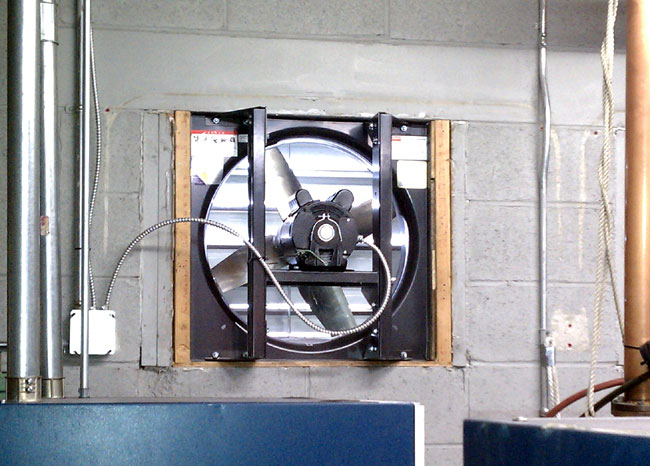
Plan B cooling consists of a 4,292 CFM Venturi fan mounted on the rear wall of the building.  The fan is controlled by a ceiling-mounted thermostat set to 95 degrees.  If the AC’s fail, the ceiling temperature will rise and the fan will turn on.

Transmitter site emergency cooling fan

The room volume is about 3600 cubic feet, therefore this fan will change the room air about once every 60 seconds or so. It is not the best plan to move humid, potentially dirty outside air through a building, but it it keeps the station on the air while the main AC units are being repaired, then so be it.

The entire system went on line last week and is working well.

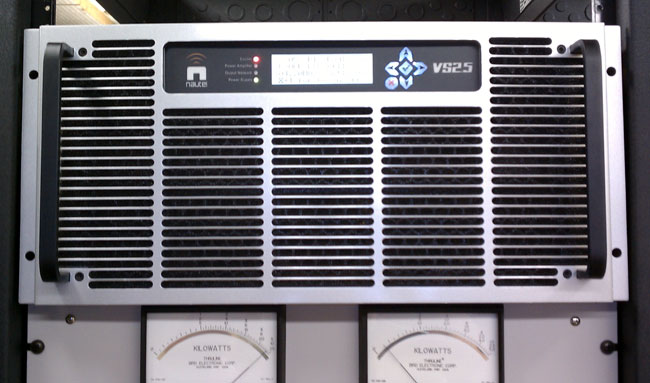
The Nautel VS-2.5 FM transmitter

This is cute. A small (VS allegedly stands for “Very Small”) integrated 2,500-watt FM transmitter.  This one we just finished installing as a backup transmitter for WSPK, on Mount Beacon, New York.

Nautel VS-2.5 FM Transmitter

This site has a Nautel V-7.5 as the main transmitter.  That unit is very reliable, however, this transmitter site is non-accessible 4-5 months out of the year due to ice and snow.  The last time we had an off-air emergency due to a crippling ice storm, it took an entire week to clear away all the downed trees so we could gain access to the site via snowmobile.  As such, every system needs dual or even triple redundancy.  The lack of said redundancy has led to several prolonged outages in the past.

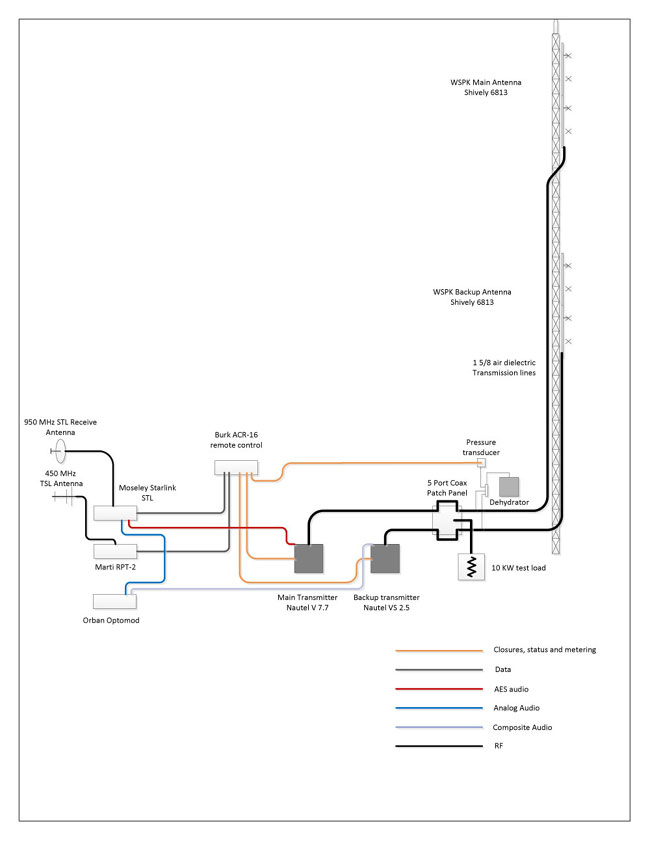
WSPK signal flow diagram

Last year, we were finally able to install a backup antenna after 63 years without one.  This year, it is time to upgrade the rest of the backup equipment.  The new auxiliary transmitter is connected directly to the auxiliary antenna via a five-port coax switch.  This allows for the use of the dummy load for testing when we are present, but removes a potential failure point in the coax switch.  There have been at least two incidences of the disk jockey accidentally transferring the transmitter into the dummy load when taking transmitter readings.  Hopefully, this configuration will be fairly idiot-proof.  I am making an interlock panel that will prevent both transmitters from being on the air at the same time.

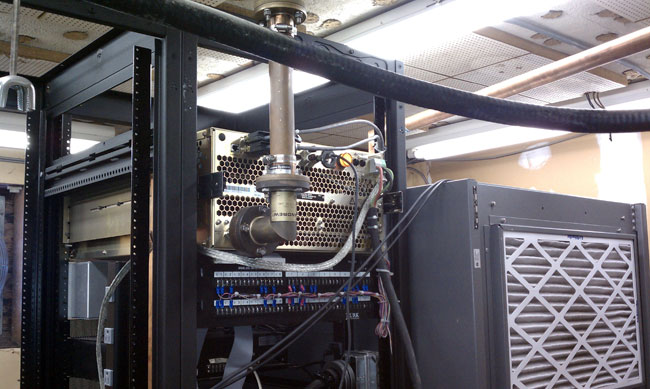
Nautel VS 2.5 connections

This site is a work in progress.

The backup processor is at the transmitter site, the main processor is in the rack room at the studio.  This works well because the main processor occasionally looses its mind and needs to be rebooted.  It would be a significant pain to drive all the way up to the transmitter site just to reboot the processor.  It might not happen at all during the winter.  The backup processor has no mind so it is not an issue.

The VS transmitter is attractive because it has a built-in exciter that accepts composite, AES, or IP audio.  The exciter also has a built-in Orban processor as an option.  Thus, if it really hit the fan, we could use the LAN extender to get the audio to the site.  Further, it could be addressed by any studio in the company WAN.  Which is cool, when you think about it.

Nautel continues to crank out innovative, dependable products and there is nothing wrong with that.