
I thought it would be interesting to do a comparison between the two types of transmitters, both AM and FM. I have been doing this thing for 25 years and have quite a bit of experience working on all types of transmitters. Some of the broadcast transmitters I have personally worked on over the years include:
- Harris: FM-20H, FM-5G, HT-35, HT-10, HT-3.5, FM-25K, FM-5K, Z5-CD, MW-50A, MW-50B, MW-1A, MW-5A, BC-5H, SX-5, SX-1A, Gates 1
- Broadcast Electronics: FM-5B, FM 3.5A, FM5A, FM30A, FM35A, FM30T, FM20T, FM10S, FM5C, FM1C, AM10A, AM6A, AM5E, AM1A
- Continental Electronics: 816R-2, 814R-1
- Collins Rockwell: 831F-1, 838E-1
- Nautel: ND-1, ND-5, XL-60, V-40, V-10, V-7.5, NV-40
- Gates: BC5P, BC1T, FM5B
- General Electric: BTA-25
- RCA: FM20ES1, BTA5J, BTA1-AR
- CSI/CCA, Visual, Energy Onix, Bauer, McMartin, QEI, some Italian something or other, etc. Various makes and models.
I think I have a fair amount of transmitter experience under my belt. What I have found is that certain brands of transmitters are better than others, regardless of whether they are tube or solid-state. There are several differences in each type, obviously. As to some blanket statement about which is better, solid state or tube, I don’t have one. My statement would be “It depends.”
Tube transmitters are more rugged and will take more abuse than a solid-state unit. Things like heat, lightning, EMP, and mismatched antenna won’t phase a well-designed, well-manufactured tube transmitter. On the other hand, they are less efficient AC to RF, have higher B+ voltages, have hard failure modes, and are more difficult to linearize, if that is required for some reason.
Solid state transmitters are more broad-banded, easier to change frequency, they have soft failure mode due to redundant amplifiers and power supplies. The voltages are lower, thus they are safer to work on.
Here is a complete list of advantages and disadvantages of each type:
| Attribute | Tube | Solid State | Comment |
| Ruggedness | Very rugged, able to take heat, EMP, lightning, mistuned antenna, poor operating environment, etc | Not heat tolerant, lightning and EMP can damage MOSFETS, switching power supplies sensitive to AC mains issues | Advantage: Tube |
| Electrical Efficiency | Less efficient | More efficient | Advantage: Solid State, however efficiency gain can be wiped out due to larger air conditioning requirement |
| Failure mode | Hard, most often | Soft, most often | Advantage: Solid State, failure of a single module or power supply generally will not take unit off the air |
| Frequency agility | Difficult | Easy | Advantage: FM Solid state transmitters can easily be moved. AM transmitters still require extensive retuning. |
| Re-occurring cost | More | Less | Advantage: Solid State, as tube changes are required every two to three years |
| Maintenance | Same | Same | Advantage: neither |
| Servicing | Requires skilled engineers to service and trouble shoot | Modules and power supplies are often hot swappable and returned to manufacture for repair | Advantage: Solid State, however either type requires occasional measurements with specialized test equipment |
| Servicing safety | High voltages, contact will be fatal | Lower voltages, but can still be fatal | Advantage: Solid State |
| Redundancy | Low | High | Advantage: Dependant on TPO, Higher powered solid-state transmitters are much more expensive than there tube type counterparts |
| Cost | Less | More | Advantage: Dependant on TPO, Higher powered solid state transmitters are much more expensive than there tube type counterparts |
| Availability | Good used market, some new FM transmitters still being built | Good new and used | Advantage: Tube |
| Reliability | Dependent on brand | Dependent on brand | Advantage: neither |
For some reason, the latest Broadcast Electronics tube-type transmitters seem to have very long tube life. I installed an FM20T at WYJB in Albany, New York, in early 2001 and it is still on the original tube, some ten years later. The same can be said for the 2005 FM20T and FM30T installation at WHHZ/WKZY, Gainesville, Florida. Those tubes show no sign of giving up anytime soon. I don’t know if that is an unusual trait of the transmitter or that particular tube.
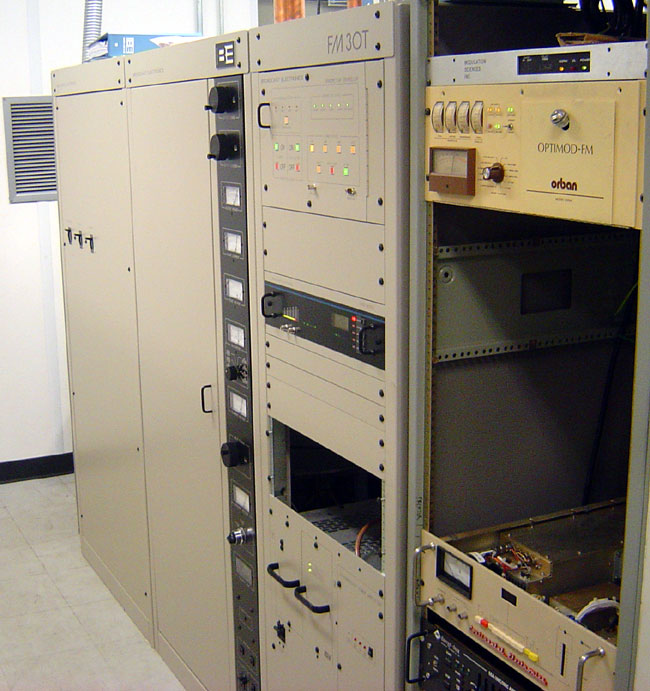
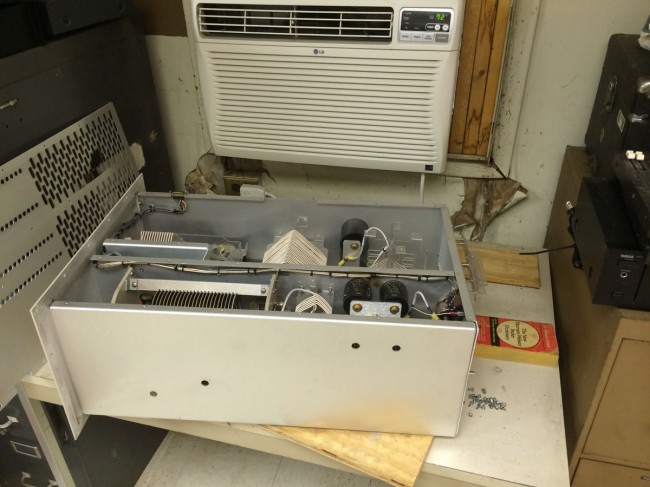
The above comparison seems to heavily favor a solid state transmitter. As a general rule, brand new solid state transmitters both AM and FM have advantages in almost every category except high power FM transmitters, where tube types still make sense. From a used transmitter standpoint, there is nothing wrong with a tube type transmitter, provided it has a solid state IPA. I have noticed the 4CX250B driver tubes most often used in FM IPA stages have markedly reduced reliability of late. I would also tend away from transmitter makes and models where the manufacture is no longer in business or no longer supports the product.













Well that answers my question 😉 Thanks Paul.
No worries, Rob, it is what we are here for 🙂
Paul – You raise some valuable insights here of solid-state-vs tube technology in FM transmitters. I had the same discussion with an associate earlier around a 100kW AM rig (Continental 317 C3) here in South Africa – High Power AM’s of this order generally are not cheap to run and this particular plant needs a new batch of 4-400s and 4CX35,000A’s to bring the plant back to its rated spec. I’m sure the cost of a solid state plant can be recovered in the power cost/tubes that these guys will spend on the 317’s
Vaughan, They could save quite a bit of money in operating expense (tubes and electric) by switching to solid state. Nautel makes 100 and 200 MF transmitters, although I’ve never worked on one of those. The most powerful MF transmitter I’ve worked on is a Nautel XL-60, which is a good unit. Last I installed one, a 4CX35,000 was near $9,000 USD, but that goes back several years.
Of all the transmitters you have dealt with ,both AM and FM,tube and solid state,which have you found to be most reliable? Least reliable?
Dewey, good question. Are you trying to get me in some type of trouble? I would have to say I prefer the Nautel transmitters , they are top notch and the Nautel service people are on the ball. Second to that, the BE AM solid state and FM tube units are very good performers. There are many BE FMxxA and B series tube units that are still in service as main transmitters after 25 years. I also like the Continental 816 series transmitters. Those would be my top three.
Then there is everyone else. As far as least reliable, I’m not going to go too far down that road, other that to say the Harris MW50 series transmitters were one of the quirkiest boxes I’ve ever had to deal with.
Nope,…not trying to get anyone in trouble. I was just curious as to which transmitters you liked,and/or preferred the most,… and which you disliked the most and why. Though I am in the Amateur Radio Service,I still enjoy your site on commercial broadcast radio. I,too,have been bitten by the radio bug. If I were in your field of work,I would also have to most likely choose Continental 816 boxes as well,with Nautel being second to them. Haven’t read up enough on BE units to be familiar with them.Being a ham,I would have to go with an old GE 1 kw unit or a Gates 1 kw unit. Back on the subject,I wanted you to know I really did enjoy reading the article and found it very interesting.
Paul – I represent Nautel in Southern Africa and have installed their VS1 and VS300 for customers over here. I’ve done some real ‘listening’ to FM exciters over the years and really liked the FX50. It is an excellent sounding exciter. However, I think Nautel have excelled themselves with the VS series and its an outstanding unit.
Wondering if you could possibly help – I’m in process of doing a cost of ownership comparison between a tube 50kW (Continental 317C3 or similar) and solid state transmitter. Would you have access to power consumption and heat load figures for the 317C3 on hand…?
Vaughan, I agree with you on the FX-50 exciter, they are well designed units. The Nautel M-50 and I can’t remember the name of the exciter in the V-40 transmitter also sound very good. Nautel knows what they are doing.
Regarding the 317C transmitter, that is one of the few that I have not personally taken care of. I know the Dougherty transmitters were pretty efficient for tube types, somewhere in the neighborhood of 73-75% in the amplifier stage. For a 50 KW carrier, that amounts to about 67,000 watts AC, thus there’d be about 17,000 watts waste heat without modulation. Depending on the density of the modulation, that figure could easily double or more.
As far as the overall transmitter efficiency, you have to take into account the tube filaments, the blower motor, etc. I’d put the over all efficiency somewhere around 55-60%, which is a common figure for all late model tube type AM transmitters.
Thanks Paul – The VS Transmitter performance is modelled around the NVE Exciter which is integrated into the NV Series. The features of the VS are certainly unprecedented in the industry and I have customers reviewing their prized digital exciters to replace with a VS Series.
Hi Sir Paul, may I ask if you have experience or heard about Quark Electronics from Italy? and RVR also from Italy? Both of them are solid-state now, which do you think is better? Thanks 😉
Cliff, I have heard of RVR, we had a 1000 watt RVR unit being used as an IPA in a Harris FM25K unit. Not heard of or seen Quark Electronics. Generally solid state units are the way to go, especially on high power AM stations.
This is a great comparison. Thank you for this. One thing that was not touched on was the sound quality of Tube vs Solid state. I have listened to various radio stations and have heard a significant difference in sound quality. Some have a narrow sound where some sound more full. One station that I listened to, I know has a tube transmitter and it really has a nice full sound. Any information you could provide on sound quality between the two technologies would be appreciated. Thank you.
@CDN, sound quality is a very subjective term. Tuning, inter stage bandwidth, antenna bandwidth all effect the quality of a station’s sound. Assuming that there are no issues with the transmitter or antenna, an FM transmitter will sound the same whether tube or solid state. For AM transmitters, solid state units have better fidelity, that is to say, the transmitted waveform will remain more or less faithful or the same as the audio input. With tube transmitters (and other tube audio gear) there is a certain amount of harmonic distortion added by tubes which the human ear perceives as “warmth” or “fatness” which is pleasing for most who hear it. Thus, many broadcast audio processors have some type of fatness settings to mimic this. Of course, ersatz tube sound is no substitute for the real thing
Please can some one out there outline the tube and solid state transmitters advantages and disadvantages for high power short wave transmitter?
steve
Stephen, I have little or no experience with HF broadcast transmitters, however, they are similar in form and function as AM aka MF/MW transmitters. Thus, I would put forth the following:
AM tube transmitters are rugged but less efficient that solid state counterparts. Older tube transmitters may not have spare parts. AM solid state transmitters are more efficient, but also more expensive. Also, some brands of transmitter are more complicated and require a higher level of understanding than others.
Continental HF transmitters have Solid State Modulators (SSM) which are standard with all new transmitters and I believe available as retro-fit for older models.
If money where no object, I would go for the solid state unit.
Does the efficiency of the SS transmitters drop off over time? What should I expect out of a 20 year old Nautel ND10?
Eric: No, there is no reason for solid state transmitter efficiency to drop over time. If that has happened, there may be problems with components (dried up electrolytic capacitors, burned out diodes, etc). A 20 ND10 should be every bit as efficient as the day it rolled out of the factory. You may want to check with Nautel and make sure that parts are still available, but I’d bet that they are.
Been enjoying reading your blog. I only deal with UHF television transmitters, but still finding lots of valuable tidbits here. I wanted to add a few notes about tube vs solid state that I’ve found in the TV world.
I cut my teeth on an old RCA 110kw unit with three klystrons. Very energy enefficient, not real reliable, but many of the problems appeared to be from years of “deffered maintenance” from the previous engineers. When DTV came along we installed a Harris Diamond HD solid state UHF transmitter with a TPO of 17.5kw (this one went online in 2002). You’d expect this to be a very reliable rig, but far from it. We have seven of these in our network, all of them have issues. Blown LDMOSFETs, and switching power supply failures are the biggest issues. Support has been mixed.
In 2009 we installed an Axcera dual-IOT transmitter to replace the RCA on analog service, and then converted it to a single IOT digital rig in 2010. Why would do that when we have a solid state transmitter already? It’s more reliable. It’s been almost like a refrigerator. Plug it in, blow the dust out once in awhile, and let it run. Uses about 1/2 as much power as the Diamond. Not sure yet what the tube life is, but I’m still on the first one, and have a spare in the socket of the other half of the rig. We’re about to embark on making this into a redundant system, so we can run either half of the transmitter, as long as the driver is ok. Right now we use the Diamond as the spare, so I’ll eventually be almost triple redundant. I hope I don’t put myself out of a job!
Biggest problems we’ve had with our Axcera’s have been water flow meters failing, and the solid state IPA’s having issues with broken solder joints that are most likely caused by thermal cycling (We’re a PBS station and don’t run 24 hours a day due to severe budget constraints).
None of this really applies to AM/FM broadcasting, but I’d thought I’d share my experiences anyway.
Hey Josh, I have only worked on one TV transmitter in my time, a 6 KW Larcan unit on channel 8. I have stood next to several others over the years. I see that Harris traditions carry over into the TV world as well. I know that radio field engineers generally like the solid state equipment because it has a soft failure mode (most of the time) and the RF modules can be changed out with out going off of the air (on some units). As you point out, the biggest difference between radio and television transmitters is the cooling methods. Very few liquid cool radio transmitter exist, whereas most TV transmitters are liquid cooled.
Thanks for the comment and keep reading!
Hello Paul. I just happened onto your blog site, and am doing some reading, which lead me to this subject. I have worked on TV and Radio transmitters of all type, shapes, and sizes over the course of many year. Quite frankly, I’d need to spend a lot of time and screen space to figure it all out. (and the fact no one cared about what I had done) I have my personal favorites, too. Just before Collins sold its broadcast business, they made a awesome, rock solid, sweetheart 1kw AM transmitter. It is the best I have ever used, too. I hand built a brand new, in the box, MW-5A when they first came out. (yes, it came in pieces) I now work at the place that I built it for, and the people that followed me torn it up. I really almost broke down in tears seeing what was left of it. I also dealt with the FM-20 and have nothing good to say about that. (1973-1974 model) About 2005 Harris made the CD-20 FM transmitter, which I currently maintain, and it is a sweetheart. I wish the other two FM’s were those. What a sweet rig. From a technical point of view, the Harris DAX-6 is not high on my list, but is reliable. Too many traps for my tastes. The other two FM’s are BE FM-30T’s. Both have been good transmitters, but our 98.3 has a 19th harmonic that trashes the cell site across from us, so have had to do some really bazaar things to get that down to -110db. (I think the Harris CD-20 would do better due to its design) By the way, this harmonic is from the cabinet, not the antenna. Guess whose 18dbi antenna points right at the cabinet? I do like Nautel. Their people are super. They continue to innovate. It’s the little things that count. The oldest transmitter was a Western Electric AM rig, and I have to add this nasty old TV transmitter that required all manner on nonsense to keep running. (can’t remember if it was RCA or GE) I personally own a Bauer 707 1kw rig. It has seen a lot of abuse over the years, and trying to get it back into shape has been trying. I put it in the same sorry state as the MW-5A. I may just give it back to Bauer, for free, and call it a lost cause. (they refurb their gear and re-sell it. The jury is still out on this one) Too many years, and too many transmitters and stations, Paul.
I’m looking for a qualified engineer to checkout our radio transmitters. Any help?
Regards,
Joel
Some Tennessee perspectives. I love Solid State transmitters a lot (especially Nautels and better BE) but feel like in lightning country and East Tennessee wild weather, you need a tube rig of high quality to be your old reliable spare. I like older Collins and Continental tube units, and BE on both tubes and SS, and Nautels no matter what. Both rigs have advantages and drawbacks, and I would not be without either as well. Both have their niche they do well.
Kent, I agree with your transmitter brand choices. You are correct that a good tube rig is rugged and can serve as a good backup of last resort. Good tube rigs like Continental, Collins, and BE are solid units but can be somewhat costlier to operate due to tube replacement costs. Still, if I had my choice in the matter, I’d have a tube type AM or FM transmitter at each site.
I got a used FM trans a Harris with a FM-30 BE exciter and the first thing i noted how many used 4cx250 b there were and I found out they used 17 watts excter drive were the tube makers say 10 watts is safe as i got the trans free two of those new tubes paid for all my gas to go get the trans cool huh Allen
what’s the difference fm transmitter type Solid State Hot Pluggable with hot swappable? thank you sir.
Solid state hot pluggable and hot swappable refer to the same thing: The ability to remove and plug in modules while the transmitter is on the air. Generally, transmitters that have the ability to disable the power to individual RF modules can be hot swappable.
I am surprised with your comparison of efficiency showing solid state FM’s more efficient than tube type. Perhaps things have changed with the latest generation of 50 V LDMOS transistors. When I was designing BE FM transmitters in Quincy in the early 1980s, having a cavity amplifier with 78% DC to RF efficiency, along with a simple nonregulated plate supply having over 90%, plus the addition of a driver and filament + blower favored the tube transmitters, such as the FM30 series (or Harris xxxx). Overall AC to RF efficiency was >60%. It was pretty hard to get an overall efficiency of >50% with transistor amplifiers, due to the class of operation, the need for multiple devices and combiner loss, and still needing cooling fans. Is there evidence of current or old solid state transmitters that are in the high 60% overall efficiency?
I am still designing tetrode HPAs as solid stage isn’t economic at the power levels of hundreds of kW or a MW at VHF as of now.
Hi Paul,
I am currently organizing to start a radio station here in Ghana, West Africa and needed to choose a transmitter.
I am an armature(i just got got out of college) with an interest in Broadcast Engineering. Your Blog is helping me a lot in my understanding. At least now i know i am looking at a BE, a Nautel or a Continental and i think a tube will suit the ruggedness of mu location as well as the cost.
I would want you to help me decide on a particular transmitter. I need a 5KW transmitter.
Hello Mr Thurst, pls i’m currently on a report on the operation process of the BEFM35T using the FX50 exciter. pls i’d appreciate any/all information garnered, as the difference between solid state and tube transmitter has moved my work more. also info on dummy load, dehydrator and the programmable input equipment. thank you very much
you can reach me thru (redacted). i would also appreciate other information from other members in the house. Thanks so much, expecting your response.
HELLO SIR! I JUST WANT TO ASKED IF YOU HAVE ANY SCHEMATIC DIAGRAM FOR A 150WATTS PRE AMP MODULE? OR EVEN AN ACTUAL PHOTOGRAPH OF THE PRE AMP. WE ARE OPERATING AN HARRIS HT 35FM. THE PRE AMP WAS OVER DRIVED BECAUSE OF THE DEFECTIVE EXCITER (THE 1-FM EXCITER. OUR PROBLEM IS THE 3 RESISTORS THAT ARE ATTACHED TO THE 2 PAIR TRANSISTOR (MOSFET) BURNT. WE CHECKED THE MANUAL BOOK BUT THERE IS NO RESISTOR VALUE MENTION ON THE BOOK. THANK YOU MR. THURST.
Question of the day… I’m looking into purchasing a silent FM with a tower site and no transmitter installed. I’ve got an opportunity to purchase a Harris FM5K at a very reasonable cost, or, of course, dozens of options going new solid state. I’ve been told that due to the reduction in maintenance, over the long haul I would probably see a better signal across my entire contour with a solid state unit and not to buy the tube unit. Then… I am also told by another engineer that I’d be better off to save the $$$ and just pay for my engineer to drop by a bit more often. Is there any truth to the solid state overall having better coverage? At 6kw, I need every ounce of signal I can get. More coverage… Fact or fiction? And since you’ve dealt with a FM5K, is there a better tube option, or are these reasonably reliable?
That is a good question. In an ideal world, RF is RF, it does not matter how it is generated. However, solid state transmitters have less distortion due to bandwidth restriction in the final stage, which generally translates to better sound and less effects like picket fencing.. Another matter to consider with tube transmitters; the future availability of tubes. The is but one source for tubes these days, and they seemed to be more geared toward medical applications.
IIRC the FM5K uses a 4CX250 as a driver, so you’ll either be converting to a solid state IPA (if possible), or replacing the driver tube twice a year. Tube life on those seems to have gone straight to hades.
Personally I’d invest in a solid state 5kW for the reasons Paul mentioned and more.
That answers my question on that… I think I’ll be modern. Have a great holiday! And many thanks for the input.
I need to change frequencies on 3 small AM transmitters (50 to 250 watts) from 1620 and 1610 khz to 1000 khz.(they have crystal oscillators).
A friend gave me some 1 MHZ crystals.
How can I make that change happend? Need some help, please!
Patrick, contact the manufacturer and ask for frequency change instructions. They’ll be specific to whatever brand you have.