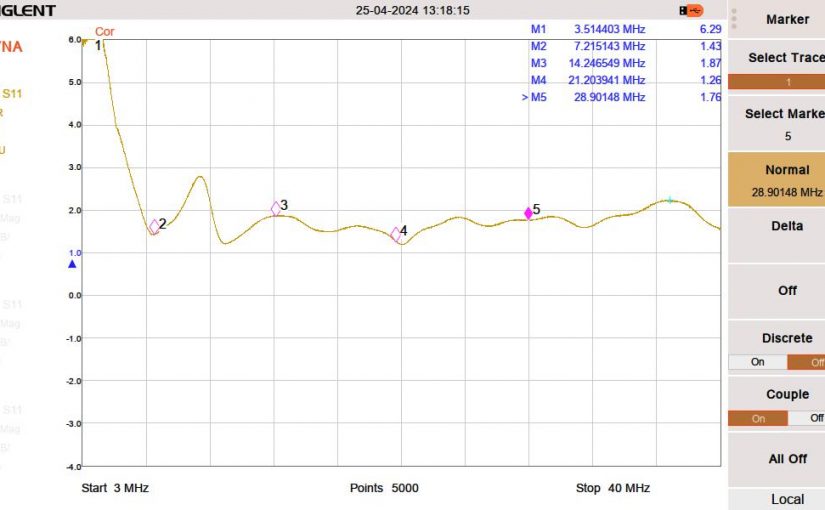
Brief Update: This post is 13 years old and still gets quite a few views. My K8AY antenna is still up and functions well. I had two accidents over the years; a branch from a nearby tree landed on one side of the loop during a winter storm and the 2N5109 BJT was damaged in an electrical storm. Both were easy fixes. Interestingly, I used my VNA to look at the antenna’s efficiency. Somewhat surprising to me, it is a relatively good antenna across the HF band. Below 3 MHz, it drops way off, likely due to the ferrite material used in the built-in balun.
Not to take anything away from Gary Breed, K9AY, who makes and sells these things under the corporate name AYTechnologies, I decided to make my own K9AY antenna system and controller. Basically, after looking at the currently available commercial version, I figured I could make a better unit for less money and be happy.
The basis for the K9AY antenna is that it has a steerable null. The gain around the antenna is close to unity, except for the terminated side of the loop, which has a deep null. This can be switched around using a combination of relays that change the loops and termination. This comes in very handy for MW and SW listening when co-channel stations can create annoying interference and heterodynes. I have had success pulling many stations out of the muck, especially in the AM band using this antenna.
This antenna requires a good ground to work against. For optimum installations, I would recommend placing two radials under each side of the loops. This will keep the ground conductivity below the antenna fairly constant, thus the value of Rterm will remain consistent for each band.
My other idea is to add a preamp right at the antenna to overcome transmission line loss and the loss from a 4 port passive receiver coupler. Something around 10 dB, low noise (obviously), low parts count, and rugged. I decided that a Norton preamp was a good design, with only one active device, a common 2N5109 BJT. Most of the time, this preamp is switched off and out of the circuit. There have been several occasions, however, where an extra 10 dB made the difference between no copy and good copy.
This is the schematic of the relay board and preamp combined:
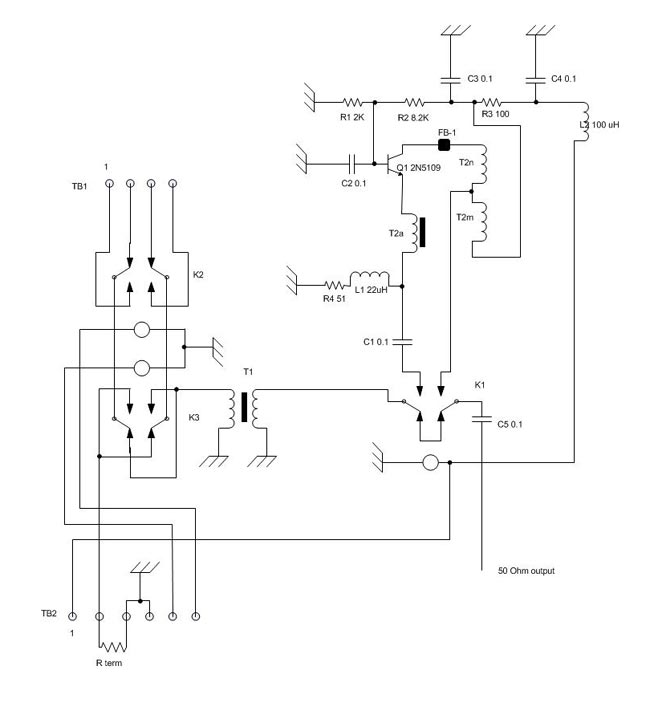
The parts list is as follows:
| Symbol | Part | Symbol | Part |
| C1 – C5 | Ceramic 0.1 uf capacitor | R1 | 2 Kohm ¼ watt |
| FB-1 | Ferrite bead, Amidon FB-43-101 | R2 | 8.2 Kohm ¼ watt |
| K1 – K3 | Omron G6K-2F-Y small signal relay | R3 | 100 ohm ¼ watt |
| L1 | 22 uH ¼ watt | R4 | 51 ohm ¼ watt |
| L2 | 100 uH ¼ watt | T-1 | 9:1 balun |
| Q1 | 2N5109 w/heat sink | T-2 | Norton feedback trans |
The 2N5109 transistor is a CATV unit with 50 input and output, reducing the impedance transformers required. The value of Rterm is determined by which band one wants to operate on. I used Omron G6K series low signal relays. Again, because this is a receive-only antenna, those relays will work well.
Terminal board connections, TB1:
| Terminal | Use |
| 1 | SW loop |
| 2 | SE loop |
| 3 | NW loop |
| 4 | NE loop |
Wire loops go between Terminals 1-4 and 2-3.
Control terminal board connections, TB2:
| Terminal | Use |
| 1 | Preamp power |
| 2 | Rterm |
| 3 | Rterm ground |
| 4 | Ground |
| 5 | Relay 2 |
| 6 | Relay 3 |
To create a low noise preamp, I decided to use surface mount devices and to try and make all the traces as close to 50-ohm impedance as possible. I created this SMT-printed circuit board:
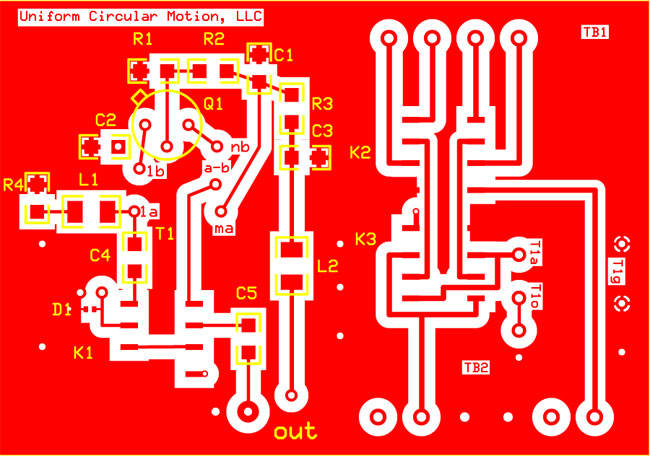
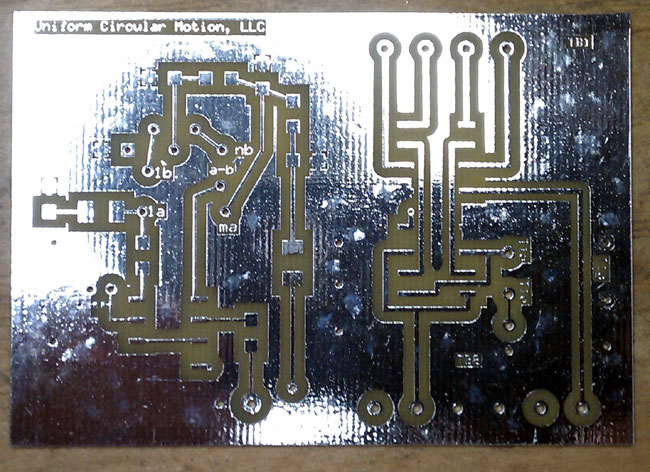
From this, I ordered 6 boards from PCB Express:
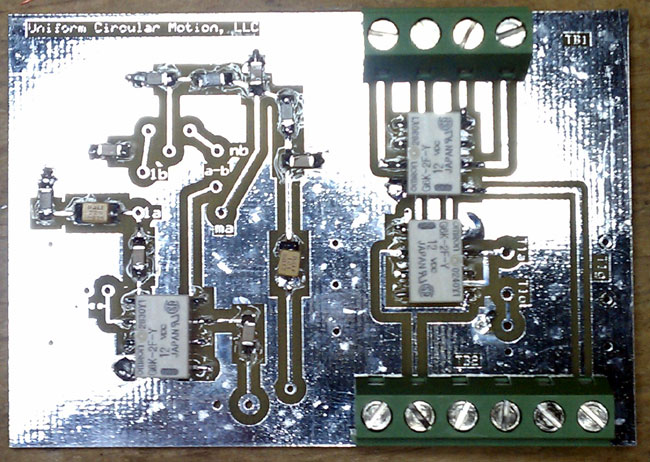
This is the board with all passive components installed:
This is the board completed:
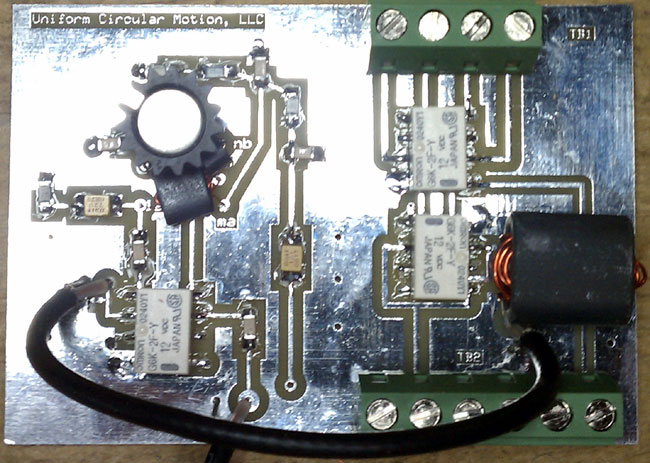
My current K9AY is an amalgamation of parts removed from various equipment. The relays are large, 12 VDC units which do not have the best contacts. It works well enough, but I’d love to get one of these units into the control box at the base of the antenna. Unfortunately, my antenna field is still in about 18 inches of snow, so it will have to wait until some of the snow melts off.
I would position this antenna as far away from transmit antennas as possible to avoid overloading the preamp and or causing problems with the switching relays. For the average amateur setup, a 75 to 100-foot separation should be more than enough.