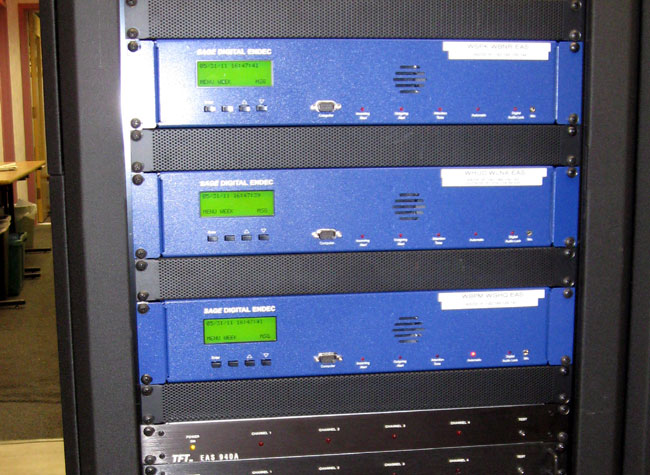
Mixed, at least in my neck of the woods. I was stationed at an LP-1 station which was monitoring a PEP station directly. On my end, the test went fine without intervention. Please excuse the cellphone video, I am used to my good camera, which I left at home.
Many others in the New York area had problems. Stations with newer SAGE (Blue front) CAP-capable EAS ENDECS had issues, even the ones that were also monitoring the PEP stations directly.
Many of those stations broadcast the header tones and about 10 seconds of audio. The audio abruptly stops and is followed by twenty seconds of dead air followed by the EOM. I can speculate that the SAGE EAS units should be checked for proper configuration and be tested back to back while receiving duplicate messages from different sources spaced apart by ten seconds.
Several stations downstream from the LP-1 stations did not receive anything at all. Others received the alert tones but no audio, some had high levels of background noise, thirty seconds of static, audio cut off, etc. All in all, most would look at this and say “Thank God it wasn’t a real emergency.” Silver lining: For all those that are concerned that the federal government will attempt to diabolically take over the entire broadcast spectrum and say evil things; Doh! foiled again.
It is a pretty good simulation of what will happen on November 9th. The script used is not the actual script that will be used for the national test.
After the test, the video shows how to bail out of the national test in the event that a valid EAN is not received. This is important information, as this particular failure has occurred many times in the past. If the LP-1 or PEP station that transmitted the test fails to send a valid EOM, the EAS unit will continue to transmit that station’s programming indefinitely. If the LP-1 or PEP station resumes regular programming while the EAS unit is relaying their programming over the air, that would be a good indication that the LP-1 or PEP station has failed to send a valid EOM.
This is a test, you have been warned. The FCC has scheduled the first nationwide mandatory EAS test for November 9th, 2011 at 2pm EST (1900 UTC). According to James A. Barnett, Jr., Chief, Public Safety and Homeland Security Bureau:
For the test, FEMA will trigger the EAS “cascade” architecture by transmitting the EAS code used for national level emergencies to the first level of broadcast stations in the national-level of the EAS, which in turn will rebroadcast the alert to the general public, as well as to the next level of EAS participants monitoring them. This should continue through all levels of the system until the alert has been distributed throughout the entire county.
Since this date is beyond the CAP deadline of September 30, 2011, it seems like CAP would be the distribution method, but there is not nothing I can find to verify that. The above paragraph makes it sound like the PEP system might be used.
This will be an interesting evolution for a number of reasons. If the EAS system fails to operate as planned after giving five months warning for a nationwide test, it would point toward a fundamental design flaw in the system. A more realistic test of the EAS system would involve perhaps one hour’s notice and then trigger the event. Notice should be given so that broadcast station personnel can answer questions from the listening and viewing public.
Then there is the EAS EAN protocol itself. There are many that feel, rightly or wrongly, that the federal government should not be able to take control of privately owned broadcast stations and cable systems for any reason. The way that the EAS encoder/decoder units are now required to be wired into the audio air chain means it would be very hard to override any mandatory alert, such as an EAN if there were a reason to do that. There have been several instances of false alerts, WGN-AM being the most recent, where programming on downstream broadcast and cable systems was disrupted for several minutes.
So, save the date. It will no doubt be interesting to see how this all works.
Lots of ink has been spilled about the new CAP (Common Alert Protocol)implementation and what it all means. Since the FCC started the six-month CAP clock ticking on September 30th of last year, they have extended the deadline by six months to September 30, 2011.
The idea of upgrading EAS is a good one. When EAS replaced EBS in 1997 it was supposed to do away with the over-the-air relay system also known as the daisy chain. This was left over from the 1960s CONELRAD system implemented by Kennedy. That replacement never occurred and stations today are still monitoring other broadcasting stations for their EAS alerts. The daisy chain was and still is the source of all EBS and EAS failures.
CAP is supposed to eliminate that weak link by allowing the EAS unit to access government IPAWS message servers directly, allowing FEMA to automatically send out alert messages to designated areas. This has some libertarians in an uproar, as they see government intrusion and taking over privately owned radio stations to broadcast emergency information as a form of tyranny. In as much as the definition of “emergency message” has not been codified by FEMA in any of their information, they may have a point. In the past, the general definition of emergency communications was those that were pertaining to imminent threats to the safety of life and property. According to Executive Order 13407, Public Alert and Warning System, the purpose is to:
…have an effective, reliable, integrated, flexible, and comprehensive system to alert and warn the American people in situations of war, terrorist attack, natural disaster, or other hazards to public safety and well-being…
Which is certainly much broader in scope. How does one define a hazard to “well-being?”
SAGE alerting systems have completely revamped their ENDEC to include CAP 1.2. It uses the internet to connect to IPAWS servers and receive CAP messages. As the SAGE ENDEC owners manual notes, participation in local and state-level alerts is at the discretion of the station management, as regulated by the current version of FCC Part 11. National-level participation is mandatory:
Participation at the national level is mandatory for most broadcasters. You may petition the FCC to become a “Non Participating National” station, but you must still receive and broadcast the EAN code, and then leave the air. These requirements are always evolving, refer to the FCC rules, in particular CFR 47 Part 11 for details.
Oftentimes, it is the local emergencies that are the greatest and most immediate threats to human life; the tornado, the tsunami, etc. Those are the most pressing threats, not the national-level alerts, which were implemented in the 1960s to warn of a major attack from a foreign country, something not very likely these days.
SAGE ENDEC
Further, the internet has proved to be less than reliable when trouble occurs. During the terrorist attacks on 9/11/2001, dial tone, cellphone, and internet service for much of lower Manhattan were disrupted because the TELCO facilities were in the buildings that were destroyed. Most internet services rely on wired or fiber optic services provided by TELCO or cable companies, which can be affected by power outages, damaged infrastructure, and so on, which would likely occur in a major emergency.
It does not seem to be the most robust method for the distribution of emergency messages.