The Polyphaser IS-PT50HN-B

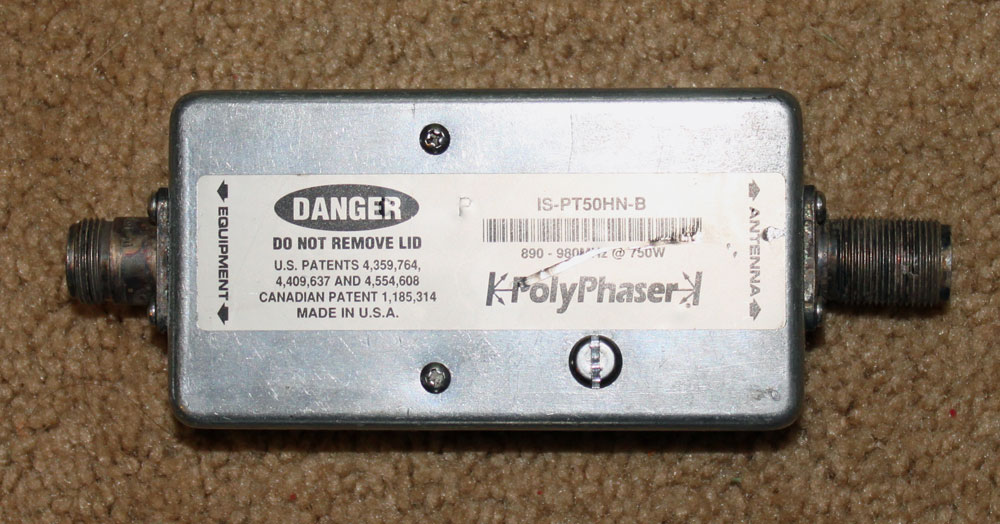
I found this on the floor at an old transmitter site:

Polyphaser IS-PT50HN-B DC block surge suppressor

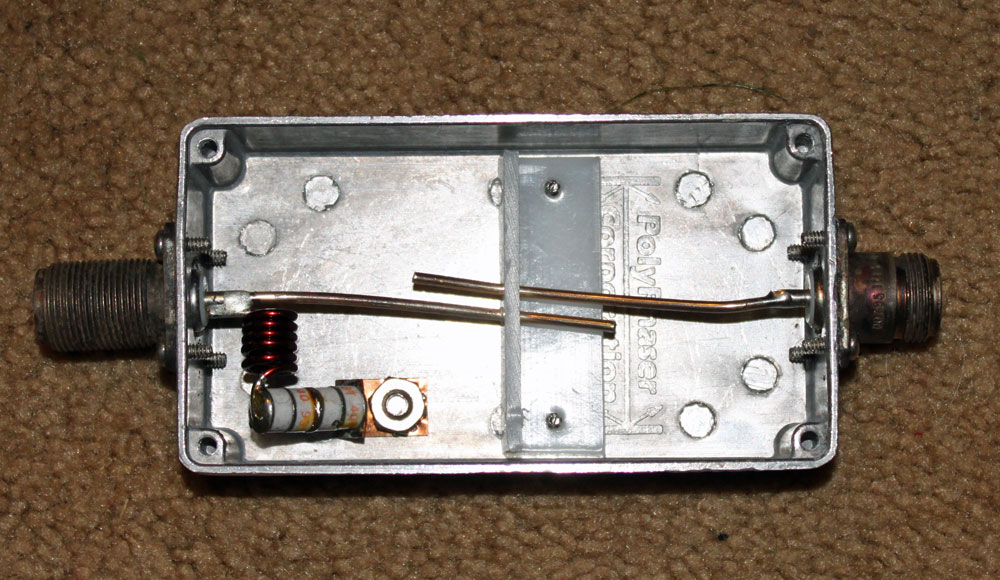
Since it appears to be discarded, I ignored the dire warnings and opened it up to look inside:

Polyphaser IS-PT50HN-B DC block surge suppressor

This is is a DC blocked lightning surge suppressor designed for 890-980 MHz, 750 watts maximum.  The two parallel wires represent a capacitor, coupling the radio to the antenna, the inductor acts as an RF block to the gas discharge tubes.  The design is such that the inductor acts to block the normal in-use radio frequencies but will allow the 10-30 KHz lightning pulse to pass to the gas discharge tubes and thence to ground.  The inductor and gas discharge tubes are on the antenna side of the unit.  I measured these units with a DVM and they all appear to be good.

My only comment on this unit is that there is no effort to maintain the transmission line impedance.  At the upper end of the UHF spectrum, this can lead to return loss and wasted power.  For a receive application, it may not be so bad, but for a transmitter, I would rather use something else.

For lower VHF frequencies, something like this can be DIY fabricated with minimal expense and effort.  The case must be bonded to the station ground.

FM Fool website

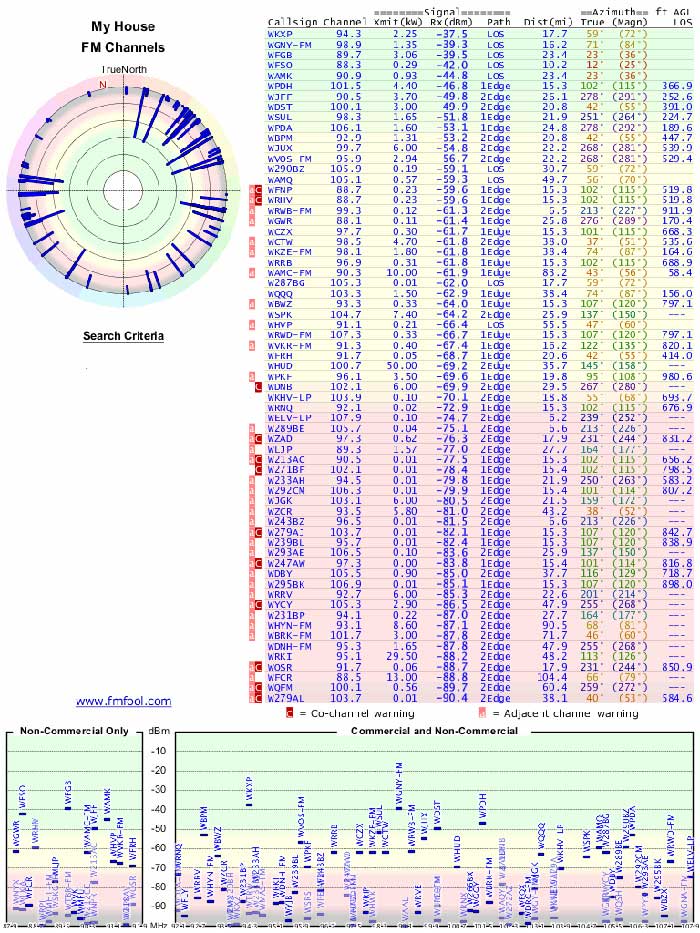
Just for geeks, the FM Fool website is.  Nonetheless, it is a cool site to look at and can be used as a tool to find out what stations are available in any certain area.  Using the FCC database and terrain profile, it will print out a radar plot of all signals for any address in the US:

FM Fool Radar plot
FM Fool Radar plot

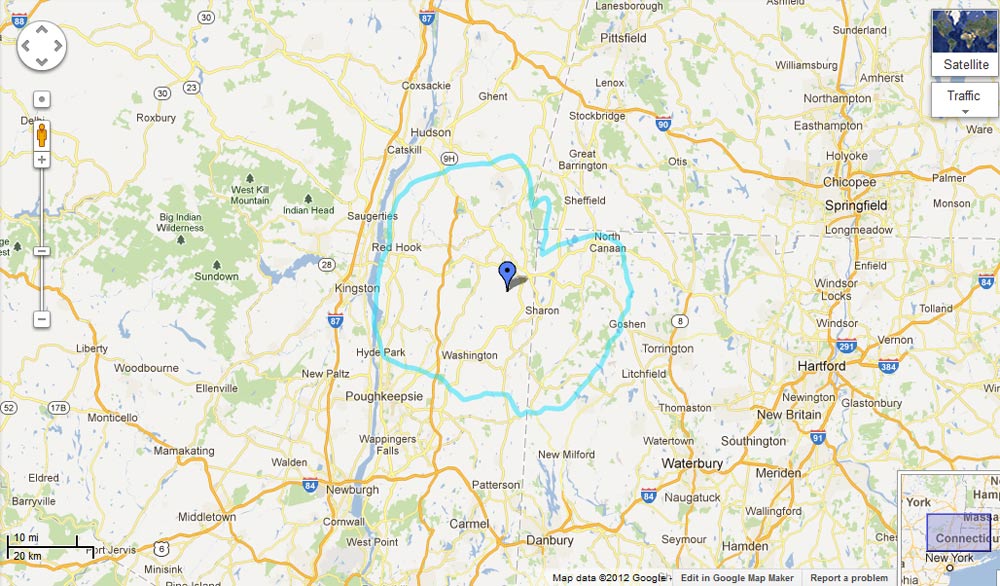
This plot is for my house based on a 30-foot outdoor antenna and includes all FM stations that are even marginally receivable.  We kind of live off to the side of nowhere.

The transmitter database was last updated on July 5, 2012.  Longer bars represent stronger signals.  Details about each transmitter are provided in the table to the right of the plot.

This is a companion site for the TV Fool website.  If you want to see what off-air TV signals are available at any given location, this is the way to do it.  A few years ago, I was thinking of getting rid of the Cable TV in favor of off-air reception.  Unfortunately, there are only a few off-air TV channels available at my house.  Therefore,  I threw out the TV.  Problem solved.

We are experiencing technical dificulties, please stand by

There appears to be some issue with my version of WordPress, the server in use, and the version of PHP. The ISP recently upgraded my server and migrated my site over to a new unit, which was supposed to be transparent. Right. I am working with the ISP to resolve these issues as quickly as possible and return to my regular blogging.

In the meantime:

Update: All fixed, for now anyway. Something about a mismatched password in the backend. To all those that tried to comment, my apologies. It should all be working correctly now.

SSAC BKON tower light flasher

Tower light outages are fairly typical in this business and I have spent a fair amount of time at various tower bases poking around in the junction boxes looking for trouble. Over the years, I have replaced several old mechanical tower light flashers with these SSAC solid-state units. The SSAC units are nice, in that they have a zero voltage turn-on, which tends to extend the service life of incandescent bulbs.

This unit appears to have taken the brunt of a lightning strike:

SSAC BKON FS155-30T tower light flasher

I would hazard a guess that lightning struck the top part of the beacon housing where the bulb socket is located, then traveled down the AC line to this device.  Luckily, it appears the wire insulation inside the conduit to the beacon fixture is still intact.  Sometimes, under high stress, wire insulation can fail, as it is most often rated for 600 volts maximum.  I have also seen that happen on more than one tower, especially if water has made its way into the conduit.

SSAC BKON tower light flasher

Side view, this was mounted on a hot AM tower, but was not the unit designed for high RF environments. Those units are denoted with an “RF” suffix. The difference between the two, the RF models have bypass capacitors installed internally.

SSAC FS155-30T destroyed by lightning

Lightning path to ground, through the bottom of the case.