Ready for CAP? (AKA Common Alert Protocol)

Like any good government agency, the FCC in conjunction with FEMA is working on upgrading the acronym-heavy EAS system with CAP, which stands for Common Alert Protocol. CAP includes something that  FEMA has been working on something called IPAWS, which stands for Integrated Public Alert Warning System.

The FCC is still in the comment/response process (FCC Docket 04-296) which can get long and drawn out.  I would not expect to see any NPRM until late fall 2010 with any changes taking effect in early 2011 or so.

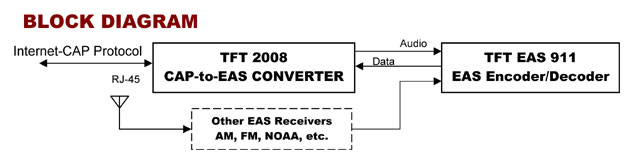
Basically, CAP looks like this:

An EAS to CAP converter monitors a CAP source (think e-mail server) and when a CAP message is received, it converts it to EAS protocol and sends it to an input source of an EAS encoder/decoder.  The EAS encoder/decoder then passes that information through and broadcasts it.   Of course, the EAS encoder/decoder can still be programmed to pass through specific types of messages for specific areas and ignore all others.

Thus far, several manufacturers have designed CAP converters for use with existing EAS units:

Implementation would look something like this:

EAS CAP converter diagram

For a TFT-2008 system.  Others such as SAGE and Trilithic are integrated into the EAS encoder/decoder units.  Basically, the CAP part of the EAS system needs an ethernet port with access to an IP gateway to receive messages from the CAP server located off site.  That is the weak link in the system, as far as I am concerned.

It is not like some of our so-called trading partners have been trying to tinker with the inner tubes or anything.  It is also not like that same trading partner makes most of the cheap ethernet switches and routers found in many radio stations, hardware that can be easily configured remotely.  Configured to redirect certain IP addresses to new, exciting, and exotic locations such as Iran or Pakistan.

Perhaps I am paranoid, or not.  It falls back to my time in the military when somebody said “It’s good to be a little paranoid if everyone is out to get you.”

The history of Carborundum

There is a very good blog called Arcane Radio Trivia which publishes interesting tidbits of radio trivia, and a lot of stuff that a reader might not have heard before, hence the name.  A post put up last week, when I was out of town, deals with carborundum (Silicon carbide) which is one of the first semiconductors used to produce diodes, and thus detectors for radio.

Certain naturally-occurring minerals can be used to detect radio signals, including galena, zincite, silicon,bornite and others. Carborundum was unique among the early crystals because it was synthetic. It was durable, and at 9 mohs much harder than most available crystals. More here. Also interestingly it requires it requires a negative potential of 1 volt to be used as a diode. Carborundum was not created with this purpose in mind. It was created in the early search for artificial diamonds

Like many things in early radio, there are several plot twists in this story and if one is interested in radio history, it is work a click to read.  While you are there, check out “It’s 105 degrees and rising

RF is killing bees!

I found this article and video interesting:  Study links bee decline to cell phones.

The article goes on about CCD (Colony Collapse Disorder) where entire bee colonies die off for unknown reasons.  Some speculate that increased use of pesticides might be to blame (which makes perfect sense to me).  Still, others think that cell phone towers are the culprits.  Noting:

“Animals, including insects, use cryptochrome for navigation,” Goldsworthy told CNN.

“They use it to sense the direction of the earth’s magnetic field and their ability to do this is compromised by radiation from [cell] phones and their base stations. So basically bees do not find their way back to the hive.”

One study in India involved attaching a cell phone to the side of a bee hive and powering it on for two fifteen-minute periods each day. These researchers found that the honey production in the hive dropped off and the hive queen’s egg-laying was cut in half.

All of that is indeed interesting, but somehow I think that a lot of information is lacking.  First of all, any first-year physics student can tell you, the RF field around a cellphone antenna decreases logarithmically as a function of distance.  In other words,  for each unit of distance away from the antenna, the power density decreases by 10 times.  Therefore, placing even a mobile phone directly on a bee hive will likely generate much higher RF fields than would otherwise be encountered, unless there was a bee hive in one of the cell tower antennas.

Secondly, there is no mention of power levels, although the frequency appears to be in the 900 MHz range, if this is the study (.pdf) being referred to in the article.

Finally, the compound referred to, as cryptochrome, is also interesting.  Breaking the word down, one finds “Crypto” which means hidden, and “Chrome” which means color.  According to the Wikipedia article, which most often can be believed when it comes to such subjects, it is indeed used by some animals to detect magnetic fields.  However, RF used by cell phones has long been in use by other technologies such as two-way radio, pagers, cordless phones, baby monitors, TV, early radar, and other high-power emitters.  It would be most unusual that RF-induced CCD would just now be showing up.

In short, there is very very thin evidence that cell phones are causing CCD and it is a shame on CNN for propagating such nonsense without doing research.

Converting electrical degrees to height in meters or feet

Here is one of those things that can often be a head-scratcher for the uninitiated:

The FCC database gives antenna height in electrical degrees when what you really want to know is how tall is that tower.  Never fear, figuring all this out, requires math.  Pretty simple math at that, too.  I prefer to do these calculations in metric, it is easier and the final product can be converted to feet if that is desired.

First of all, radio waves travel at the speed of light, known as “c” in many scientific circles.  Therefore, a quick lookup shows the speed of light is 299,792,458 meters per second (m/s).  That is in a vacuum, in a steel tower, there is a velocity factor, most often calculated as 95%, so we have to reduce the speed of light in a vacuum to the speed of RF in a steel tower.

299,792,458 m/s × .95 = 284,802,835 m/s (speed of a radio wave in a steel tower)

Frequencies for AM radio are often given in KHz, which is 1000 cycles per second.  For example, 1,370 KHz × 1000 = 1,370,000 Hz (or c/s)

Therefore:

284,802,835 m/s ÷ 1,370,000 c/s = 207 meters per cycle.  Therefore the wavelength is 207 meters.

There are 360 degrees per cycle, therefore:

207 meters ÷ 360° = 0.575 meters per degree

If the height of the tower is 90°, then 90° × 0.575 m/° = 51.57 meters.  Add to that the height of the base insulator (if there is one) and the concrete tower base and that is the total tower height.

To convert meters to feet, multiply by 3.2808399.

In the United States, that tower would be 169.78 feet tall.