Archives

July 2010
M T W T F S S
« Jun    
 1234
567891011
12131415161718
19202122232425
262728293031  

Categories

Nautel YouTube channel

Nautel, Ltd., which always seems to be a forward thinking company, has their very own YouTube channel. Okay, that is not such a big deal, I have my own YouTube channel too.

There are lots of video on how to configure a NV transmitter, which, as I have said before, fancy GUIs are all well and good, I am more concerned with the MOSFETS generating the RF.  I would forgo the GUI in favor of more more reliability, but that’s just me.

I would put the DRM+ video up on the blog, but the embed function is disabled.  Anyway, I enjoyed watching many of these, you might too.

Filament Voltage Management

4CX35,000C ceramic vacuum tube

4CX35,000C ceramic vacuum tube

There are still many hollow state (AKA tube type) transmitters floating around out there in the broadcast world.  High power, especially high power FM transmitters are often tube types and there are many good attributes to a tube transmitter.  They are rugged, efficient and many of the well designed tube units can last 20-25 years if well maintained.

There downside of a tube transmitter is tube replacement.  Ceramic tubes, like a 4CX20,000 or 4CX35,000C cost $6-9K depending on manufacture.  A well maintained tube and last 3-4 years, I have had some lasting 8 years or more.  My personal record was for a 4CX35,000C that was a final PA tube in a Harris MW50A transmitter.  The tube was made by EEV (English Electrical Valve, now known as E2V)  and lasted approximately 84,000 hours, which is 9.58 years.  When it finally came out of service it looked like it had been through a fire, the entire metal plate body was dark blue.  I took it out because the power was beginning to drop a little and it was making me nervous.

This was not accident, I did it by maintaining the filament voltage, keeping the tube and transmitter clean.  The tube filament supplies the raw material for signal amplification.  Basically, the filament boils off electrons, which are then accelerated at various rates and intensity toward the plate by various control grids.  The plate then collects the amplified signal and couples it to the rest of the transmitter.  When a tube goes “soft,” it has used up its filament.

I had a long conversation about this one day with Fred Riley, from Continental Electronics, likely the best transmitter engineer I have ever known.  At the time, the consensus was to lower the tube filament voltage no more than 10%.  On the 4CX35,000C, the specified filament voltage is 10 volts, therefore, making it 9 volts was the standard procedure.  What Fred recommended was to find the performance “knee,” in other words, where the power began to drop off as the filament voltage is lowered.  Once that was determined, set the voltage 1/10 of a volt higher.  I ended up running that EEV tube at 8.6 volts, which was as low as the MW50’s filament rheostat would go.

The other important thing about tubes is the break in period.  When installing a new tube, it is important to run only filament voltage for an hour or two before turning on the plate voltage.  This will allow the getter to degas the tube.  New tubes should be run at full filament voltage for about 100 hours or so before the voltage is reduced.

Tube changing procedure:

  1. Remove power from transmitter, discharge all power supply caps to ground, hang the ground stick on the HV power supply.
  2. Remove tube, follow manufacture’s procedures.  Most ceramic tubes come straight up out of their sockets (no twisting).
  3. Inspect socket for dirt and broken finger stock.  Clean as needed.  Finger stock, particularly in the grid section, is important for transferring RF.  Broken fingers can lead to spurs and other bad things
  4. Insert new tube, follow manufactures recommendations.  Ceramic tubes usually go straight down, no twisting.
  5. Make all connections, remove grounding stick, half tap plate voltage supply if possible, close up transmitter
  6. Turn on filaments and set voltage for manufactures recommended setting.  Wait at least 90 minutes, preferably longer.
  7. Turn on plate voltage and tune transmitter.  Tune grid for maximum current and or minimum reflected power in the IPA.  PA tuning should see a marked dip in the PA current.  Tune for dip, then load for maximum power.
  8. Turn off transmitter, retap plate supply for full voltage
  9. Turn on transmitter and plate supply, retune for best forward power/efficiency ratio.
  10. After the 100 hour mark, reduce filament voltage to 1/10 volt above performance knee.

Of course, every transmitter is slightly different.  There may not be a dip in the plate current if the transmitter is running near it’s name plate rating, in which case one would tune for maximum forward power.

This system works well, currently one of the radio stations we contract for has a BE FM20T with a 4CX15,000A that has 9 years on it, still going strong.

Broadbanded AM antennas

Partly for my own edification, partly just because, here is some information about AM antenna systems and their bandwidth. An AM tower is a radiator which, simply by the physical constraints of the tower structure itself, is pretty narrow banded, even under the best conditions. Add to that, antenna tuning units, transmission line phasing, antenna phasing units, diplexing units and things can get very squished outside of the immediate carrier frequency. This seems to be a particular problem with directional antennas, which most AM stations employ.

WGY 810 kHz, Schenectady, NY transmitting tower w/open feed line

WGY 810 kHz, Schenectady, NY transmitting tower with open transmission line

As an engineer, you can get some idea of how narrow an antenna system’s bandwidth is by looking at the base impedance measurement.  Every AM station is required to keep the latest impedance measurement on file.  When looking at these measurements, there will be on curve which indicates base resistance (R) and another curve that indicates reactance ( X, although often noted as + or -j).  If the resistance and or reactance curve is slopped steeply at the carrier frequency and out to 20-30 kHz, it is a narrow tower.  Add to that the differing phase shifts of an ATU and or Phasor and things will be compounded.  That is why it takes a professional to design and tune up these things, a poor design will never sound right.

Another way to get some idea of bandwidth requires a field strength meter.  Modulate the transmitter with a 10 kHz tone at 50% modulation.  Then, away from the near field, measure the carrier and 10 kHz +/- the carrier frequency on the log scale.  The side bands should be symmetrical and about 1/4 the carrier level.

Generally speaking, antenna systems need to be designed for low VSWR across the entire side band range (+/- 10 kHz from carrier) as well as symmetrical distribution of radiated energy across the lower and upper sidebands.  Several factors influence these conditions:

  1. Electrical tower height, perhaps the hardest thing to change once a tower is constructed.  Short towers (less than 80 electrical degrees), or very tall towers, (taller than 200 electrical degrees) present problems.  If one where constructing an AM station and could choose any tower height, something between 120 to 190 electrical degrees would be ideal.  Existing towers can be top loaded to add electrical height for an additional 30 degrees or so.  Beyond 30 degrees it becomes difficult to physically attain and therefore impractical in most situations.  Top loading and bottom loading a tower can reduce bandwidth if done improperly.   Bottom loading an AM tower is almost never done due to the very high voltage and current as the electrical length approaches 180°.
  2. Antenna matching networks can greatly improve or degrade bandwidth, depending on how they are designed.  A T matching network has more parts and is more expensive, however, it allows for optimum control over the R and jX phasing.  This becomes much more difficult with directional antenna where phase considerations are a part of the stations antenna field pattern development.
  3. Phasors present the biggest challenge, particularly in the power divider sections.  A tank circuit power divider is the worst choice, a shunt circuit power divider is the best bandwidth choice, however, it is the hardest to conceptualize.

Obviously, the more complicated the antenna system, the harder it will be to keep the bandwidth open over 20 kHz of spectrum.  This is especially true on lower frequency AM signals, where the bandwidth is a much larger percentage of the frequency.   Multiple pattern, multiple tower DAs are a nightmare.  Single tower non-directional stations are the easiest to modify.

As far as the circuit itself, higher Q circuits have smaller bandwidths.  Simply stated, in an alternating current circuit, Q=X/R.  The better the reduction of X, which also has a lot to do with the relationship of the current and voltage phasing, the better the Q will be.  This is why a T network is the best design for an ATU.  With a 90° or 180° tower, this is relatively straight forward.  In towers that are shorter or taller than that, it becomes more difficult as the value of R becomes less friendly.

In most cases, some sort of L/C network can be deployed to decrease the Q of an antenna system at the base of the tower.  Directional stations also need to have the phasing equipment looked at, because, as noted above, certain designs can created bandwidth bottlenecks.  All in all, it is usually an expensive proposition for a multi tower directional station to broadband it’s antenna system.  This is another reason why IBOC on AM is destined to fail, many AM towers cannot pass the extended sidebands adequately.

BE AM6A power supply

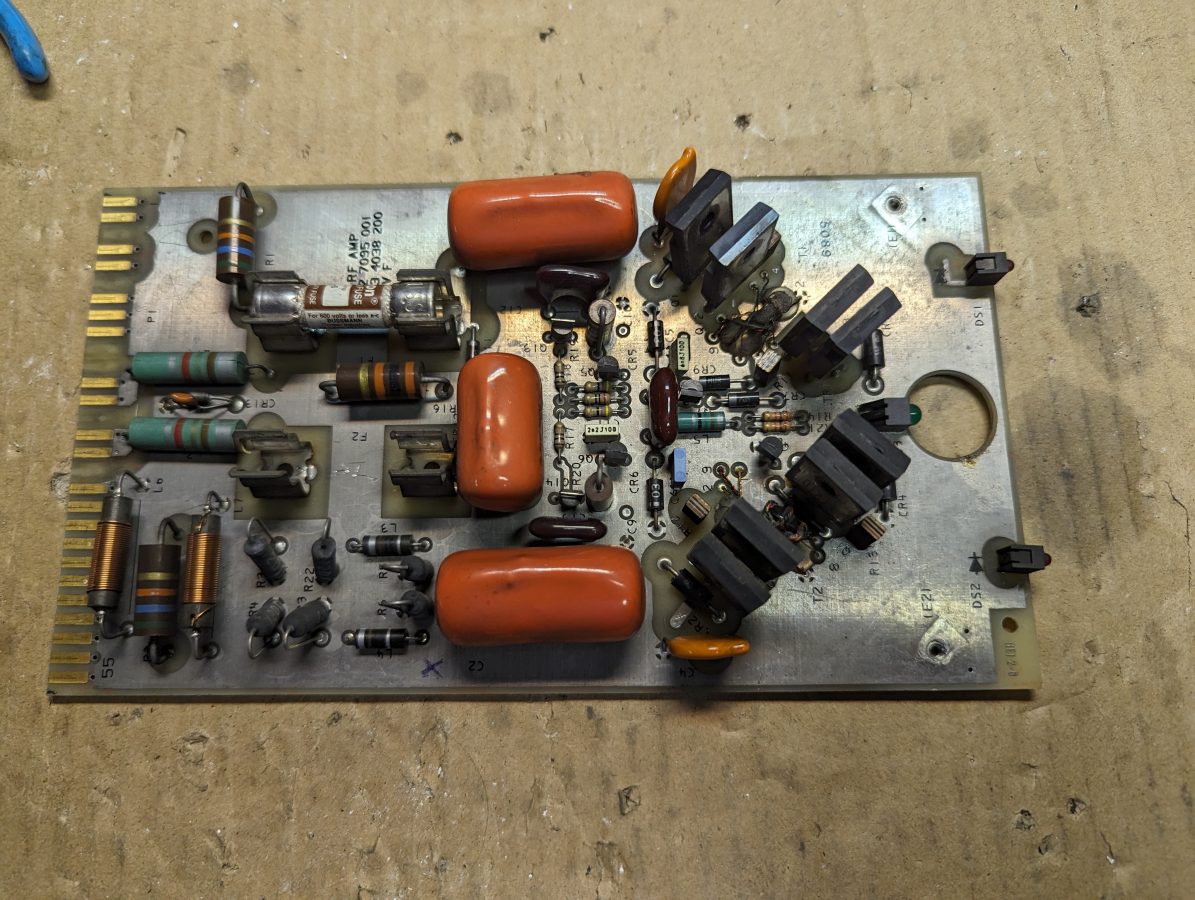
Another picture from my collection, this one is the back side of a power supply module from a Broadcast Electronics AM6A transmitter:

Bang!

Bang!

It happened during power up from 1 KW to 5 KW and it was quite loud, as I was standing right next to the transmitter.  The exploded part is a 0.1 uf capacitor that looks like an add on.  In fact, some of the other power supplies don’t have it.  It also took out the 20 amp slow blow fuse.

I like the exploded look of the board, kind of like on The Road Runner, when Wyle E. Coyote looks into a box and something explodes.

This is the only problem I have had with this particular transmitter.

BE AM5E power supply problem

This is from my burned out shit collection, pictures section:

Broadcast Electronics AM5E power supply

Broadcast Electronics AM5E power supply

It is a power supply from a Broadcast Electronics AM5E transmitter.  Here is another view:

Broadcast Electronics AM5E power supply mating connector

Broadcast Electronics AM5E power supply mating connector

As you can see, there was a small fire started in the mating connector for the transmitter wiring harness.  I did not install this unit so I have no way to know for sure what happened, but I suspect that the mating connector was not pushed all the way in during installation.  In this business, really in all engineering fields, it is the little details that will catch up with you.

I know that one of the stations I used to work at had a fire at their electrical service panel at the FM transmitter site, after they installed a new transmitter.  This happened after I departed for greener pastures.  In any case, it is very important to torque the connections on any service disconnect or circuit breaker to the panel manufacture’s specifications.  I also check the lugs every so often with a Fluke 62 mini IR temperature meter. Any loose connections will show up as hot spots, which can be fixed before the fire breaks out.

All current carrying electrical connections should be double checked for solid connections before the transmitter is turned on, then check periodically thereafter for heat buildup and or heat damage.

My friend, the MW-50B

I began fooling around with radios when I was 10 years old or so. First, I built one of those shortwave radio kits from Radio Shack, which was back when they still sold radios.

Then I bought a small tube type AM transmitter at a garage sale.  The woman there said her son built it several years ago from a kit and it had the instruction manual.  I don’t even know who made the kit.  After some experimentation and changing out some tubes, I got the thing to transmit on about 1600 kHz, although it was a little hard to nail down as it drifted quite a bit until everything heated up.  I don’t know what power that thing put out, but it was certainly less than a watt.

All of this lead to a brief stint in the military as a radioman.  That was an interesting field, albeit different from what I thought it would be when I signed up.  It was during this time that I did some part time work at an AM/FM/TV station assisting the Chief Engineer.  Once it was established that I actually knew something, my responsibilities grew until I was assigned the AM/FM part of the deal.

After a year of that, I moved to a different city for family reasons and took the Chief Engineer job at a local AM/FM station.  The AM station was a 50,000 watt directional in the high end of the band which had a Harris MW-50B transmitter.  My previous station had a Bauer 10,000 D AM transmitter.  What could be so different? Plenty I learned, on my second day.

Harris MW50B transmitter with 50 KW air cooled power supply

Harris MW50B transmitter with 50 KW air cooled power supply

We were subjected to a wicked lightning storm, which, Murphy being present, took out the main transmitter.  The backup was a GE BTA25 which was running at half power because of the age of the 5891  final tubes.

The symptoms of the MW-50 where as follows:  It would run along fine then there would be a big blue flash and a cannon shot boom, followed by the step start relays cycling and it would come back on the air.  There were no overload lights nor any other symptoms leading up to the overload or subsequent to it.

I began by killing the power and shorting out all the high voltage parts with a shorting stick.  I noticed that things inside this transmitter where a little unusual, so I got the manual out and started reading.  The most unusual aspect of this transmitter is the 25 KV isolated box that the PA stage occupies.  25,000 volts DC is a great big potential and what I found over the years is that this transmitter needs to be kept very clean.  Of course, this unit had not been, and that was a part of the problem.

The other unique aspect of this transmitter is the damper diode, which is required by PDM transmitters to conduct voltage during the negative modulation peaks.  If the damper diode breaks down for any reason, the PA supply voltage tries to go to infinity, which is a good deal larger than 25KV and all sorts of problems begin.

To make a long story somewhat shorter, this is the problem I had.  The solid state damper diode had one bad section, which was causing all sorts of corona problems during heavy negative modulation peaks.  It took a call the Harris factory to determine this.  The entire diode assembly needed to be replaced because every section is matched.  That cost a couple of thousand dollars as I recall.

While I was working on the MW-50B transmitter, I was not impressed.  It seemed a little cheap and flimsy.  Later, when I voiced my concerns with the station management, the Harris transmitter salesman stopped by and said I needed to get with the program if I wanted to work in that market.  This was a Harris town you see, if you start bad mouthing our products, you’ll be the one to suffer.  Well, he retired, I kept looking around for other AM transmitters.  Three years later I went to work for the competitor across town.  Today that station has a Nautel ND-50.

The MW50 went off the air once every 6 months for the entire time I worked at this station.  It was always something different, power supply rectifier, bad PDM board, bad directional coupler, arcing insulator on the isolated box, etc.  I began to feel it didn’t like me, and I know I didn’t like it.  In fact, you could say I have never really liked Harris transmitter products ever since.

Update: Okay, I left a few things out of the narrative:

The 50 KW air cooled power supply was the light weight version.  Most MW-50 transmitters had 100 KW oil cooled supplies.  The problem with the 50 KW power supply was it was designed with a zero safety factor.  All of the rectifier were running at or near maximum current and voltage.  It only took one of 144 diodes to go bad, either short or open, and the whole transmitter would crash.  Again, no overload lights or other indications of problems.  We later installed air flushing fans in the power supply cabinet to keep things cool and that helped out quite a bit.

The other thing was a DC feedback sample to the PDM card.  It seems that if the filaments were turned off before the bleeder resistors took the 25 KV supply to zero, the remaining voltage would be routed to the PDM card via the DC feedback sample, blowing the foil off of the circuit card.  We fixed this by installing a gas discharge tube with a series resistor at the connection point for the DC feedback sample.

Then there are the infamous 1N914 diodes in the directional coupler that Dave points out below.

I am sure I am forgetting something else, but you get the idea.

General Electric BT-25-A

This is one of my favorite old transmitter memories.  Back when I landed my first Chief job, I was working for an AM/FM combo.  The AM station was a 50,000 watt flame thrower that first went on the air in 1947.  The original transmitter, a General Electric BT-25-A was still in service as a backup unit.  These pictures are from the last night it operated, December 16, 1993.  The bank made us remove all of the PCB transformers and capacitors before they would refinance their loan.  Of course that was most of the transmitter, the rest of it was scraped or sold for parts.

This is a long transmitter, GE BT-25-A looking from the control cabinet

This is a long transmitter, GE BT-25-A looking from the control cabinet

The transmitter takes up the entire span of the room.  There were eight large cabinets, each with its own stage or section.  The stages were connected to each other by a wiring trough in the floor.  The transmitter used lead jacketed cable within and between sections.

IPA stage with "multi-meters"

IPA stage with "multi-meters"

The IPA section had been modified to use 833A tubes.  This is where the RF was developed and amplified for the final section.  It is in the middle cabinets of the transmitter, the audio and control section being to the left, the PA and PA power supply being to the right.

PA section.  Those WL 5891 tubes.

PA section. Those are WL 5891 tubes.

Final section. There were three tubes, only two where in use at any given time.  The third tube was a spare which could be quickly placed in service by throwing a knife switch and moving those bars on the back wall around.   This picture was taken with filament voltage only, we had to close the door to turn on the PA voltage.

air cooling blower

air cooling blower

The transmitter was cooled by this blower which faces down into the floor.  A concrete duct work carried the air to the various stages of the transmitter.  The blower is powered by a 2 1/2 HP motor.  There were two blowers, one in use and one is standby. Behind this is an air mixing room and filter room.  During the winter time, the transmitter waste heat was used to heat the building by closing a series of ducts and opening other ones.

Modulation transformer and modulation reactor

Modulation transformer and modulation reactor

This is in the transformer vault.  The unit to the left is a modulation transformer, it was 7 feet tall.  Directly in front is the modulation reactor and just out of the picture to the right is the plate transformers.  The plate supply was 480 volts 3 phase.  The other piece of green equipment is a hydraulic tube jack, to get the 5891 final and PA tubes out of their sockets.

The transformers where what contained most of the PCBs.  The modulation transformer contained about 150 gallons of Pyranol, the GE trade name for their transformer oil.  Pyranol contained greater than 750,000 parts per million PCB.

It is a shame we had to kill this transmitter, is sounded wonderful on the air.  The day we signed it off, there was nothing like it, not the Mw-50B that replaced it, nor the Nautel ND-50 that replaced the MW-50, nor the DX-50 at the competing station across town.

What a shame.

AM transmitter preferences

Engineers are funny.  We all have our likes and dislikes and our reasons for both.  I don’t really like Harris products.  Even when I was in the military, their stuff seemed a little “light.”  I suppose having to deal with an MW-50B transmitter at my first full time chief engineer gig didn’t help that impression.  The MW-50 would “blow up” every six months or so.  I say blow up because that is the only way I can describe it, no overload lights or any other indication of trouble until the blue lightning flashes and thunder from the PA section.  What a POS.

Other Harris transmitters, such as the SUX-1, FM20H, Gates-1 etc have also left me less than impressed.

In order of preference, my choice of AM transmitters would be:

  1. Any Nautel solid state unit.  Nautel makes good equipment that is well supported.
  2. Any BE solid state transmitters.  I favor the A model over the E model, but both are good.  One condition, they must absolutely be well grounded and all of the toroid filters provided by the manufacture must be used when installing.
  3. Any tube type Continental transmitter.  There are older units, I believe 816R but they work well and sound good on the air.

Really, that is about it.

Matching an AM transmitter to a tower

This was a fun little project I was involved with last year.  Diplexing two AM stations to a single tower.  This particular tower was brand new, replacing an older tower that was rusting from the inside out.  As such, it had slightly different characteristics than the old tower, so it was a whole new project.  Fortunately, the old Antenna Tuning Units (ATU) were made by Kintronics, so they had plenty of head room on both side of the circuit for matching purposes.

The replacement tower is up, the new unipole antenna has been installed and now it is time to match the transmitters to the tower. This involves using some math. At some point in radio history, someone decided that all transmitters should have an output impedance(Z) of 50Ω (ohms). Impedance in an alternating current (AC) circuit (all radio frequency is AC) is like resistance in a direct current (DC) circuit. The only difference is impedance requires the use of the Z axis to calculate. You remember 9th grade algebra and the Cartesian Coordinate graphing system, the X and the Y axis. Looking down on the X and Y axis, the Z axis would be stick straight up, which makes it a three dimensional problem.

Station number one, broadcasts on 980 kHz at 5,000 watts. The tower is 240 feet tall which is close to 1/4 wave length, nearly ideal for an AM station. Using a Delta Operating Impedance Bridge (OIB-1) and a Potomac SD-31 frequency Generator, I measured the impedance at the base of the tower. On 980 khz it is 74Ω with +j160 reactance. Using the ohms law pie chart, anything can be  figured out about electricity:

ohms law pie chart

ohms law pie chart

Therefore, the base current will be I=√(P/R) =√(5000/74) = 8.3 amps. The voltage will be E=√PxR =√(5000×74) = 608 Volts.

A bit about reactance; it is noted by using the letter j, which indicates it is an imaginary number. Basically in an AC circuit, there is inductance and capacitance. They are the reciprocal of each other, sort of (this could get into a long, long post if I have to explain the roles of inductance and capacitance in and AC circuit). Reactance is an undesired inductive or capacitive component that has to do with the lead or lag time between the voltage wave form peak and the current wave form peak. In standard utility company parlance it is know as the “Power Factor”. In RF circuits it causes inefficient power transfer and it needs to be canceled. A +j value indicates that the reactance is inductive, and therefore needs to be canceled out with a capacitor. A -j value indicates the reactance is capacitive and needs to be canceled out with an inductor.

Then there is the difference in impedance, the transmitter and transmission line is 50Ω and the tower is 74Ω. Enter the antenna tuning unit (ATU). The ATU matches the base impedance of the tower through the use of a T network:

To determine the value of each leg of the T network, we need to employ math again. Here is where the details will catch up with you. Remember, there are two stations on this tower, a 980 kHz and a 1430 kHz. We need to make two T networks, one for each station. There are a few characteristics of a T network that can be used to our advantage here. A T network can also function as a low pass or high pass filter depending on the relationship between capacitance and inductance. In an inductive circuit the phase is advanced and in a capacitive circuit the phase is retarded. If we can make the phases of the two stations 180° opposing, this makes an excellent start to a filter network. Therefore, one station should be +90° and the other should be -90°.

So, on 980 kHz we want to match 50Ω to 74Ω with a +90° phase shift. Simple. Each leg of the T network needs to have the following value:

Z(leg)=√Z(antenna) x Z(transmitter) or Z=√(50 x 74) = √3700 = 60.8Ω

This is a highly simplified diagram that does not show the pass/reject filters employed between the ATU and the tower to properly combine both stations onto one antenna. That would be an extensive topic that I am not even sure I could adequately describe here:

Wdvh T Network Diagram

So each leg needs to have an impedance of 60.8Ω. The input leg is inductive, the ground leg is capacitive and the output leg is inductive. Remember, the output leg is already inductive by +j163. The inductive reactance needs to be canceled out, but some of it can be used in the T network. To make the output network match the rest of the T network, it will need 102.4Ω capacitive reactance (163-60.8=102.4Ω). To calculate these values, we use the L and C formulas which are 980 KHz = .98 mHz):

C = 1/(2π f (mHz)Xc) or 1/(6.28 x .98 x 60.8) or 0.00267 uf (ground leg, 60.8Ω)

C= 1/(2π f (mHz)Xc) or 1/(6.28 x .98 x 102.4) or 0.00159 uf (output leg, 102.4Ω)

and

L= Xl / (2π f(mhz) or 60.8 / (6.28 x .98) or 9.88 uH (input leg, 60.8Ω)

This combination should get us close to the Z 50Ω impedance that the transmitter is looking for.

The next frequency is 1430 kHz with a power of 10,000 watts. This frequency should be retarded by -90 degrees, so the input will be capacitive with in inductive leg to ground and a capacitive output. The tower measures 165Ω with -j105. Perfect!

Again, the current and voltage at the base of the tower on this frequency will be I=√(P/R) = 7.78 amps and E=√PR = 1,285 volts.

Wtmn T Network Diagram

Z= √(50×165) = √8250 = 90.82Ω

L = Xl / (2π f(mHz) = 90.82 / (6.28 x 1.43) = 10.11 uH (ground leg, 90.82Ω)

C= 1 / (2π f(mHz) Xc) = 1 / (6.28 x 1.43 x 90.82) = 0.00122 uf (input leg, 90.82Ω)

and

C= 1 / (2π f(mHz) Xc) = 1 / (6.28 x 1.43 x (-j105-90)) = 0.0074 uf (output leg, 75.8Ω)

Since the current and voltage for both stations are additive (with slight variations due to phasing on the two frequencies) the total current at the tower base will be 8.3 amps + 7.8 amps = 16.1 amps and the total voltage will be 608 volts + 1285 volts = 1,893 volts. Now you know why there is a fence around the bottom of the tower!

That is the theoretical part.  Using the OIB-1 and the generator, I tuned leg to ground to give the approximate valued noted above.  The inductive legs are easier to tune than the capacitive legs.  Since the value of each component is stamped on the name plate, I was able to estimate where the tap should go.  The capacitors are fixed, so they required some series/parallel connections to get the values close.

After all that, the transmitters are turned on and the system is measured under power.  Everything was pretty close, but a little bit of final tuning was required.

Once the transmitters were happy with the match, I did an full impedance sweep of both frequencies and recalculated the base currents for each station.  Then all of the harmonics and additive frequencies were checked to make sure that any spurious emissions were below the FCC required maximums.  That involved driving about 1 mile away and using a Potomac Instruments FIM-41.

The Frequencies measured were:

  • 530 kHz, lower intermod product
  • 1880 kHz, upper intermod product
  • 1960 kHz, 980 second harmonic
  • 2940 kHz, 980 third harmonic
  • 2860 kHz, 1430 second harmonic
  • 4290 kHz, 1430 third harmonic

And there you have it, that is how an AM transmitter is coupled to the base of a transmitting tower.