
Once upon a time, in the not-too-distant past, all long-distance communication in the US was handled by one company, AT&T. There was no other company that could transmit data over medium to long distances. The breadth and scope of their communications network are not understood by most people these days. Most people know that AT&T handled long-distance telephone calls for the Bell Telephone System until the Bell breakup in 1984. However, AT&T did a lot more than long-distance phone.
For example, if you watched the network news or network TV show anytime before 1980, it was likely brought to you via AT&T microwave system, known as AT&T long lines. Listen to the news on the radio, same deal. Before the widespread use of communication satellites and fiber optics, the AT&T microwave relay network was the only way to get various types of electronic media signals from one place to another.
Beginning in the late 1980s, competing local and long-distance telephone companies began installing fiber optic cables between company offices. That coupled with the increased use of satellite systems for mass media video and audio delivery services made the huge AT&T microwave network obsolete. Some of the old microwave sites that are located in downtown areas have been reused by local phone companies and cell phone providers. Many of the rural sites now sit empty.
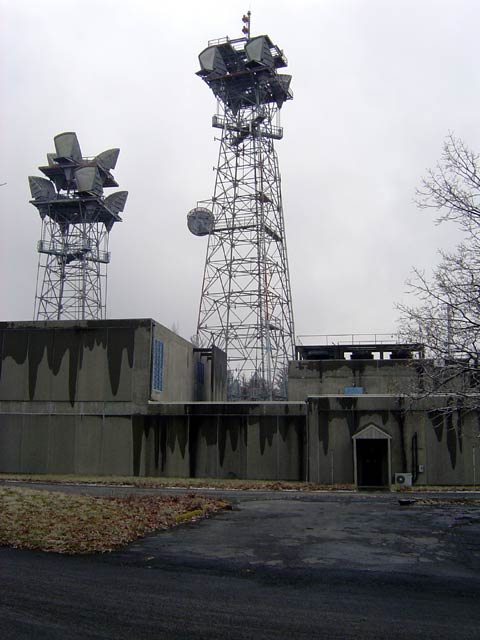
This is the former AT&T microwave relay site located near Kingston, NY. It is now owned by American Tower, Inc. There are two towers behind the building, only the tower on the right has a few active communications antennas on it. The taller tower is 190 feet tall and was built in 1957. The shorter tower is 120 feet tall and was built in 1961. Both towers and everything on them were made by Western Electric, the same company that manufactured the telephone sets. Chances are, Western Electric contracted the actual manufacture of equipment out to others, then billed AT&T, their parent company a markup. Something that would make all MBAs proud.
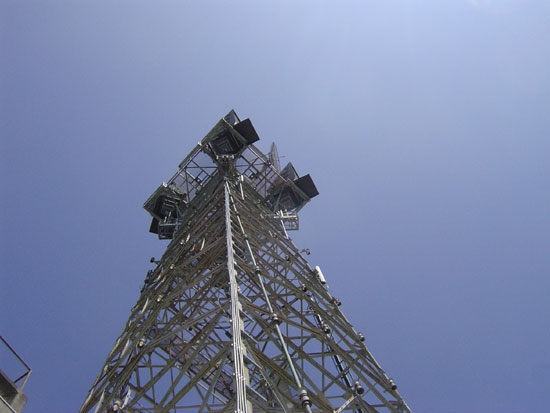
This tower was built in 1957. The structure and galvanizing are still in excellent condition.
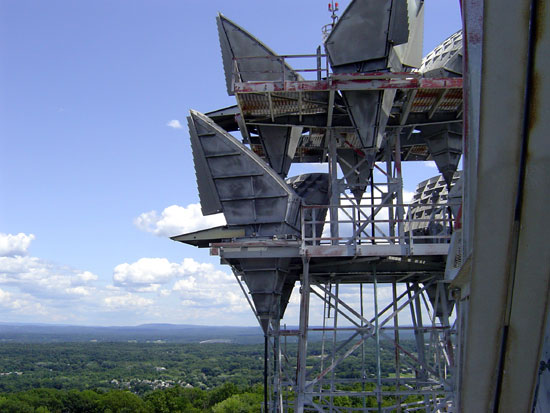
The large antennas you see on the towers are microwave horn antennas. They are no longer in use. Several transmitters and receivers would have been connected to each one of these antennas by use of RF multiplexers. Each microwave transmitter/receiver would have had several data channels. Generally, this was C Band microwave equipment, so it was in the 4, 6, and 8 GHz frequency range.
All of this telephone traffic was transmitted on digital data channels unencrypted. Many have argued that this allowed the government (most notably the NSA or National Security Agency) to intercept and listen to most domestic long-distance telephone calls within the US. There is a book called Puzzle palace by James Bamford if you are interested in NSA history. It was written more than 20 years ago, so it doesn’t really apply today, but it is an interesting look at what the government was up to.
The building itself is huge, the first floor is 16,000+ square feet and the second floor is 10,000+ square feet. Only about 1000 square feet of this space is actively being used.
I believe this building was built in the late 1940s or early 1950s, just as Kingston was growing into a major IBM manufacturing site. It has remnants of the ATT coaxial-based system that was used prior to microwaves. The IBM buildings are located a few miles to the southeast of this location, they are another cold war relic for discussion later. The IBM buildings were a major computer research and development site in the 1950s until it closed in 1992. It was assumed that the Soviets had several spy satellites trying to steal secrets from the area, and the IBM facility was a primary nuclear target.
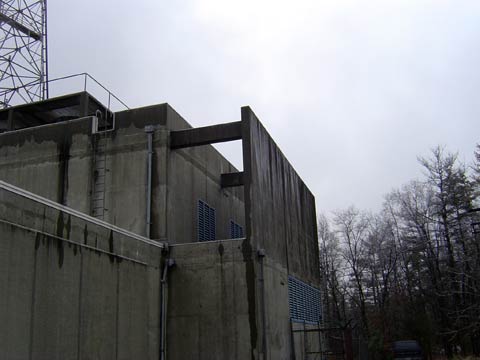
The microwave relay site has 12-inch re-enforced concrete walls. The ventilation air intakes have blast baffles to prevent a pressure wave (from a nuclear explosion) from blowing the ventilation equipment off of its mounts.
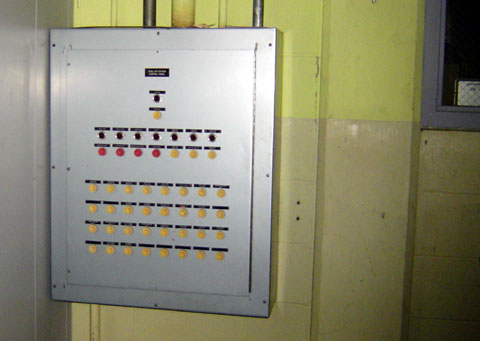
All of the outside openings were able to be sealed with steal blast deflectors using a pneumatic control panel located in the control room. There was a five-minute timer, presumably to allow the HVAC units to be secured before the doors were closed. They were heavy gauge steel shutters designed to deflect the pressure wave of a nuclear explosion. Since this is an earlier building, it is likely that it is built to a 2 PSI pressure wave spec. Newer buildings were built to 20 or even 50 PSI. This microwave relay site would not have withstood a direct hit from a nuclear warhead, especially the higher-yield warheads that came later on.
There is a bomb shelter in the basement. I found a couple of olive drab cans of civil defense water laying around. The lights were not working at the bottom of the stairs, so I chose not to go into the bomb shelter itself.
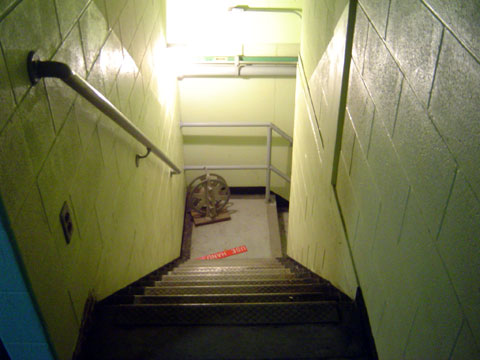
“Okay everybody, the missiles are on their way, so let’s head down these stairs and pray”
There were two diesel generators, one was 325 KW which could run the entire building. The other was a 200 KW which could run the critical building functions. The fuel storage consisted of two 10,000-gallon tanks buried in the ground outside. Each steel fuel tank had a cathodic protection circuit. Basically, a small negative electrical current was passed to the steel tank to keep it from rusting. Apparently, it worked because when the tanks were removed in 2000 after 45 years in the ground, the primer was still on the outside of the tank.
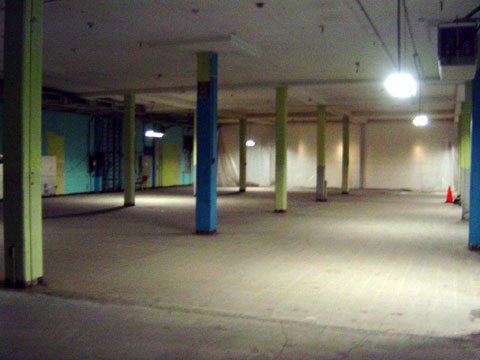
On the main floor, there were rows and rows of wire terminal equipment, microwave transmitters, receivers, and data and RF multiplexers in racks. The room in the above picture is about 10,000 square feet, there is another 6,000 square feet beyond the plastic heat barrier. This microwave gear received and transmitted data from Albany and Germantown to the north; Poughkeepsie, Putnam Valley, Ellenville, and Spring Valley to the south. All of that equipment is gone now, replaced by empty space.
There are about 500 copper wire pairs of telephone cables that came into various parts of the building to carry the DS-1 and DS-3 circuits that interfaced with the TELCO office in Kingston.
All in all, this was a serious building, no expense was spared in the construction and equipment outfitting. The entire building is shielded with copper mesh screens embedded in the concrete walls. There were redundant systems on top of redundant systems, something that you do not see these days, even in government buildings such as emergency operation centers (EOCs) and 911 call centers.

Recently, while looking at Google Route maps, I came across Rosendale, NY and the name jogged some distant memories from my days with AT&T Long Lines. In the mid-to late 60s I worked at the underground site at Chesterfield, MA (outside Northampton)
It was designed to withstand a 20 Mega-ton blast within 2 miles. We
served Westover AFB and radar sites from Montauk to Maine. We switched data through 1ESS to Control Ctr. at N. Syracuse, which plotted response to target and passed data back through us to interceptors. After a few years down in the “office” I had an opportunity to move to the “outside Cable Group”. The Rosendale Cable was one of the L3 coax that we maintained down to the CT/NY line (around Amenia).
We also maintained L4, which had repeaters every mile.
I left the office in ’73 and went to a Nuclear Power Plant. The office was decomissioned some years later after SAC Command left Westover. I still drive by abandoned road side cable marker poles
and wonder if a few people remember how important this was in
a bygone era.
I would like more information about the 20 Coax Cables because I was an inspector and splicer on the line from Boston to Chicago. We only worked to east of Medina, Ohio. Did all splicing in the Tully, New York under ground building. I was a testroom supervisor out of Deposit and Owego microwave systems.
When I was in the EE program at UMass/Amherst in the late 70s, I had the opportunity to tour the Chesterfield site when it was in operation. All the calls were being transmitted over coax at that point, the microwave tower on an adjacent hilltop was unused. We were told the AUTOVON switch was connected to Westover and Loring.
There was a nuclear blast detector on the front lawn.
Westover AFB was extensively hardened because of its role as a SAC airbase and home of the 99th ABW during the cold war.
I worked at Rosendale from 1964 through 1969, assigned to various positions, carrier, power, #5crossbar switching, a very different kind of switching customer made for the military, multi-level preemptive, SAC, NOVID , etc,
Rosendale was one of some 60 harden sites to ensure continuity for the US military and FTS .
An amazing situation, and as usual, with AT&T, Bell Labs, and Western Electric, the job was done, on time and within budget
Amazingly enough, in my later years with AT&T, I was the transmission engineer for undersea cable systems aboard the CS Long Lines, a very special and exciting project, I was indeed blessed with some amazing assignments from the job I loved best..
I recently read a book, ‘The Idea Factory’, how Bell Labs invented the 20th century, an amazing story of invention, scientific discovery and discovery, never witnessed, since or before. Truly a National jewel.
where is this building located outside of Kingston?
I worked L3, L4 and L5E in Los Angeles in the ’70s and ’80s, plus floors and floors of LMX-1, -2 and -3, every channel bank they ever made and four floors of 4 wire testboards…plus BN, N and ON carrier that ran everywhere. At the time, it was said that the LA Grand Complex was the largest carrier office in the US. It had a whole two floors of MW…TD-2 mostly, TD-3, TH-2, TJ and TN and some Collins. The nearest hardened site was Mojave 02, about 70 mile.s north, out on the desert, which had an AUTOVON 4E and was a hub that connected two others. All those underground buildings are largely empty now. The Grand Complex is an “internet condo” now, but still houses 3 4Es. The last MW shot out of LA went dark in 1993, the last L3 went cold in 1990, with the L4 and L5E going away a couple years later. When I worked in there 2000 people worked in that complex every day. Now? No one, except for building maintenance coming in and going out. My favorite job was trying to keep the L3s in good shape. I don’t know how many of those repeaters and regulators I serviced on the test bench, but it was in the thousands. Good times now gone.
Was that the original L-1 to L-3 conversion project?
Mojave02 was one of those AUTOVON #5A XBARs, but it was in a building on ground level! There wasn’t enough floor space left, so they put it up in this temporary building up top! I guess that the rationale was that the 4Es were coming (still in developement at the time), as floor space was already dedicated to it down below, and WECo would install and test, then traffic would be cut over. The 5A was removed and the building stood vacant for decades after that. The undergrounds in CA were a Pacific Tel & Tel project, and they weren’t all that much like the Long Lines versions. There was no Long Lines presence in CA by law, except for remote TV services in LA and some other special services, until 1981, when “normalization” happened, and PT&T’s entire Toll Division, including all the XBTs, 4As, 4Es, and long haul carriers went to Long Lines.
Is this the Bob Scarborough that worked at T-Pass?