In the putsch to revitalize AM, FCC Commissioner Ajit Pai advises that it would be best if we did not argue about solutions. Actually what was said was this:
On the other hand, if too many broadcasters allow the perfect to become the enemy of the good, our efforts could be doomed by infighting.
That is well and good, so long as the proposed solution does not make things worse. I would posit that worse is already the enemy of the good, so any proposal that would make things worse should be protested vigorously.
I have written quite a bit about AM, its relevance, and possible revitalization. There is no size fits all solution to the problems facing AM broadcasters. In the final equation, stations should be judged on their viability as a business and service to the community. Those that fail to measure up should turn in their licenses.
Update: And so it begins. The narrative is already being shaped, as Darryl Parks (original post has been removed) has found out. After posting in his blog a few comments on the FCC’s revitalization efforts, he was excoriated by several high-profile broadcasters calling his comments “Beyond not helpful.” For those not versed in double speaking, that means it is harmful. While Parks may not have gotten all the technical jargon exactly right, his points are valid and are in agreement with the widely accepted laws of physics. I know, I know, quoting science is dull and boring, something that conspiracy theorists are well practiced with.
I am wondering what is going on with the HD Radio rollout these days. Particularly the all-digital AM conversion scheme being bantered about so often last spring. Not much is being discussed publicly about that or the AM revitalization. I have found FCC Commissioner Clyburn’s remarks at this week’s NAB Confab interesting. HD Radio is paid lip service here:
There are hurdles: if broadcasters do not broadly embrace the HD technology and the multicasting and other enhancements that it makes possible, listeners will have few incentives to buy digital receivers. Likewise, if no consumers own digital receivers, then there is no reason to broadcast in digital. But I’m not worried. More than 15 million digital receivers have been sold so far, and that number will only rise. Thirty-three auto manufacturers include or plan to include digital receivers in their cars, and those receivers are standard equipment in over 80 models. This will dramatically increase the number of digital receivers in the coming years.
But in the solutions for AM broadcasters, HD Radio is not mentioned at all. What is put forward as a six (actually five) step plan to revitalize AM radio turns out to be some rearranging of the deck chairs and a little more. Cliff notes version for the FCC’s AM revitalization:
Open a one-time filing window for AM license holders to acquire an FM translator
Relaxing community coverage rules for AM licensing allows greater flexibility for transmitter siting
Eliminating the “Ratchet Rule” used in nighttime allocation studies for new facilities
Permitting more widespread use of MCDL technologies by eliminating STA requirements
Reducing minimum field strength requirements by twenty-five percent allowing the use of shorter towers
While those options may save an AM license holder some money, none of them do anything to improve the technical quality of AM broadcasting. Several of them (#2, 4, and 5) will, in fact, if widely implemented, reduce signal levels over cities of license, making electrical noise and interference problems more prevalent. This is a step in the wrong direction.
These points are basically a rehash of some of the MMTC’s (Minority Media Telecommunication Council) ideas for a radio rescue first bantered about in 2009.
This demonstrates that the NAB and the FCC are not at all serious about revitalizing the AM band but merely marking time and making it look good until the final transmitter is switched off.
AM licensees are on their own, but all is not lost. I have noticed several successful stand-alone AM stations that are not only surviving but thriving. The common thread in this station is good local programming. On the technical side of things; a well-maintained plant with good quality audio feeding a properly operating transmitter and antenna array will go a long way to providing good service to the city of license.
Alternative title: Who will really benefit from all digital AM HD Radio™?
Remember when, at license renewal time, radio and TV stations played this announcement:
On (date of the last renewal grant), (station’s call letters) was granted a license by the Federal Communications Commission to serve the public interest as a public trustee until (license expiration date)…
Emphasis mine.
There seems to be a disassociation between those words and the actions of certain broadcasters who view their licenses as a matter of fact and have little regard for the public interest. The FCC exacerbates the situation with the attitude that everything, including the entire radio frequency spectrum, is for sale to the highest bidder. John Anderson (DIY Media) has a great article on how big business interests game federal regulators into doing what they want. This happens in all sectors; banking, agriculture, energy, health care, media, military and so on. There are many examples of shoddy regulators and big business gone wild over the last ten years to fully prove this theory. If you don’t believe me, do a little research. There is no reason to think that the FCC is different from any other federal regulatory agency.
The vast majority of mass media outlets in the US are owned by just six major corporations (see below). Radio remains the only piece of the mass media system that has not been completely rolled up in consolidation. Currently, there is a small number corporate radio owners who own a combined ~2,300 stations and one public broadcasting network that accounts for another ~900 stations. I include public radio here because the majority of those station’s upgrades were footed by the taxpayer though grants from the Corporation for Public Broadcasting. That leaves a majority of the approximately 8,500 radio stations that are still owned by a diversified collection of medium and small groups and individuals.
Forcing radio stations to adopt the proprietary, all digital HD Radio™ as the broadcasting standard would, in effect, drive many of those small owners and individuals out of business because of the exorbitant costs for equipment upgrades, antenna modifications, and licensing fees. This would create a new wave of consolidation as smaller groups and single station owners sold out. Any remaining small station owners will not have the legal wherewithal to fight against the coming waves of digital interference on both the AM (medium frequency) and FM (VHF) bands.
Therefore, the short answer to the question; who benefits from an all conversion to all digital HD Radio™ is iBquity and its investors, many of whom are found in the list of consolidated media corporations below. Who looses? Just about everyone else; small and medium group owners, independent radio owners, listeners, communities of license, radio employees, advertisers etc. For those sitting on the fence, thinking “I’ll just do my job any everything will be just fine.” Full implementation of HD Radio™ will destroy what is left of broadcasting in this country. Radio is already on shaky ground as a result of product dilution, staff cuts, mediocre programing and competing media systems. One more step backward, such as adopting a technically flawed digital system that works worse than its analog counterpart, and the remaining listeners may just say “screw this,” and abandon radio altogether. When the last radio station is turned off, what do you think will happen to your job then?
At the big NAB Las Vegas confab, FCC commissioner Ajit Pai and to a lesser extent, Commissioner Rosenworcel, encouraged people to write or email them with their ideas on how to revitalize AM radio. I suggest we take advantage of that invitation and tell them what HD Radio™ really is. There is a shrinking window of opportunity to join the discourse and be heard, now is the time.
Let not any one pacify his conscience by the delusion that he can do no harm if he takes no part, and forms no opinion. Bad men need nothing more to compass their ends, than that good men should look on and do nothing. ~John Stuart Mill
What is at stake? The future of diversified media and radio broadcasting in the US.
Sidebar: Mass Media Consolidation
Can the public trust a mass media that is owned mostly by six mega corporations to honestly and without bias report news, current events, investigate corruption, and be a government watch dog? History says no.
Who owns the media?
Time Warner
Home Box Office (HBO)
Time Inc.
Turner Broadcasting System, Inc.
Warner Bros. Entertainment Inc.
CW Network (partial ownership)
TMZ
New Line Cinema
Time Warner Cable (spun off in 2009)
Cinemax
Cartoon Network
TBS
TNT
CNN
HLN
MapQuest
Moviefone
Castle Rock
Sports Illustrated
Fortune
Marie Claire
People Magazine
Walt Disney
ABC Television Network (8 stations owned, 200 affiliates)
Disney Publishing
ESPN Inc.
Disney Channel
Radio Disney (31 stations, 2 affiliates)
SOAPnet
A&E
Lifetime
Buena Vista Home Entertainment
Buena Vista Theatrical Productions
Buena Vista Records
Disney Records
Hollywood Records
Miramax Films
Touchstone Pictures
Walt Disney Pictures
Pixar Animation Studios
Buena Vista Games
Hyperion Books
Viacom
Paramount Pictures
Paramount Home Entertainment
Black Entertainment Television (BET)
Comedy Central
Country Music Television (CMT)
Logo
MTV
MTV Canada
MTV2
Nick Magazine
Nick at Nite
Nick Jr.
Nickelodeon
Noggin
Spike TV
The Movie Channel
TV Land
VH1
News Corporation
Dow Jones & Company, Inc.
Fox Television Stations (25 stations)
The New York Post
Fox Searchlight Pictures
Beliefnet
Fox Business Network
Fox Kids Europe
Fox News Channel
Fox News Radio
Fox Sports Net
Fox Television Network (175 affiliates)
FX
My Network TV
MySpace
News Limited News
Phoenix InfoNews Channel
Phoenix Movies Channel
Sky PerfecTV
Speed Channel
STAR TV India
STAR TV Taiwan
STAR World
Times Higher Education Supplement Magazine
Times Literary Supplement Magazine
Times of London
20th Century Fox Home Entertainment
20th Century Fox International
20th Century Fox Studios
20th Century Fox Television
BSkyB
DIRECTV
The Wall Street Journal
Fox Broadcasting Company
Fox Interactive Media
FOXTEL
HarperCollins Publishers
The National Geographic Channel
National Rugby League
News Interactive
News Outdoor
Radio Veronica
ReganBooks
Sky Italia
Sky Radio Denmark
Sky Radio Germany
Sky Radio Netherlands
STAR
Zondervan
CBS Corporation
CBS News
CBS Sports
CBS Television Network (16 stations owned, 200 affiliates)
CNET
Showtime
TV.com
CBS Radio Inc. (130 stations)
CBS Consumer Products
CBS Outdoor
CW Network (50% ownership)
Simon & Schuster (Pocket Books, Scribner)
NBC Universal
Bravo
CNBC
NBC News
MSNBC
NBC Sports
NBC Television Network (10 stations owned, 200 affiliates)
Profile of a successful AM radio station, March 2013: WSBS, Great Barrington, Massachusetts
Great Barrington is either a large village or a medium-sized town with a population of approximately 7,100. There are many listenable FM and AM radio stations from Albany, NY, Pittsfield, Springfield, and Poughkeepsie, NY markets. There are also a few local stations; WBCR-LP, WMAQ (WAMC repeater), and W254AU (WFCR repeater). While the competition is not fierce, citizens have a variety of stations to choose from.
WSBS is a class D AM station on 860 KHz with 2,700 watts daytime power, 250 watts critical hours, and 3.9 watts night time power.
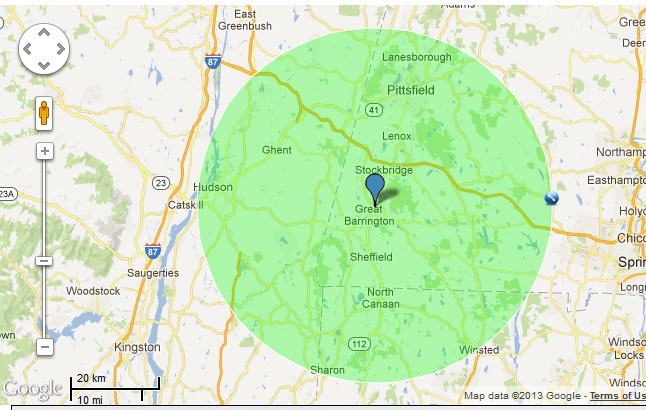
WSBS AM 860 KHz approximate daytime coverage area
This is the approximate daytime coverage area for WSBS AM. I could not find any good coverage maps online, so I made this one myself. When I am driving, I get the station reliably to Kingston, NY, however, indoor listening may be a different matter. With 3.9 watts ERP, nighttime coverage does not include much of the city of license.
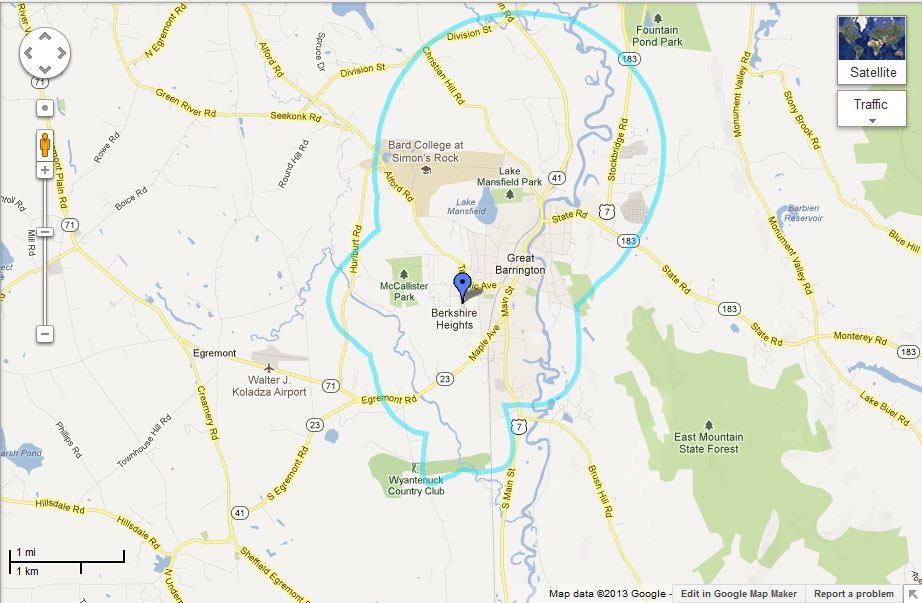
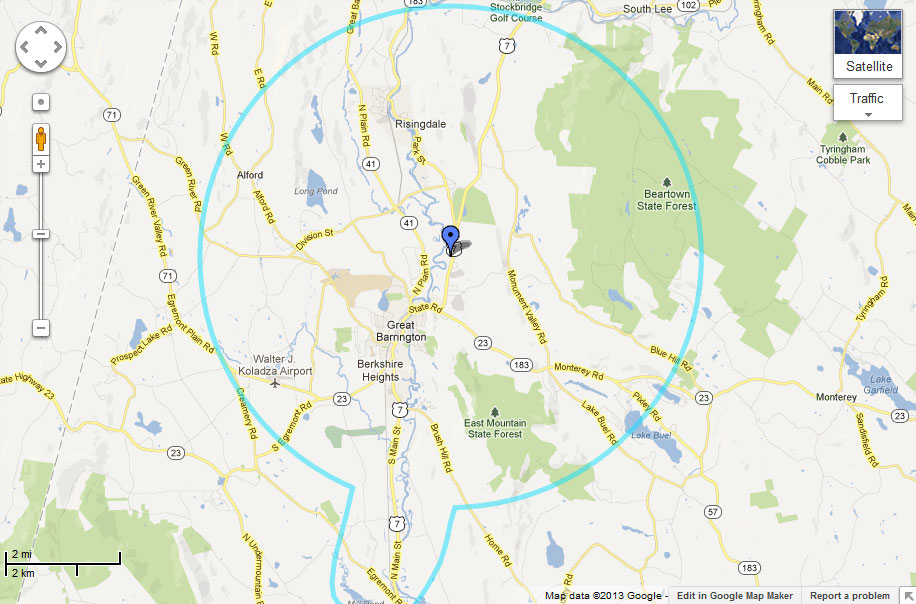
They have a translator on 94.1 MHz, W231AK. This is an example of when an FM translator on an AM station is a benefit to the community of license. W231AK has recently been moved from the top of the roof of the Fairview Hospital to the WSBS AM tower. During this move, the ERP was increased from 35 watts to 250 watts and the highly directional antenna was replaced in favor of a 2-bay half wave spaced circularly polarized Shively 6812.
W231AK old service contourW231AK new service contour
Not only did the move increase the translator’s coverage area, it also reduced operating expenses for the radio station, as they no longer have to pay rent or TELCO charges.
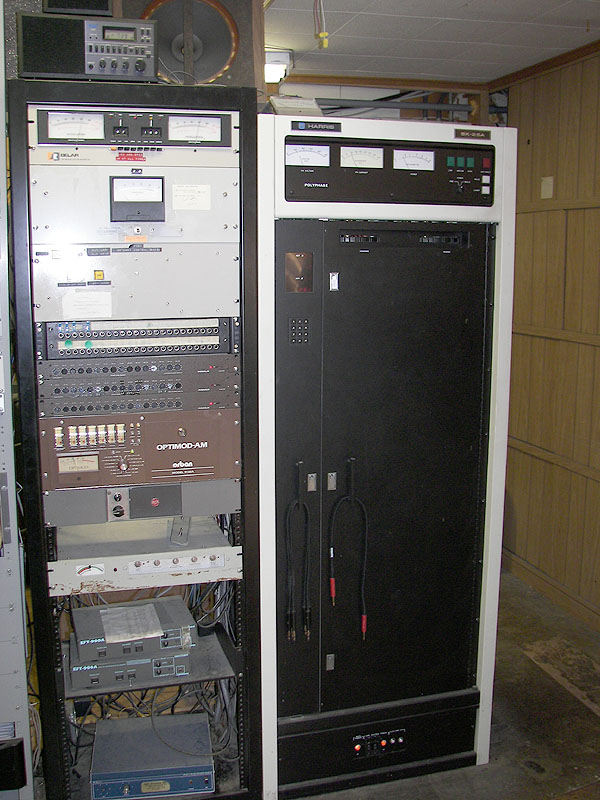
WSBS 860 KHz Harris SX2.5 transmitter, courtesy of NECRAT
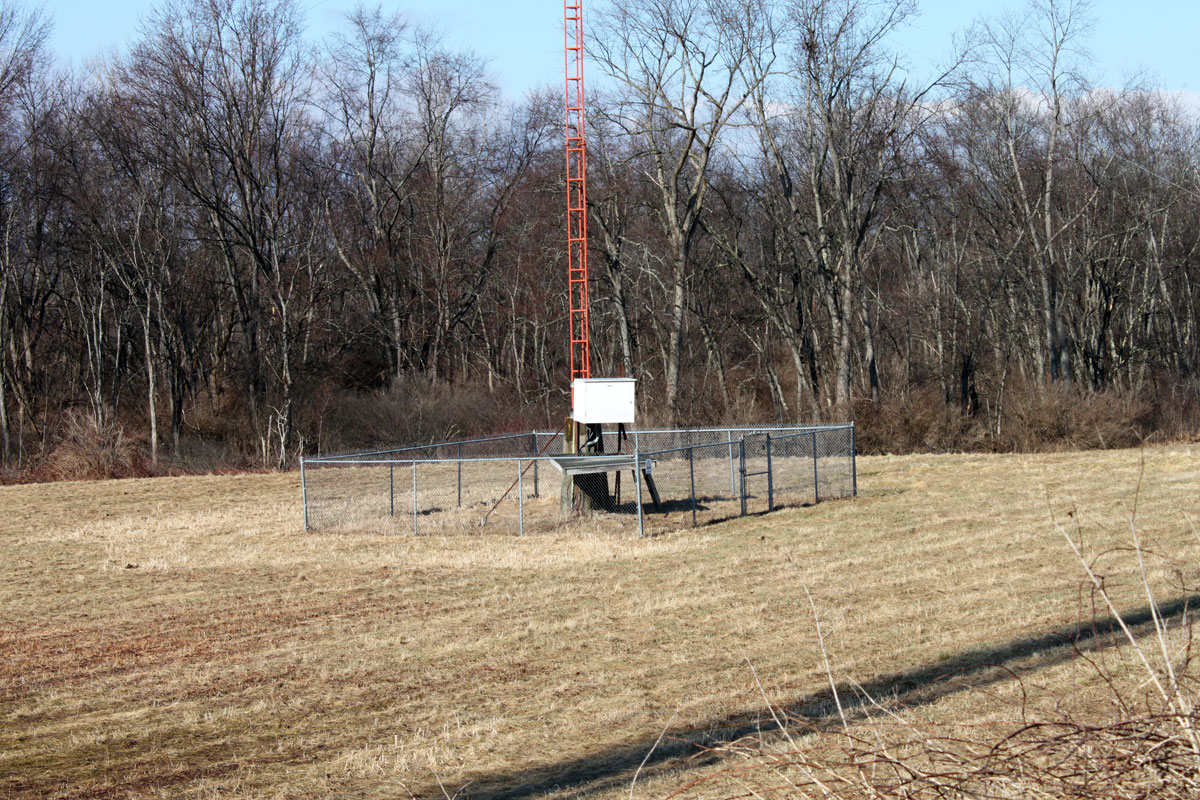
The main transmitter for the AM station is a Harris SX2.5 . It transmits from a 79-degree tower, the tower and antenna field are well-maintained.
WSBS 860 KHz, Great Barrington, MA tower base and ATU
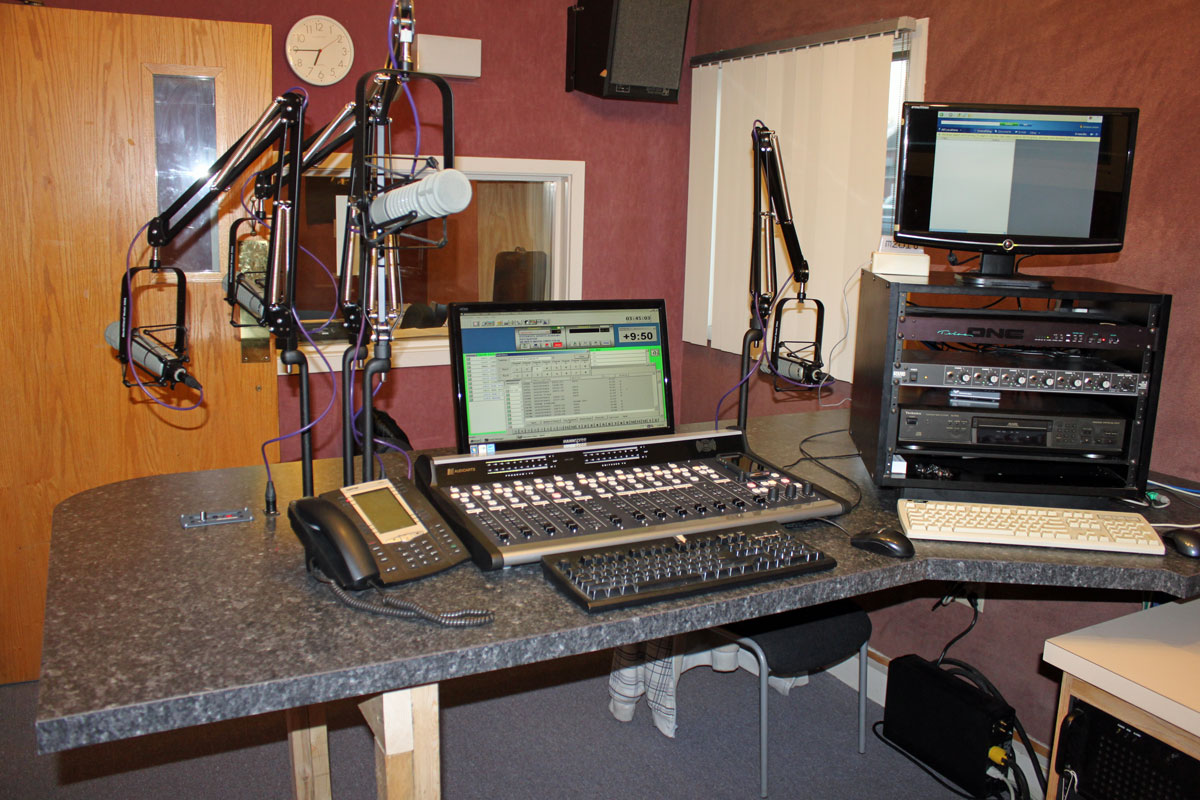
The studio has a new Audioarts Air4 console, which we just finished installing last December.
The station has an AC music format, which is quite popular. As the FM translator’s coverage has been quite limited until recently and there have been issues with the telephone company circuit taking the translator off the air, the majority of listeners are tuned to the AM signal. There is a live morning show and afternoon show, the rest of the day is voice tracked with music on hard drive. They have frequent contests and give aways. They also do local sports, community events, news and things like live election night coverage. In short, the station serves its community and, as demonstrated by a recent Chamber Business event at the station’s studio, the community appreciates its radio station.
There is nothing magic here; no gimmicks, IBOC, or another technical wizardry. This facility is at best, technically average, albeit well maintained. There is an older Orban Optimod processor, an older AM transmitter, and the original, electrically short tower. The station also has a working emergency generator. The only new tech is the web stream, which all radio stations should have.
The station is successful because of its programming, period. People love local radio. Making connections with listeners imparts a shared sense of community. Being on the air with a local presence during storms, even when the power is out, is a big deal. When it comes to relevance within the community and local businesses; in 2013 all radio stations need to earn that.
Conclusion:
I do not suffer from technophobia; when digital radio was first proposed, I welcomed the idea. It was not until I began looking at the technical proposals and iBiquity’s proprietary system that I became concerned. After hearing the initial implementation of AM HD radio on WOR in NYC, I was not impressed with either it’s audio quality or the side band interference that the analog/digital hybrid AM HD system created. What is of even greater concern is the propensity for government regulatory agencies to rubber stamp technical proposals by lobbying associations without testing or even fact checking.
Digital modulation methods at medium frequencies present a unique challenge where the ratio of the signal bandwidth to available frequency spectrum becomes too great to be practical. This is exacerbated at the lower end of the band where side band symmetry is difficult to achieve at ±15 KHz required by the all digital and the analog/digital hybrid version of AM HD radio.
Clearly, AM radio needs a technical revamping. Can it be saved? Yes. Is it worth saving? Yes. Is a yet unproven proprietary digital modulation scheme the way to do it? No.