Marconi would be impressed

I finished up another GatesAir FLX-10 install recently. This one was way out in Provincetown, MA at the end of Cape Cod for WOMR (Outer Most Reaches). That is a community radio station that has an eclectic mix of programs. The studios are on the second floor of an old church.

Main studio, Wheatstone Console
Talk Studio, up/down studio furniture

The transmitter site is located about a mile away from the studios.

WOMR antenna

A few details on the installation; the antenna is mounted on the water tank, which is the tallest thing around for many miles.

WOMR antenna, Shively 2 bay 6810 mounted on a water tank


The building is less than 120 square feet, which made working a little tight.

WOMR transmitter building, Provincetown, MA
GatesAir FLX-10 transmitter placed
Pump Station


There was very little room outside for the heat exchanger because of the need to get vehicles around the water tank for maintenance. The area around the building was taken up with a generator and HVAC gear. We ended up mounting it to the side of the building horizontally. The main reason was that the wind at this location could come from any direction. If mounted vertically, there was a chance that the wind could blow into the heat exchanger against the fans, possibly causing some overheating problems. Also, the horizontally mounted unit will have a smaller surface area during Hurricanes and Nor’easters.

Heat Exchanger, mounted horizontally on the northeast-facing wall


To do this, I made a unistrut frame and attached it to the outside wall.

The liquid-cooled transmitter takes up much less floor space than the prior transmitter, a Nautel V-10. This installation also included activating an HD Radio signal for this station.

The GatesAir FMXi4G importer/exporter resides at the transmitter site. Currently, the station has HD-1 on the air, no word on any future sub-channels.

Looking North towards the Atlantic Ocean

We had nice weather on one of the days. On the last day (Friday) it was raining with 35 MPH wind guests.

Speaking of Marconi, the US’s first trans-Atlantic wireless transmission station is a few miles down the road in South Wellfleet. Nothing is left of the site; time and erosion have taken all traces away.

Postcard, South Wellfleet Marconi Station
Bronze plaque placed in 1953 by the Wellfleet Historical Society

Here we are standing on the location of the transmitting building. The last two tower bases tumbled over the cliff edge in 2011.

It’s always an enjoyable time installing a liquid-cooled transmitter!

Fordham University WFUV

Over the last several months, I have been helping out in a small way with WFUV’s new transmitter installation. George Evans, CE for WFUV, and Bill Weeks of Wolftron Electronics did most of the work. This project’s location is unique; the transmitter is in an equipment shelter on top of the Montefiore Medical Center in the Bronx. That complicated the removal of the old transmitters and installation of the new transmitters.

WFUV tower atop the Montefiore Medical Center

This is the top of the Montefiore Medical Center in the Bronx. The building has 28 floors. To access the transmitter, one needs to go up another flight of stairs to the roof. Go outside onto the roof and take two more flights of stairs to the transmitter shelter just below the tower. Those stairs can be seen as a thin wispy thing on the left of the elevator building.

WFUV tower, close up

At the top of the tower, the two-bay Shively antenna is for WVBN 103.9 Mhz. WFUV 90.7 MHz is the six-bay Shively just below that.

BE FMi 703 (FM-10S)

These are the transmitters being replaced. There are two of them running combined for a TPO of 14.2 KW (including the -14 dBc HD subcarriers). They are about 20 years old.

The before picture; combined BE FMi 703 transmitters

As you can see, there is little room to work in this space. The old transmitters needed to be removed from the room, hosted down two stories to the main rooftop, wheeled around to the door, and then lowered another flight of stairs to the 28th to the elevator.

It makes me tired just thinking about it.

BE FMi 703 (less RF modules and power supplies) being lowered to the rooftop level

Out with the old, in with the new.

GatesAir FAX15K being hoisted from the roof up to the transmitter shelter

The GatesAir FAX15Ks made the trip up safely. Able Rigging from New Jersey did all of the moving into and out of the shelter. The two transmitter chassis, all of the boxes containing the exciters, RF modules, power supplies plus a 25 KW dummy load, and the cut-up for scrap Myat variable T antenna combiner were removed in one go.

The after picture; GatesAir FAX15K transmitters, two cabinet version

The FAX15K’s are in the shorter cabinets (requires two) because the taller cabinet would not fit in the elevator.

FAX15K with back doors removed, power block, combiner, directional coupler, and RF output flange.
3-inch coax switch and RF plumbing

The output of each transmitter goes to a 3-inch coax switch. The bottom port of the switch goes to the Shively filter (thence to the antenna), and the top port goes to the 20 KW dummy load.

3-inch coax switch
Bill Weeks routing control wiring to coax switch
WFUV CE George Evans, heading to the job site
“How many more times do I have to climb these stairs today?”
But the view is great! Mid and upper Manhattan in the distance
Your author is about to tell a sea story…

I enjoyed working on this project.

How long should a transmitter last?

This Broadcast Electronics FM3.5A is 40 years old. There was a small problem that took the station off the air for a couple of hours this morning. The high voltage shorting solenoid fell apart, causing the 40 amp breaker in the service panel to trip.

BE FM3.5A defective shorting solenoid

These types of failures will become more frequent as the transmitter ages. Things like air switches, blower motors, tuning and loading mechanical assemblies, circuit breaker fatigue, plate rectifiers, screen and plate bypass capacitors, exciter and controller fans, etc. The list of potential failure points can get quite long. The fact is, nothing lasts forever.

Manufacturers nameplate

There is no backup transmitter for this site and there is no easy way to get a temporary unit on line, if needed. This is not the oldest main transmitter that we service with no backup. That honor goes to a CCA DS-3000 built in 1970.

The question is; how long should old tube transmitters be kept in service? Also; how long should we (an independent service company) agree to maintain them? The temporary solution for the above failure was to remove the broken shorting bar and turn the transmitter back on.

Broken shorting bar removed

That creates a safety issue for anyone who may need to work on the transmitter before the replacement arrives. It also creates a potential liability issue for my company.

I put a big label on the back door indicating that anyone doing service needs to discharge the power supply capacitor with the grounding stick (which they should be doing anyway). But I will feel better when the shorting solenoid is working again.

Measuring FM Harmonics

Anytime a new transmitter is installed or major changes to an FM transmission system are implemented, the performance measurements described in FCC 73.317 should be completed to ensure no interference to other radio services. This is becoming a larger issue with the advent of LTE and 5G mobile data. These services along with E911 and other mobile services are often co-located at FM transmitter sites.

The FCC stipulates that emissions removed from the carrier by more than 600 KHz must be attenuated 80 dB below the carrier. These days, that is not enough. We have had issues with older tube-type transmitters interfering with cellular and mobile data service, even though they met or were far below the FCC specification. The first in, first out rule also didn’t seem to matter either. Those mobile phone providers paid a lot of money when they purchased chunks of RF spectrum at auction, and the FCC will side with them if there is any dispute.

Having a record of measurements that show compliance with the FCC regulations can go a long way in heading off any future problems. I make measurements out to the 10th harmonic.

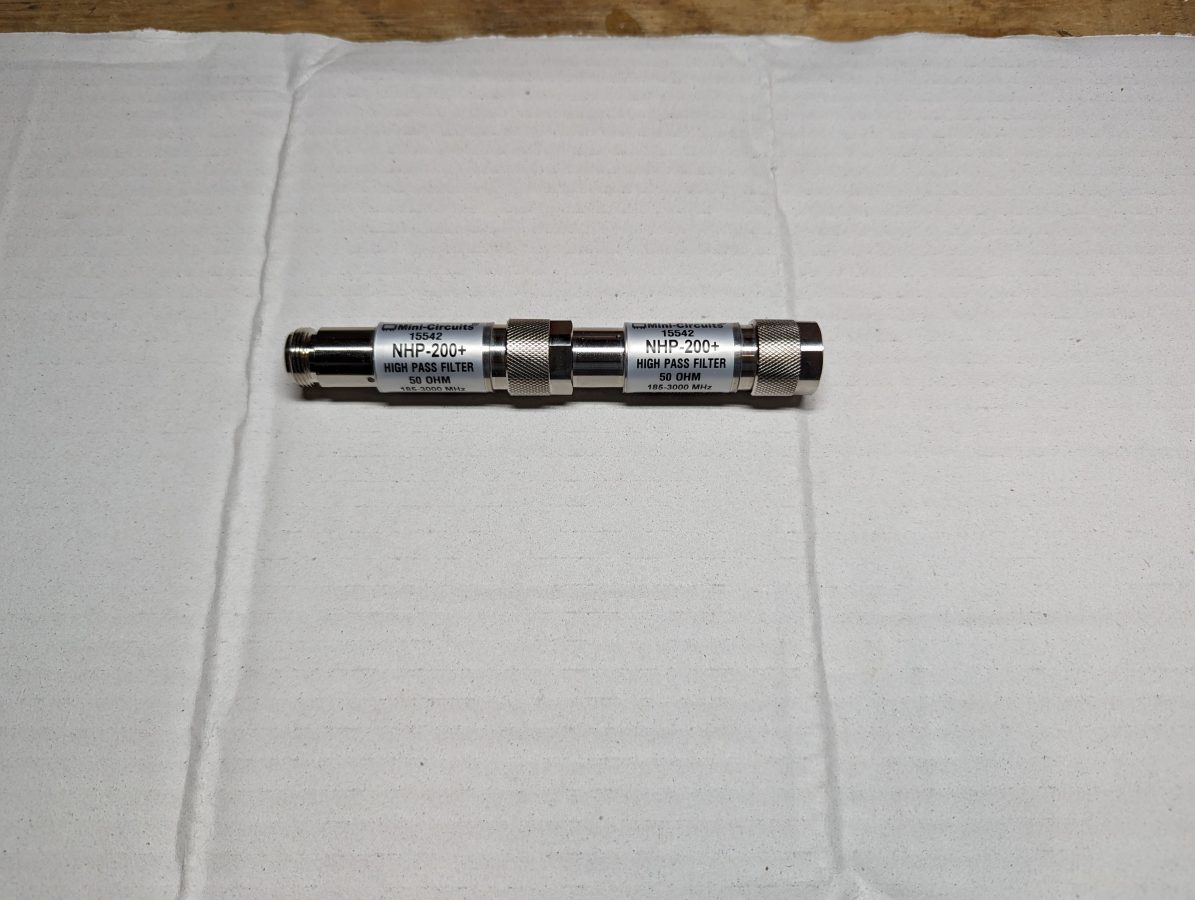
To get the best results, I have been using a couple of high-pass filters from Mini-circuits.

Mini-Circuits NHP-200+

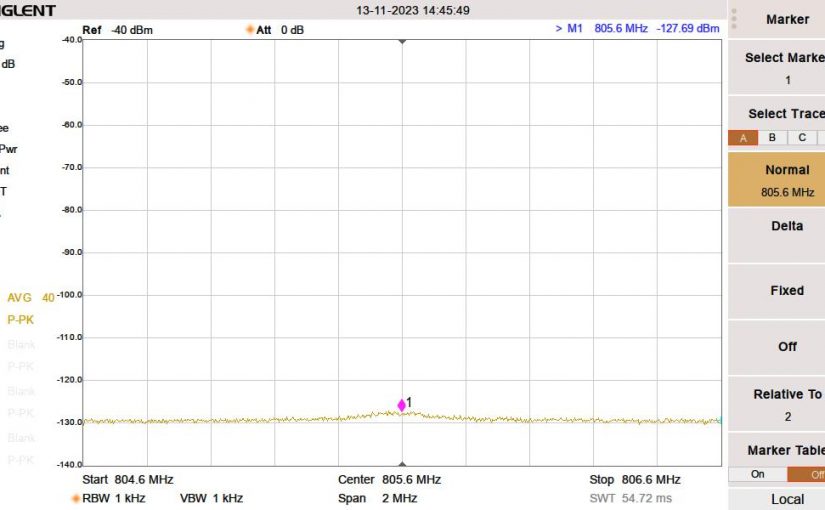
These attenuate the carrier power seen by the spectrum analyzer by approximately 90 dB depending on the frequency. That allows the instrument noise floor to be lowered to -130 dB which should be well below any receiver noise floor being used by other wireless services.

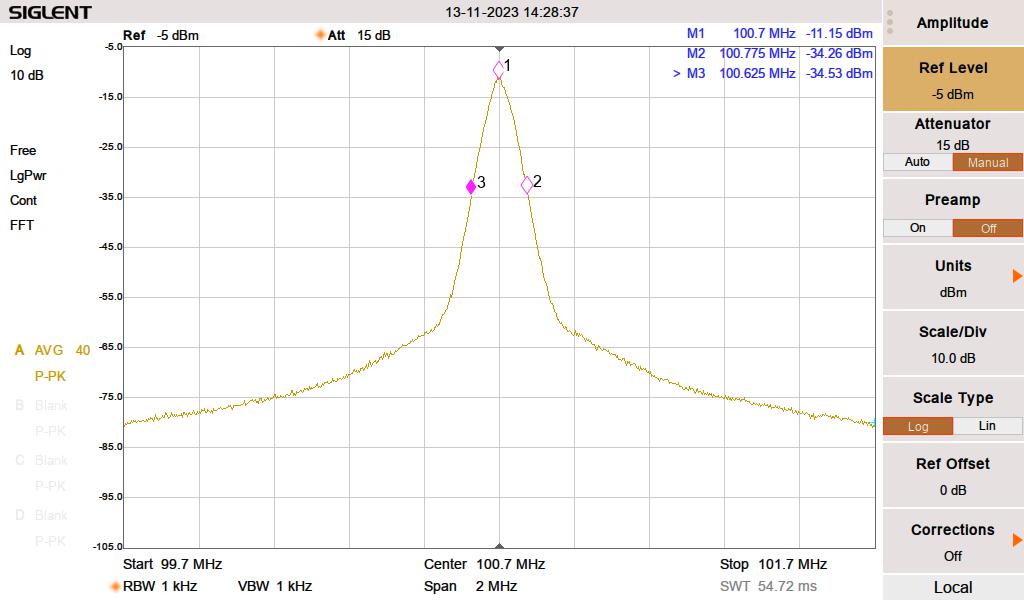
100.7 MHz no HPF
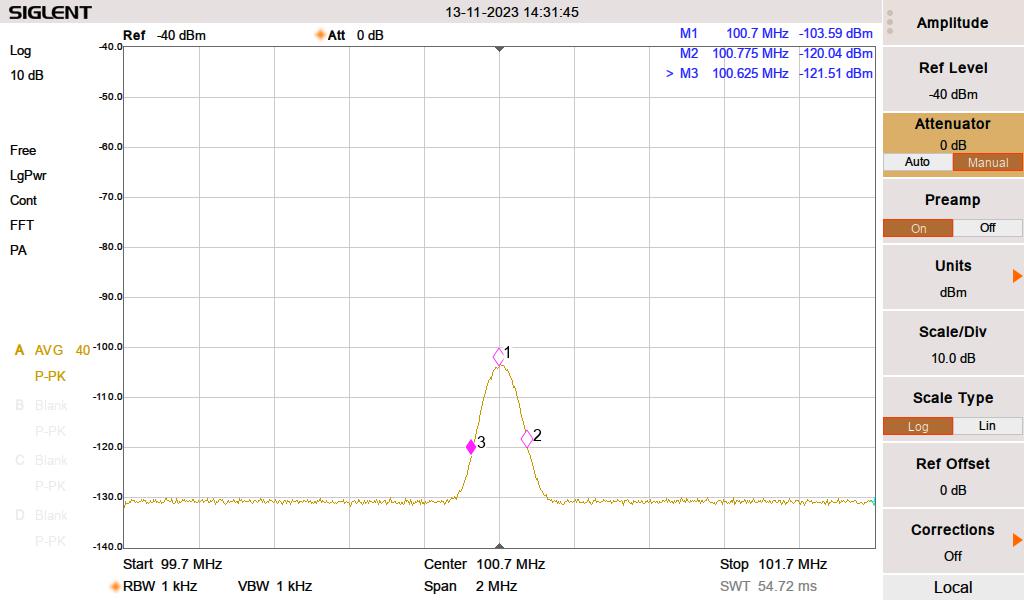
100.7 with two HPF-200+ High Pass Filters

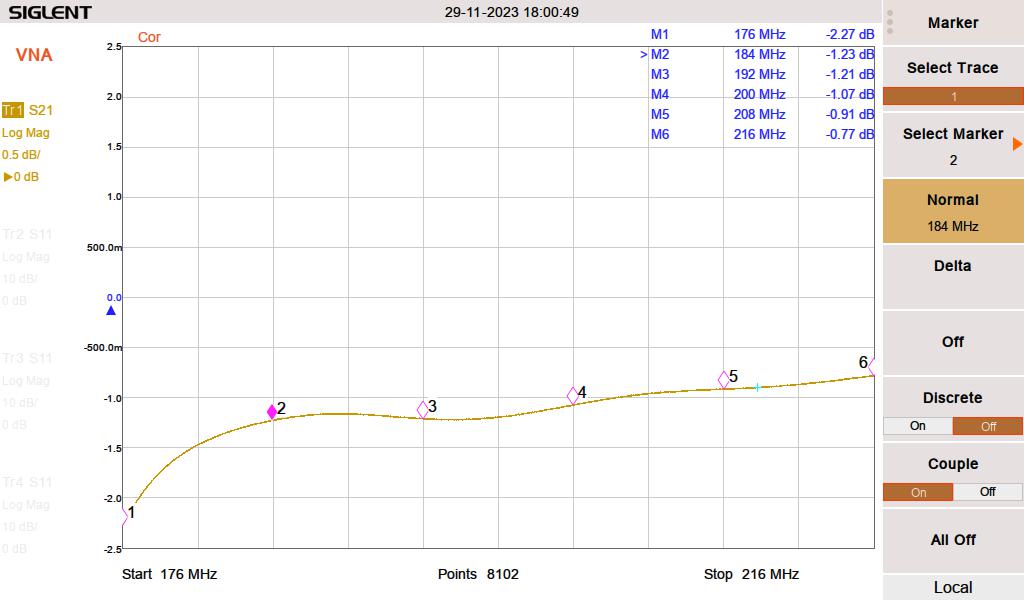
The carrier is attenuated by 92.44 dB. The rest of the measurements are made with the attenuation set to zero and the preamp turned on. For the lowest FM frequency, 88.1 MHz, the filters are on the edge of their shoulder at the 2nd harmonic. I measured the return loss and found that they matched the manufacturer’s datasheet.

Mini-circuits HPF-200+ X 2, 176 – 216 MHz S21 Return loss

That loss is counted as attenuation for the second harmonic. For the rest of the harmonics, I used 0.5 dB attenuation, which represents connector loss. I could have also measured the cable loss at each harmonic, but that seems unnecessary, given several of the readings were below the noise floor.

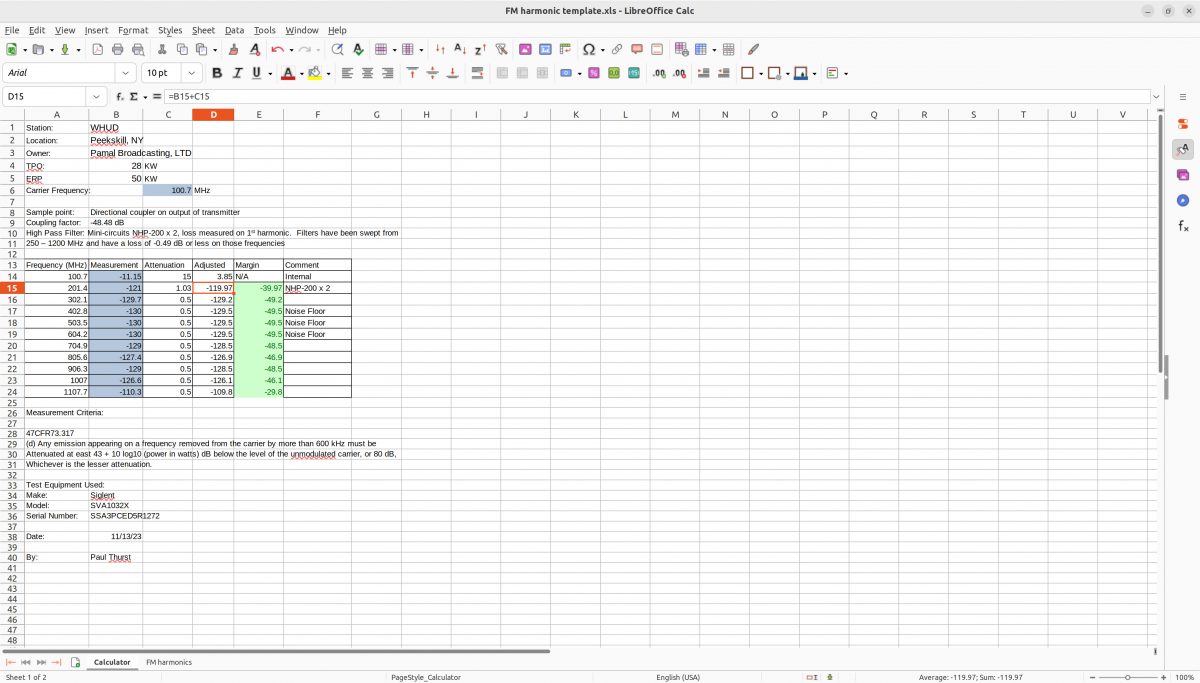
To speed things along, I made this handy Excel spreadsheet, which does all of the calculations for me:

FM harmonics spreadsheet

A copy of that spreadsheet can be downloaded: FM Harmonic template

Once completed, I printed a copy and put it with the station maintenance log at the transmitter site.