Tube transmitters vs Solid State transmitters

I thought it would be interesting to do a comparison between the two types of transmitters, both AM and FM.  I have been doing this thing for 25 years and have quite a bit of experience working on all types of transmitters.  Some of the broadcast transmitters I have personally worked on over the years include:

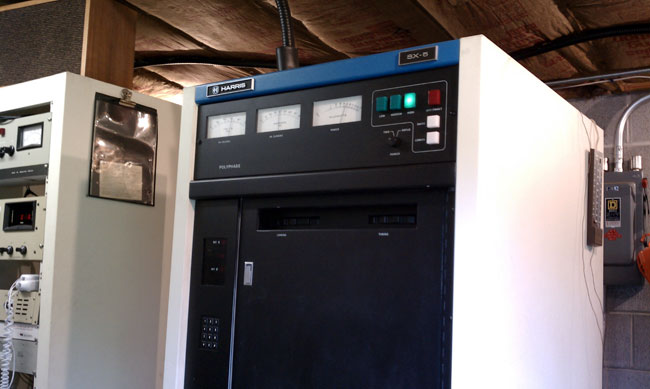
  • Harris: FM-20H, FM-5G, HT-35, HT-10, HT-3.5, FM-25K, FM-5K, Z5-CD, MW-50A, MW-50B, MW-1A, MW-5A, BC-5H, SX-5, SX-1A, Gates 1
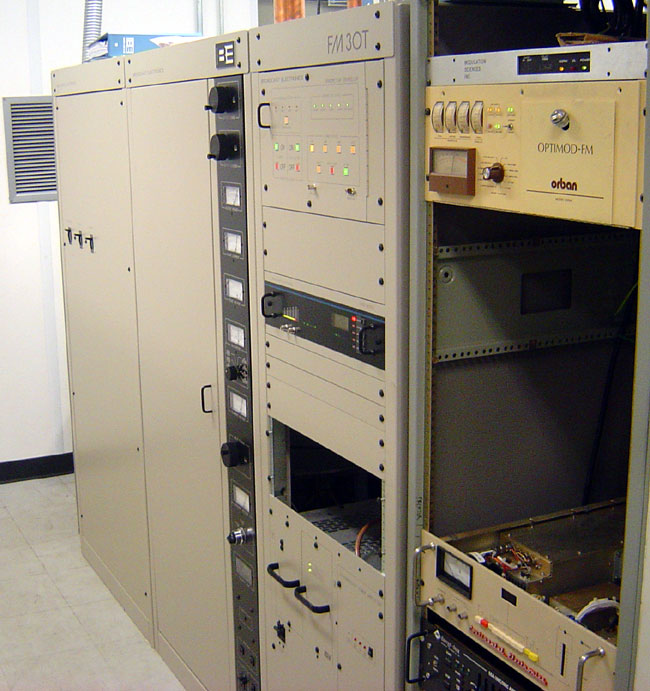
  • Broadcast Electronics: FM-5B, FM 3.5A, FM5A, FM30A, FM35A, FM30T, FM20T, FM10S, FM5C, FM1C, AM10A, AM6A, AM5E, AM1A
  • Continental Electronics: 816R-2, 814R-1
  • Collins Rockwell: 831F-1, 838E-1
  • Nautel: ND-1, ND-5, XL-60, V-40, V-10, V-7.5, NV-40
  • Gates: BC5P, BC1T, FM5B
  • General Electric: BTA-25
  • RCA: FM20ES1, BTA5J, BTA1-AR
  • CSI/CCA, Visual, Energy Onix, Bauer, McMartin, QEI, some Italian something or other, etc.  Various makes and models.

I think I have a fair amount of transmitter experience under my belt.  What I have found is that certain brands of transmitters are better than others, regardless of whether they are tube or solid-state.  There are several differences in each type, obviously.  As to some blanket statement about which is better, solid state or tube, I don’t have one.  My statement would be “It depends.”

Tube transmitters are more rugged and will take more abuse than a solid-state unit. Things like heat, lightning, EMP, and mismatched antenna won’t phase a well-designed, well-manufactured tube transmitter.  On the other hand, they are less efficient AC to RF, have higher B+ voltages, have hard failure modes, and are more difficult to linearize, if that is required for some reason.

Solid state transmitters are more broad-banded, easier to change frequency, they have soft failure mode due to redundant amplifiers and power supplies. The voltages are lower, thus they are safer to work on.

Here is a complete list of advantages and disadvantages of each type:

AttributeTubeSolid StateComment
RuggednessVery rugged, able to take heat, EMP, lightning, mistuned antenna, poor operating environment, etcNot heat tolerant, lightning and EMP can damage MOSFETS, switching power supplies sensitive to AC mains issuesAdvantage: Tube
Electrical EfficiencyLess efficientMore efficientAdvantage: Solid State, however efficiency gain can be wiped out due to larger air conditioning requirement
Failure modeHard, most oftenSoft, most oftenAdvantage: Solid State, failure of a single module or power supply generally will not take unit off the air
Frequency agilityDifficultEasyAdvantage: FM Solid state transmitters can easily be moved.  AM transmitters still require extensive retuning.
Re-occurring costMoreLessAdvantage: Solid State, as tube changes are required every two to three years
MaintenanceSameSameAdvantage: neither
ServicingRequires skilled engineers to service and trouble shootModules and power supplies are often hot swappable and returned to manufacture for repairAdvantage: Solid State, however either type requires occasional measurements with specialized test equipment
Servicing safetyHigh voltages, contact will be fatalLower voltages, but can still be fatalAdvantage: Solid State
RedundancyLowHighAdvantage: Dependant on TPO, Higher powered solid-state transmitters are much more expensive than there tube type counterparts
CostLessMoreAdvantage: Dependant on TPO, Higher powered solid state transmitters are much more expensive than there tube type counterparts
AvailabilityGood used market, some new FM transmitters still being builtGood new and usedAdvantage: Tube
 Reliability Dependent on brand Dependent on brand Advantage: neither

For some reason, the latest Broadcast Electronics tube-type transmitters seem to have very long tube life.  I installed an FM20T at WYJB in Albany, New York,  in early 2001 and it is still on the original tube, some ten years later.  The same can be said for the 2005 FM20T and FM30T installation at WHHZ/WKZY, Gainesville, Florida.   Those tubes show no sign of giving up anytime soon.  I don’t know if that is an unusual trait of the transmitter or that particular tube.

WKZY, Gainesville, Florida

The above comparison seems to heavily favor a solid state transmitter.  As a general rule, brand new solid state transmitters both AM and FM have advantages in almost every category except high power FM transmitters, where tube types still make sense.  From a used transmitter standpoint, there is nothing wrong with a tube type transmitter, provided it has a solid state IPA.  I have noticed the 4CX250B driver tubes most often used in FM IPA stages have markedly reduced reliability of late.  I would also tend away from transmitter makes and models where the manufacture is no longer in business or no longer supports the product.

Transmitter trips main breaker

Received a call last night, after a particularly bad thunderstorm, that WGHQ in Kingston, NY was off the air.  Earlier in the day, the transmitter had tripped the main breaker after a thunderstorm.  I arrived at the transmitter site and found the breaker tripped again.  Once the breaker was reset, the transmitter came back on and ran without any overload indications.  The transmitter is a 10-year-old Nautel ND-5.

WGHQ Nautel ND-5 transmitter

I was thinking of breaker fatigue as the breaker is the original 1960 breaker installed when the building was built.  I reset the breaker and turned the power output down to 3 KW, thinking the reduced load might not trip the breaker until we could get a replacement.  The transmitter was on the air running as I was about to lock up and go home when I heard, but more felt through the floor, a THUMP! There I stood and watched the transmitter go dark.

At least it happened when I was there looking at it.  Because of the lightning, I was thinking of something in the output network.  I reset the breaker and once again, no faults, and the transmitter came back on.  Strange.  Obviously some sort of power supply issue.  Here are the clues:

  1. The B- voltage was right where it should be at 72 volts.
  2. All other readings, reflected power, forward power, and power supply current are normal before and after the breaker trip
  3. No fault lights
  4. The service panel breaker, which was tripping, is rated for 70 amps, and the transmitter front panel breaker which did not trip, is 50 amps.

The Nautel factory rep was thinking either breaker fatigue or the big transformer in the base of the transmitter had gone bad.  According to him, no one had ever heard of a transformer going bad in these transmitters, which makes a certain amount of sense.  Unlike a tube transmitter, which steps the B+ voltage up several times, these transmitters reduce the B- voltage by about 2/3rds or so.  With a step-up situation, a surge would be multiplied many times and could very easily punch a hole in the transformer’s secondary winding insulation.  I have, in fact, experienced this on at least two occasions.

That leaves the wiring between the transmitter and the service panel.  I double-checked the panel breaker with my volt meter to ensure that the voltage was indeed off.  Then I removed each phase from the connection lugs in the transmitter and tested the wire to ground with my Fluke 77 DVM.  Sure enough, two of the phases showed resistance of 1.2 and 1.7 MΩ to ground where it should have been infinite.  Further, when I took the cover off of the service panel, I found a dead mouse.  Unfortunately, I didn’t have any #4 THHN, and all the home improvement stores were closed by that time, so it had to wait until morning.

The thunderstorm seems to be a coincidence.

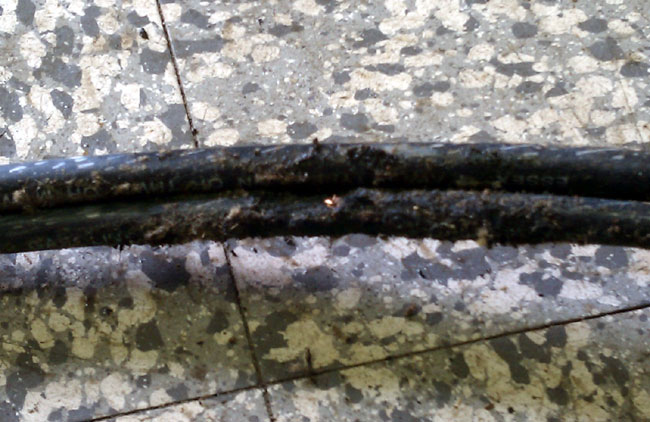
After we pulled the wire out of the conduit, we found this:

mouse chewed feces encrusted electrical cable
Mouse chewed feces encrusted electrical cable

It is a little hard to see, but that shiny spot is copper.  The cable jacket is chewed back quite a ways and the entire thing is encrusted in mouse feces and urine.  I love to work on stuff like this.  LOVE IT!  Hantavirus, here we come!  That reminds me, I need to get some of those blue latex exam gloves and throw them in the truck…  Anyway, far back in the conduit running through the concrete floor where it bends to go up to the service panel, the mice apparently had a nest.  They got into the conduit under the transmitter, where it transitioned from 3-inch rigid to 1 1/4-inch flexible metal without the benefit of a junction box or proper fitting.

We pulled new copper conductors in and installed a proper junction/transition between the 3-inch and 1 1/4-inch conduit.  The service panel was also missing several knockouts of various sizes, which were sealed with knockout seals.  The transmitter was back on the air at full power about 16 hours after it went off.  Unfortunately, the station has no back up transmitter, so they were off for that period of time.  Perhaps now they will look into a backup transmitter or at least an exterminator, but probably not.

WCKY transmitter site tour

This is of interest because of the GE BT-25-A transmitter footage.  I do not know the serial number of the WCKY BT-25-A transmitter, but it looks identical to the old WPTR BT-25-A unit which can be seen in this post.  As I stated in that missive, I have not heard any transmitter before or since, that sounded as good as this unit.  They were really engineering marvels, even in 1999 when this video was shot.

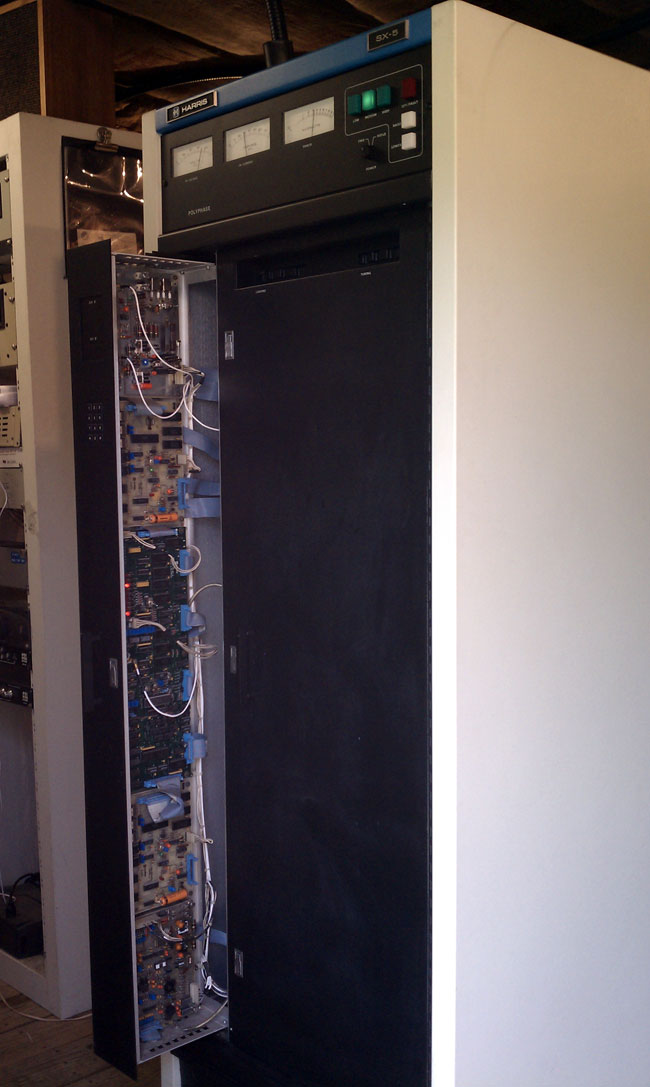
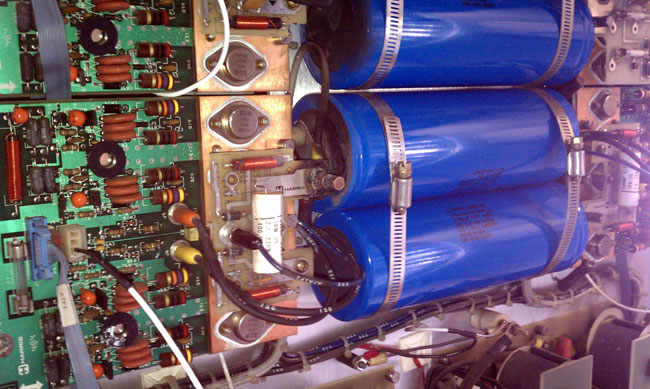
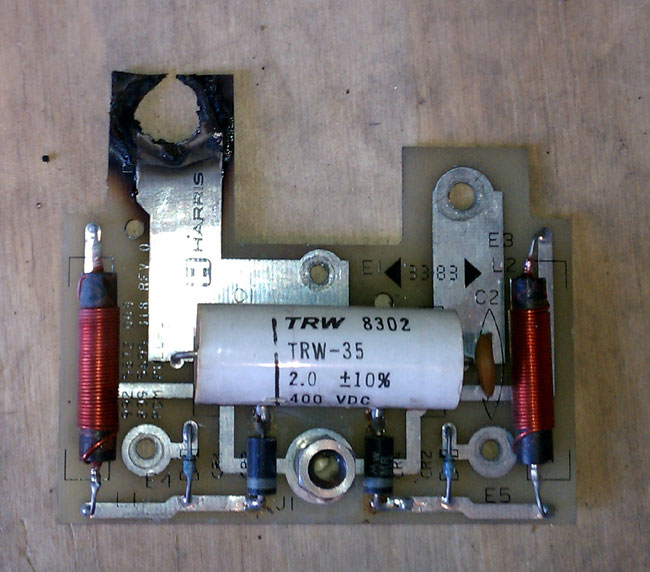
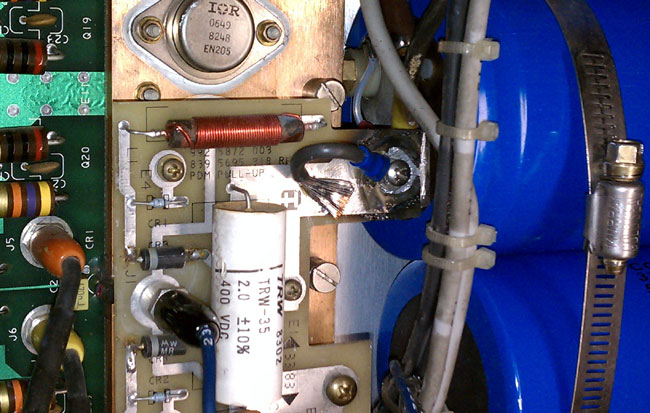
No doubt the MW-50 (no letter) and particularly the DX-50 transmitters are more efficient. In this day and age when many AM stations are just scraping by, overpaying for utilities is not an option. I noticed the Harris MW-50 transmitter with the PDM drawer open. That brings back memories too, those PDM boards were a pain in the rear, as I recall.

Donating old equipment

There is a propensity among radio engineers to save old equipment. Sometimes I look at something and think, “Man, that cost a lot of money ten or twenty years ago.”  Truth be told, much of what is saved will never be used again.  This equipment should be scraped or donated to someone who might find it useful.  One thing that is most appreciated by Amateur Radio (AKA Ham) operators is old 1 KW tube type AM transmitters.  Ham operators love these things and with good reason.

A fair amount of repair work, some cleaning, and a bit of reworking will turn what might have been a useless dust collector into a 160 or 80-meter AM rig and with a good story to boot.

Personally, I’d rather see a Gates BC1T or RCA BTA1R off to a new home than off to the scrap yard.  To that end, today we unloaded the BC1T at WLNA to a willing ham.  This particular transmitter had last run in 2001 or so and was used as a spare parts supply for other BC1T transmitters owned by the same company.  There was no way it would ever work again and truth be told, it really wasn’t needed any longer anyway.  Since the Harris MW5B was replaced as the main transmitter by a BE AM6A, the backup transmitter was never used.

Gates BC1T transmitter

John Aegerter, a frequent commenter on this blog, drove all the way from Madison, Wisconsin to pick it up.  Prior to picking up, I removed all of the tubes, transformers, crystals, and glass envelope time delay relays.  I packed up the glass objects in a box.

Gates BC1T tubes, transformers and spares

There were several spare tubes and parts which are no longer needed.  These went with the rig, along with whatever manuals I could find.

Gates BC1T loaded into pickup truck

The transmitter was then loaded into the back of a Dodge Ram 2500 pickup truck and tarped for its trip back to Wisconsin.