Zorch is a term used to describe an over voltage or over current condition that usually leads to catastrophic failure, e.g. the power supply was zorched by lightning. There is also a quality to radio signals that defy and exceed theoretical definitions for service contours or power density. That is quality defined as:
Zorch (adj): The ability of an RF signal to be received in unlikely locations; outside of predicted service contour, in steel structures, underground facilities, tunnels, etc.
It brings to mind the saying, “antennas are not amplifiers and amplifiers are not antennas.”
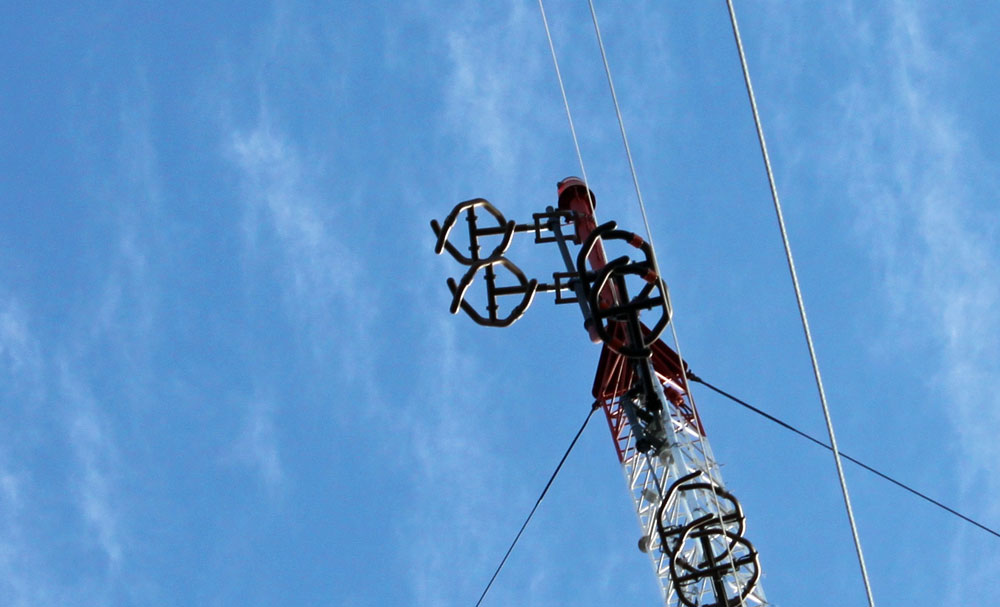
During the earlier stages of FM broadcasting, there was a notion that costs could be reduced by increasing antenna gain and reducing transmitter size. While theoretically, ERP (Effective Radiated Power) is ERP, broadcasters soon learned that high gain antenna, low TPO (Transmitter Power Output) installations lacked building penetration and had other reception issues. Realizing that there is a trade off between antenna bays, transmitter power output especially in difficult reception areas, a great debate occurred and continues on what the optimal system is. The answer is, it depends on the receiving environment.
Where this technical detail can be really important is with lower powered FM stations; Class A and LPFMs to be exact. They are already battling against bigger stations that have tens or even hundreds of times more power. Certainly an LP-100 station has it’s work cut out for it. The choice of antenna is perhaps one of the most important technical decisions to be made. Choosing the right balance of antenna type, antenna gain, antenna height and transmitter power output can greatly influence reception reliability and thus coverage area.
A good study of this quality can be had by looking at various LPFM installations:
| Station ERP (watts) | Antenna Type | Antenna Gain (power) | TPO (watts)* | Coefficient of Zorch |
| 100 | 1 bay vertical | 0.92 | 127 | 0.1 |
| 100 | 1 bay circular | 0.46 | 253 | 0.4 |
| 100 | 2 bay vertical full | 1.98 | 58 | 0.15 |
| 100 | 2 bay vertical half | 1.40 | 83 | 0.2 |
| 100 | 2 bay circular full | 0.99 | 118 | 0.5 |
| 100 | 2 bay circular half | 0.70 | 166 | 0.7 |
| 100 | 3 bay circular full | 1.52 | 77 | 0.46 |
| 100 | 3 bay circular half | 1.01 | 115 | 0.52 |
*Includes 100 feet of 1/2 inch foam transmission line, Andrew LDF4-50A, loss of 0.661 dB at 100 MHz, or 0.859 power gain.
Stations should try to get the transmitting antenna as high up as permitted without reducing ERP. In other words, the FCC allows 100 watts ERP with 98 feet Height Above Average Terrain (HAAT) radiation center in their current LPFM rules. Being lower in height will reduce the coverage area. Going over 98 feet HAAT will cause the station’s power to be reduced, which will lower the coefficient of zorch accordingly. Therefore, getting as close to 98 feet HAAT, which is different than 98 feet above ground level in many places, will net the best performance.
If a singular polarization (horizontal or vertical) is desired, vertical polarization should be chosen, as most mobile reception is by a vertical whip antenna. For best reception performance, a circularly polarized antenna will work best, as receiver antenna orientation will not effect the signal reception. A circularly polarized antenna has better building penetration and multi-path characteristics. The FM broadcast circularly polarized antenna in not a true circularly polarized antenna, it is actually unpolarized.
The use of a multi-bay antenna has the effect of focusing the RF radiation outward, perpendicular to the element stack, thus limiting the radiation directly up or down from the antenna. This is more pronounced with one half wave spaced antennas, which may be an environmental consideration in heavily populated areas.
Thus, the best coefficient of zorch for an LPFM station would be a circularly polarized, 1/2 wave spaced, 2 bay antenna. This antenna would have some gain over a single bay antenna, take up less room on a tower than a full wave spaced antenna, offer good RF protection performance for the general public living and working under the antenna, reduce wasted upward radiation and offer good building penetration for the ERP. It would require a slightly larger transmitter and more electricity, but that trade off is well worth the effort.