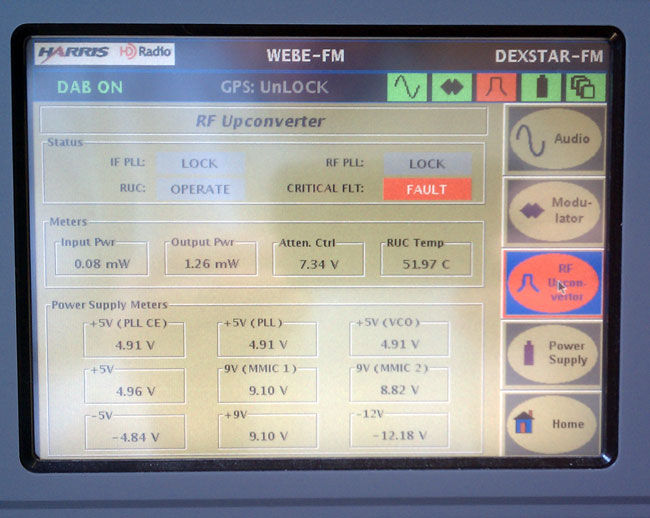
I went to put the HD transmitter back on the air for WEBE yesterday, to be confronted with this:
Harris Deathstar HD radio exciter
Swearing ensued.
The fault is with the RF upconverter, which is unlocked. I don’t know why the GPS is unlocked, I’ll have to climb up on the roof and look at the antenna.
It is a pretty good simulation of what will happen on November 9th. The script used is not the actual script that will be used for the national test.
After the test, the video shows how to bail out of the national test in the event that a valid EAN is not received. This is important information, as this particular failure has occurred many times in the past. If the LP-1 or PEP station that transmitted the test fails to send a valid EOM, the EAS unit will continue to transmit that station’s programming indefinitely. If the LP-1 or PEP station resumes regular programming while the EAS unit is relaying their programming over the air, that would be a good indication that the LP-1 or PEP station has failed to send a valid EOM.
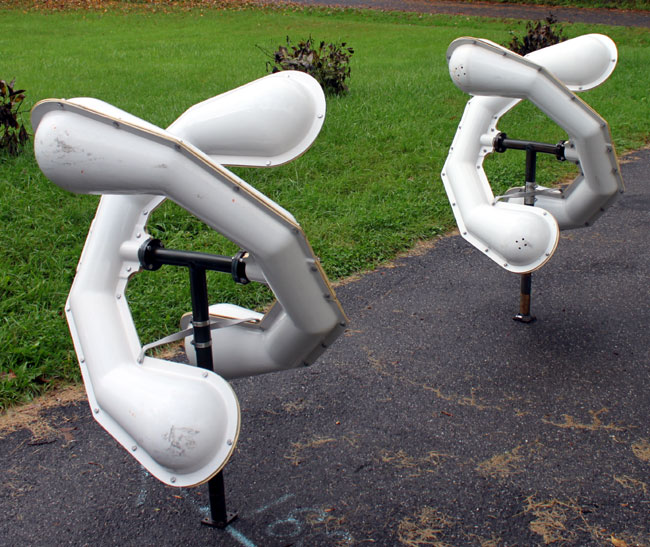
This was in the back room of one of the radio stations we work for:
ERI LPX2E FM antenna with RADOMES on the ground
It is a burned-out ERI LPX2E antenna. The manager was complaining that it took up too much space and he didn’t know what to do with it. Could I get rid of it? Sure, no problem. I could at least cut it up and scrap it.
When I first looked at it, it seemed complete and undamaged, however, upon further examination it seemed that some of the inter-bay line had overheated and one of the tuning sections that goes from the power divider out to the bay was missing. Therefore, I took it apart and separated the copper from the brass. Most of the antenna is made from yellow brass, due to its hardness. The inner line sections are copper and the mounting hardware is all stainless steel. I will perhaps break even time-wise, but it is one of those projects that can be done on my time in between other paid work, so it will be fine.
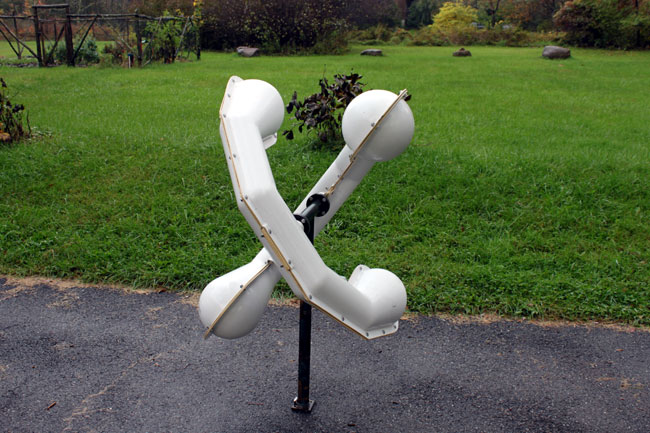
ERI rototiller antenna bay
I am going to keep one bay intact with the RADOMES on as some sort of modern art project. My daughter thinks we should install it in the yard as a part of a fountain-fish pond-bird bath contraption. The idea is to mount the bay facing up as in the picture above and run a hose up the inside of the transmission line to the T section. A hole will be drilled there and some type of fountain head installed to spray water up over the RADOME. The system will be run by a solar-powered pond pump. I’ll have to take pictures when it is done.
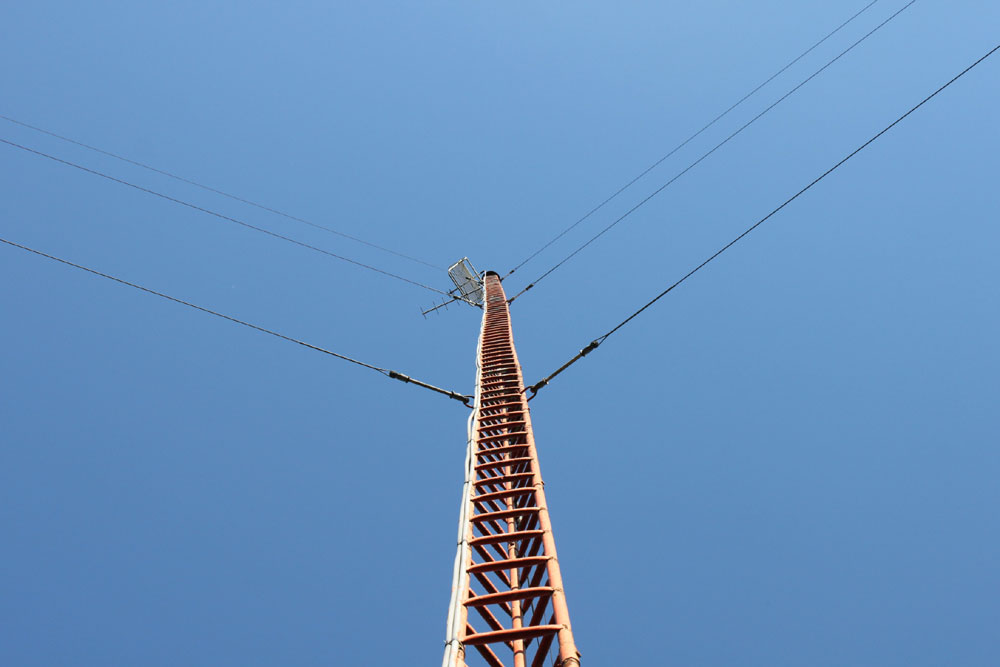
This is a situation that is and will be playing out over and over throughout the country as the decay advances. W*** signed on the air in March 1963. I believe this is the original tower:
W*** tower
As you can clearly see from this picture, this tower has several problems. Aside from the loose guy wires, the rust, and general structural decay, it is bent in several places. Currently, the forces are in equilibrium, but for how long, no one knows. It is certainly not safe to climb. At 144 feet, it is no longer required to be marked or lit, thus, over the years, the paint peeled, the weep holes filed up, and the guy wires rusted and loosened, which leaves us with the situation today.
At the transmitter building, there are other issues with the basement flooding, mold, etc. Truth be told, this station makes no money on its own. It would cost several tens of thousands of dollars to fix all these issues, and for what; a high end of the broadcast band class D AM station which has not shown up in the ratings for fifteen years. Once upon a time, it was a surviving, perhaps not thriving, local radio station. Those times have long since passed.
The question is; what to do with it? Sign it off and surrender the license? Fix all the problems and continue to broadcast? Donate it? If so, who would take it? Or, more likely, wait until the tower collapses and deal with it then.
I’d imagine that there are many others just like it dotting the country. On the whole, the AM broadcasters that are viable would be better off if this dead wood was cut away and discarded.