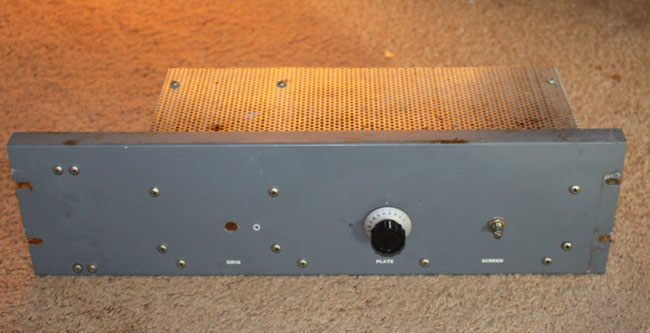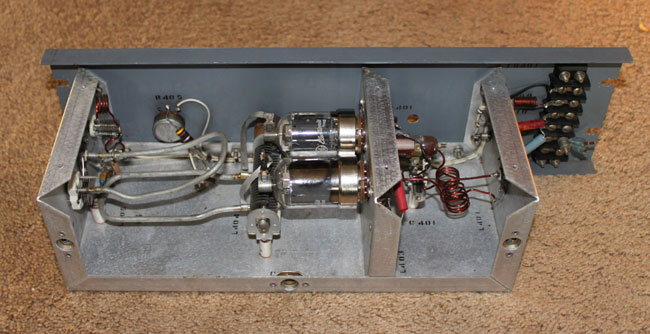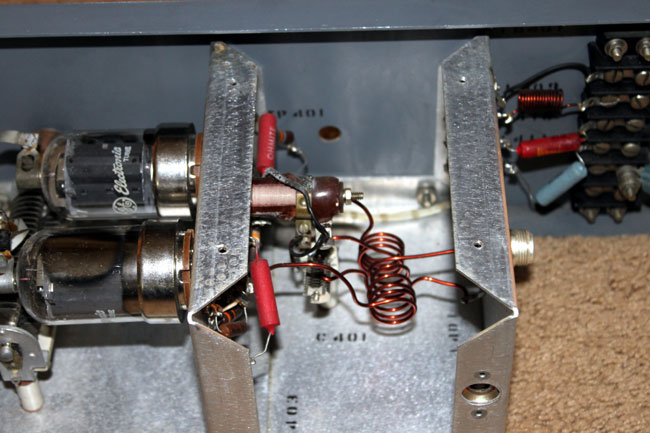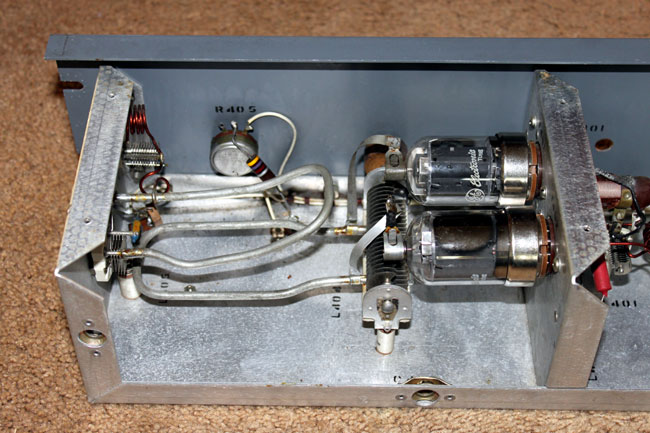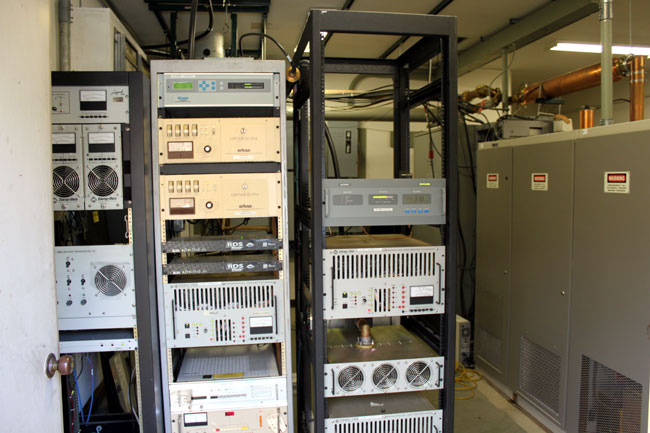
The BE FM20T transmitter

This is the main transmitter for WYJB in Albany, NY. The backup is the Harris FM20H3 on the right. I haven’t turned that unit on lately, but it normally makes quite a fuss the first time the Plate On button is pushed. The FM 20T on the other hand, is mellow and even-tempered.

WYJB 95.5 Mhz, class B, transmitter Albany, NY

One other thing of note; The FM20T is still on its original tube.  I looked up the maintenance records for this transmitter, it was installed in December of 2000.  Eleven years later, the 4CX15000A (ed note; 4CX12000A) is still cranking out 15 KW TPO, which is impressive.  I found that high-power ceramic vacuum tubes actually seem to last longer when run closer to their limits than those that are running at half power.

Judicious management of filament voltage is required to achieve this type of longevity.  There is a set procedure for installing a large ceramic vacuum tube:

  1. After the tube is in the transmitter, run it at a full filament voltage for at least an hour or so before turning on the plate voltage.  This allows the getter to absorb any stray gases in the tube.
  2. Once the plate voltage is applied, proper tuning should be completed as quickly as possible.  Tuning procedures vary from transmitter to transmitter, however, the general idea is to obtain the maximum power output for the least amount of plate current while keeping the PA bandwidth within acceptable limits.  Some transmitters can get narrow-banded at high efficiencies, which manifests itself as higher AM noise.
  3. After the tube has been in use for 90-100 hours, the filament voltage should be reduced gradually until a drop in the transmitter output power is noticed, then increased by 0.1 volts.

This maximizes the filament life for that particular transmitter and power output.  Once the filament can no longer boil off enough electrons, the tube power output drops and it is time to replace it.

This site also has two other radio stations, WZMR, 104.9  and WAJZ 96.3 , both class A using solid-state transmitters of less than 1,000 watts:

WAJZ and WZMR Energy Onix solid state transmitters
WAJZ and WZMR Energy Onix solid-state transmitters

Not the prettiest sight in the world, but it does stay on the air.  There is no money to go back and neaten up this work, unfortunately.

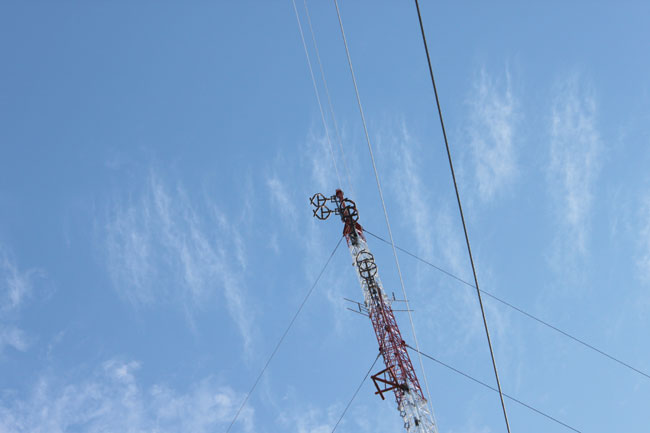
The tower supports all three antennas.  There was some discussion of a common antenna for all three stations, however, WZMR is a directional station, thus it would require its own antenna.  Doing a common antenna for the other two stations was cost prohibitive, so the tower supports three two bay antennas.

WYJB, WZMR, WAJZ FM antennas, New Scotland, NY

The stations are all located in the New Scotland, NY tower farm.  WYJB is licensed to Albany, WZMR is licensed to Altamont and WAJZ is licensed to Voorheesville.

A look at the new Facebook Data Center

Very good article on the new Facebook Data Center in Prineville, Oregon via Wired.com.  One of the interesting aspects of the data center design is the energy efficiency aspect.  In a data center that services 800 million users, shaving a few percentage points off of the energy bill represents huge savings.

According to the article, the location was chosen for its climate.  The area has low humidity, thus allowing the use of evaporative cooling system verses the conventional refrigeration cycle systems most often used.

Another area is in the servers themselves. Facebook decided to design their own servers, using a stripped-down platform, larger heat sinks, slower fan speeds, etc to reduce the amount of electricity used.

All in all the article is well worth reading, as the future of broadcasting will be centered on data centers such as this one.

CHU: Time nor tide waits for no man

CHU is an HF time signal station operated by the National Research Council of Canada. It operates 24/7 and announces the hour and minute each minute of every day on frequencies 3,330, 7,850, and 14,670 KHz. This is the Canadian counterpart to WWV and WWVH.  In the strictest sense of the term, it is a broadcasting station, although many would also classify it as an HF utility station as well.  Many countries had HF time signal radio stations at one time, but there are fewer now.  Back in the day before GPS, these time signals were critically important to anyone needing coordinated event timing.  We used the carrier frequency from WWVH as our frequency standard for test equipment.  WWV and WWVH also transmitted a very accurate 1 kHz tone for the same purpose.   According to the CHU website:

Normally CHU’s emission times are accurate to 10-4 s, with carrier frequency accuracy of 5×10-12, compared to NRC’s primary clocks, which are usually within 10 microseconds and 1×10-13 compared to UTC.

Additionally, every minute between 31 and 39 seconds, CHU broadcasts FSK time code with a Bell 103 standard (2225 Hz mark, 2025 Hz space) at 300 bits/second (IRIG time code).  This could be used as a backup for GPS time clocks on automation systems if GPS were to fail for some reason. One would have to write a little software program to decode the hex output and reset the computer clock once per minute accordingly.  That should not be too hard.  LINUX information and software can be found here.  More on CHU time code here.

CHU Ottawa, Ontario, Canada

In my location 3,330 KHz is audible 24/7.  That signal is transmitted with a carrier power of 3 KW into a non-directional vertical dipole antenna as is 14,670 KHz.  The 7,850 KHz signal is transmitted with a carrier power of 10 KW into the same type of antenna.

Canadian Time Signal station CHU, aerial view

There is some discussion of adding an additional time station transmitter in western Canada and of changing the modulation from AM to DRM or at least adding some type of DRM service.

The 80 Amp Circuit Breaker

Just because I can, here are a few pictures of the inside of a rather expensive 80-amp DC-rated circuit breaker:

80 amp DC rated circuit breaker open

What is the difference between a DC-rated breaker and an AC-rated breaker? Good question. Because DC is, well DC, the current is continuous. Once an arc is struck, greater separation is needed between conductors to extinguish the arc.  Using an AC breaker in a DC application can lead to an internal arc and fire.  That would be a bad outcome.

Just how did the insides get exposed, one might ask? Well, there I was working on a solar installation with said breaker placed on a horizontal surface waiting for installation when somehow it was knocked to the floor, creating a large crack in the side of it.  Angry I was because this thing set me back some fifty dollars.

80 amp DC rated circuit breaker closed

This picture shows the breaker closed, the contacts are still undercover to the left of the exposed parts. What is cool is one can get a good idea of how a circuit breaker works.  As the current flow increases, the magnetic field around the coil increases.  When it reaches the trip point the small steel piece is pulled down, causing the mechanical assembly to unlock and open the contacts.

Old tech stuff that is taken for granted probably has saved millions of lives since electrical use became widespread.