I was fooling around with my HTC Android phone yesterday and discovered something that has a definite use for radio remotes. An Application called Hertz will record .wav files, which can then be transferred via e-mail or ftp to the studio and played back on the air. The program is pretty slick, it allows sample rates from 8 to 44.1 kHz.
I made a sample recording, the microphone in the HTC phone is okay, a better microphone would sound better. After it was done, I emailed it to myself and listened on the laptop. The email took about 4 minutes for 20 seconds of a 32 kHz .wav file. One could cut that down by choosing a lower sample rate. I have found that 32 kHz is the minimal acceptable sample rate for analog FM. Anything lower than that sounds choppy.
In another potential use, a news reporter could use this to record audio to save and transfer to a computer using a USB cable. The recording time limit depends on the size of the SIM card and the sample rate. Additionally, my HTC Android phone will detect and use WiFi networks, where available, for data services. Using a WiFi network will avoid those 3G data charges and also increase download/upload speeds.
My Verizon plan has unlimited data transfer, so it really doesn’t matter what sample rate I use, your mileage may vary.
Couple the Hertz app with the VNC app mentioned previously, and a person could do all sorts of things remotely with a radio station. The Hertz app is available for free download from the Android app store.
This is The Stairway to Heaven for a different decade.
It is so big. She looks like, one of those rap guys’ girlfriends. But, you know, who understands those rap guys? They only talk to her, because, she looks like a total prostitute, ‘kay?
Ordinarily, I don’t much go in for such things as rap music. But this is entertaining and somewhat universal.
Hard to believe that it was almost twenty years ago. Almost every lyric in that song is innuendo for some sex act. Like it. Dislike it. No rules were broken when making this song. It went to number 1 on the Billboard chart in the summer of 1992 and no radio station anywhere ever received a fine for playing it. It was quite scandalous at the time, of course, we were young and naive then. Things have changed.
To the beanpole dames in the magazines: You ain’t it, Miss Thing!
It occurs to me that part of the reason that the radio industry sucks is that the music industry sucks. The radio and music industry used to have a symbiotic relationship, each benefiting greatly from the existence of the other. Of course, the greed and poor business practices of the last decade have driven every fun and thus entertaining element away from both industries. Leave it to the bean counters, who know the cost of everything and the value of nothing.
Sadly, no hit that I have heard on the top 40 stations these days even comes close to the entertainment value of this 18-year-old song.
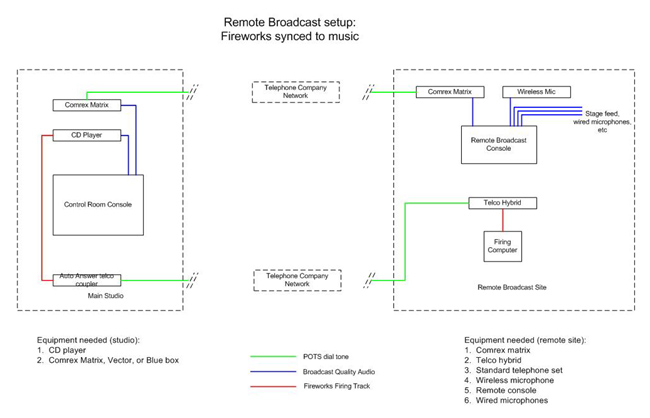
In previous years, I have had the very pleasurable experience of setting up a fireworks show remote with music synchronized to our FM radio station. Ordinarily, I don’t go near a remote broadcast, however, this is one of the more intricate broadcasts requiring coordination between the studio, the remote site, and the fireworks barge anchored 300 yards offshore, out in the Hudson River. The fireworks company, Garden State Fireworks, are consummate professionals and produce a very well-choreographed show.
Giving them the synchronizing track on-site is not very hard, however, I was surprised to hear that not every radio station does that. In fact, one of our, ah, ehm, Clear Channel competitors from The big Metropolitan Center Nearby could not be bothered to do it for the 4th of July fireworks this summer and last summer too.
The synchronizing track is on the left channel of a CD that Garden State Fireworks created, it is 1200 baud FSK data, 8,N,1, so it is pretty robust.
I thought I would post on how I do it and why. First of all, for the how part, there are two options:
Play the music CD at the remote site and relay broadcast quality music back to the studio without any time delay. Hard to do even with an ISDN line.
Play the music CD at the studio and relay telephone quality audio for the firing track to the remote site from the studio. Have the remote site play the air signal over the local PA system.
Option number 2 is technically far easier than option number 1, although it takes a fair bit of coordination. Also, the sound reinforcement guy didn’t like the air signal idea because of the quality of the audio. That is a little nit-picky, especially given the fact that much of the music at the fireworks show will be drowned out by the fireworks explosions. In the end, he saw it my way.
Here is a list of equipment needed:
Telco auto answer coupler, such as the Indy Audio
Telco Hybrid, such as the Telos
If the announcer is at the fireworks site, a POTS CODEC such as a Comrex Matrix or blue box
Wireless microphone
Telephone set and cord with RJ-11 connector
Miscellaneous mic cables, power cords, etc
At the remote site, two pots lines from the local phone company, long distance service as required.
Here is the block diagram:
Note, this assumes no delay in the telco network, which under ordinary circumstances using the wired, not cellular network, there should not be any. The touchiest part of the whole thing is getting the stage coordinated with the studio during the transition to the remote broadcast. Once that is done, everything else just falls into place.
The firing computer is located onshore next to our broadcast booth. They send the signal out to the barge on a wireless LAN link.
That is the how part. Here is the why (the soundtrack is a little low):
That is from three years ago, but you get the idea.
Even though I don’t work for these people anymore, I asked if they needed help with the broadcast this year. “Nope, we got it, thanks.” I will be paying close attention.
I have been reading with interest the whole debate about radio being dead or dying vs. radio being a vibrant thriving business.
Radio is not dead by any measure, however, it is declining for a number of obvious reasons. There are more competing entertainment and information options, that is true. Ipods, netcasters, and satellite radio have taken some of radio’s listeners away. However, the main culprit in radio’s decline is the investment bankers that are squeezing every drop of blood nickel out of the industry before moving on to their next victim investment opportunity.
The net result of this has made much, not all, of radio predictable and boring. No longer is radio the source for new music, news, information, and entertainment as it used to be. I don’t think that anyone will argue that point. The money men have fired most of the creative and talented individuals who used to bring in the listeners and replaced them with computers. They have also cut news staff, support staff, and anything else that lives and breaths except salespeople. More salespeople are always required.
HD RadioTM radio is a joke at best. Setting aside all of the technical problems with coverage and building penetration, the programming sucks too. The same purveyors of crap on the main analog channels are now branching out on the HD2 and HD3 channels. I can’t believe that the secondary channels will somehow be better than the main analog channels, or even marginally good enough to buy an HD Radio radio. Some groups are putting their AM programming on an FM HD2 channel, which is great if one cares to hear drug-addled corpulent talk show hosts wheezing into the microphone in full fidelity. At least on the AM analog broadcasts, everything above 4.5 KHz is cut off, wheezing included.
The good news is, there are still some radio stations that are programmed well. Radio sets are almost universal, every car has one, every house has at least one or two, and most offices, stores, etc. Radio reception is still free. Radio is still popular among many people. Radio owners could very easily become involved with their communities of license, make better programming decisions, hire staff, and add valuable informative local programs again. This decline would soon be forgotten.
The bad news is that is unlikely to happen. Less than a snowball’s chance in hell unless someone wakes up and smells the coffee.