Audio Processing

Any radio station’s on air signal is its biggest marketing tool.

What sounds bad:

  • Over use of compression (gain reduction)
  • Over use of high frequency EQ
  • Over “equalization” on all frequencies
  • Over modulation
  • Overly aggressive composite clipping
  • Improper use of FM pre-emphasis
  • Poorly tuned transmitters (tube type)
  • Poorly matched antenna systems (all types)
  • Poor quality audio input
  • Over use of bit reduction on the STL
  • Analog STL’s that are off frequency
  • Playback of bad audio recordings

What sounds good:

  • Moderate use of compression to bring up audio levels for in car listening
  • Using equalization that suites format (e.g. more mid-range for all talk, more bass for urban, etc.)
  • Properly adjusted processor output levels for the correct modulation levels
  • Setting the pre-emphasis correctly
  • Tuning tube type transmitters for minimum distortion
  • Tuning antennas for adequate impedance and bandwidth
  • Making sure that audio input levels are correct, the audio is properly distributed and terminated with the correct impedance
  • Using STLs that have enough throughput that either no bit reduction or minimum bit reduction is used
  • Regularly check analog STL frequencies and re-adjust as necessary
  • Get rid of all bad audio recordings in the automation/playback system. Make sure that new files are from good sources and/or are re-recorded correctly

I took a little road trip between Christmas and New Years (Happy New Year!). I cannot help myself, I ended up tuning around the radio to see what was on. Suffice to say, I found the usual formats and a few locally focused stations. What struck me was the sound of some of the stations. While most sounded acceptable, if not somewhat generic, there were a few that had ear splitting, headache inducing audio. These stations were often over modulating and way over processed. It would have been better if there were no processing at all.

That got me thinking, what is or rather what should be the point of audio processing? Way back in the day, there were loudness wars. These were often program director ego induced efforts to sound louder than the competition because if you were louder, it meant you had more power. As listeners tuned their analog car radios from station to station, the signal that “jumped out” was mostly likely to attract more listeners. At least that was the way it was explained to me in the by a program director in the late 1980s.

We are no longer living in a listening environment where loudness is of huge importance. The number of audio sources has increased greatly; iTunes, Amazon Alexa, Spotify, Tune in, Pandora, YouTube Music, Sirius XM, iHeart, and AM/FM radio. Audio levels can be anywhere and listeners have gotten into the habit of raising or lower the volume as needed. Outside of program directors, (or whatever they are called these days) offices, loudness means next to nothing. If you asked an average audio consumer how loud their program sounded, they would not likely know how to answer you.

I believe what most people are looking for is an enjoyable listening experience. The most important quality of any type of audio processing is that the product sounds good. The problem is “sounds good” is very subjective. Perhaps a better term would be technically sounds good. The audio should be free from distortion and artifacts of CODEC bit reduction. Overdone AAC or HE-AAC has this strange background swoshy platform behind everything which is headache inducing. Instruments should sound as they do when heard live. In other words, Susan Vega’s voice in the original Tom’s Diner should sound like Susan Vega.

Next would be compensating for difference levels in program material. A bit of gain reduction so that those in mobile listening environments can hear all of the program material. Finally, some format specific equalization can be useful. That is it. Moderate use of various audio processing tools can certainly accomplish those things. Like everything else, too much of a good thing is bad.

Vagabond Able; The story of the USCGC Courier

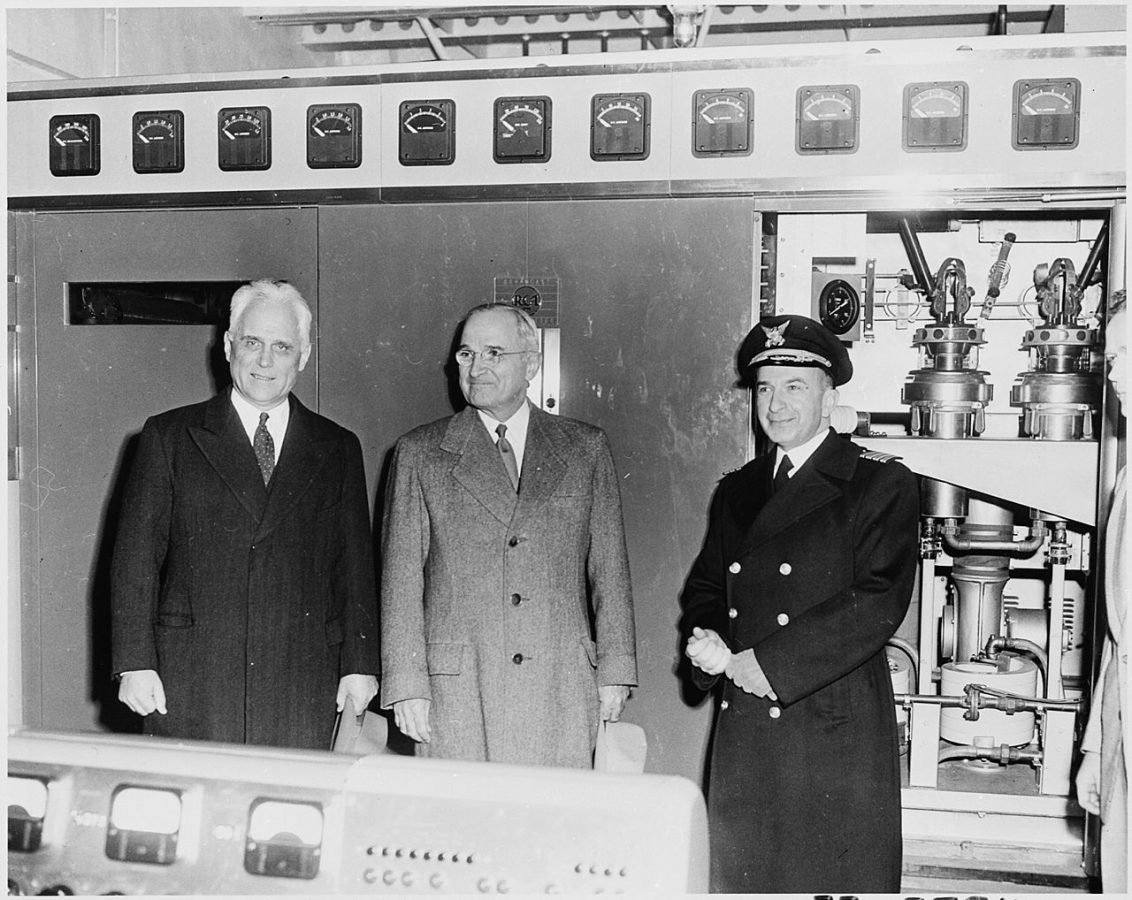
The VOA and shortwave broadcasting story is interesting from an engineering perspective. Over several decades, the US government spend many millions of dollars building out transmitter sites both overseas and in the continental US to transmit information behind the iron curtain. The Coast Guard Cutter Courier WAGR-410 was a converted cargo ship fitted out with an RCA 150 KW Medium Wave transmitter on 1259 kHz and two Collins 207B1 35KW shortwave transmitters in the cargo hold.

President Truman standing in front of an RCA BT-150, 150 KW AM transmitter on board USCGC Courier, 1952.

The ship had various wire aerials, including the Medium Wave antenna supported by a barrage balloon.

From September of 1952 until 1964, The Courier was anchored primarily off of Rhodes, Greece broadcasting programs into the Soviet satellite states in eastern Europe and the Soviet Union itself. This arrangement made it difficult to jam, although expensive to support and maintain.

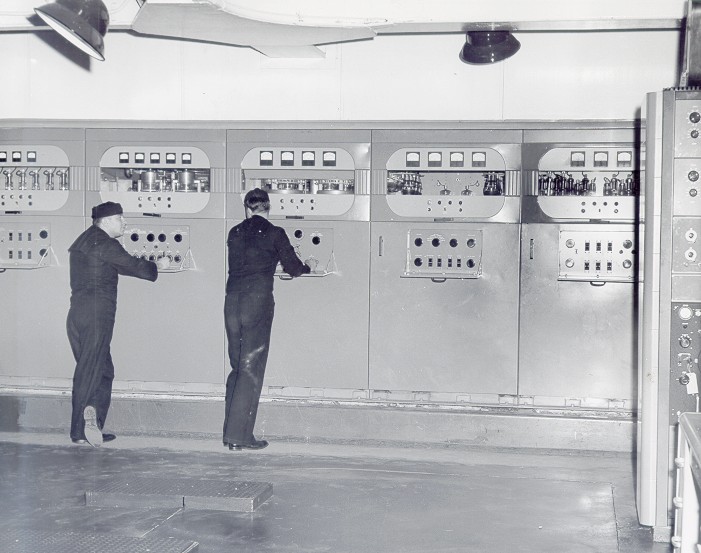
Coast Guard guys, operating a Collins 207B1 Shortwave Transmitter

It was, however, just one of the methods of broadcasting used.

Through the 1950s and 1960s, VOA, Radio Free Europe, and Radio Liberty built extensive sites in Bilbus Germany, RARET in Portugal, Tangiers, Tinang in the Philippines, Morocco, Udon Thailand, Greenville Site A and B in North Carolina, Dixon and Delano California, Bethany Ohio, etc. Many of these sites supported multiple curtain arrays, rhombic antennas used to receive programming, generators, living facilities, etc. In other words, no expense was spared.

In Rhodes, Greece; eventually the transmitting equipment from the CGC Courier was transferred ashore as a VOA relay site. The Courier then returned home.

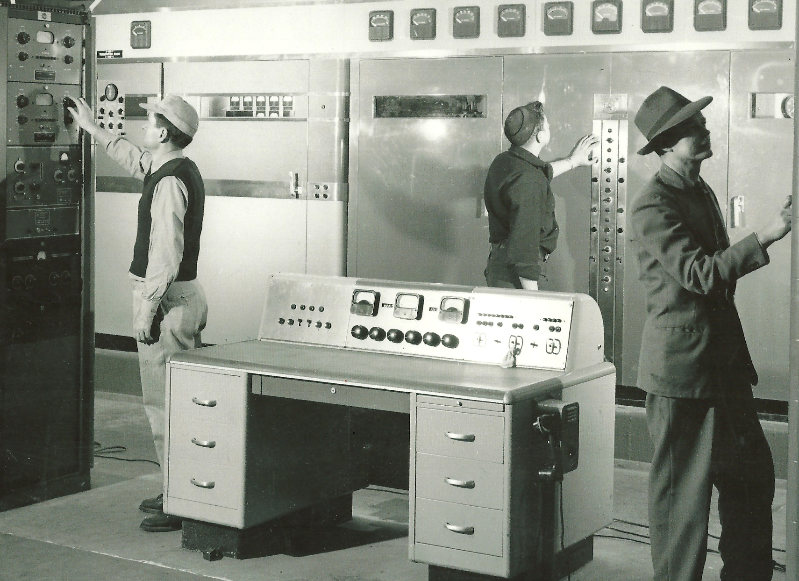
Transmitter control operator position, USCGC Courier

The point of the story; a lot of time, effort, and money went into broadcasting information to the Soviet Union and its satellite states over the period of four decades. From what I am told (by people who lived through that time period), the payoff really occurred in 1986, when the Chernobyl nuclear power plant accident happened. State-run Soviet radio and television were broadcasting Swan Lake, while RFE/RL had useful information including where the worst of the radiation was spreading, the wind direction, and how to protect humans from radiological hazards. For many average Soviet citizens, this was the tipping point and the collapse of the Soviet Union was inevitable from that point forward.

After the fall of the Soviet Union, many of these sites were shut down and the facilities were torn down because the cold war was over. Shortwave broadcasting was seen as expensive and unnecessary. Unfortunately, many warning signs were missed along the way and the present occupant in the Kremlin has wild dreams of a New Russian Empire. To revive shortwave in the 2020s would require another monumental and sustained effort starting with getting good receivers into the right hands. Shortwave broadcasts could become an alternative information source, especially if the Russia-Ukraine war becomes a protracted draw. However, it is not simply a matter of turning a few transmitters on and scheduling some Russian language programming.

Could the Russian state propaganda machine be engaged and defeated; yes. Will it be quick and easy; no. Is it worth it; yes. The real problem is apathy. The Russians have been subjected to terrible governance since pretty much the beginning of their existence. How to overcome that apathy and the corresponding sense of helpless victimhood of the Russians themselves is the question.

Regarding Vagabond-Able, after the USCGC Courier returned to the US, it was used as a training ship until 1972, when it was decommissioned.

USCGC Courer WATR-410/NFKW

Disinformation and Shortwave radio

I came across an interesting article on the Engineering and Technology website:

How to defeat disinformation with short-wave radio

The takeaway is this:

“When you’re in an environment where infrastructure has been damaged, where transmission towers have been destroyed or where the power supply to the transmission equipment isn’t reliable and robust, such as some parts of Ukraine, then you end up with a fallback to older equipment, such as battery-powered radios,”

Griffiths, Sarah. “How to Defeat Disinformation with Short-Wave Radio.” RSS, The Institute of Engineering and Technology, 9 Nov. 2022, https://eandt.theiet.org/content/articles/2022/11/how-to-defeat-disinformation-with-short-wave-radio/.

That applies not only to war zones but also to natural disasters or other situations where widespread disruptions occur in communications or power distribution networks.

The article focuses mainly on the BBC’s efforts to get information to Ukrainians who may be listening on shortwave radios in occupation zones. That is an effective use of shortwave radio, to be sure. One problem with this idea; if there are no regularly used shortwave frequencies in the affected areas, who will have access to a shortwave radio? There may be a few receivers around in any given community, but the vast majority of people will not have access to them. The idea that a broadcast service can be neglected for years if not decades, then be quickly dusted off and put into use is simply not realistic. This applies to AM and FM radio as well.

Attention K-mart shoppers…

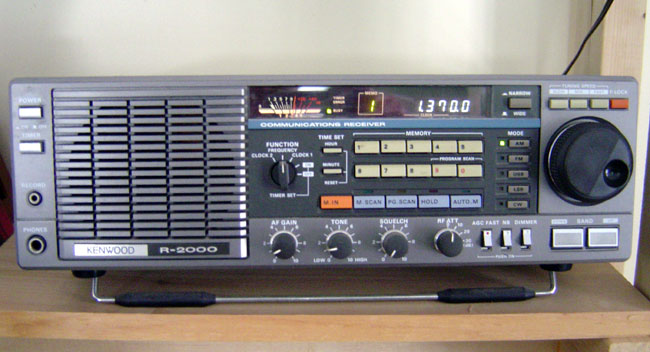
During the impending doom that is/was Hurricane/tropical storm Henri, I decided to bust out the old Kenwood R-2000. This venerable radio has been in my collection since 1989, when first purchased at the AFEES on Andersen AFB, Guam. Over many a year, it has given me lots of great service. However, the last time I tried it a few years ago, the frequency tuning was all haywire and it seemed to be inoperative. I set it aside, as I always seem to have something important to work on. Not so much today.

As I discovered, there were two problems; the first being a dead lithium battery and the second was the dirty pots on the VCO stepper, which are common failure modes for these units. I unsoldered the lithium battery and ordered a new one (CR 2032 with leads). The VCO stepper issue was corrected with a few slight turns of a small screwdriver. There are a couple of Youtube videos on this procedure. Truth be told, the entire unit needs an alignment, which I will do once the replacement battery arrives. The service manual is available from several sources online and it gives very good directions on how to perform an alignment.

Tuning around the Shortwave bands, I heard the normal things; some hams sending CW, some good some bad. A few messages from the Air Force Global HF network. On the broadcast side of things, Brother Stair seems to have multiplied… Then I came across an interesting signal on 9395 KHz. KMRT was broadcasting the K-Mart shopping soundtrack from the 70s-90s, interspersed with spoof ads for “Plummet Mall.” As the story goes, these cassette tapes were saved from the rubbish bin by a store manager in 1992. Now, they are being broadcast for everyone’s enjoyment on the short waves. I can say, I felt like I was pushing that shopping cart down the very narrow isles looking for a pair of Adidas.

This is via WRMI, Okeechobee, Florida.

This was a lot of fun.

I will finish the alignment/repairs of the Kenwood R-2000 and put it back in service in the upstairs equipment rack. Enough of these software-driven dongles, it is nice to just listen to the radio without having to boot up a computer.