Cost of Starting a LPFM vs Cost of Internet Streaming

I have been watching the LPFM proceedings with some interest. The FCC has not exactly promised to have a filing window by the end of 2012 but indicates that it might try to do that. In comparison to such evolutions in the past, this is moving pretty fast. Those that want an LPFM station need to start planning now.  As in previous LPFM windows, the availability is for non-profit organizations only.  This does not mean all hope is lost; NPR stations are all non-profits and most of them are very successful.

One of the biggest questions is: How much will it cost?  Like all things, it varies greatly.  If I were to put an LPFM or internet radio station on the air, there would be certain minimums, such as the use of professional audio equipment, a new antenna, and some type of redundancy.

Generally speaking, radio stations and internet stations both need some type of office/studio space.  This can range from large and opulent to a closet.  The costs for these would depend on the type and quantity of equipment installed, whether the equipment is new or used, the building, the area, etc.  Those facilities also have monthly reoccurring costs such as rent, electricity, telephone service, internet service, etc.

Since internet radio stations and traditional terrestrial over-the-air radio would use the same type of studio equipment, those costs will be similar.  Here is a breakdown of the studio equipment:

NomenclatureCost new (USD)Cost used (USD)Comments
12 Channel professional audio console$6,000.00$2,500.00Used for call-in/on air
Studio Furniture$5,500.00$1,000.00Can also be fabricated locally
Microphones, RE-20 or SM-7B$250-350$100-150Per unit, several required
Monitor Amp$250.00$100.00Can also use consumer version
Monitor speakers$500.00$200.00Can also use consumer version
CD Player$500.00$200.00Professional unit with balanced outs
Computer w/ professional sound card$1,500.00$500.00For automation and sound file storage
Computer, general use$700.00$300.00General information web browsing
Computer, Streaming w/sound card$900.00$400.00Sound card should be good quality
Studio Telephone system$1,900.00$300.00Used for call in/on air
Barix remote box$240.00 (x2)N/AUsed for IP remote broadcasts
Comrex Matrix POTS codec$3,200.00$700.00Used for telephone line remote broadcasts
Misc wiring, hardware, ect$1,000.00$800.00Connectors, mic booms, wire, etc
Total$21,780.00$7,930.00 

Some equipment is not available used such as Barix boxes.  Of course, not all of this is required for a radio station, however, most local radio stations would want the capability to do remote broadcasts, take phone callers on the air, have multiple guests in the studio, etc.

For a traditional LPFM station, the transmitting equipment would entail:

NomenclatureCost New (USD)Cost Used (USD)Comments
300 watt transmitter and exciter4,400.002,000.00Smaller transmitters with higher gain antennas can also be used
2 Bay ½ wave spaced antenna$1,900.00$700.00 
125 feet ½ inch coax$350.00N/A 
100 foot guyed tower and installation$4,000.00$3,500.00Not needed if station is on tall building or leased site
STL; IP radio w/ barix boxes$850.00 In lieu of standard 950 MHz STL
STL standard 950 MHZ$6,500.00$3,500.00 Used in lieu of IP STL
STL antennas, transmission line$2,500.00$1,500.00 
FM Processor$10,000.00$1,200.00Can also use software such as Breakaway Broadcast
Misc connectors, grounding kits, etc$1,100.00N/A 
EAS unit$1,900.00N/AFully operational CAP compliant
Processing software, Breakway broadcast$200.00N/AIn lieu of standard FM processor
Total$12-24K$8-12K 

This is a generic station, most will be somewhat different due to antenna supporting structures, transmitter powers and antenna types.  For the best possible signal, a circularly polarized antenna should be used.  A two bay, 1/2 wave spaced antenna will give the maximum signal density, while minimizing downward and upward radiation.  The upward radiation is simply wasted energy, as no one in space is listening to FM radio.  The downward radiation reduction is key if located in congested areas.

For internet radio station, the following would be required:

NomenclatureCost New IUSD)Cost Used (USD)Comments
Streaming Server2,100.001,100.00Includes professional sound card
Audio processing software200.00N/ARecommend software such as Breakaway Broadcast
Audio Processing, outboard hardware650.00400.00In lieu of software
Audio Streaming aggregator 1,200 to 2,400N/AAnnually

While LPFM’s are much more expensive than internet only stations, LPFM’s have the advantage of built in marketing, which is the on air signal.  If it is broadcasting on the air, word will get out.  On the internet, some other type of marketing will be needed to spread the word.  Also, LPFM’s should also be streaming, which would incur the same costs above.

The long and short of it is, to put a technically viable LPFM on the air is not an inexpensive proposition.  It is worth the effort, however, because the advantages of an LPFM over an internet only station are great.

Low Pass Filter design

Every good transmitter, tube transmitters, in particular, require harmonic filtering.  The last thing any good engineer or broadcaster wants is to cause interference, especially out-of-band interference to public safety or aviation frequencies.  All modern transmitters are required to have spurious emissions attenuated by 80 dB or greater >75 kHz from the carrier frequency.  In reality, 80 dB is still quite high these days, especially in the VHF/UHF band, where receivers are much more sensitive than they used to be.  A good receiver noise floor can be -110 dB depending on local conditions.

The principle behind a low pass filter is pretty easy to understand.  The desired frequency is passed to the antenna, while anything above the cut-off frequency is restricted and shunted to ground via a capacitor.

Low pass RC filter
Low pass RC filter

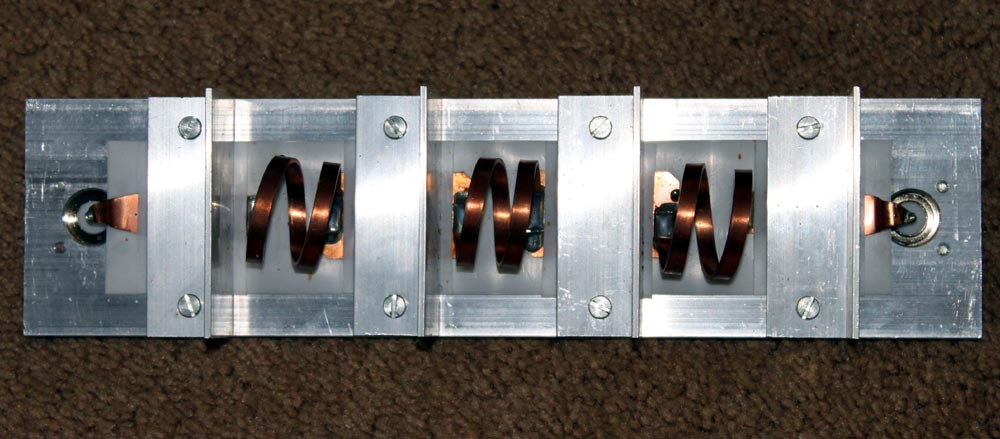
In this case, the resistor is actually an inductor with high reactance above the cut-off frequency.  Often, these filters are lumped together to give better performance.  This is a picture of an RVR three-stage low pass filter:

RVR three stage low pass filter
RVR three-stage low pass filter

RVR is an Italian transmitter maker that sells many transmitters and exciters in this country under names like Bext, Armstrong, etc.  The inductors are obvious, the capacitors consist of a copper strip sandwiched between teflon insulators held down by the dividers in between the inductors.

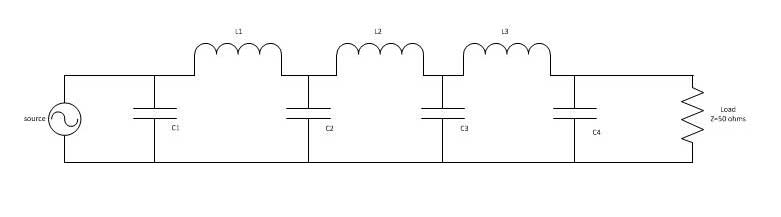
Schematically, it looks like this:

Low pass filter schematic diagram

For the FM broadcast band, a good design cutoff frequency would be about 160 MHz. This will give the filter a steep skirt at the first possible harmonic frequency of 176 MHz (88.1 x 2 = 176.2).

Values for components:

CapacitorsValueInductorsValue
C120 pfL174.7 nf
C254 pfL275.1 nf
C354 pfL373.9 nf
C420 pf  

The inductors are wire, or in this case copper strap, with an air core.  It is important to keep the transmitter power output in mind when designing and building these things.  Higher carrier powers require greater spacing between coil windings and larger coil diameters.  This particular filter is rated for 1 KW at 100 MHz.

Shocker: LPFMs have little or no impact on commercial FMs

The long-awaited report, required by the NAB as a part of the Local Community Radio Act has concluded that LPFMs have little or no impact on commercial FM stations. No kidding?

The executive summary states that:

LPFM stations serve primarily small and rural markets and have geographic and population reaches that are many magnitudes smaller than those of full-service commercial FM stations. In addition, LPFM stations generally have not been in operation as long as full-service commercial FM stations, have less of an Internet presence, and offer different programming formats. We also found that the average LPFM station located in an Arbitron Radio Metro Market (“Arbitron Metro”) has negligible ratings by all available measures and has an audience size that lags far behind those of most full-service stations in the same market.

Followed by:

Although each of the stations differs considerably in its individual characteristics, the results of the case studies show that the selected LPFM stations generally broadcast a variety of programming continuously throughout the day, operate with very small budgets, rely on mostly part-time and volunteer staff, do not have measurable ratings, have limited population reach, and do not generate significant underwriting earnings. All but one of the station managers that we interviewed stated that the LPFM station is not competing directly for listeners with any specific full-service stations.

And:

We conclude that, given their regulatory and operational constraints, LPFM stations are unlikely to have more than a negligible economic impact on full-service commercial FM stations.

Forgive my excessive block quoting of the FCC report titled: Economic Impact of Low-Power FM Stations on Commercial FM Radio, I found those portions of text far better than anything that I could write on the subject.

The NAB is reportedly “reviewing” the results, which the cynical me thinks is just another way of stalling a potential LPFM window later this year.

NAB thinks Translators offer more value than LPFM

Alternate title: “I love Stupidity,” somebody else’s, usually not my own.  It’s a bit hard to reconcile the NAB’s desire for translators against the need and strong community support for local radio.  The original intent of translators was to fill in coverage areas of existing FM licenses within the parent stations’ protected contour.  Very few translators are actually used for that purpose today.  They have, instead, morphed into vast over-the-air relay networks for NPR and religious stations or are relaying programming of HD-2 channels that would otherwise not be heard.  Why we would need more of that, I don’t know.

The unfortunate part of all that stupidity is the side effects.  Think of the stupid driver who cuts off a tractor-trailer on the interstate and causes a big pile-up.  There are potential injuries to those involved in the accident but also the inconvenience to all those stuck in miles of backed-up traffic.  That is a fairly minor occurrence.

With big corporate government, the size and scale of stupidity can reach epic proportions. To wit:  During the natural disasters that overtook the northeast, indeed other areas of the country as well, local radio was proven to be a reliable, sometimes life-saving means of communication time and time again.  Yet, in spite of all that, the NAB seems to think that LPFM stations (community radio) should be second to cross-band translators broadcasting AM stations and HD-2 channels.  Regarding FM translators on AM stations, the NAB says:

NAB first commends and supports the Commission’s proposal to eliminate the restriction on the use of FM translators by AM stations to translators that were authorized as of May 1, 2009. FM translators enable AM stations to overcome inherent technical disadvantages that limit audio quality compared to other services, thus limiting their service to the public and even threatening their economic viability.

Oh where to begin? First of all, AM stations do not have inherent technical disadvantages, that is a myth.  Off-the-shelf AM receivers are of inferior quality and make a well-designed, well-executed AM station sound like a telephone. If one were to listen to an older AM radio or AM on a receiver with variable bandwidth IF, one would find that it can sound quite good, if not very good. The problem is that the receiver manufacturers never carried through with the promise to open up the bandwidth following the implementation of NRSC-2 in 1991.  One should wonder why.

Second, there are many AM stations out there that are economically viable. Those stations have local programming and serve the community of license and have not been neglected or turned into an automated syndicated radio repeater.  Now, could a class C or class D AM station benefit from a translator at night, sure? That may not be a bad distinction to draw, especially for those class D stations with no nighttime operating authority.

Regarding more translators in general, it is difficult to imagine what all those new signals will be used for, other than more of the same (relaying distant, out-of-market religious stations, NPR stations, or HD-2 programming which nobody cares about).    The FM band is already full of such things and could actually use less, not more.

While unfortunate, the NAB’s position is not surprising.  They do the bidding of their dues-paying members, after all.  The anti-competition we are a monopoly stance of the NAB members is not new either. Remember the required economic impact study required by the LCRA on the LPFM vs full power commercial FM stations.  To think that a 100-watt LPFM could significantly impact the business of a class A, B or C FM station is laughable.  Yet, it was a requirement stuck into the bill at the behest of the NAB.

It is up to the broadband-minded FCC to see how to slice the remaining FM spectrum up and whether the corporatist NAB’s argument holds water or the rising call of the people who want a return of local radio and local community service will be heard.

This is a video of what happened during Tropical Storm Irene in Ulster County, where I live:

We are truly fortunate that no one here was killed. In the mean time, the waters around here are still receding, we had some additional flooding Wednesday (9/7) with another 6 inches of rain from Tropical Storm Lee with flood warnings still in effect for several local creeks.

In my neck of the woods, we have nine radio stations licensed within about a 16 mile radius.  One is religious, one is a college station, the other is a classical music format programmed from Albany, 90 miles away, one is a LPFM run by a local high school and two are commercial AM or FM station.  The commercial stations used to be located in downtown Ellenville but moved to Poughkeepsie, about 30 miles away in 1999.  The religious, college, and classical stations are small and have no backup systems or interest in emergency programming.  That leaves the high school LPFM, WELV-LP.

In the height of the storm, 11.53 inches of rain had fallen in the previous 8 hours, the power was out, cable was out, the internet unavailable, the Verizon telephone company office in town was almost underwater, we had two sources of local Ulster county information; WDST (100.1 MHz, class A) in Woodstock and WELV-LP in Ellenville.  WDST  studios are located in Bearsville, which is about 25 miles north of here.  They are a locally owned, locally programmed station with a good record of community support.  They did a good job updating emergency information, flooded roadways, emergency shelter information, power restoration information, dry ice, alternate emergency numbers in case 911 went out, rallying points for local fire departments, etc.  Ellenville Central School district’s WELV-LP also did a good job, although much more confined to the local area around Ellenville and have a much smaller coverage area.  Still, they were live on the air with up to date information.  Thankfully.

Next time, who knows?