Radio Museums Series; Asheville Radio Museum

History is one of my interests. Working in Radio over the years, there is plenty of interesting history that surrounds the first electronic mass media. My parents grew up in the depression/WWII era. For them, radio was a vital information source. Listening to FDR’s fireside chats about the economy and the progress toward recovery was a friendly voice reassuring them that times were indeed difficult but they would get better. Then the shock of the Pearl Harbor attack on December 7th rippled through the airwaves on a Sunday afternoon. These are the life long memories of my mother, who is now 92.

Preserving some of this history for following generations, who take the free flow of information for granted, is a worthwhile cause. Thus, I want to visit, then write about the many Radio Museums around the country. Each is a little bit different with its collection and interpretation of radio history.

Over the Christmas/New Years holidays, my SO and I went on a road trip around Western North Carolina and Virginia. We visited the Asheville Radio Museum along the way.

One thing that I found interesting is the People’s Radio. This was from Nazi era Germany (1933-45).
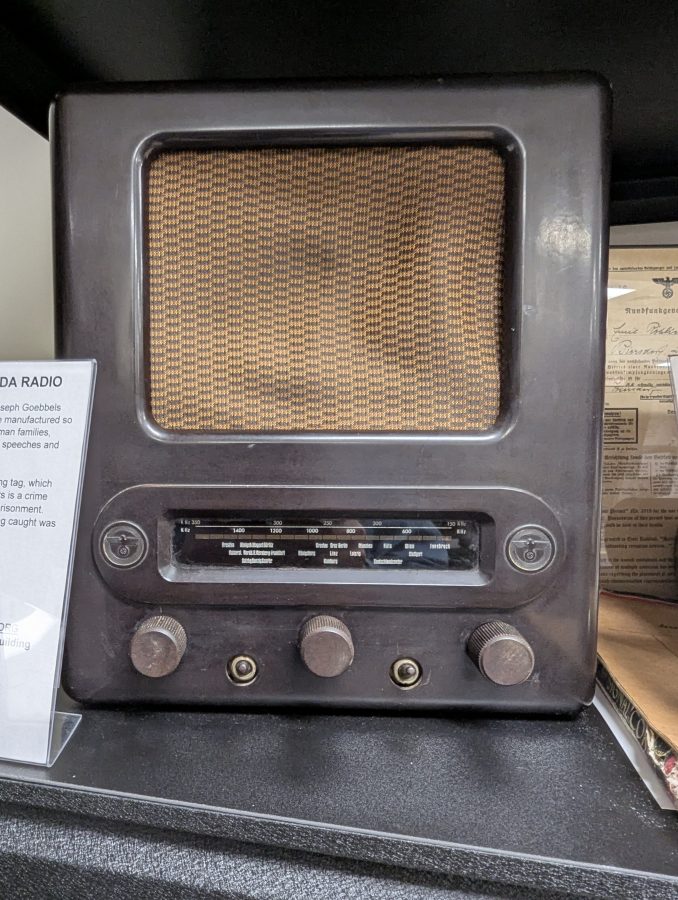
Folks Radio

This radio only had medium wave and was designed only to receive radio stations from Nazi radio stations. In order to possess a radio, a permit from the government was needed.
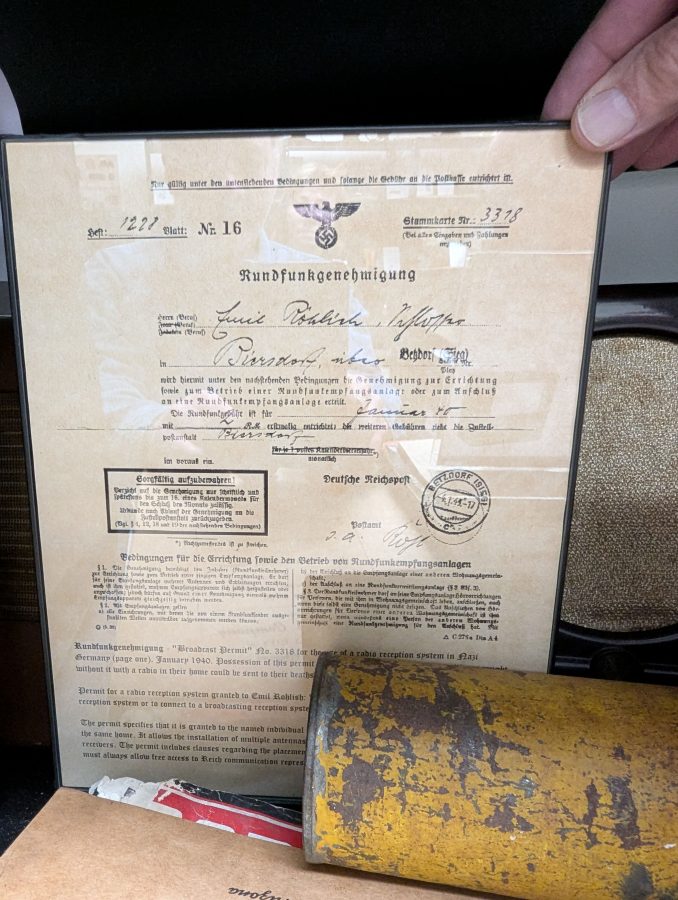
Nazi German Broadcast permit

Having a radio receiver without a permit would lead to an arrest and possibly being sentenced to death. In addition to that, getting caught listening to a non-Nazi radio station would result in arrest, imprisonment and later in the war, possibly death. It was no trivial matter.
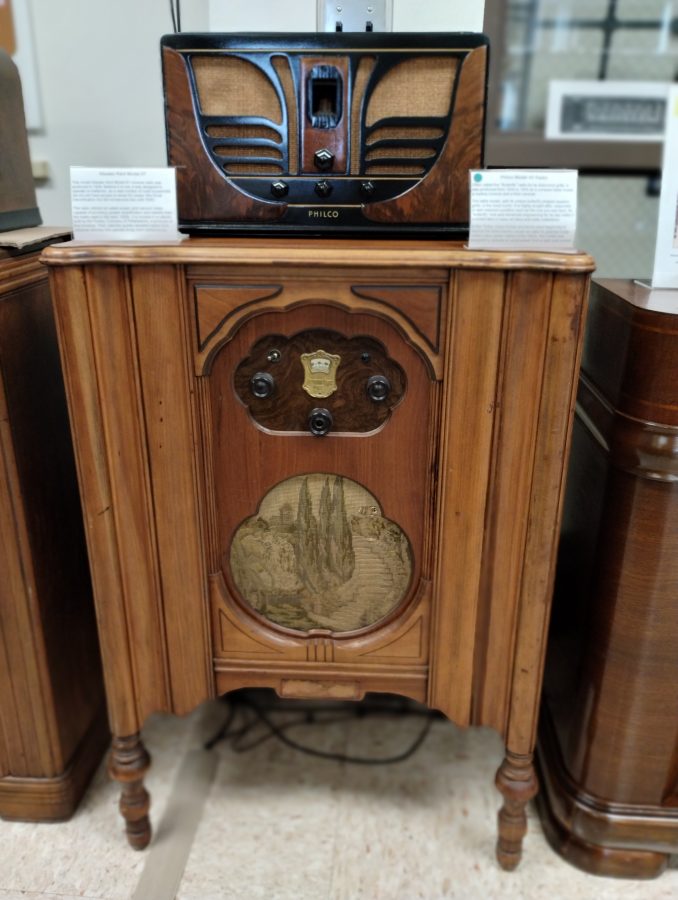
Atwater Kent console with Philco table top receiver

Older radios were often treated as a piece of furniture. My parents both said that evenings were often spent sitting in the living room listening to the radio. Radio dramas were performed live and included programs like Amos ‘n’ Andy, Mercury Theater of the Air, Jack Benny, Ed Sullivan, The Lone Ranger, The Fleischmann’s Yeast Hour, Calling all Cars, The Answer Man, Dick Tracy, Death Valley Days, The National Barn Dance, to name a few.
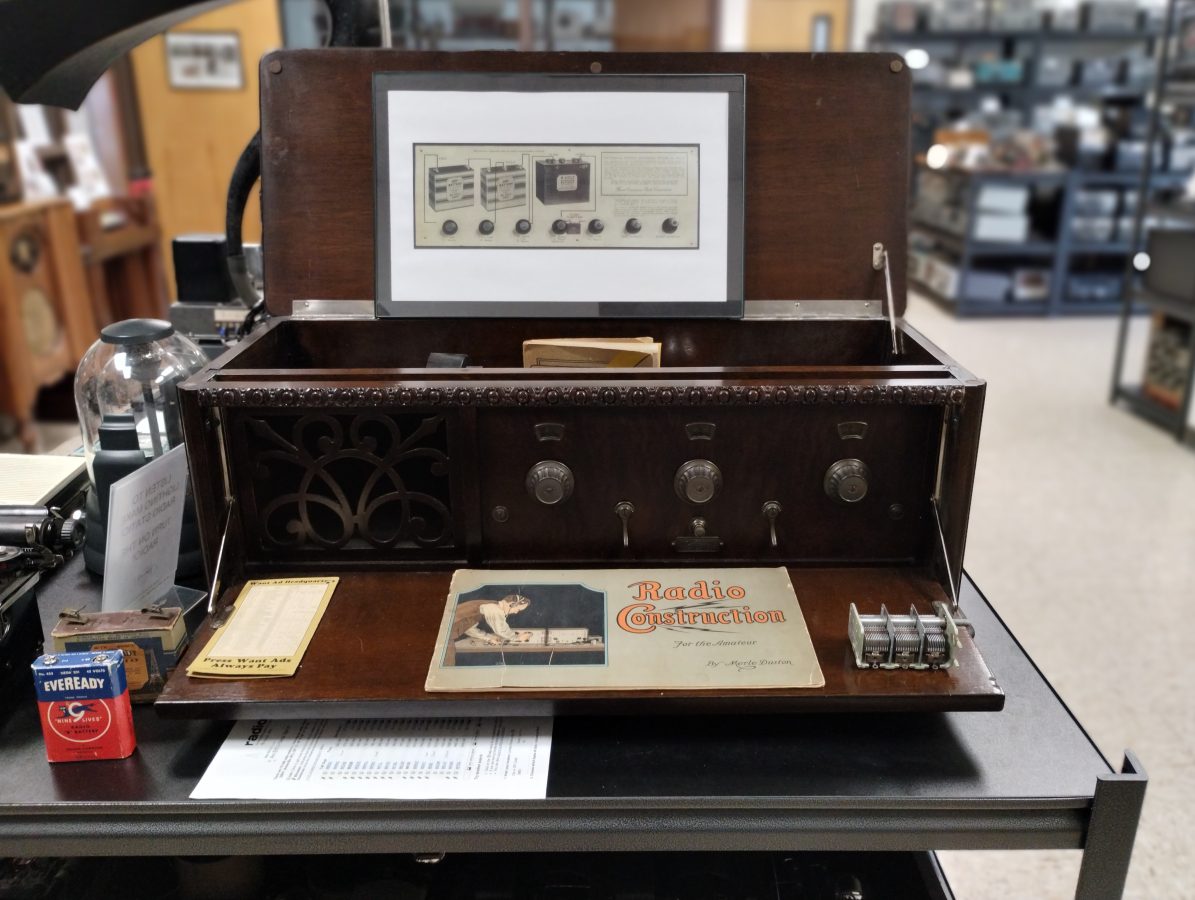
Early tabletop radios were powered by batteries
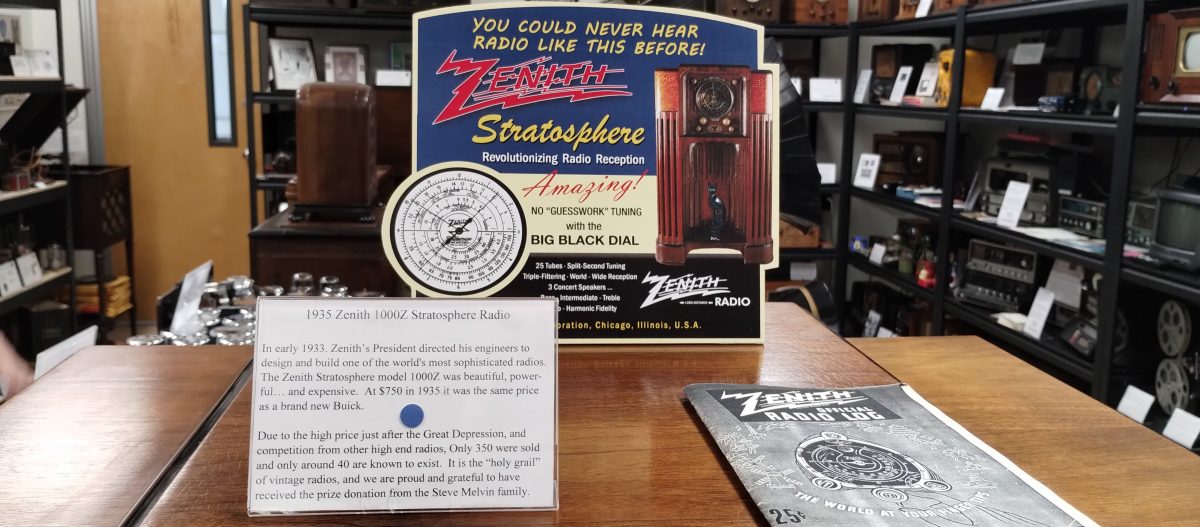
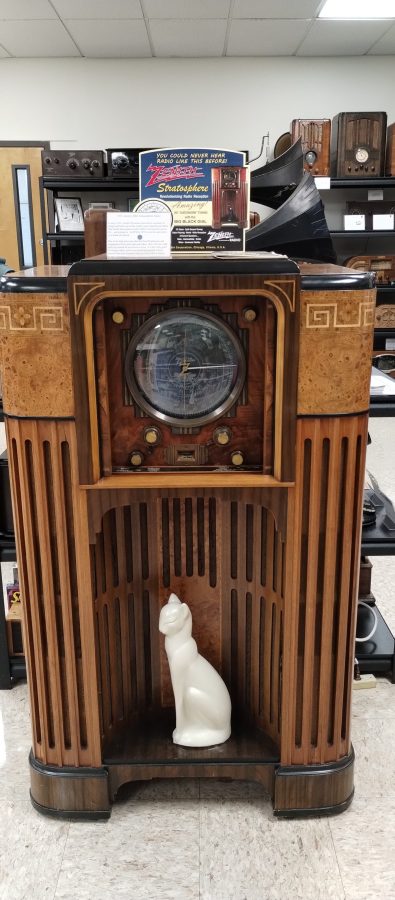
1935 Zenith Stratosphere 1000Z console radio
Zenith Promotional Materials

The top of the line console radio was the Zenith Stratosphere 1000Z. The porcelain cat was a notable feature for these radios.

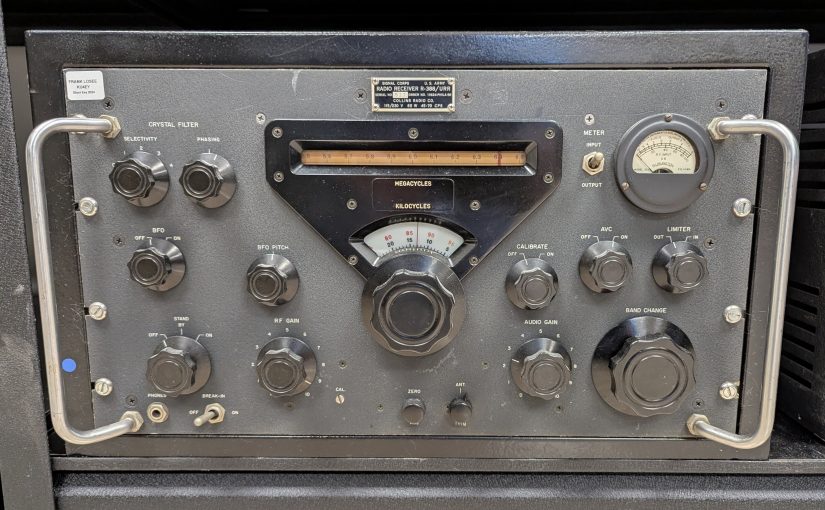
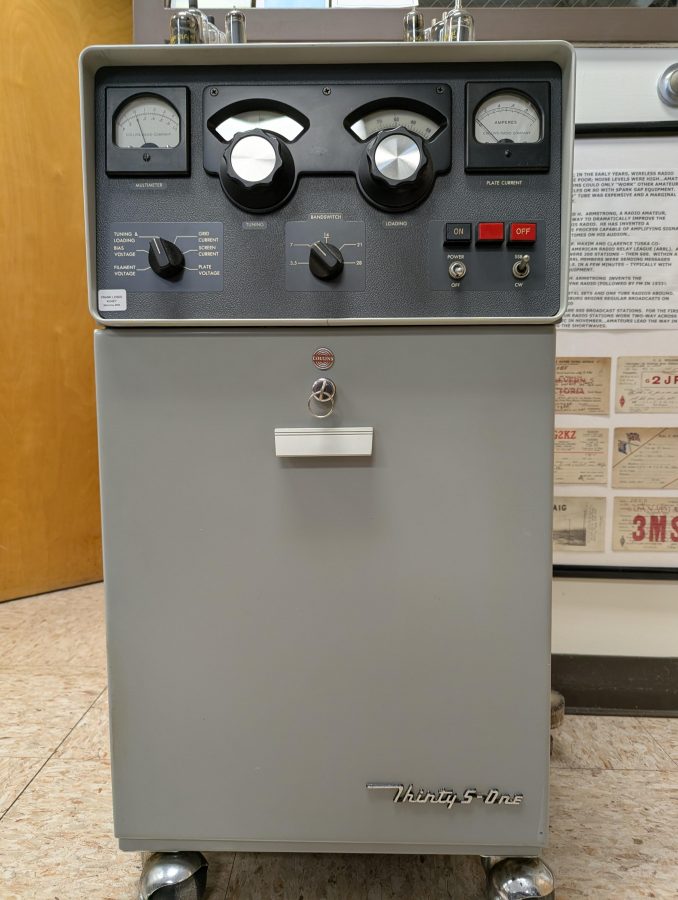
The Asheville Radio Museum holds Amateur radio license W4AFM. They have a decent display of vintage Amateur radio gear.
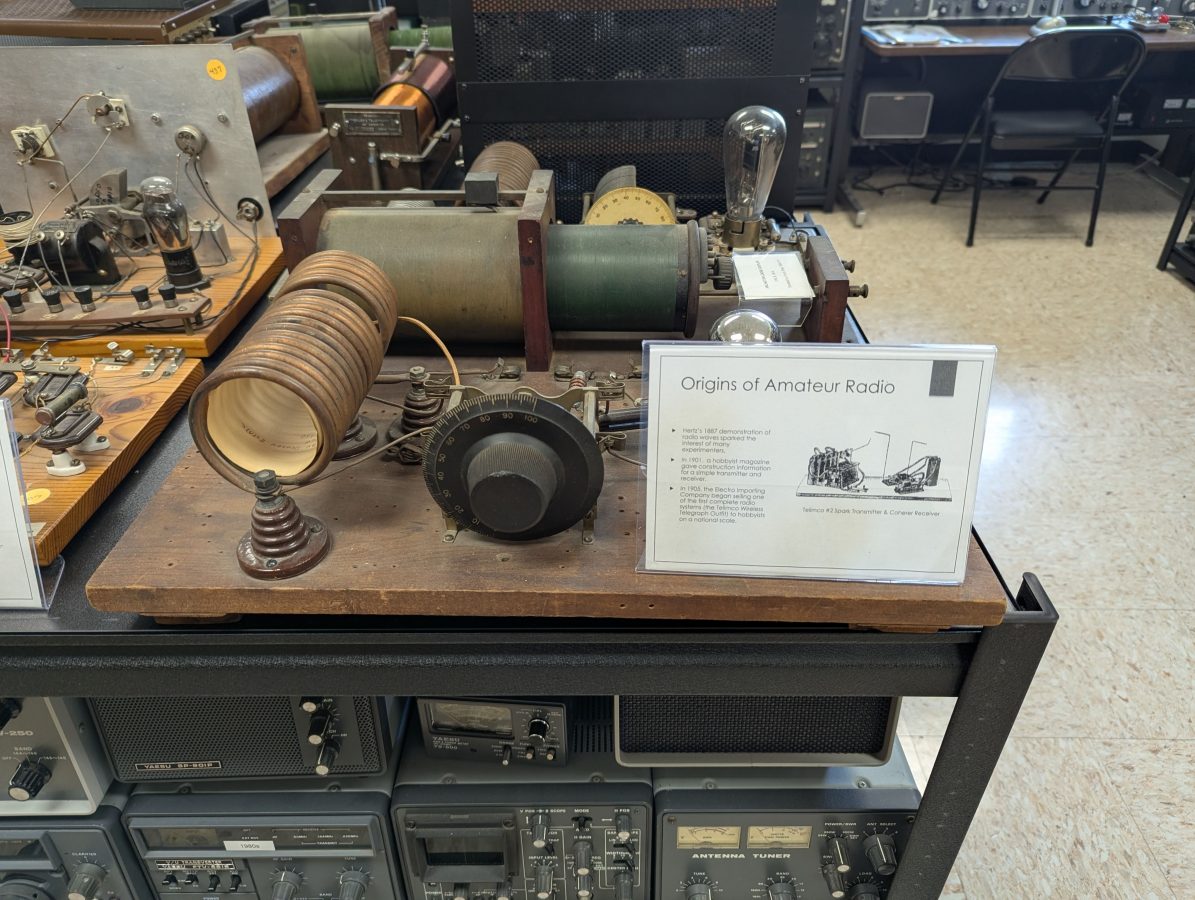
Old Amateur radio circa 1915
Collins 30-S-1 HF Linear Amplifier
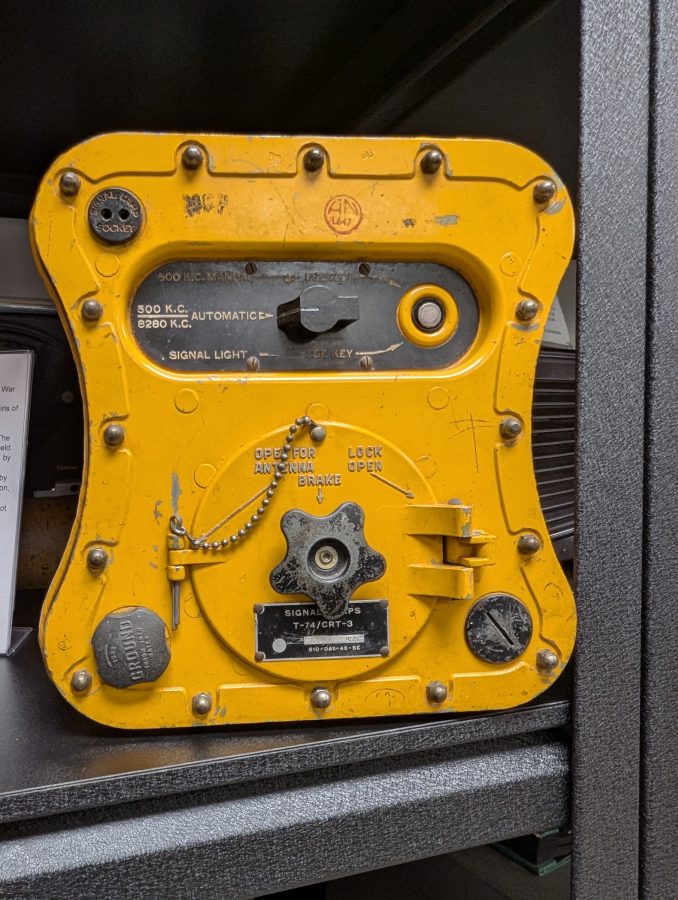
AN T-74/CRT-3 life boat transmitter

This is a WWII era life boat radio which transmitted on 500 KHz and 8,280 KHz. It was powered by a hand crank and could send an automatic SOS or a CW message could be sent manually by the key button. The round door on the front contained a wire antenna. After 1947, the HF Lifeboat frequency was changed to 8,364 KHz, which remained in use until about 1992.

There are several other displays on early telephones, the proximity fuses developed during WWII and so on.

The Asheville radio museum is located in room 315, Elm Building, A-B Technical Community College, 16 Furnihurst Drive, Asheville, NC.

Special thanks to Stuart Smolkin for coming in on his day off to give us a tour.

W2XMN Alpine, New Jersey

This historic site is where Edwin Armstrong continued developing FM radio starting in 1936 after his fallout with David Sarnoff of RCA. There is an active experimental station on 42.8 MHz, WA2XMN. It is usually on the air to commemorate Armstrong’s FM demonstration to the FCC, which happened on 17 June 1936.

Last Thursday, June 19th, I had a very enjoyable afternoon at SBE Chapter 15’s annual summer barbecue. Over the years, I have probably passed by hundreds of times, often thinking, someday I’d love to see what is there. I can say, I was not disappointed.

The site was constructed in 1936, after Edwin Armstrong was asked to remove his FM equipment from the Empire State Building by RCA. At that time, RCA was more interested in TV development and thought that FM had little place in broadcasting. Boy, were they wrong.

Alpine Tower

Armstrong had this 400 foot tower built and used this building as his test bed. Broadcasting on two frequencies; W2XMN on 42.8 (later 44.1) and W2XEA on 92.1 MHz (later KE2XCC on 93.1 MHz) with power of 50 KW.

W2XMN building, Edwin Armstrong’s laboratory

Today, the WA2XMN broadcasts are produced by a replica GE BT-1-B phastron transmitter built by Steve Hemphill, with a power output of 250 watts. Unfortunately, there is a large hill between that site and my house, so I cannot hear it very well from my radio room. However, during the broadcast, there were several reception reports from around the area, including out on the eastern end of Long Island.

WA2XMN transmitter on 48.2 MHz, Alpine, NJ
WA2XMN 250 watts forward power

The story of FM and Edwin Armstrong is a mixed tale. He was a professor of Electrical Engineering at Columbia University in New York. A creative engineer, having several patents to his name including regenerative receiver, super hetrodyne receiver, wide band FM, and early FM radar, he had a close relationship with David Sarnoff, the president of RCA. Unfortunately, that relationship soured over patent infringement lawsuits and Armstrong eventually committed suicide in 1954.

After which, the site ownership went to Columbia University. It sat, mostly unused, until it was purchased by the current owner (K2 Communications) for use as a land mobile transmitter site. Thankfully, they knew what they had and preserved the historical features. They are currently working on turning the W2XMN building into a museum.

W2XMN building

Columbia University has an extensive archive of information about Edwin Armstrong. More information can be found here: Alpine NJ, Alpine, NJ Part II, Closing of Station KE2XCC

There is also this excellent article in the Short Wave Listening Post: WA2XMN revives Armstrong’s Legacy with 90th Anniversary Broadcast

If you have the time, This Week In Radio Tech (TWiRT) has a Youtube Video: Armstrong FM at Alpine (it is about an hour long).

I always recommend, for those interested in the history of FM broadcasting; Empire of the Air by Tom Lewis.

And a final thought; there is nothing in this job that is worth your life. Suicide is a permanent solution to a temporary problem. Most engineers I know (myself included) are introverts. We tend to take responsibility for things which do not really belong to us. One of the things that I learned, over time, is to enforce boundaries. It can be difficult to do with the electronic connectivity today; the ability for people to interrupt your life via text, email or phone call. Sometimes those things are important, but too often, not. When this happens, use your words. Respectfully tell the other person that you will deal with it during business hours. If that doesn’t work, remember; there are many, many open positions for broadcast engineers these days.

The Alford Antenna

I have been doing a bit of work in this building recently.

5th Avenue Lobby, Empire State Building, New York, NY

Therefore, when I saw the opportunity to acquire a piece of NYC radio history, I took it. The SBE Ennes Workshops are designed to bring affordable education to the Broadcast Engineering community. One major problem in the Broadcast Engineering field is the aging workforce. Any resource that can spur interest by younger people is important. Named after Harold E. Ennes, the Ennes Educational Foundation Trust funds scholarships, workshops, seminars, and helps underwrite the costs of producing text books. Making a donation by bidding on an element of the Alford antenna was an easy decision.

Alford Antenna, courtesy of NECRAT

The Alford antenna was manufactured and installed in 1965 on the 102 story observation deck of the Empire State Building. It was designed by Andrew Alford, an electrical engineer, who designed antennas for ILS and VOR aviation navigation systems. It is the first purpose build combined FM master antenna system in the world. Both the antenna and combiner system were novel ideas at the time.

The master antenna was becoming a necessity because the spire and tower on top of the Empire State building had become over crowded with FM and TV antennas. In the 1931, RCA/NBC leased the 85th floor of the ESB for their development laboratory.

Circa 1936, RCA television transmitter on 85th floor, from the Early Television Museum

Once both services became commercial, the FCC forced RCA/NBC to allow other FM and TV stations to locate on the building.

According to the IEEE paper written about it, the idea of a master antenna came about in 1959. It was not until the mid 1960’s that the first three stations agreed to the idea.

The requirements for the new antenna included:

1) System should accept the output of seventeen different FM station transmitters at a power level of 10 kW each.
2) The antenna should radiate an essentially omnidirectional signal in both horizontal and vertical polarizations in approximately equal amounts.
3) The antenna gain and multiplexer losses should be such that each station can achieve an ERP of approximately 5.5 kW in both polarizations (the maximum power presently authorized by the FCC for that height above ground and that location).
4) The antenna system should be well matched over the entire frequency band from at least 92 to 108 MHz and preferably from 88to 108 MHz.
5) The external portions of the antenna should be deiced.
6) System VSWR should be 1.1 or less at each station’s input over a 200 kHz band centered at each station’s carrier frequency.
7) Isolation between antenna and other antennas on building should be at least 40 dB.
8) Isolation between FM transmitters connected to the system should be at least 40 dB for adjacent FM carrier frequencies and at least 36 dB for non-adjacent FM carrier frequencies.
9) The frequency-phase characteristic of the system as measured at each station’s input should be linear within ±50 throughout a 200 kHz band centered at each station’s carrier frequency.
10) System should allow for any number of stations to participate at the beginning and should allow for additional stations to be added from time to time as required up to a maximum of seventeen in any arbitrary order of carrier frequencies.

IEEE TRANSACTIONS ON BROADCASTING, VOL. BC-13, NO. 3, JULY 1967, The Empire State Building Master FM Antenna.

That article is an interesting read.

This is one of 32 elements of that antenna. It was in position 10L, according to the name plate. Date of manufacture was 7-65. It is 81.28 x 139.7 x 13.9 cm (32 x 55 x 5.5 inches) and weighs about 45 KG (100 lbs). The RF input is 1 5/8 inch EIA flange, located in the middle of the mounting plate.

Alford antenna name plate
Alford Antenna on my dinning room table
Alford antenna, covers removed

Of course, the covers had to come off so I could see what was inside. The antenna is cast from non-magnetic (AKA stainless) steel. The elements were installed with the covers down, as they are not water proof and have weep holes to allow condensation to drain out of the element.

Inside contains the resistance heating element. Interestingly, the return wire for the element is tied to ground and does not have an insulated path to neutral. Each return wire was burned open, meaning that at least this antenna element had no heaters. In the northeast, that will certainly lead to problems.

Heating element return wire, broken off

I wonder if that was one of the reasons to replace it with a new master antenna. Other reasons would be that newer antennas have better circular polarization, more even signal pattern giving better reception, better gain characteristics, better combining systems with more isolation and the ability to pass HD Radio side bands, etc.

No doubt, this antenna section will end up in my radio room, but I am still working on how I will display this interesting piece.

Golos Ameriki

The Voice of America; expended goodwill edition.

Radio Liberty and Radio Free Europe were The main sources of Western information behind the Iron Curtain during the Cold War. While the VOA, RFE, and RL used HF, there were also FM relays in the mix. If you wanted to know what the US Government’s position was on any topic, VOA, RFE, and RL were the information sources.

I wrote several articles about this in the past:

So what happened? Why has the current administration shuttered those services?

There are several good reasons why many government broadcasters have reduced or eliminated shortwave:

  • Fewer people care about the US Government’s position
  • Changes in geopolitics
  • Reduced listenership to HF Shortwave Broadcasts due to technical difficulty
  • Large double-sideband AM transmitters are expensive to operate and maintain and therefore are a target for reducing expenses
  • HF transmitter sites require a lot of land and physical infrastructure, which is also expensive to maintain
  • New distribution technology is easier for the end user and less expensive to operate

Many people, particularly young people, do not know the difference between an over-the-air broadcast and an internet stream. Buying a special receiver, putting up some indoor or outdoor antenna, then tuning around several different frequency bands to find something worth listening to, seems like a lot of work. These days, there are few shortwave broadcasts worth listening to, especially in the English language.

The BBC greatly reduced HF distribution of The World Service starting in 2005, favoring more internet-based distribution. Radio Canada International completely went off the air in 2012, scrapping its extensive transmitter site in Sackville NB in 2014. Radio Australia signed off in 2017. Deutsche Welle mostly left the HF band in 2011 while reducing its FM in 2016. The Voice of Russia ended HF broadcasts in 2014.

The only state-owned shortwave broadcaster that has expanded is Radio China International.

VOA Greenville B has some very old transmitters. The newest units date from the late 1980s or early 1990s. The oldest are the two original Continental 420As, dating from 1960, and are original to the building. When I visited there in 2017, two transmitters were on the air, the BBC and the AEG broadcasting at half power to Cuba and Africa respectively. The rest were shut down. The Continentals were difficult to change frequencies on because of the Doherty modulation. The GEs were long in the tooth, but at least serviceable due to the stock of spare parts from site A. I think the overseas sites in the Philippines and Sao Tome are similar.

Many have pointed out, and rightly so, the Internet censorship issue. Terrestrial radio broadcasting is often the best or only way to circumvent the suppression of information. Kim Elliot pointed this out in his Radio World article “Why we need Shortwave 2.0” All of those points are valid.

What can be done? Implementing DRM30 as a worldwide HF broadcasting standard would be a step in the right direction. DRM30 can send ancillary data, including Radiogram type news bulletins. DRM30 is much more energy efficient than DSB AM because there is no carrier, which wastes half or more of the transmitted power on a carrier that contains no information. Instead of a giant transmitter site, with curtain arrays, a more distributed transmission system with several frequencies on the air at the same time uses lower-powered transmitters, simpler antenna systems such as Rotating Log Period Arrays (RLPA), or non-directional vertical towers. This would require some changes to the FCC rules, but now is the time for that.

TV’s ATSC 1 has something called a “Transport Stream ID,” (TSID) which is a unique number assigned to each broadcaster. Wide-band SDRs are capable of scanning across many HF bands. Implementing something similar for DRM30 HF broadcasts would not be that difficult. Shortwave Listeners just program the HF TSID to lock onto the digital broadcast of their choice, if it is available. This would make HF Broadcasting available to most non-technical people looking for information. Most of this can be done with existing technology. However, DRM still (almost 2 decades later) lacks receivers. There is a development on that front as well: RF2Digital support module. The point is that there are many good ways to improve the technology, keep HF broadcasting relevant, and bypass attempts at internet censorship.

What will be done?