The first aid kit

One of the things that was drilled into my head when in the military was first aid, which we were all required to learn. Those of us who worked around high voltages were also required to know CPR, including passing the American Red Cross CPR course.  I have used CPR on three separate occasions, and none of the victims lived to tell about it.  I have been told by my wife’s cousin, who is an ER doctor, that that result is fairly typical, especially in older persons with heart conditions, which in two instances was the case.

I have always carried a standard first aid kit in my truck.  Things like band-aids, gauze pads, sterile water, Hydrogen Peroxide, medical tape, splints, antimicrobial cream, blankets, etc.  Nothing hugely complicated, something like this unit.  I have used it recently at accident scenes, which I tend to stop if it looks like they need help.

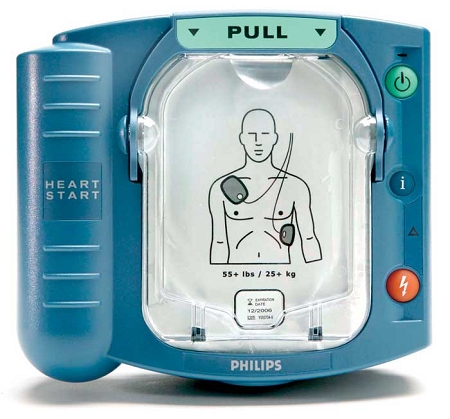
Philips Heartstart onsite AED

To complete this, I have also purchased an AED.  As one medic once said, if a heart gets shocked out of sinus rhythm, it can be easily shocked back into sinus rhythm provided it is done quickly.  Working on high-voltage power supplies always entails some risk, even when all safety procedures are followed.  As little as 60 mA can cause arrhythmia.  Dry skin has a resistance of about 300 ohms, which means that 180 VDC is the threshold for fatal shocks.  This value is much lower if the skin is wet. Any shock received through either hand is likely to travel through the chest and can effect the heart.  Many of the transmitter sites we service are remote, medical help may be 30-60 minutes away under good conditions.  Having an AED on hand is just a little bit of extra insurance, that will hopefully never have to be used.

CPR procedures have been updated in the last few years, if one has not recently reviewed them, it might be worthwhile to take a refresher course.  I will say, hands-only CPR is an improvement not only because it is more effective, but also because most heart attack victims vomit and lose control of their bowls.  Reduced contact with someone else’s stomach contents is always welcome.  This AED came with a training video CD.  While AEDs are designed to be intuitive, having training on their use is always a good idea.  The Red Cross also gives classes that include the use of an AED with hands-only CPR.

This is what you’ll get…

Back many, many years ago, in a city far away, I was driving down the road and I flipped one of “my” stations on the air.  The end of this song was playing:

The ending sounds an awful lot like a Moseley MRC-16 transmitter remote control’s return telemetry.  When I heard that on the air, my first response was “HOLY SH*T! The telemetry is on the main channel!”  A little voice in the back of my head said “That is not possible.  How is that possible?”  I grabbed the gigantic, then state-of-the-art Motorola bag phone and dialed the studio hotline, just before I hit the  “send” button, the song faded out and the announcer came on back selling “Karma Police by Radiohead

Wow.  Radiohead?  Karma Police?  WTF?

I almost had a coronary.  When I got home, I tried explaining this all to my then-girlfriend, who didn’t get it.  Few do.  At the time, making such an error would be very bad form indeed and likely open the unfortunate party to all sorts of snickering and finger-pointing at the next SBE meeting.

Last Radio Playing

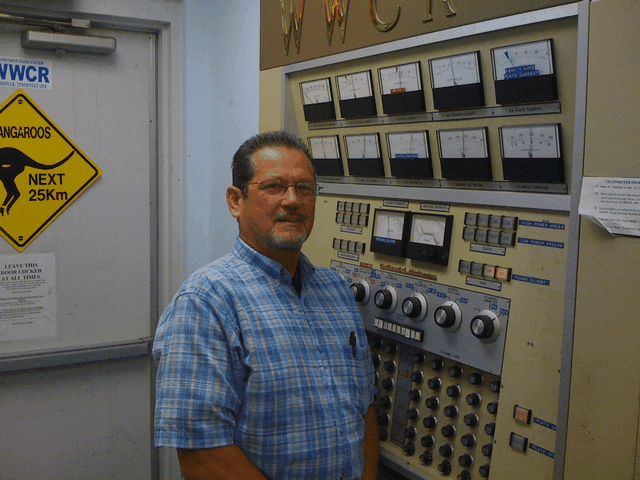
Sounds like some dire prediction, but no, actually it is a good radio show heard on Shortwave, WWCR-2 to be precise.  The show, at least during the weeks that I heard it, consisted of blues and other music that you likely won’t hear anywhere else.  Allan Gray, the host, also often interviews musicians and other persons of note.  I stumbled on this show a few weeks ago while listening to 12,160 KHz on Saturday afternoon. WWCR is touted as “World Wide Christian Radio” and there are many religious shows to be sure.  They also air several secular programs like World of Radio, Golden Age of Radio, DX Partyline and Ask WWCR and Info Wars, and others.

Allan Gray

From reading their schedule, Last Radio Playing can be heard on WWCR-2 Tuesdays at 5 pm est (5,070 KHz), Saturdays and Sundays at 3 pm EST (12,160 KHz), and on WWCR-3 at 8 pm (4,840 KHz).  WWRC is located in Nashville, TN.  They have four Continental 418 HF transmitters with a carrier power of 100 KW each.  WWCR-2 uses an azimuth of 85 degrees true and WWCR-3 uses an azimuth of 40 degrees true, both into Rhombic antennas with 14 dBi gain.

Today the show consisted of Christmas Music, which on the AM wide band receiver, sounded pretty good.  Anyway, if you are so inclined, tune in and take a listen.

Radio Industry Technology Study

Wheatstone, Inc has sponsored a radio industry future technology study which brings into focus some of the connections between technology and radio business models.   It appears to be very thorough, polling radio professionals on all aspects of technology development and management.

According to Josh Gordon:

While it is hard to predict which of the radio industry’s newest business models will succeed in generating new revenues, we can better anticipate the winners by measuring how fast the technologies that enable them are being adopted.

To find out, we surveyed the radio professionals involved in all aspects of technology management (engineers, and operations and technical management). The results reported in this study can serve as a benchmark for managers to evaluate their own organizations’ progress.

The first graph tells:

Wheatstone Technology Survey Results

Almost everyone believes that the internet will play a greater role in radio (and all media).  This goes against the “radio with its head in the sand” idea that can be found in some corners of the internet (I’d provide a link, but the site has turned on a paywall).

The question is, what are management-type people doing about it?  Some have good ideas on how to bridge the gap between making money the old-fashioned way; selling spots, to making money the new way; brand imaging,  media promotion, and personal contact through new media.  While it is generally agreed that radio stations should stream their audio, many, if not most, make little or no money on this.  If radio is going to make some revenue on internet applications, obviously some new ideas are needed.

Unique local content seems to be the most sought after, things like local news podcasts, or new music, e.g. studio sessions with up-and-coming bands and musicians, locally produced shows that are area specific, etc. Put a 10-second sponsorship in front of those and people will get the message.  Other things like value-added contests can only be heard on the internet.  Interactive radio station apps that have streaming, now playing, recently heard features that link to a .mp3 store for iPhone and Android operating systems.  Text link adds on radio station web pages, etc.

On the flip side of this, huge, great amounts of bandwidth will be required if the internet streaming is going to approach the same number of off-the-air listeners.  Depending on how the radio station has the stream set up, anywhere from 20 to 64 kbps of data transfer is needed for each listener.  For a station in a large metropolitan area, multiply that by 500,000 to 4,000,000 listeners at any one time, and data gridlock ensues.

On the in-house side, the red hot, cutting-edge thing these days is AOIP (Audio over IP), which Wheatstone is heavily invested in with its E console series.  While some might not think of AOIP as a traditional Internet application, it nonetheless uses the same transport protocols as other Internet applications.   AOIP offers some great advantages over other routing systems, as both private (internal) and public (wide area) networking can be used to transfer audio in real-time.  Of course, this is not as easy as plugging the new computer into an ethernet jack, it takes more planning than that.

Wheatstone has published an excellent white paper on Network Design for Ethernet Audio.  Well worth the read.

As AOIP technology develops more, web streams could come directly from the console and be customizable according to destination.  Further, IP logging can create stream user profiles and customizable greetings, listening preferences, and so on.  This would require that the web streaming server be in-house and that the studio facility has enough bandwidth to handle all of the outgoing streams and other content.

Certainly an in-house IT/Web developer will be needed to manage and maintain such a system.

You can download and read the entire studio at Alethea/Wheatstone Radio Survey.  The cliff notes summary is this:

Finding #1: Almost all radio tech people believe the Internet will play a bigger part in the future of radio.

Finding #2:Of the new revenue generating technologies, streaming a station’s signal has the biggest earning potential.

Finding #3: Technologies that require little or no capital investment are being deployed at similar frequencies by both stand-alone and group owned stations.

Finding #4: A technology gap is emerging as stand-alone stations deploy revenue generating technologies requiring investment at only half the frequency as group owned stations.

Finding #5: The revenue generating technology that most group owned stations plan on deploying next is a mobile app, while for stand-alone stations, it is broadcasting in HD Radio, with mobile apps coming in a close second.

Finding #6: There is a big divide between radio stations that are now, or will soon be, making money from streaming their signal over the Internet, and those who likely never will.

Finding #7: The day will come slowly, but in 15 years a majority of radio stations expect they will have more online listeners than RF listeners.

Finding #8: Despite the expected decline in over the air listeners, few stations expect to turn off their transmitters.

Finding #9: Three years from now, radio station technology will be more IT centric with more automation, as well as more networking between stations, IT networks, and office and audio networks.

Finding #10: Three years from now, the stability of each radio station network will be more important, as will networks with no single point of failure.

Finding #11: Three years from now, more audio consoles will be networked together. Also, the bandwidth of those networks will be required to increase.

Finding #12: The top reason group owned stations bought an AoIP network was to reduce maintenance costs. The top reason for stand-alone stations: to share talent.

Finding #13: At stations that have installed an AoIP network, more than a third of stand-alone stations found installing it harder than anticipated, while only 16.7% of group owned stations found installation harder than anticipated.

Finding #14: At stations with an AoIP network, more than one in four stand-alone stations and one in three group owned stations report latency problems.

The study is a good indication of where technical managers see growth.  One thing that internet sites like Pandora have shown, radio broadcasters cannot sit back and be content with the status quo.  Without technical innovation and some outside-of-the-line thinking, the radio will be bypassed by newer more interactive media services.

Something to ponder.