ABC turns to HF during tropical Cyclone

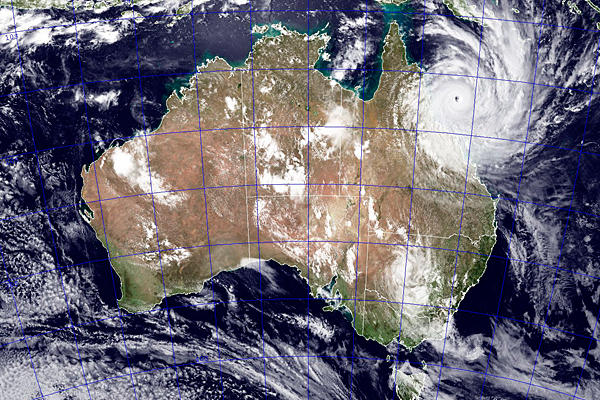
Super Tropical Cyclone Yasi, a category 5 storm, came ashore this morning between Cairns (pronounced Cans) and Townsville, Queensland around midnight Thursday (9 am Wednesday, NY time).

Tropical Cyclone Yasi, February 2, 2011

Radio Australia carried Australian Broadcasting Company (ABC) Queensland coverage of the storm, which was extraordinary.  Spot coverage, emergency information, sheltering information, updates, and calls from listeners in the midst of the storm.  Some of it is pretty intense.  One fellow, John, out in the country all by himself in the height of the storm sounded somewhat forlorn, I hope he makes it.

Due to the size of the storm, widespread power outages are expected and may last for weeks or months.  As a part of this, there are numerous outages and potential outages in their AM and FM broadcasting chain.  To that end, ABC has two shortwave frequencies available for their Queensland service; daytime (8 am to 8:30 pm local time, 2100 – 0830 GMT) on 9710 KHz and night time (8:30 pm to 8 am local, 0830 – 2100 GMT)  is 6080 KHz.

Once again, HF (shortwave) radio gets the job done when local stations, cell towers, and internet connections to dead.  Sometimes it is the low-tech answer.

Egypt demonstrates why the Internet is unreliable

On Thursday, January 27th at 22:34 UTC (about 4:30 PM, NY time) Egypt cut off outside access to the internet.  According to Renesys:

At 22:34 UTC (00:34am local time), Renesys observed the virtually simultaneous withdrawal of all routes to Egyptian networks in the Internet’s global routing table. Approximately 3,500 individual BGP routes were withdrawn, leaving no valid paths by which the rest of the world could continue to exchange Internet traffic with Egypt’s service providers.

Go and read the entire article.  Notice how the government asked and the ISP corporations complied.  This is in response to massive riots and uprisings in Cairo and other cities which may topple the government.   Think that the internet and new media alone can keep our government honest and doing the people’s work?  Think again.  Net Neutrality is a pipe dream and would do nothing to stop this type of censorship regardless.

A free press is one of the critical legs of our democracy.  Traditional broadcasting and media have been decimated in the last 15 years.  They are not without fault, cutting staff, politically slanted reporting, and profit-taking has done their part.  Fortunately, while staff have disappeared, the infrastructure (networks, transmitters, printing presses) remains in place.  They need to be revitalized and utilized.  There is a trend that I and others have noticed where small operators, perhaps one or two stations at most, are providing excellent service to their respective communities and running circles around other, group-owned stations in the same market.

Medium Wave List

This is an excellent data base of LW and MW worldwide: www.mwlist.org

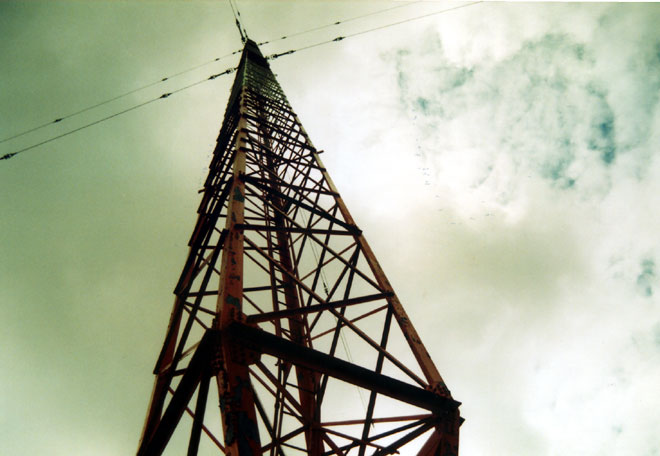
WGY 810 KHz, Schenectady, NY

According to the website:

This is a radio station database of all Longwave (LW), Medium wave (MW) and Tropical bands stations worldwide. You can browse frequency and location lists, search for stations, and get technical information. If you register, you can use a online logbook, create bandscans, and provide update information to the database editors. This is a free, open and non-commercial hobby project which depends on the cooperation of many individuals.

For LW/MW DXer’s this is a good information source.

Listening to the Radio like doing Cocaine

Well now, this explains a few things.  Always interested in carrying science forward, I read with interest the article on Gawker which cites a study from McGill University in Montreal, Canada.  The gist of the article states that we seek out music we enjoy because of a chemical reaction in our brains:

If music-induced emotional states can lead to dopamine release, as our findings indicate, it may begin to explain why musical experiences are so valued. These results further speak to why music can be effectively used in rituals, marketing or film to manipulate hedonistic states. Our findings provide neurochemical evidence that intense emotional responses to music involve ancient reward circuitry and serve as a starting point for more detailed investigations of the biological substrates that underlie abstract forms of pleasure.

By extension, radio has previously been the venue for most new music discoveries.  Although this continues today, it is being supplanted by “new media” sources such as youtube.  As a point of reference, studies on cocaine addiction show that dopamine levels increase by about 22% during use.  When a listener is exposed to what is perceived as good music (a subjective term), average dopamine levels increased by about 21%.

Risk-taking behavior like computer file sharing, when known consequences are large, could enhance that by adding an element of danger.  The Gawker article lists Samuel Barber’s “Adagio for Strings,” which I always found somewhat depressing.  Something more like this a little more fun:

You can disregard the T-shirt pitch at the end if you want.

So there you are you erstwhile program directors, now you know why your job is important; you are to make us addicts, or not, depending…