
My how time flies when you are having fun. Anyway, I came across this and found it funny on many different levels:

My how time flies when you are having fun. Anyway, I came across this and found it funny on many different levels:
A client of ours, WDST in Woodstock, NY, has this Best FE7KVA UPS. This unit is several years old and has already been through a couple of battery replacements. These are good units, however, Best Power has been bought up by Eaton/Powerware and they are no longer made apparently are still made.
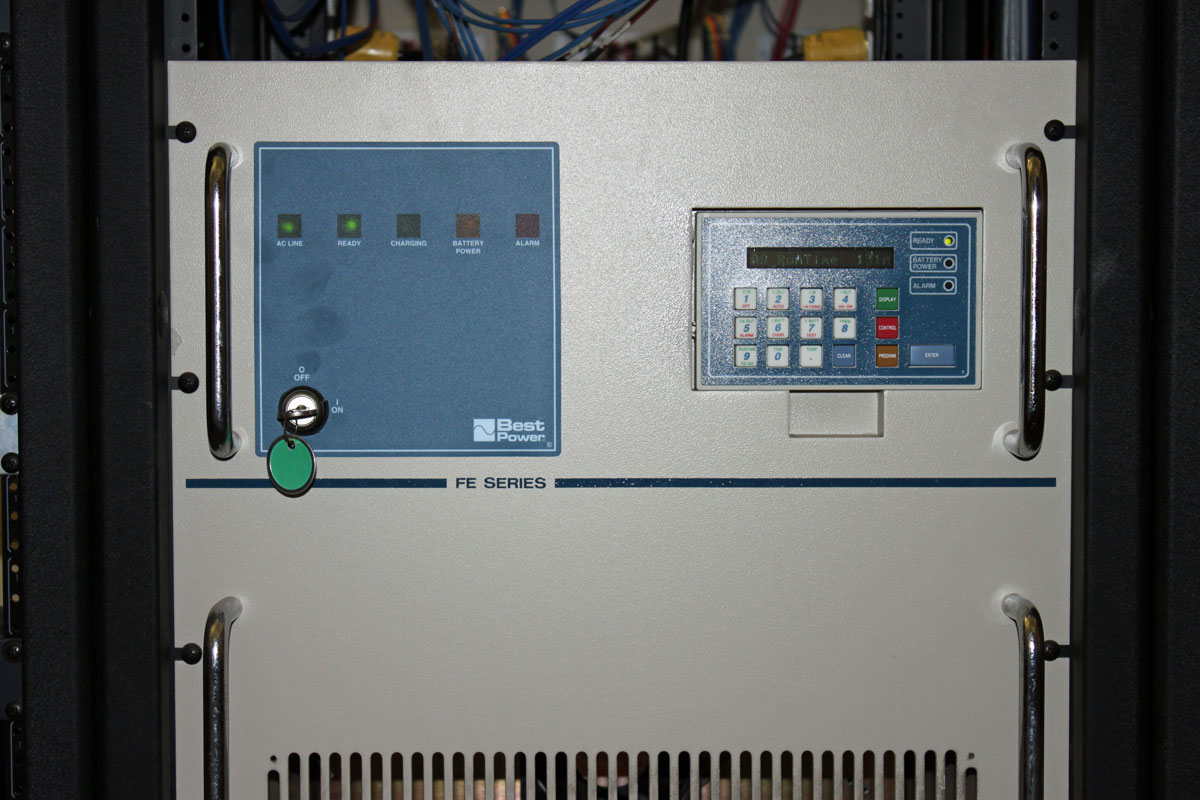
Regardless of that, the UPS is still functional, but like all UPS’s, it needs battery replacement every so often. This unit has three battery cases, each holding four 75 Ah (20 hour rate) 12 volt sealed lead acid batteries. Each battery is slightly larger than an average car battery. There is one important detail here, the batteries must be gas recombinant because the UPS has a four stage battery charging system. Gel or AGM batteries will not make it past the first or second equalizing charge.
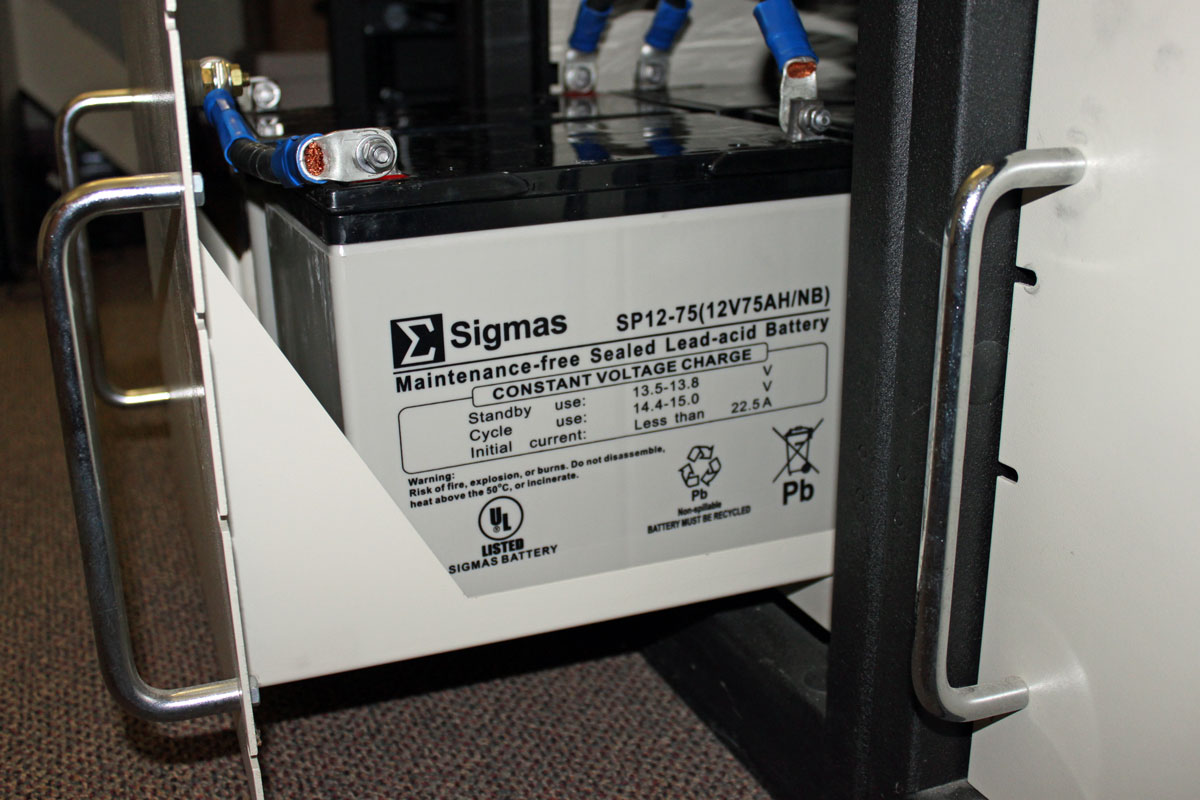
A bit about batteries and battery charging. Most battery chargers are three stage units; bulk, absorption, and float. The rate of charge depends on the voltage of the battery. Bulk charging sends the most current to the battery and for 12 volt cells, this anything below 12.5 volts or so. Absorption stage reduces the charging current and supplies a steady current until the battery reaches full charge of 13.8 volts or so. Float or trickle charging draws very little current, just enough to maintain the battery at full charge.
The forth stage of charging is equalizing which is important for multiple battery series/parallel installations. This is when the batteries are deliberately overcharged for a period of time. The reason for equalizing charges is to intentionally boil off some hydrogen gas and knock any sulfur crystals off of the lead plates. With multiple battery banks in a parallel configuration, it is important to maintain the battery resistances as close as possible so that each bank of batteries is drawn on and charged equally.
In flooded lead acid batteries, this works well and the battery either vents off the hydrogen gas or recombines it will oxygen to make water again. In non-gas recombinant cells, the hydrogen will be released into the room which may pose an explosion hazard. Additionally, the electrolyte level will need to be checked after every equalization charge. With a sealed non-recombinant battery, the case my bulge and split, spilling electrolyte and ruining the battery and battery enclosure. Thus the importance of ordering the correct replacement batteries.

After all, the reason for the UPS is to protect the expensive computer equipment connected to it. It simply will not do to install the wrong stuff and do more damage than if the UPS did not exist at all.
I have read an interesting series of articles on something called Panopticon. This is a concept put forward by an English social engineer where a prison is built in such a way that allows all inmates to be observed at any time without knowing whether they are under observation. Jeremy Bentham described it alternatively as “a new mode of obtaining power of mind over mind, in quantity hitherto without example,” or “a mill for grinding rogues honest.”
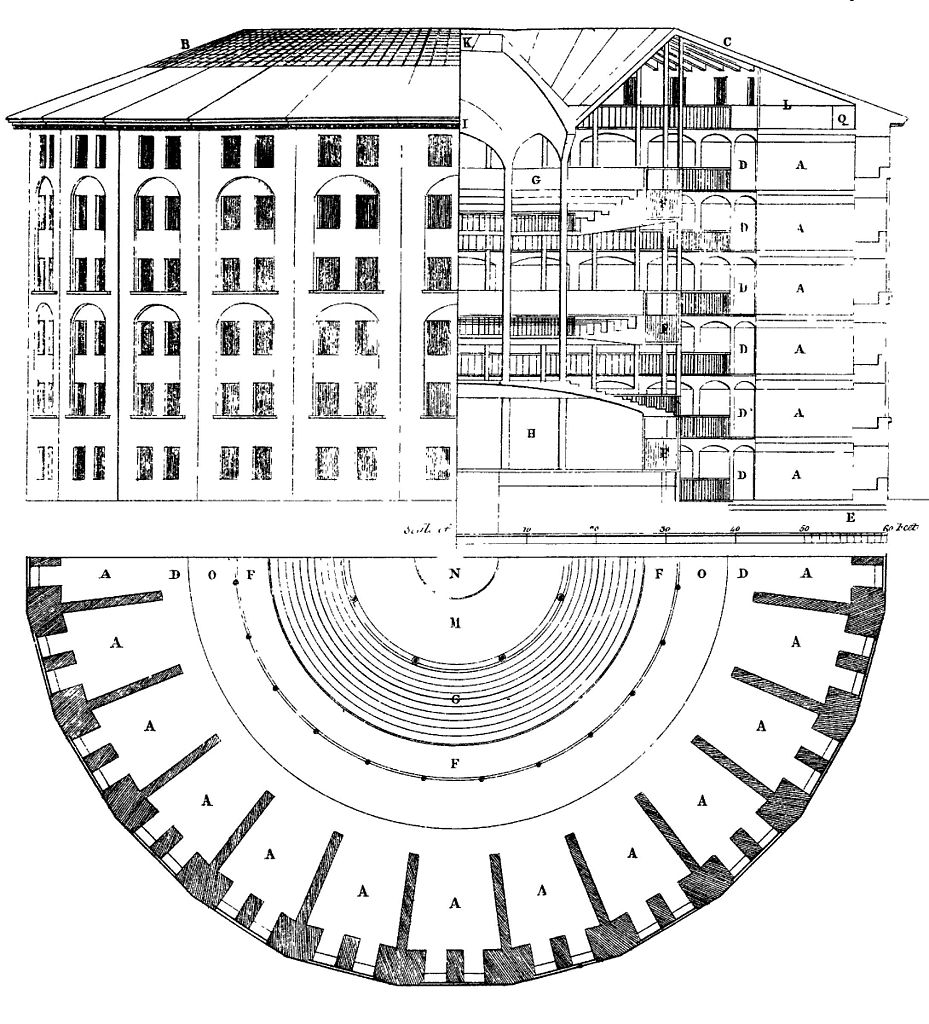
A few examples were built and used for a while:

This is, of course, tied to the current situation that the nation finds itself in with the NSA. The defenders of these actions have two common refrains; nothing we did is against the law and if you are not doing anything wrong than you have nothing to fear. Both are wrong, of course.
First, the notion that constitutional rights can be regulated away is incorrect. The US Supreme Court has ruled that (Marbury V. Madison) in the Constitution, the people established a government of limited powers: “The powers of the Legislature are defined and limited; and that those limits may not be mistaken or forgotten, the Constitution is written.” The limits established in the Constitution would be meaningless “if these limits may at any time be passed by those intended to be restrained.” Chief Justice John Marshall observed that the Constitution is “the fundamental and paramount law of the nation”, and that it cannot be altered by an ordinary act of the legislature. Therefore, “an act of the Legislature repugnant to the Constitution is void.” The limits of government intrusion provided in the fourth amendment to the Constitution of the United States stand, regardless of what the USA PATRIOT Act or any other recently passed federal legislation says.
Secondly, things have not ended well when a government has given itself this much power. In conjunction with the NSA’s all-seeing eye, the executive branch has also acquired the power to detain and hold indefinitely without charge anyone deemed a threat (defined as “terrorist”) to the government (NDAA 2012, 2013) and the ability to extra-judicially kill all they see fit (Justice Department: US drone strikes constitutional). Of course, neither of these things are constitutional either.
As the former East German Stasi officer Wolfgang Schmidt states “It is the height of naivete to think that once collected this information won’t be used.” We have, through our own lethargy and inattention brought upon ourselves the overly attached government, only not as cute as that, something like this:

Heaven forbid.
I wrote, a while back, that we have not reached a Runnymede moment. I retract that statement, we have indeed reached a point in time where civil disobedience may be necessary in order to restore our constitutional republic. The time for being safe, sitting on the fence, flying under the RADAR is over. As Aleksandr Solzhenitsyn said:
And how we burned in the camps later, thinking: What would things have been like if every Security operative, when he went out at night to make an arrest, had been uncertain whether he would return alive and had to say good-bye to his family? Or if, during periods of mass arrests, as for example in Leningrad, when they arrested a quarter of the entire city, people had not simply sat there in their lairs, paling with terror at every bang of the downstairs door and at every step on the staircase, but had understood they had nothing left to lose and had boldly set up in the downstairs hall an ambush of half a dozen people with axes, hammers, pokers, or whatever else was at hand?… The Organs would very quickly have suffered a shortage of officers and transport and, notwithstanding all of Stalin’s thirst, the cursed machine would have ground to a halt! If…if…We didn’t love freedom enough. And even more – we had no awareness of the real situation…. We purely and simply deserved everything that happened afterward.
Let us not learn the hard way.
Something that almost every radio station has but no one really thinks about; is the satellite downlink. I think radio stations began installing satellite downlink equipment around 1982. Before that, all network programming was carried hither and yon via Ma Bell’s extensive terrestrial microwave network.
Those early dishes were almost always Scientific Atlanta 9000 series 2.8-meter antenna system, which went with the SA 7300 DATS satellite receiver. Fast forward 31 years and things have changed. The satellite constellation is now spaced at one degree and those old SA 9000 dishes are not one-degree compliant.

Therefore, when it came time to re-aim a dish at AMC8, something new was required. A Prodelin 1374 3.7 meter center-fed C band dish was ordered up.
The first thing to do is look at the dish specifications and decide if the suggested mounting procedure is a good one. The soil in this area is sandy loam. The mounting design calls for a six-inch schedule 80 steel pipe at least six feet into the ground. This calls for renting an excavator, digging a six-foot deep hole, buying a 36-inch sono-tube and a 16-foot piece of 6-inch schedule 80 steel pipe, and a couple of yards of concrete from a truck. This work is all being done on the ground system for the WDCD antenna array. All the while, abandoning the old pad and dish in place. Seems like a lot of money and wasted materials. Reusing the old pad and part of the old mount made more sense. I did some rough calculations on paper regarding wind forces, this was the results:

The maximum static force is 1,555 N on the back bolts of the mounting ring into the concrete pad. Maximum wind force is 5,603 N, and a maximum wind from bearing 76° T will exert a force of 7,158 N or 730 Kg force on the back bolts of the mount. The concrete that the mounting bolts is embedded in will withstand 4,267 Kg of force at six inches deep. The the existing pad and 3/4 inch J bolts are well within their rating to handle this load, so it seems like a good design. Putting that to practical use:

First, we unbolted the azimuth mounting ring and removed the old dish, leaving the bottom of the mount. I drilled down 6 inches into the old concrete pad and inserted 1/2 inch re-bar. These re-bar are somewhat diagonal toward the center of the tube towards the new mounting pole.

Then, we placed the 6 inch by 8 foot schedule 80 pipe in the center of the tube and attached it to the tube with 1/2 inch all-thread. We used the all thread to adjust the 6-inch pipe to be vertical.
Next, we filled the old mount up with 4,000 PSI (280 Kg/square cm) ready-mix concrete and let it cure for one week.

While that was curing, I bolted the new Prodelin 1374 dish together on the ground. Follow the directions closely on this one, there are many pieces of hardware that look the same and are almost the same but will not work if exchanged.
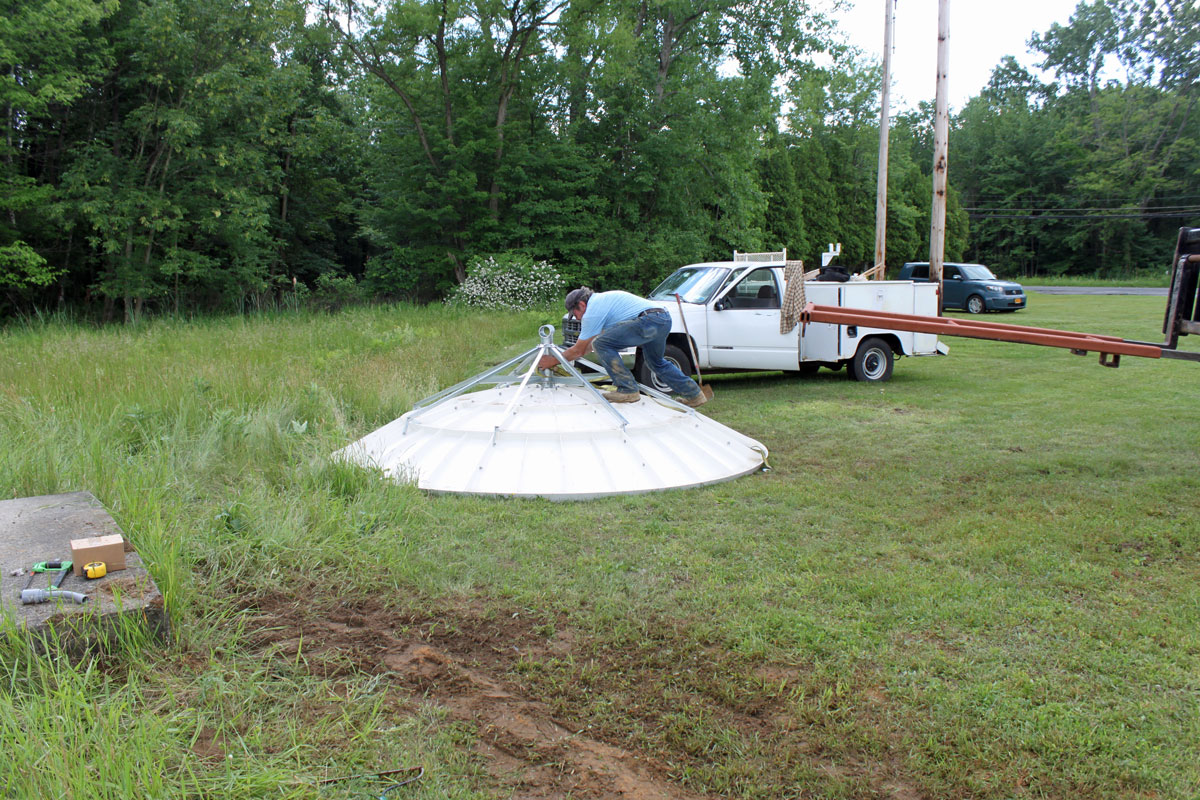
We used a loader with a lifting bar on it to sling the new dish into place. I was going to video tape this evolution, but we were short handed and I ended up helping bolt the dish on the mount once it was placed there.
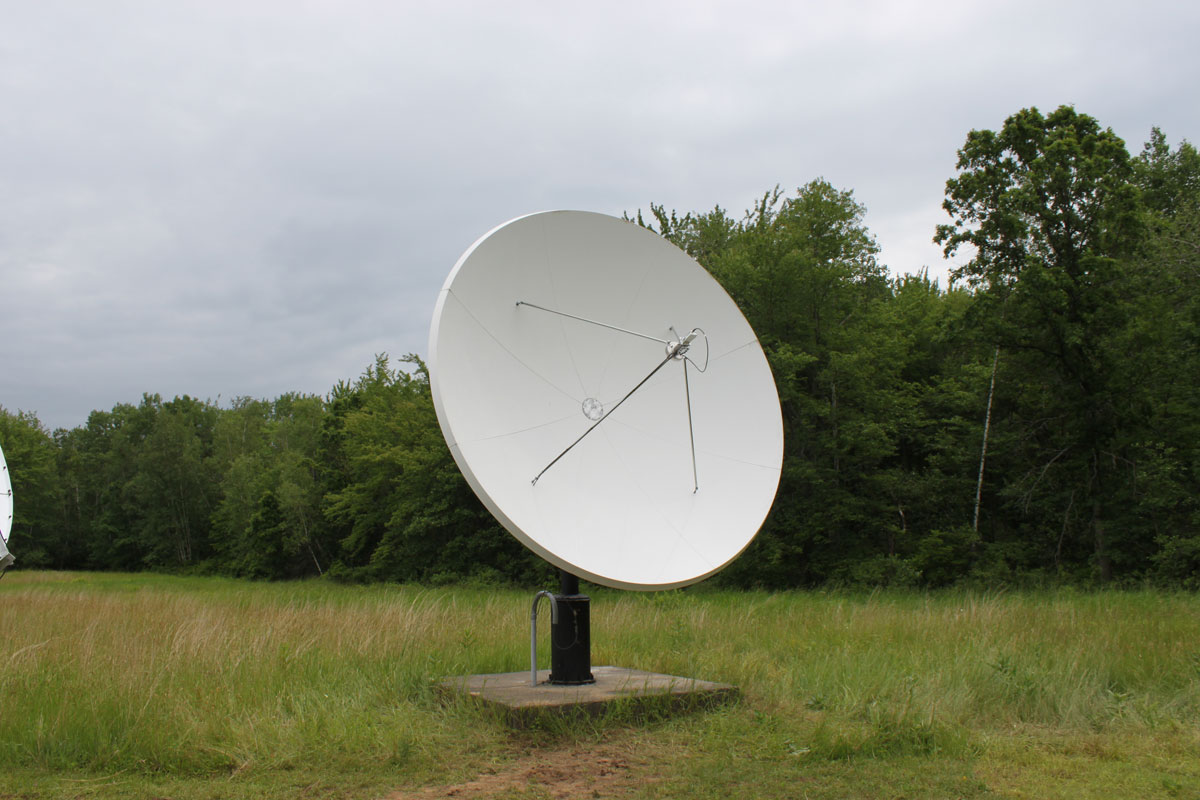
Once the dish was mounted, I installed the feed horn and LNB.

Then there was the aiming; this dish is pointed at AMC-8, for which I found this information from dishpointer.com most helpful:
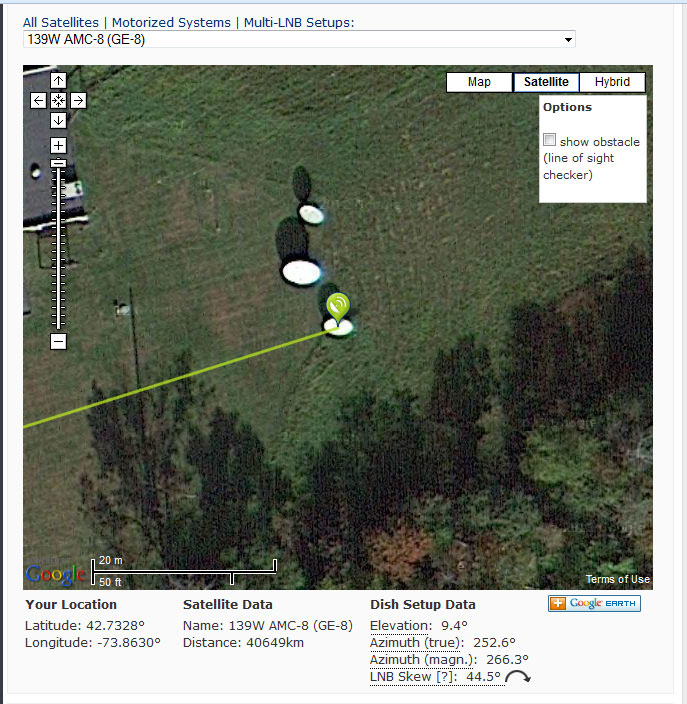
This is a crowded neighborhood and finding the right satellite took a bit of trial and error.