STEELYARD Over The Horizon Radar

This does not have much application for broadcast radio, other than the technical facilities are fascinating.  I did once hear the slow speed version on 500 KHz distress and calling frequency, which is below the broadcast band.    DUGA-3 Over The Horizon Radar (OTH) was a Soviet early warning radar system that operated on HF (between 3-30 MHz).  When I was in military communications, stationed on Guam, we were often plagued with the “woodpecker” sound, oftentimes pegging the signal strength meter on whatever frequency we were using. On any typical day, at least once or twice we would have to change frequencies due to the “RAT TATATATATATATATATATATATATAT!” coming in over the top of what we were trying to do.  Anyone who listened to shortwave radio or was a ham radio operator from the mid 70’s on through 1989 will be familiar with the sound.

The NATO classification for the system was STEELYARD.  I don’t know if it is a coincidence or not, but the name fits the system design. There were three systems, one located near Chornobyl, inside the evacuation zone, which was abandoned intact.  The second was near in Ukraine, outside of the Chornobyl exclusion zone, and the third was on the Russian Pacific coast, near the island of Sakhalin.

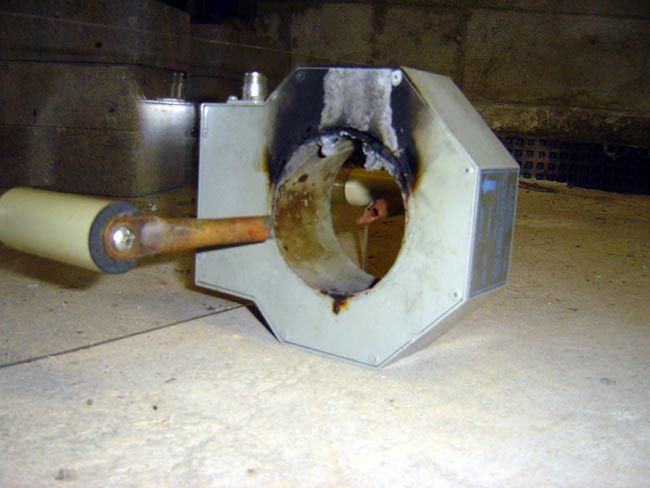
Basically, it operated in the HF frequency range, 3-30 MHz with a power of about 10 million watts (some sources up to 40 MW).  The propagation conditions were continuously monitored with an ionospheric chirp sounder (the civilian version looks something like this).  The best frequency for the target area was then chosen and used without regard to band plans or frequency planning.  In fact, often the Soviet shortwave propaganda station Radio Moscow was also interfered with.  The target areas were the missile launching and testing areas used by the US and Great Britain.  The object resolution was about 15 km, which is not that good, but good enough to determine the origin and flight path of a potential missile.

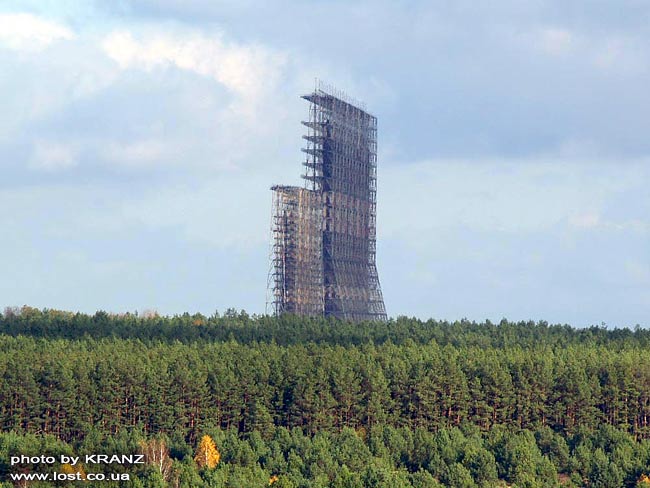
Distant view STEELYARD OTHR array, Chernobyl, Ukraine

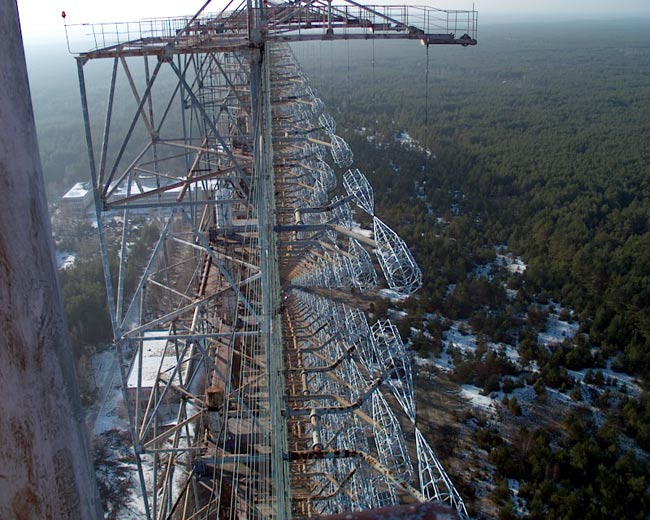
The remains of the DUGA-3 array near Chornobyl represent some real engineering feats.  First off, the tall towers are 146 meters (479 feet tall), the short towers are 90 meters tall (295 feet)  and the system is aligned in a row 750 meters (2,460 feet long). The taller towers are for lower frequencies because they have larger transmit antenna elements, thus the shorter towers are for higher frequencies.

Side view STEELYARD OTHR, Chernobyl, Ukraine

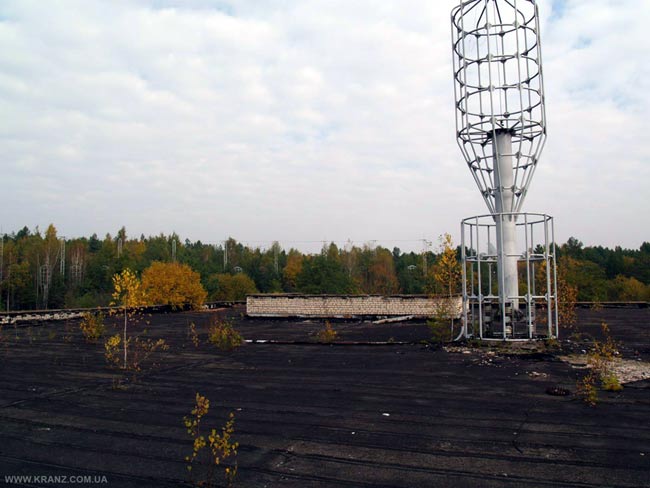
The array itself is quite an impressive close-up.  The cage like devices are the radiating elements of the antenna.  The elements are feed by open wire feed line from the bottom of the tower.  Behind the radiating elements, you can see a series of wires, these acted as a reflector, directing the energy transmitted out the front of the array.

Active transmitting elements, OTHR

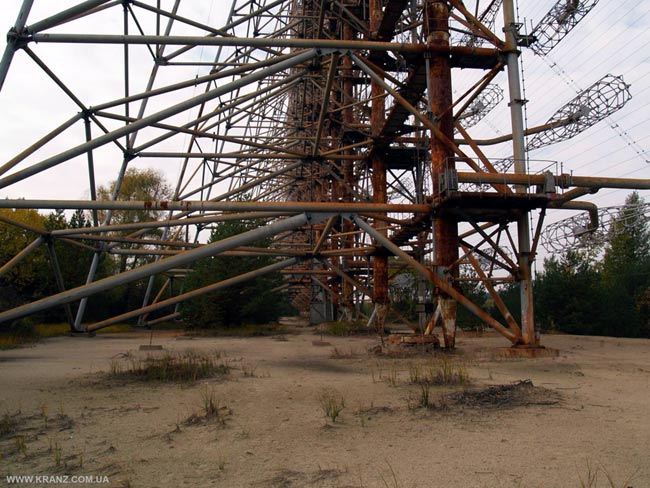
Considering the wind load, these are substantial towers.  I would say the wind load on the face of the tower would be almost equivalent to flat plate.  The towers are strongly back-braced.

Under the towers, OTHR

The ionospheric chirp sounder receive antenna is also located at a site known as “The Circle.”  An ionospheric chirp sounder sweeps the HF spectrum from one location and is received in a second location.  This gives real-time radio propagation information.  The Circle is about ten miles away from the STEELYARD array.

Ionospheric chirp sounder antenna, Ukraine

The other DUGA-3 radar stations were scraped after the system was turned off in 1989, this one was abandoned intact.  Over the years looters have made off with most of the transmitter and receiver apparatus, wiring and associated scrap metal.  Only the towers remain and empty buildings remain.

Pictures from Lost Places, more pictures and information there.

S.2881 – FCC Commissioners’ Technical Resource Enhancement Act

The House version of this bill is HR 4809.  It seems that in this day and age, as the country is becoming more and more technologically advanced, the communications regulation arm of the federal government is feeling a little left behind.  This is a fairly common thing these days, companies are run by accountants and lawyers while the engineers and technologists that actually do whatever technical thing the organization is supposed to be doing are “those funny guys in the basement” or corner or wherever.  The bill reads as such:

Section 4(f)(2) of the Communications Act of 1934 (47 U.S.C. 154(f)(2)) is amended by inserting after the first sentence the following new sentence: ‘Each commissioner may also appoint an electrical engineer or computer scientist to provide the commissioner technical consultation when appropriate and to interface with the Office of Engineering and Technology, Commission Bureaus, and other technical staff of the Commission for additional technical input and resources, provided that such engineer or scientist holds an undergraduate or graduate degree from an institution of higher education in their respective field of expertise.’.

That would be a step in the right direction.  Hopefully said engineer has several years of experience also, field experience would be even better.  As a radio engineer, I learned that theory is great and most of the time everything goes together exactly as it is supposed to.  There are those occasions, however, where theory has to be thrown out and a prove-fail/prove-pass approach needs to be taken.

In any case, the bill appears to be on the fast track and hopefully, the FCC commissioners will choose and use their staff engineers wisely.

I-Buzz

Rumor has it that iBiquity is going to release a software upgrade for the AM IBOC system they peddle.  Allegedly it is going to improve the sound quality of the digital signal, allow the analog signal to increase its bandwidth to 10 kHz, and provide data such as song titles.  No word on whether they will be providing software upgrades to consumers for the many HD radioTM receivers out there.

I have been following a discussion on AM quality over the last few days.  It seems many engineering types at least, acknowledge that analog AM can sound good, if not more natural than FM.  The addition of IBOC hybrid mode on AM station has created more noise and further degraded the station’s main signal by reducing the bandwidth to less than 5 kHz.

Tonight I am listening to WWVA on 1170 kHz, and there is this horrific white noise/hash over top of the station.  Same thing on 1190 kHz, all courtesy of WHAM 1180’s IBOC transmission.  It is one thing to trash your own station, limiting the analog audio response to 5 kHz.  It is quite another thing to trash the adjacent frequencies with noise making them unlistenable.

Here is a brief clip (recorded at 8:00 pm EDT, March 24, 2010):

The second clip, WWVA has faded out (recorded at 9:10 pm EDT, March 24, 2010)

The audio in these videos is adequate but not the best, still, it is pretty clear that there is a whole bunch of white noise on top of WWVA’s signal and on 1190 where no station is coming in. The only conclusion that I can draw is that WHAM is operating with their IBOC turned on. This was recorded at a location that is 197 miles from WHAM and 364 miles from WWVA.  I have made several better recordings directly into the computer without the video frequency readout reference.

In 1990, the FCC mandated NRSC-2 (73.44) spectral mask on all AM stations, requiring them to put in brick wall filtering to limit the bandwidth to 10 kHz or less.  They also require all AM stations to do “equipment performance measurements” (73.1590) to verify that the stations are complying with FCC regulations.  This was done because of excessive sideband splatter by AM broadcasters creating interference to adjacent channel stations.  I agree in principle with the NRSC-2 standard, I think it serves a purpose.  Why then, are stations allowed to interfere with other stations with IBOC signals?  Even though Ibiquity has put up a spectral mask that complies with NRSC-2, it still creates interference.  Isn’t this a double standard?  A station in Pennsylvania gets fined $4,000.00 for operating past its sign-off time (because operating after sign-off might create harmful interference), yet, WHAM gets to generate noise all night and drowned out adjacent channel stations that are hundreds of miles away.

In the meantime, if the FCC inspector shows up at a station that has not made the required “equipment performance measurements” they will get a fine too.

Am I crazy, or is it hypocritical bull shit to fine one station for potentially harmful interference, but then the FCC to ignores its own rules and allows another type of interference?  Hint: I am not crazy.

I have recorded this in .wav format and I am sending it to the FCC with an interference complaint letter.  It is about time somebody made some noise about this noise.  Apparently, there are many engineers who feel the same way.  Will Ibiquity listen, or will they keep doing CPR on a corpse?