Computer file manipulator

It just doesn’t have the same ring as Disk Jockey or DJ.  However, that would be an apt description of the person who plays the hits on most radio stations these days.

It is mostly just drag and drop the next element into the play deck if anything needs to be done at all.

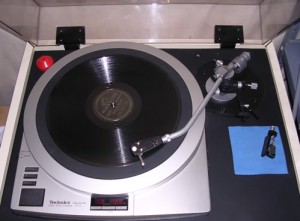
Technics SP-15 Turntable

I remember when DJs actually jockeyed disks, it was a sight to behold.  Back in the day when everything was on vinyl except the commercials, which were on the cart, the DJ had his or her hands full.  Most of the songs were in the 2:30 to 3-minute range, so while the song was playing, the next song had to be cued up on the platter, the old song needed to be put back into its sleeve and shelved (most of the time), check the log to see what was on deck, pull the next commercial stop set, answer the phone and god forbid if the Program Director called on the hotline and it rang more than 3 times.  And hopefully, the head wasn’t too far away, that coffee went somewhere, after all.  While all that is going on, timing, audience interaction, hitting the post, and sounding fun.  In spite of what Howard Stern says, it was not easy.

Today, of course, if there is even a person in the studio, they may glance up at the computer screen every now and then to see when the next time they need to talk.  Otherwise, they would be engaged in talking on the phone with their girlfriend, texting, surfing the internet, or watching a baseball game on TV.

Copper theft and how to avoid it

One of the unfortunate signs of the times is the increased theft of valuable materials. Copper, while not as expensive as it once was, still fetches a fair amount at the scrap dealer. One local telephone company has been having a difficult time keeping its aerial cables intact in certain areas. For radio stations, the situation is compounded by remote transmitter sites with lots of copper transmission lines and buried ground radials around AM towers.  Reduced staffing levels also mean that the weekly trip to the transmitter site is now every two weeks or perhaps once a month or even less.

Sites that are not visited or monitored very often are prime targets for copper theft.  Forget asking the local constabulary to patrol more often, the few times I tried that I was met with a blank stare.

A few common sense type things that I have learned over the years may keep your site intact:

  1. Keep up appearances.  A neglected transmitter site is more likely to attract the wrong type of attention from the wrong type of people.  Clean up any rubbish, dead equipment, keep the weeds and trees cut down, etc.  If a site looks well tended and is often visited, a thief may think twice about lifting valuable metals.
  2. Along with #1, keep things buttoned up.  Secure all transmission lines to ice bridges, remove any deadlines, etc.  If there are ground radials poking out bury them, same with ground screens, copper straps, etc.  Out of sight, out of mind, leaving this stuff exposed is asking for somebody to come along and give a tug.
  3. Fences and locks.  Towers are required to be fenced and locked to prevent electric shock hazards.  It is also a good idea to fence the building, generator, and fuel tank if possible.
  4. Post all sorts of warning signs, RF warning, high voltage, no trespassing, under video surveillance, pretty much anything to deter trespassing and vandalism.
  5. Add video cameras with a video recording device since most theft occurs during non-working hours.  Last year, the company I used to work for traded a video surveillance system for the studio location.
  6. Compensate a neighbor to keep an eye on the place and call you if they see any suspicious activity.  It doesn’t even have to be money, I once worked out a deal with a neighbor for some T-shirts and CDs.   That was the best alarm system we ever had.

In the long run, keeping all the copper parts where they belong is a great way to avoid those annoying “the station is off the air” phone calls not to mention the expense of replacing damaged transmission and ground systems.

The loudness wars are over, Apple has won!

Excuse me while I gag…

Okay, that’s a little better.  I was just reading up on the newest, greatest, holy cow, gee whiz, gotta have that expensive box processor, also known as the Omnia 11.  I have to hand it to Mr. Frank Foti and his marketing team.  They have created one heck of a buzz about this thing, and it seems like folks are jumping on board to shell out $10 – $12 K for the box.  But let us review a few things.

I will admit most freely that I tend to be an audio purest.  I do believe that a limited amount of processing has its merits, especially for those listeners in high-noise environments like automobiles, work sites, etc.   With sloppy DJs working the consoles, there is a minor need for some limiting, gain reduction, and so on, just to the air product levels aren’t all over the place.  Those are real-world considerations.

Does an iPod have an air chain processor? No, if the iPod user wants more loudness, they turn up the volume.  Since most Ipod users are normal people and not some burned-out DJs with bad hearing, the volume control on an Ipod has plenty of headroom to satisfy.  Does a Droid or a Blackberry or whatever else people are listening to these days have an air chain processor? No.  And most users/listeners of those devices are perfectly happy with the quality and quantity of audio.

Back in the day when loudness meant a bigger transmitter, more carrier power, bigger signal, was easier to tune manually with the non-digital dial readout, etc., perhaps a loudness war with the cross-town rival was part of the game.  Nowadays, nobody cares except the program directors.  I repeat NOBODY CARES.  Ask anybody on the street what the loudest radio station is.  They very likely won’t even understand what you are trying to ask and you likely could not explain it in terms that would make them understand, much less care about.

The average person doesn’t give a rat’s ass about loudness.  Nor do they really care about how deep and full the DJ’s voice is, or how well the noise gate works, or the six-band EQ, or any of that crap.  In fact, if the music sounded just like it does on the iPod, e.g. completely unprocessed, they probably wouldn’t even notice.  The competition has changed and radio is being left behind because many people are stuck with old ideas about how things used to be.  Times have changed, and what should be the driving force in radio, the listeners, want to hear the music that they like.  That is what the program director should be worried about, finding and playing good music that the listeners want to hear.  Or having the best talk show, the most interesting news, or whatever other programming the station carries.

If the programming content is good, compelling radio, they will listen.  Never mind the air chain processor, the mic processor, the limiter, how loud the station is, what power the transmitter is running at, etc.  That is for the Engineers to take care of.

The first radio stations

On this, the 98th anniversary of the sinking of the Titanic, some radio history is in order.  Before broadcast stations, radio was mainly used by ships at sea sending messages in Morse Code to coastal radio stations.  These messages could be routine; we are on schedule, we are carrying such and such cargo, request port clearance, etc.  They could also be urgent; the ship is sinking, we need medical advice, etc.

RMS Titanic, April 10, 1912

Most of these early radio stations were owned by Marconi Company, which later became RCA.  One of the first Marconi Stations was in Wellfleet Cape Cod, the original call sign was MCC (for Marconi Cape Cod) later changed to WCC.

On April 14th about 11:45 pm, the Titanic struck an ice burg and sank about two and a half hours later.  The RMS Titanic call sign MGY was equipped with a radio transmitter at a time when ships were not required to be.  Sadly, the finer details of distress procedures for radio-equipped ships had not been worked out.   After this incident, radio distress procedures were codified and the SOS evolved into an internationally recognized distress signal.

On the night the ship sank, the Marconi employed radio operators were sending routine traffic to Cape Race, Newfoundland radio.  Because the radio apparatus used spark gap transmitters and crystal radio receivers, interference from other ship stations often caused problems.  Earlier in the evening, a Titanic radio operator had strongly rebuked the operator from the closest ship, the SS Californian, telling him to “Shut up, shut up, I am busy; I am working Cape Race.” At about 11 pm the SS Californian operator retired for the evening and the Californian never received the distress call.  Sadly, this incident probably led to the high loss of life because the Californian was just over the horizon to the west and would have likely been able to rescue many of the passengers before the Titanic sank.

Coast Guard radioman Jeffrey Herman has a good SOS story from the late 70s.  Being stationed in Hawaii, he was on duty late one night at Coast Guard Radio Station Honolulu, call sign NMO.

John Davies, the radio operator on board the Eriskay also has a story about receiving an SOS while at sea. Fortunately, that one turns out a little better.

I remember one night, hearing an automated SOS on the international lifeboat frequency (8364 kHz).  I imagined some poor guy cranking the lifeboat radio not knowing if it was going out or not (I was right, it turns out).  We heard him on Guam and DF’d him to off the coast near Australia.  We notified the Australian authorities, who diverted a nearby ship that picked 26 survivors up the next morning.

I am sure there a quite a few old CW (morse code) radio operators out there that have similar stories.  By the 1990s most maritime communications had moved to INMARSAT, and CW and coastal radio stations became redundant.

The end of commercial Morse Code in the US came on July 13, 1999, when KFS, the last coastal radio station, signed off.  Most of them have been scrapped and the valuable coastal land sold off to developers.

The development of broadcast radio was a direct offshoot of these radio stations.  AM radio, or rather AM technology was developed by ATT as an adjunct for their long-distance system.  ATT used High Frequency (HF) voice circuits to span oceans for several decades, up to about the mid-1960s.  Amateur radio operators began fooling around with voice broadcasting, using ATT’s patented AM technology around 1915 or so, after tube-type transmitters and receivers became available.   Somebody realized that money could be made with the new-fangled radio contraption and commercial broadcasting was born.