The death of the Album Side

When I was a wee young lad, the local FM station in town did something called an “Album Side” every Wednesday night at 8 pm.  It was a great way to hear half of an album before plunking down five hard-earned dollars at the record store.  It was also a way to sometimes get a recording of half of the songs on the album using the trusty stereo cassette deck.

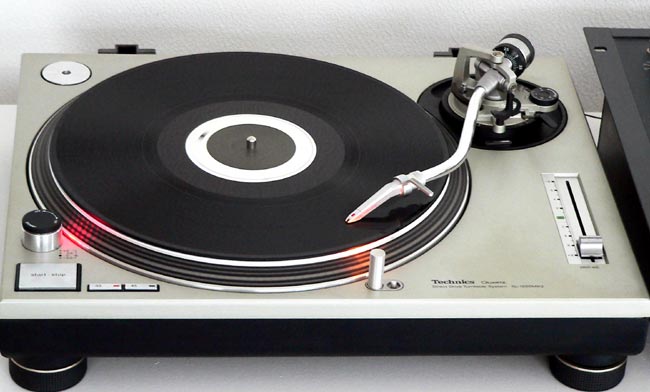
Technics SL-1200 turntable
Technics SL-1200 Turntabe

By way of these unauthorized recordings, I accumulated a bunch of cassette tapes that had bands like Aerosmith on one side and Foreigner on the other.  Often, the last 8-10 minutes of a cassette tape side would be silent.  This, coupled with the auto-reverse mechanism on the cassette deck often lead to confusion with my high school sweetheart… the music ends, then while we were otherwise distracted, and several minutes later, the music begins again at high volume.

I grew up in much simpler times than these.

In any case, the advent of the CD pretty much ruined the concept of album sides.  It means much less to somebody to have a show where one would play “half the songs on a CD, one after another, without commercials or liners.”  When CDs became the norm for music playback somewhere in the late 1980’s early 1990s so went the album side.  These days, with computers, MP3, and all the other music storage mediums, most people wouldn’t even know what an album side was.  The shame of it is, it was a great selling tool for the record industry.  Even though I owned those bootleg cassette tapes, later on, I went out and bought almost all of the albums that I had illegally recorded off of the radio.  To get the other side.

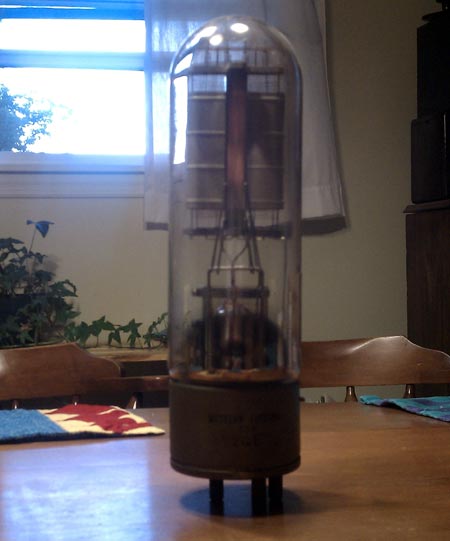
Western Electric 212E vacuum tube

The company I work for is in the midst of cleaning out a studio location.  Most radio engineers are some form of pack rat.  I know I have been guilty of this myself, not wanting to throw something away because tomorrow, it might be needed.  That was carried out to the extreme at this location.  One of the things that I found in my clean-out was a Western Electric 212E vacuum tube.

Western Electric 212E vacuum tube

It is an impressive thing, measures about 12 1/2 inches tall, including the pins.  I am thinking this is pretty old, it probably came from a pre-WWII Western Electric AM transmitter.  This would make the most sense, as the station signed on in 1926 with 250 watts.  Back in the day,  Western Electric was the patent holder for AM technology.   In fact, there was some talk of suing General Electric for patent infringement after the airing of the world series by WJZ and WGY in 1922.  Parent company AT&T was working on radio modulation techniques to implement with their telephone system.

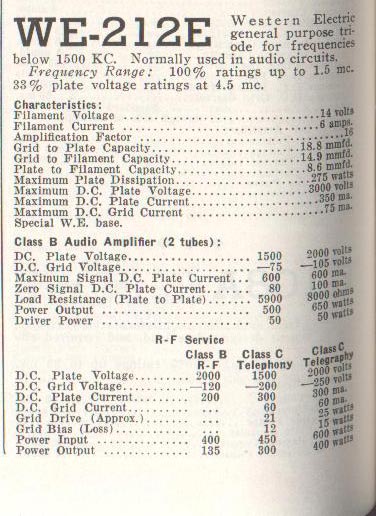
These tubes were used for audio amplification, according to the spec sheet, the plate could dissipate 275 watts.  Filament voltages is 14 volts at 6.2 amps, the plate voltage was 3,000 volts, maximum.  It is a tetrode.  The RF counterpart to this tube is the WE 308A.

From what I am to understand, these have not been made since 1960 or so.   I also understand there is quite a cult following for this tube amongst Asian audiophiles.  There are several examples of extremely low distortion class A and AB amplifiers using this tube type.  Some prices on eBay are in the $1,500 to $2,000 per tube range.  Unfortunately, I don’t think this one works anymore as there is a loose screw and little bits of what looks like control grid wire in the bottom of it.  It does light up with 12 volts on the filament, however.

IBOC update, part II

In a way that never ceases to amaze me, Bob Strubel spins another yarn about HD Radio.™  According to Bob:

Tom’s experiences at the Ford dealership are disappointing. We believe they reflect the growing pains which often occur when companies launch new technologies. Tom hit the lot as factory installed HD Radio receivers were just launching.

Well, then, I guess that explains that.  If I went to a Ford dealership today, I’d find plenty of models with HD radio(s)™ stock, right?

As far as new technology and growing pains, let us pick that apart piece by piece:

  • IBOC has been in development since 1990 or thereabouts.  Not really new technology.  Apple’s iPhone and iPad are new technology (2 years and 3 months respectively).
  • Ford Motor Company has been an HD Radio™ partner since 2007.  One would think that all the kinks would be worked out by now.
  • The IBOC rollout hit a wall around 2008 and hasn’t grown since then, both the AM technology, which appears to be shrinking, and the FM technology, which appears to be subsidized by the US government.

To test Mr. Strubel’s next statement:

Had he been able to hold out with his old Explorer for another couple months, he would have been able to purchase an Escape with a factory installed HD Radio receiver as these vehicles hit dealerships the first week of August.

It is now the third week in August, I stopped by three Ford dealerships in reasonable-sized cities around here.  Not really wanting to waste a salesperson’s time, I cut to the chase and asked about vehicles with HD radios.  Here is the response:

  • Dealership #1 said they knew about HD radio, but none were in any of their stock vehicles.  They also could not give me an idea of how long I’d have to wait to receive one if ordered separately.
  • Dealership #2 pointed me in the direction of SiriusXM, saying that satellite radio was digital radio, or HD Radio™, or whatever it was
  • Dealership #3 never heard of HD Radio™ and said that all their radios were digital (Like, Duh!)

Finally, there is this standard iBiquity statement that seems to go well in any situation:

…it’s ironic that his negative experience happened at a time when the consumer rollout of HD Radio Technology is stronger than it has ever been. We are seeing dramatic receiver sales increases across all segments – OEM auto, consumer electronics, and the new portable HD Radio category. Overall sales of HD Radio receivers will more than double in 2010, and that is on top of a doubling from 2008 to 2009. Can anyone point to any other facet of AM/FM that has seen this sort of growth over the last several years?

Sure, analog AM and FM receivers continue to fly off the shelves in all the markets quoted above too.  Furthermore, doubling receiver sales from one small number to another small number is not that dramatic.  As Mark Twain said: “There are three kinds of lies; lies, damned lies, and statistics.”  It’s like the rookie batting 1000 after his first time at bat; it happens occasionally, it is really not that dramatic or remarkable.

Comparing new technology such as the iPad to middle-aged technology such as IBOC is silly.  The iPad has all sorts of neat features, interactive programs, applications, etc.  IBOC is just a one-way radio that does sound any better than the old-style radios.

Remotes using a Smart Phone

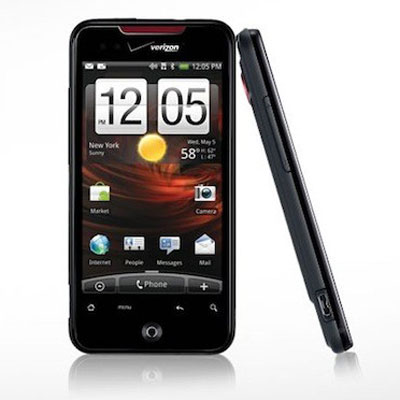
I was fooling around with my HTC  Android phone yesterday and discovered something that has a definite use for radio remotes.  An Application called Hertz will record .wav files, which can then be transferred via e-mail or ftp to the studio and played back on the air.  The program is pretty slick, it allows sample rates from 8 to 44.1 kHz.

I made a sample recording, the microphone in the HTC phone is okay, a better microphone would sound better.  After it was done, I emailed it to myself and listened on the laptop.  The email took about 4 minutes for 20 seconds of a 32 kHz .wav file.  One could cut that down by choosing a lower sample rate.  I have found that 32 kHz is the minimal acceptable sample rate for analog FM.  Anything lower than that sounds choppy.

In another potential use, a news reporter could use this to record audio to save and transfer to a computer using a USB cable.  The recording time limit depends on the size of the SIM card and the sample rate.  Additionally, my HTC Android phone will detect and use WiFi networks, where available, for data services.  Using a WiFi network will avoid those 3G data charges and also increase download/upload speeds.

My Verizon plan has unlimited data transfer, so it really doesn’t matter what sample rate I use, your mileage may vary.

Couple the Hertz app with the VNC app mentioned previously, and a person could do all sorts of things remotely with a radio station.  The Hertz app is available for free download from the Android app store.