WSPK antenna replacement, part I

WSPK is located on North Mt. Beacon, which is the highest point for miles around. It has a fantastic signal. The site is a little difficult to get to, however, especially in the winter.  In previous years, the road has been impassable four months out of the year.  Some engineers have hired a helicopter to get up there when the snow is deep.  For that reason, it is important to keep the equipment in good shape.

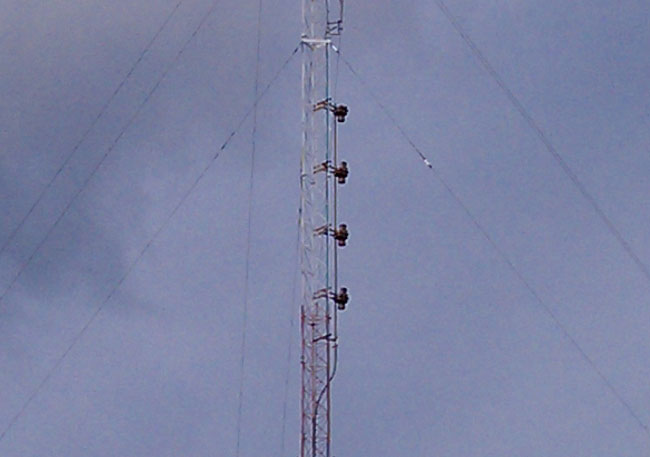
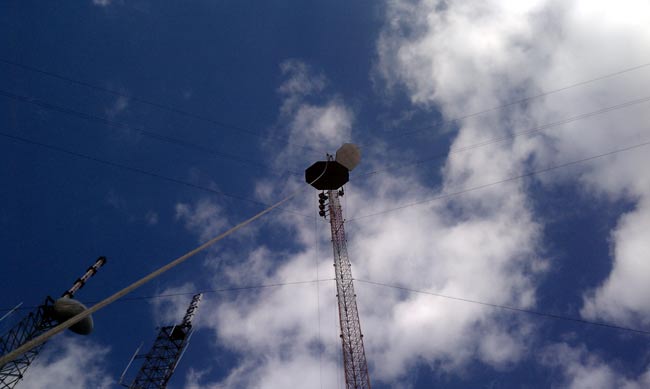
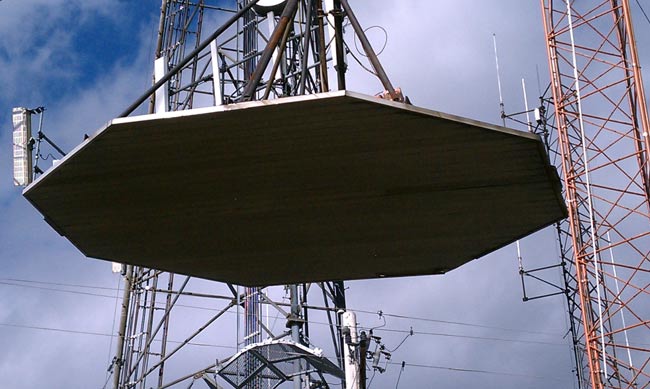
WSPK Shively 6810 antenna with damaged top radome

After last February’s snow/rain/ice storm, it was noted that the top antenna radome was missing its top.  A tower climber was sent up to look at it and it was also discovered that the top bay was bent down and the element was almost cracked in half.  A result of falling ice, likely from the big periscope microwave reflector (passive reflector) mounted above it.

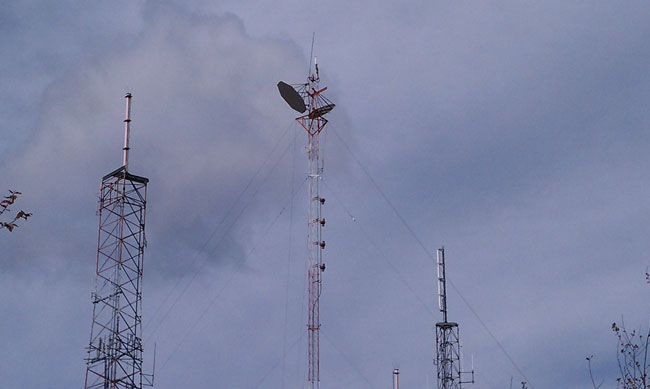
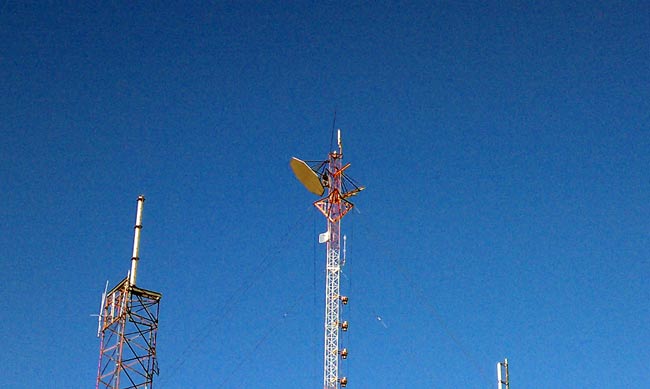
WSPK tower
WSPK tower

The periscope reflectors went out of service in 2007, but the tower owner did not want to pay to take them down, thus a problem was not being solved.   It was decided to replace the 25-year-old Shively 6810 antenna with a new one, during which work, the radio station would pay to remove the reflectors from the tower.  In exchange for that work, the radio station would then be able to repair and remount the old Shively antenna below the new one, thus having a backup antenna.  Problem solved, except for, you know:  The actual work.

The tower and the periscope microwave system were installed in 1966, operated on 12 GHz, and were used by the Archdiocese of New York to relay their educational television programming from their Yonkers headquarters to the various schools in the Hudson Valley.  Sometime around 1975 or so, the FCC mandated that periscope microwave systems could no longer be used due to all the side lobes and interference issues they caused.  They were to be taken out of service as soon as possible.  The Catholic Church, being a multi millennial organization figured “as soon as possible” meant within the next fifty years or so.  Anyway, somebody else needed that frequency, therefore in 2007, they bought the Archdiocese a new digital microwave system.

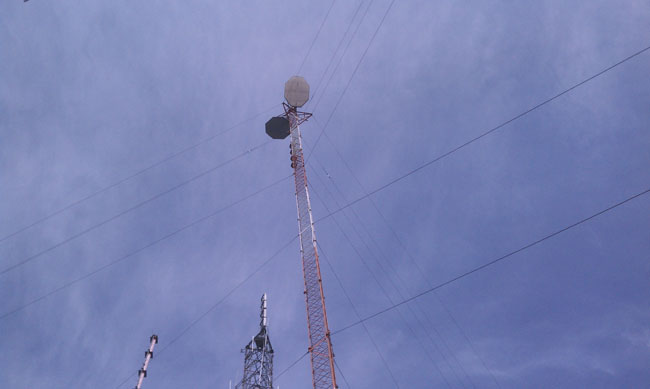
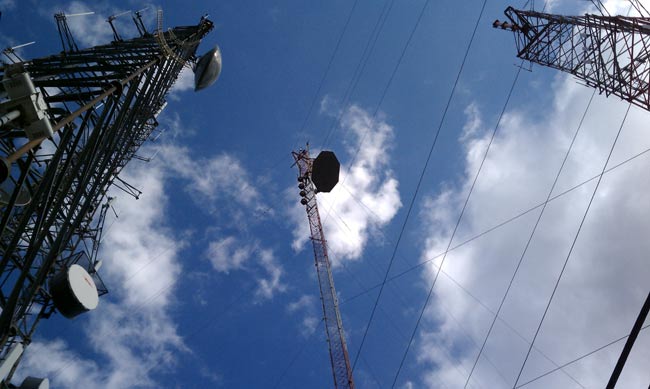
The problem with the reflectors; they are big.  They are also heavy, and present a huge wind area.  They are also 300 feet up in the air.

WSPK tower periscope reflectors seen from ground level
WSPK tower periscope reflectors seen from ground level  

Finding a day with lite winds on top of Mount Beacon can be a problem.  Luckily, the weather was with us.  Still, it took a while to get this work moving along.  The other consideration is RFR and tower climber’s safety.  There are two digital TV stations, WSPK, several cell carriers, something called “Media Flow,” and a bunch of two-way radio repeaters.  The main concern was WSPK, the DTV, and Media Flow since the top of this tower is right in the aperture of those antennas.  All either went way down in power or off the air while this work was ongoing.

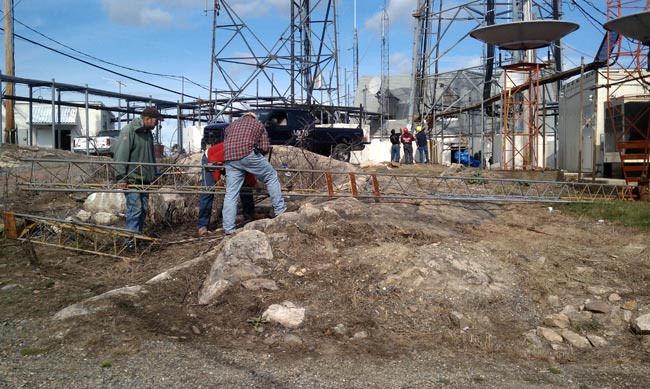
Rigging a gin pole and getting it to the top of the tower was a chore.  The gin pole needed to be threaded through those torque arms like a needle.

Gin Pole
Gin pole

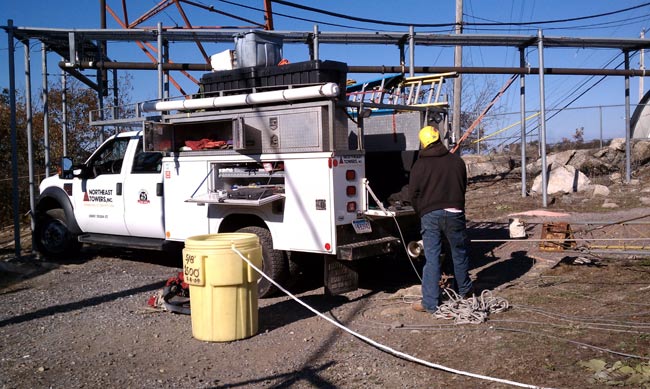
The tower riggers truck had two winches, one a basic 120-volt capstan, the other a hydraulic winch in the bed of the truck with 1/2 inch steel cable.

Tower rigger's truck
Tower rigger’s truck

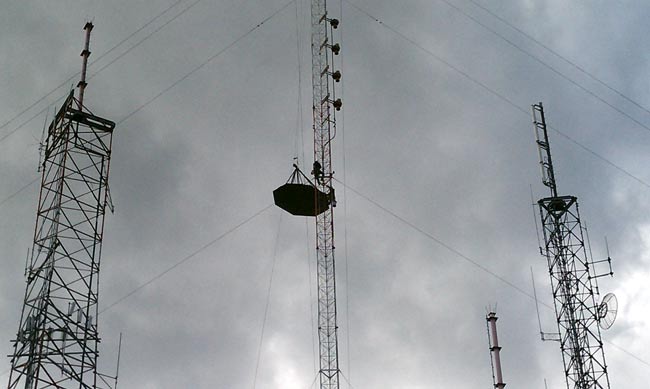
The bolts holding the reflectors in place had to be cut with a saw, you can see the tower climber working on the left-hand reflector, which gives you an idea of size.  If this reflector were to fall off the tower, chances are good that major damage and or injuries would result on the ground.  Proceed with extreme caution.

Cutting bracket mounting bolt on periscope reflector

Carefully lowering reflector past Shively 6810 FM antenna and Scala PR-950U microwave antenna.  During this phase, the tower climbers had to push the reflector out away from those obstacles with their legs.  You can see the gin pole at the top of the tower.

lowering periscope reflector
Lowering Periscope reflector

Another view:

Lowering reflector
Lowering reflector

Another view:

Lowering reflector
Lowering reflector

Almost down to the ground.  This measured 15 by 10 feet and ended up weighing 830 pounds.

Reflector almost to the ground

One down, one to go.  I can’t believe those gigantic things were at the top of this tower, on the top of this mountain for 43 years and the tower is still standing.  This is going to change the appearance of the mountain top from down below.  For years, it looked like a pair of mickey mouse ears, now it will only look like a tower.  I wonder what the environmentalists will think.

I will make a second post with the antenna pictures as this one is getting a little long.

Care and feeding of Propane Fueled Generators

Broadcasters historically have tried to remain on the air during emergency events like major storms, earthquakes, and other forces of nature.  Oftentimes, commercial power is interrupted, and thus, the backup power generator is installed.  Propane-powered generators for medium duty (power up to 45 KW) are popular because of the decreased environmental hazards, availability and expense of fuel, and ease of maintenance and repair.  This sized generator can run the critical loads of a studio facility or a transmitter site with TPOs between 5 and 10 KW.

Katolight 45 KW generator w/outside housing

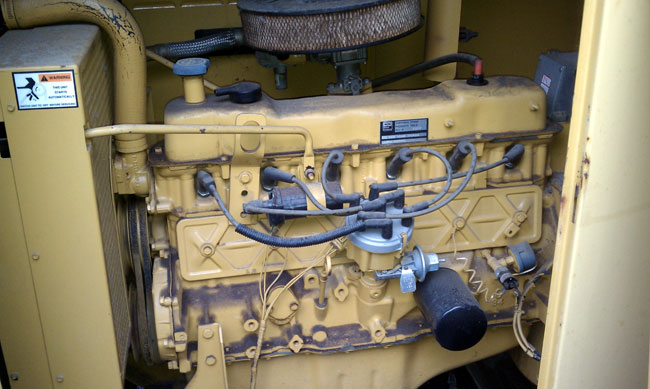
Most propane generators use a gasoline engine modified to use propane.  These generators can also use natural gas, however, because natural gas has slightly less energy, the generator’s service rating is reduced by about 10 percent.

Ford inline 6 cylinder engine

The biggest error I consistently see with propane generators is improper fuel tank sizing.  It might seem just fine to plop a 500-gallon tank down next to a 45 KW generator and expect everything to be just fine.  500 Gallons may sound like a lot of fuel, but the more important consideration is tank vaporization, that is to say, how fast the liquid propane can be removed from the tank for use.  Propane fuel companies should be able to size these things correctly, most of them have books and charts that tell what capacities and sizes are needed.  However, as a general troubleshoot guide, the following information is provided:

Generator manufacturers will specify how many BTU per hour a generator will require under full load. If not, these are some conservative rules of thumb:

  • For every 1 KW of electrical generation, 2 horsepower of the engine is needed*
  • Under full load, each horsepower will consume 10,000 BTU per hour*
  • Propane has 92,000 BTU per gallon
  • Propane weighs 4.2 pounds per gallon

*Note: These are not the figures you will find in your engineering handbooks, they are adjusted for generator winding and engine efficiency.

Propane Tank Vaporization Rates (Continuous BTU/hr vs volume at tank temperature):

Size propane in a tank (assumes 1/3 full)Maximum continuous BTU/hr at degrees F
20°40°60°70°
120129,600188,640247,680308,160338,400
150146,880213,790280,700349,200383,520
250253,800369,400485,000603,480662,700
325321,300467,670614,000763,900838,900
500396,270567,700757,300942,2401,034,700
1000708,4801,031,2301,353,9801,684,6001,849,900
1450816,1201,253,4001,645,6902,047,5502,248,480

Note: Tank vaporization depends on fuel level, tank temperature, and withdrawal rate.  The above chart is a conservative generalization and represents a safe median value.

If a propane tank cannot vaporize fuel fast enough, the generator will begin to run lean, eventually overheat, and shut down. The vaporization rate depends on the tank temperature, which drops as fuel is withdrawn.  For the above-cited 45 KW generator called to duty after a severe winter storm, the tank would need to vaporize: 45KW x 2 HP = 90 HP.  90 HP x 10,000 BTU/hr = 900,000 btu/hr.  A 500-gallon tank is too small for that size generator.

As the tank temperature drops a propane tank can develop frost on the outside of the tank, even on a hot summer day, which compounds the problem.

The correct size tank for a 45 KW generator is 1000 gallons.  This can also be two five-hundred-gallon tanks connected in parallel via a high-pressure line.

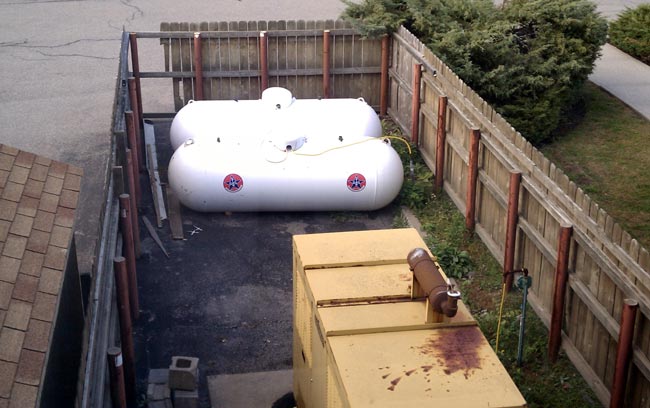
45 KW propane generator with two 500 gallon tanks
45 KW propane generator with two 500-gallon tanks

Also note, the generator’s radiator is facing the tanks so that when the unit is running, hot air is blowing on the tanks, warming them up.  This particular generator is about 25 years old, which is why it looks a little worn.  It still carries the load and mechanically is in sound condition.

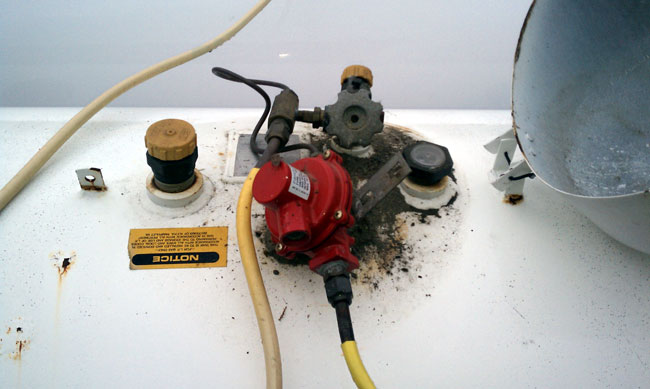
Most propane fuel systems have two regulators; one high-pressure regulator on the tank, which takes the variable tank pressure and steps it down to about 10 PSI, and the vaporizer which steps the pressure down to a few ounces per square inch (or inches of water column) and adds air creating propane gas for the generator to burn.

High pressure propane tank regulator
High-pressure propane tank regulator

It is important that the vaporizer be mounted above the snow line and that there is a little screen on the air intake, otherwise, mud wasps will build a nest in the air intake and the next time the generator is required to run, it won’t start.

Low pressure propane regulator/vaporizer
Low-pressure propane regulator/vaporizer

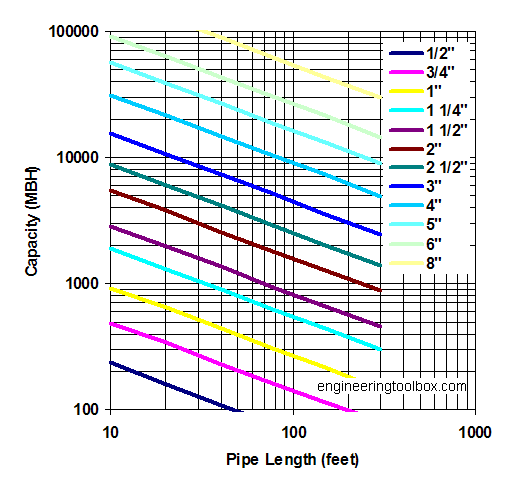
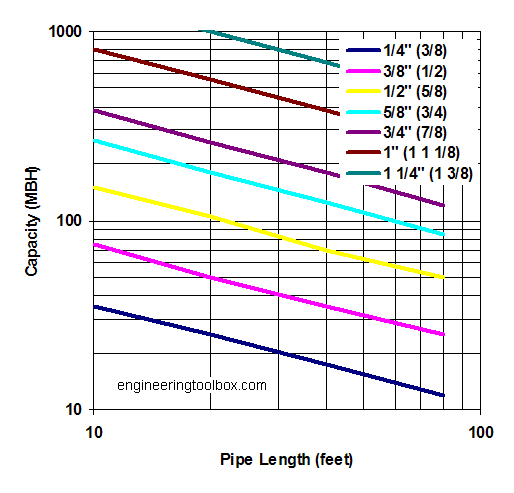
Fuel piping is also a concern, if the low-pressure lines are not large enough to handle the required BTU, the generator will run lean, creating the same problems as an improperly sized tank.  Different piping has different capacities, see the following charts:

Propane steel pipe sizing diagram
Propane Schedule 40 steel pipe sizing diagram
Propane copper pipe sizing diagram
Propane copper-K pipe sizing diagram

Assumes pressure less than 1.5 PSI, one MBTU is equal to 1,000 BTU per hour.

Once the generator is installed, maintenance is required.  As a minimum:

  • Exercise the engine bi-weekly for 15 minutes. Propane generators do not need to run under load.
  • Check fuel, oil, and antifreeze levels monthly, more often if heavy use.
  • Change the oil, oil filter, and air filter, and check the antifreeze freeze point, and battery electrolyte specific gravity yearly
  • Change out belts and hoses as needed, and pay close attention to the block heater hose, this is where leaks often develop
  • Clean out mice nests and droppings as needed

Mice love generators.

WE2XRH and the NVIS antenna

WE2XRH looks like an Amateur radio call sign but it is actually the call sign of an experimental short wave station in Alaska.  Transmitting DRM on 4.85 MHz, 7.505 MHz and 9.295 MHz with a Near Vertical Incident Skywave antenna system, they hope to cover all of Alaska and almost nowhere else with shortwave broadcast.

WE2XRH DART coverage with NVIS antenna system

This license was granted for two years in August of 2008 and renewed again this September until  July 2012.  According to the website Nextgov.com:

The company told FCC that its initial tests would be funded by and conducted for the Defense’s Joint Electromagnetic Technologies program, a classified operation whose mission is to develop technologies for use by special forces and intelligence units.

Defense also will supply surplus transmitters from the closed, Cold War-era Over the Horizon Radar, located in Delta Junction. The radar system bounced shortwave signals off the ionosphere to detect aerial targets, such as Soviet bombers, at ranges up to 1,800 miles.

The transmitters are 100 KW Continental HF units, which for this applications are running about 20 KW.  According to this Yahoo Groups posting, several Japanese shortwave DXers have received the station in late 2009, but nothing recently.  I shot an e-mail off to their information address, but did not receive a reply.

On High Frequency (HF) NVIS has been used for several years where line of sight VHF communications are not possible.  Soldiers during the Vietnam war noticed that if a vertical whip was bent over so that it was horizontal to the ground, the signal strength was slightly less but the signals were much less prone to fading.

Near Vertical Incident Skywave antenna angle vs. distance

In this case, WE2XRH is using a crossed dipole antenna which generates a circularly polarized field.  With traditional HF skywave, polarization is not a factor since the ionosphere usually causes some field rotation anyway.  It is interesting that the system had this design consideration.

The NVIS is a novel approach and it may work on Medium Frequency (MF) during the night time, but daytime coverage would still have to rely on ground wave signal.  The FCC has historically approached MF skywave as a secondary and unreliable transmission method.  The idea being to reduce the antenna take off angle to as low as possible, hence the popularity of taller than 90 degree towers.  There is good validity to that practice as mixing the ground wave and skywave components at a receive antenna will cause multipath fading.

Setting aside a new broadcasting frequency segment, say 1.6 – 1.8 Mhz, a system could be designed to transmit DRM by using groundwave during the day with a traditional 90 degree tower, and NVIS at night with a horizontal dipole antenna.    Then never the two should meet.  The night time NVIS system would have a small ground wave component, out to a couple of miles.  In addition to that, the night time NVIS system can run on an adaptive power system, when propagation conditions are poor, more power can be applied to the antenna input and in better conditions, power reduced in accordance with a remote receive monitor that reports the Bit Error Rate (BER) back to the transmitter controller.

The best NVIS antenna is the 1/2 wave dipole positioned between 0.1 and 0.2 wave lengths above ground. In the 1.6  to 1.8 MHz band, that equates a half wave dipole antenna 260 to 292 feet long mounted between 66 to 90 feet above ground level.

This would have many advantages over the current directional antenna based MF broadcasting system currently deployed.  The current system is based on pushing potential harmful signals away from a station that was licensed to the same frequency (or an adjacent frequency) earlier.  This puts the onus for proper operation on the broadcast license holder.  Most don’t have the know how or resources to insure that a n AM directional is operating properly.  I would estimate at least half of the directional AM antennas in this country are out of tolerance.  With a NVIS based night time antenna system, coverage areas would be assigned much like an FM allotment.

The BBC conducted medium wave DRM tests in 2007 with satisfactory results during the daytime, but poor reception at night time due to co channel interference.  That is why DRM will not work on the current AM broadcast band and if digital radio is to be broadcast on MF, a new frequency band would be needed.

How the Cold War was won

This is not really apropos radio broadcasting, but it is about radio and it has a lot to do with engineering.  Back in the day, as a young man out to do whatever it was, I ended up being stationed on Guam, working at the Coast Guard radio station there.  That was interesting work, to be sure, but every morning and evening, either on my way to or from work, I would drive by this, which looked very interesting:

AN FRD-10 NAVCAMSWESTPAC, Guam

I had to lift the photo from a Navy Radio history site.  Back in my day, aiming or even possessing a camera around this area or building would likely inflict the extreme ire of the Marines, who attentively observed the area and were ready to call down a painful lesson to all not obeying the “NO PHOTOGRAPHY ALLOWED” signs.

Nicknamed “The Elephant Cage” it is a Wullenweber antenna used for high-frequency direction finding (HFDF) and was part of a system called “Classic Bullseye.”  There were several of these systems across the Pacific Ocean, and they all worked together using a teletype network.  The Army-Air Force version was called a AN  FLR-9, which was slightly larger.

AN/FRD-10 antenna layout

There were two concentric rings of antennas, the tallest being the closest to the center building and used for the lowest frequencies.  It covered from about 1.5 to 30 MHz.  The rings consisted of several individual antennas, all coupled to a Goniometer with coaxial cables cut to identical lengths.  The outer ring had 120 vertical-sleeved dipole antennas, and the inner ring consisted of 40 sleeved dipole antennas.  The inner ring of towers also contained a shielding screen to prevent the antennas on the other side of the array from picking up signals from the back of the antenna.  A radio wave traveling over the array was evaluated and the Goniometer determined the first antenna that received the signal by comparing phase relationships.   The ground system was extensive.  Immediately under the antennas was a mesh copper ground screen.  From the edge of the copper mesh, buried copper radials and extended out 1,440 feet from the building.

The effective range for accurate DF bearings was about 3,200 nautical miles, which equates to about two ionospheric hops with the angle theta between 30 to 60 degrees referenced to the ground.

It was quite effective, it only took a couple of seconds to get a good bearing.  If the other stations on the network were attentive, a position could be worked out in less than 10-15 seconds.

AN FRD-10 transmission line diagram
AN FRD-10 ground diagram

It is a little hard to read, but this is the ground layout of the AN FRD-10 CDAA.  The transmission lines to each antenna are shown, along with the ground screen and building in the center of the array.

We Coast Guard types used this mainly for Search and Rescue (SAR) and the occasional Law Enforcement (LE) function.  I believe we actually saved a few lives with this thing.  I found the Navy operators to be very helpful, I think some of them enjoyed the change of targets from their normal net tripping.

The Navy operated AN FRD-10s at the following locations in the Pacific:

  • Imperial Beach, CA (south of San Diego)
  • Skaggs Island, CA (northeast of San Francisco)
  • Hanza (Okinawa) Japan
  • Waihawa, HI
  • Finegayan, Guam
  • Adak, AK
  • Marietta, WA

The Air Force/Army installed AN FLR-9’s in the following Pacific Locations:

  • Missawa AB, Japan
  • Clark AB, Philippines
  • Elmandorf AFB, AK

Basically, there was no corner of the Pacific Ocean that could not be listened to and DF’d.  Some people look back nostagically at the cold war when we “knew who the enemy was,” so to speak.  I am not one of those.  They either didn’t really know the enemy or have conveniently forgotten some of the less endearing qualities of the Soviet Union.

I believe all of these systems have been decommissioned and most have been taken down and scrapped.  The National Park Service studied the Waihawa, HI system as a part of their Historical American Building Survey (HABS HI-552-B2) (large .pdf file) before it was torn down.  Good technical description and building pictures.  Near the end of the report, it is cryptically noted that:

Beginning in the mid-1990s the NSG (ed: Naval Security Group), noting the absence of Soviet targets and wanting to cut costs and change the focus of its SIGINT collection, began closing FRD-10 sites… Undoubtedly, since the September 11, 2001 terrorist attack on the World Trade Center and the Pentagon, listening posts have gained importance and most likely increased in number and sophistication. The FRD-10 CDAA at NCTAMS Wahiawa ceased listening in August 2004; it can only be assumed the closure occurred because there was a better way to do it.

Indeed.

The Guam site has been stripped out and abandoned, the latest photo I can find is from 2008:

Abandoned AN FRD-10, Finegayan, Guam

And people think AM broadcasting is expensive…