I received this link in the comments of a previous post and found it interesting. The BBC will be closing down 648 KHz, Ordfordness England at the end of March, no doubt due to budget cuts. The site has been in use since 1972. Prior to this, the site was formerly an OTH array, COBRA MIST, which was then adopted for MW broadcasting. The video is 17 minutes long, but, if you are interested in radio history, technical aspects of AM broadcasting, and the like, it is interesting.
These are 600 KW transmitters. As Andy Matheson, transmitter engineer, explains, with a wry smile “I find them (transmitters) very satisfying, I enjoy either day work or shift work, just really working with transmitters has always been very satisfying…” I couldn’t have said it better myself.
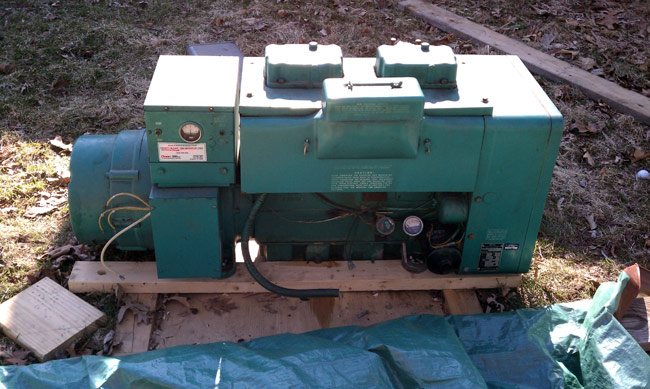
I was fortunate enough to acquire this generator last fall. It was new in 1969 and has unknown hours on it, but it appears in decent shape. I am going to do a level two overhaul and install it as backup power for my house/shop. The first order of business is a complete inspection. I discovered a few problems; the starter didn’t crank, the distributor was loose, and the carburetor had some burned-out chunk of metal attached to it.
Onan 12JC4R generator
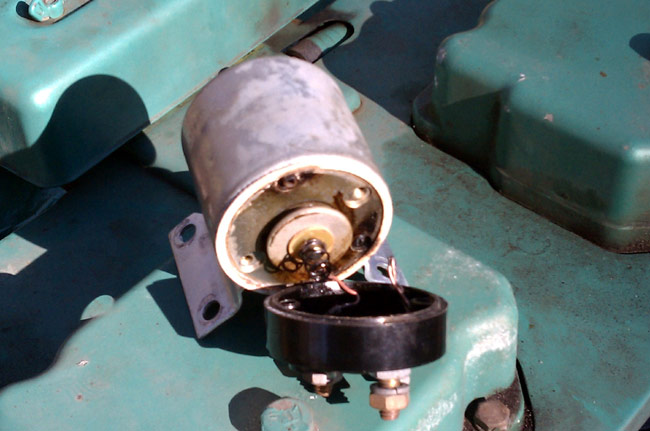
First, the starter: These units use a Prestolite MEO3006 starter, which is common to several Chrysler products from the late ’60s and early ’70s. This is obviously a replacement unit, as it is not “Onan Green.” When I hooked a battery up and tried to turn the motor over, the start relay clicked but nothing else happened. I dismounted the starter and removed the starter solenoid. The interior of the starter motor looked in good condition, which points to the solenoid. Sure enough, I removed the back of that unit and found two wires burned through and a large blackened area. While I had the starter off, I hooked it up to a 12-volt battery and it worked fine. A new starter costs $469.00, and a new solenoid cost $59.00. I opted for the solenoid.
Onan 12JC4R burned out generator starter solenoid
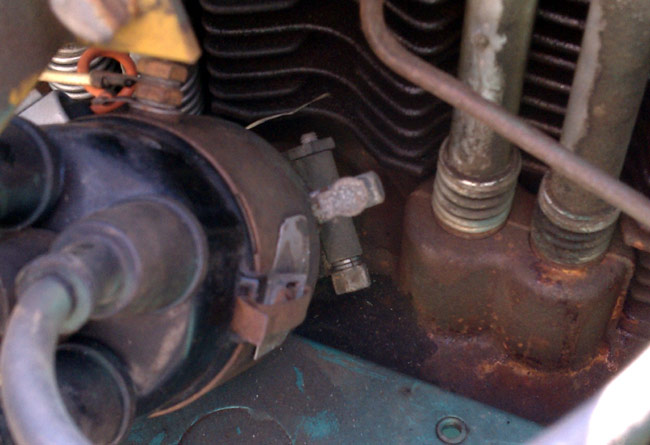
The next thing is the distributor. I was checking the points and contemplating replacing the breaker points with an electronic ignition when I discovered the distributor could turn 1/8 of a turn in each direction, as when making timing adjustments.
Onan 12JC 4R distributor clamp
I used a 3/8 box wrench and tighten up the clamp holding the distributor shaft. It took several turns and makes me wonder why it was loose. I will have to check the timing with a light once I get it running. This also could be why the generator was not running when we took it out of service.
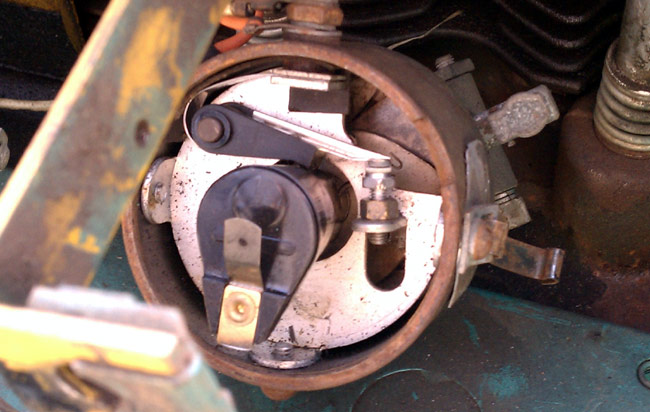
Onan 12JC 4R rotor and breaker points
As for the points, they look brand new, as do the rotor and distributor cap.
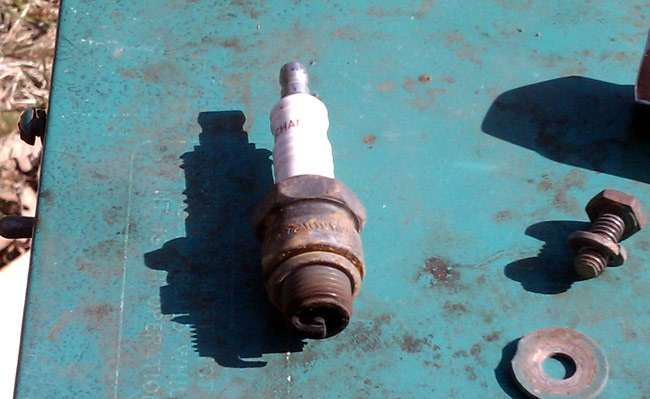
Onan 12JC 4R generator spark plug, champion H8C
The spark plugs look well used and the plug wires look original.
Finally, there was an electric choke mechanism on the carburetor which is completely unnecessary for a propane-fueled unit. The choke plate itself was wired open. The electric choke was burned open, so I removed the assembly. I then spent some time at the local NAPA cross-referencing parts. Here is a tune-up list:
Nomenclature
Onan part (old)
Onan part (new)
Napa Part
Alternate
Oil Filter
122A185
122-0193
1084
Fram PH16
Points*
166P245
166-0245
CS709
Rotor
166P234
166-0234
AL58/AL52
Distributor cap
166B307
166-0235
AL91
Condenser*
166P310
166-0310
AL38
Ignition Coil**
166B310
166-0859-02
701002
PRX 405011
Plug wire #1
167A1410
167-1602
701064
Plug wire 2,3,4
167A1409
167-1602
701063
Spark Plug
167-4
167-
Champ H8C***
Air Filter
140B640
140-1907
7-02241
Starter
191C324
191-0324
Prestolite MEO3006
Solenoid
N/A
191-0433A
ST103
*Electronic ignition set
N/A
166-0825
Pertronics 1545**
**Ignition coil W/PRX 1545
PRX 405011
*Condenser and breaker points can be substituted for an electronic ignition kit, either Onan 166-0825 or Pertronics 1545 with Pertronics PRX 405011 coil. **Pertronics electronic ignition must be used with Pertronics coil ***Champion RH8C plugs should be used with replacement wires without noise suppression plug boots.
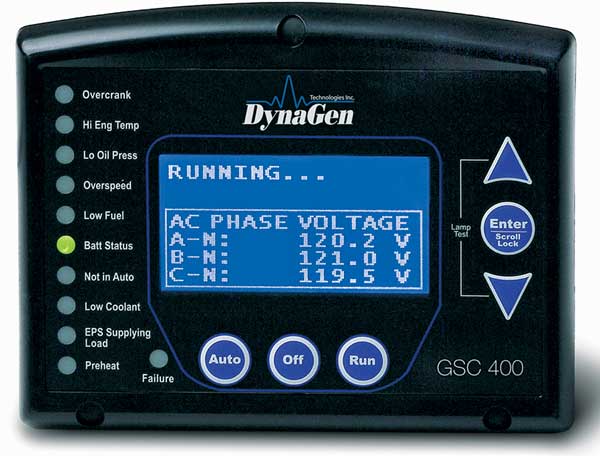
This is for an Onan 12JC generator circa 1969 with a Studebaker engine. Other models/years may vary. The other issue with this unit is there is no supervisory monitoring and control. There is no oil pressure loss, overheating, or over-crank faults. This is why the starter solenoid failed. To remedy that situation, I started to design a better control circuit. Then I looked around on the inner tubes and found somebody had already done this. DynaGen makes the GSC400p which can monitor oil pressure, engine temperature, frequency, engine RPM, hours, voltage, and current. It can fault for any out-of-tolerance condition, as programmed by the user.
Retrofit generator controller
I plan to install this in the original control box, leaving the original control circuit intact by using the remote start/stop connections. I keep the original remote/start/stop switch and hand crank switch in place for use if the fancy controller fails.
I have been watching the events unfold in Japan. It is truly astounding the power of Mother Nature. While several US networks seem to be tempering their coverage of the nuclear fuel melt, and yes, there are multiple reactor fuel melts in progress, other sources are forthright. The BBC seems to be on top of things, as well as Russia Today.
Thus far:
No fewer than four hydrogen explosions have taken place in all four reactors at the Fukushima-1 Power plant. The after the third explosion yesterday in unit 2, there are two major concerns; breach of the reactor vessel(s) and runaway nuclear fission. After that explosion, the pressure in the unit 2 reactor suppression chamber dropped from three atmospheres to one atmosphere, indicating the suppression ring had breached. Currently, the nuclear disaster is categorized as a 6/7, surpassing Three Mile Island. The worst case scenario: Reactor Unit #2 completely breaches, this unit contains Mox fuel Note: unit #3 contains the Mox fuel. (mixed plutonium/uranium oxide), which is far more dangerous than the fuels in the other reactor vessels. Mox fuel has a lower melting point and could potentially melt into a pool at the bottom of the reactor vessel resuming fission. Criticality? Yes, but not the high-order type as seen in a nuclear weapon.
The root cause of the disaster is the loss of cooling after the reactors were shut down. The nuclear fuel cores require cooling for at least two to four weeks after shutdown. The backup diesel generators went offline approximately one hour after the units were automatically shut down during the earthquake. Three probable causes for this have been proposed; the electrical switch gear for the generators was in the basement of the generator building, which was flooded by the tsunami, fuel contamination/fuel loss, and submergence of the GENSETs by seawater. All three of these scenarios point to a design flaw.
Radiation levels have varied but are elevated, peaking at various times before and after each explosion. Until this morning, the major radiation plumes were being blown offshore. The wind has become variable, causing the downwind zones to shift.
Prevailing east winds could blow some of the contamination to the west coast of the US within 36-48 hours, the east coast by 48-72 hours, and in 7-10 days there will likely be a band of radioactive particles in the jet stream that circles the globe in the northern high latitudes.
But not to worry, everything is okay. There will be no detrimental effects of this, whatsoever.
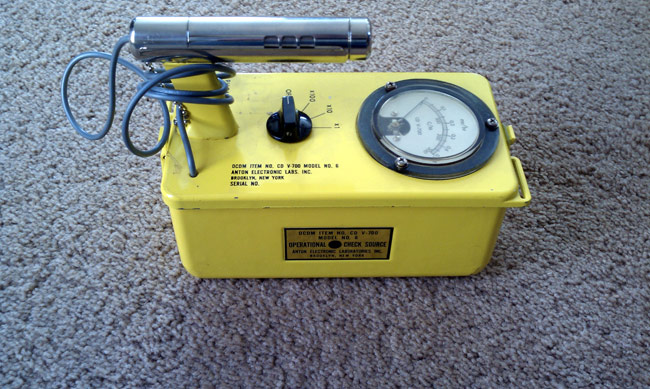
Regardless, I have headed down to the basement and dug up my CD V-700 RAD meter. I salvaged this from the dumpster at WPTR after one of the contract engineers threw it away in the early 1990’s. I believe I used this meter to measure the radiation from the tubes in the BT-25A and the MW50B transmitters.
According to the “Operational Check Source” on the side of the meter, it still works and is pretty close to the calibration level. Even if it is not totally accurate, it will still indicate an increase in radiation.
Anton Model 6 CD V-700 radiation meter
This is an Anton Model 6, which is the most sensitive of the V-700 series meters. It can be used to check background radiation levels and/or contamination of food or clothing. The best plan is not to ingest radioactive particles in food and water. Why wonder about it, when you can know?
Not later than 10 years after the date of enactment of this Act, the paired electromagnetic spectrum bands of 420–440 megahertz and 450–470 megahertz recovered as a result of the report and order required under subsection (c) shall be auctioned off by the Federal Communications Commission through a system of competitive bidding meeting the requirements of section 309 of the Communications Act of 1934.
Will this mean broadcasters be losing their Part 74 Broadcast Auxiliary RPU licenses? Section 74.402(4)(b)(4) lists those frequencies as 450.03125 through 450.950 and 455.03125 through 455.950 MHz in various channel configurations. These frequencies are used mostly for RPU but are also used for TSL systems. This is the NITA frequency allocation chart. The RPU frequencies are shared but I doubt an entity that has paid through the nose for exclusive use of a frequency band would be interested in that. Further, according to Part 97.301(a), the 70 cm Amateur Radio frequencies are from 420 to 450 MHz. That has the Amateur Radio users quite upset, and rightly so. I don’t know if this has filtered down to broadcasters yet, but losing RPU and TSL frequencies would likely be an inconvenience, to say the least.
What gives? Reading through the bill, it seems there would be a multi-part shuffle over several years to move the “first responders” to a nationwide system on the 758-768 and 788-798 MHz frequencies. The then “empty” frequencies would be auctioned off, except some of them aren’t so empty.
Does this mean that all the existing police, fire, and ambulance radios will be phased out in favor of the 700 MHz units? Didn’t they just install a bunch of trunked 800 MHz systems recently? Wasn’t that an expensive boondoggle that still has yet to be sorted out in some locations? Ah well, it’s only $2 billion or so taxpayers dollars, which, to fight terrorism, anything goes.