
Secretly, I like it when things break, sort of

Not that I am a glutton for punishment or anything, but I enjoy troubleshooting. There is a certain satisfaction in the analytical aspect of tracking down a problem and fixing it, hopefully in a permanent fashion.  Figuring out where a problem is requires a good bit of detective work;

  • Examining the clues; what happened before the failure, what are the fault indications, are there any external factors
  • Round up the usual suspects; a good maintenance log is helpful here to track re-occurring failures.  If the failure cannot be attributed to an external source (such as a power surge or lightning storm), what was the last thing that was changed or worked on?
  • Following the trail back to the origin; Often the first failed part found is a symptom, not the actual problem.  It takes some skill in reading schematics and making sense of a failure to trace it back to the real problem.

It can sometimes be exciting, like turning on the 25 KV high voltage supply and having big blue flashes issue forth from the top of the transmitter.  Sometimes it can be quite frustrating, like when the station owners refuse to spend money to fix a problem.  Sometimes it can be dull, like fixing the same problem over and over again because of the previously stated money problem.  It’s also disheartening when the problem was caused by the stupid DJ spilling soda in the console.  Not that all DJs are stupid, just the ones that spill things into consoles.

The challenge of finding the root cause can often be enlightening.  I have often discovered unrelated problems waiting in the wings while investigating the why of an outage.  It is great to fix those things before they burn the house down, but this approach often goes unnoticed by the ownership or management.  Lately, for some reason, an ounce of prevention goes unnoticed or unappreciated.

There is quite a bit of science to troubleshooting, but there is some combination of personal traits that make a good troubleshooter.   These are:

  • Inquiring or curious disposition.  It is fairly easy to get to the first failed module or part.  Discovering the reasons behind the failure and or getting down to the component level takes a good deal more effort.
  • Patience.  This goes with the second part above, it takes some stick-to-it-tive-ness to trace out the not readily apparent problem.
  • Good analytical skills.  Often failures generate a cause-and-effect scenario.  The effects can be startlingly distractive and mask the causes and the underlying problem.
  • Ability to view the large picture.  This is critical to discover outside influences and other issues that are indirectly connected to the system or issue at hand.
  • Ability to analyze the system design.  This requires background training and experience to look at a circuit diagram and discover non-error-tolerant systems.  Sometimes these systems can be modified for better fault tolerance.

Poorly designed equipment is the bane of the broadcast engineer.  Equipment manufacturers can sometimes fail to follow two key principles: KISS and maintainability.  KISS stands for Keep It Simple, Stupid.  There is no better design criteria than the KISS principle.  Adding layers of complexity increases the failure expectations.  Maintenance can be something as simple as cleaning or changing air filters.  Making maintenance tasks difficult almost ensures that they will not be done.
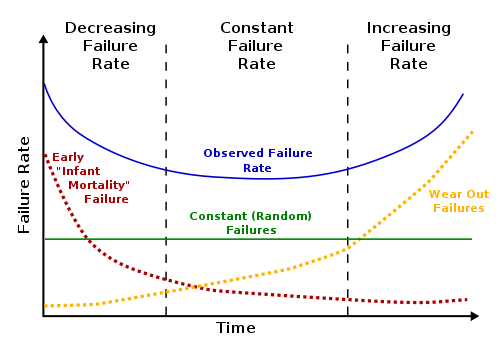
Bathtub design curve

Eventually, all things wear out.  It also takes some large-picture skills to know when it is time to replace equipment and that can vary greatly from situation to situation.

They do it a little differently in Europe

Old world and all that.  I am of the impression that European broadcast engineers are a more studied lot.  Their process involves much more deliberation, thoughtful analysis, and planning than ours does.  For example, when it comes to station loudness, most programmers and many engineers (myself not included) to do more is better.  It is thus that we get the Omina 11 and other audio squashers.

The EBU technical group takes a different approach:

EBU R128 (ed: Loudness Recommendation) is the result of two years of intense work by the audio experts in the EBU PLOUD Group

Aside from the above-mentioned EBU R128, there are four technical papers dealing with implementation, meters, distribution, and so on.  The body of work is a recommendation, not a requirement.  I can’t imagine the voluntary implementation of something like this in the US.  Even so, there are advantages to having a single acceptable level of programming audio.  It is interesting reading.

Stay tuned, 1994 redux

In case you haven’t heard, May 21, 2011, will mark the beginning of the end of the world. It is on this date, according to Harold Camping, the rapture will begin. For those not versed in bible lore, this is when God will take all of the saved souls directly to heaven, body, and all. Further research reveals that it will begin at 6 pm local time, in every time zone.

I’d imagine you can listen for updates on Family Radio stations or shortwave if there aren’t any local stations to listen to.  Those on the west coast may want to tune into the shortwave broadcast (transmitters are in Okeechobee, Florida) for a preview of coming events.  You can try:

  • 5950 KHz 22:00 through 0100 UT (6 pm through 11 pm EDT)
  • 11470 KHz 22:00 through 23:45 UT
  • 15440 KHz 22:00 through 23:59 UT

The full shortwave schedule is available here.  I am setting my clock so I can tune in and see what happens because I am curious; dead air? Does the station sign off?  I really want to know how a station plans for the end of the world.  Hopefully, it will be marked by some program, announcement, or something special.  Operations as usual would be very boring, as most Family Radio programming is mundane and predictable.

Frankly, Camping has made these predictions before, the last was September 6, 1994, when the faithful gathered in the Alameda’s Veterans Memorial Building, bibles open, hands outstretched, awaiting the moment.  After a while, it became clear that something was amiss and everyone went home, wondering what went wrong.  There have been many religious-based predictions for the world ending: 1806; October 1844; December 21, 1956; November 1982; January 1, 2000: etc.   The Jehovah’s Witnesses alone have predicted the end coming in 1914, 1915, 1918, 1920, 1925, 1941, 1975, and 1994.

It’s either a really good radio stunt, which would go down as one of the greats of all time or they actually believe it’s the end of the world.  In the case of the latter, does this mean they will be selling their radio stations?  There are several around here that I’d be interested in getting my hands on.  I’d even give a fair price, considering the circumstances and all.

Update: How do radio stations prepare for the end of the world?  T -40 minutes and the answer appears to be play canned programming, or in other words, business as usual.

Comcast Buys FCC? or Business as Usual

I received this rather humorous, hyperventilating email from some group called “Freepress.net.”

Outrageous!

FCC Commissioner Meredith Attwell Baker is leaving the FCC to become a lobbyist for Comcast – just four months after she voted to approve the Comcast-NBC merger.

This is nothing new under the sun and has, in fact, been going on for years.  It’s called “The Payoff.”  Conflict of interest?  On the surface, it sure seems that way, but perhaps there is some other innocent explanation for this move.   I can’t, for the life of me, think of what that might be, but I’m sure somebody will come up with something.

The email continues with a plea to call some congressman to investigate the FCC.  Perhaps I have grown a little cynical but I have my doubts about the effectiveness of such an effort.

In spite of my cynicism, as their motivations seem to be in the right place, I applaud Free Press for their efforts.  Other like-minded groups need to keep the pressure on and keep this in the spotlight.  Naturally, NBC and other networks have uttered not a peep about it.  The public blindly goes along while big business and wall street banksters continue their efforts to return to Feudalism.

Soon, one company will own the entire country.  Everyone will shop at the company store, Wal-something or another, live in company housing, go to the company medical clinic and worship at the company church.

The answer, of course, is independent voices, independent investigations, in-depth reporting, in short, everything that is currently missing from the media landscape today.  That, and some kind of electric shock or something to get people off of their fat asses and care about something.

Update: Several people have taken notice; The New York Times, TIME magazine, and The Daily Show.

The Daily Show With Jon StewartMon – Thurs 11p / 10c
Well, That Was Fast – Comcast/NBC Merger
www.thedailyshow.com
Daily Show Full Episodes Political Humor & Satire Blog The Daily Show on Facebook

More like this please.