A tale of two air conditioners

It was a hot day, it was a cold day. The tube transmitter was running, the solid-state (HD-1) transmitter was off the air. The books show that the company has deep pockets, but the accountant has short arms.  And so it goes.  In a sordid, yet familiar tale of leaping three-quarters of the way across a river, the builders of this transmitter site seemed to think of everything except the cooling requirements for a 35 KW FM transmitter.

Instead of installing real commercial AC units, someone decided that 34,000 BTU window units were the way to go.  At one time, there were eight of those units, all single phase 240 volts sucking down gobs of power and freezing up when the outside temperature dropped below 40°F.  This was always a problem but became more so when we took over the maintenance of this site.  When there was a full-time engineer, his time, apparently, could be wasted running back and forth turning the window units on or off in the winter as required.  Now that a contract company is doing the work, it becomes cost prohibitive to require such things.

Therefore, the time had come to make a change.  To that end, six of the 34,000 BTU window units were removed from the building.  Two of the existing holes in the wall were used to create an emergency cooling system, consisting of a 4,292 CFM fan and a couple of shutters.  Two other holes were used for the new air conditioners and two holes were blocked up.  The remaining two window units were left in place in the combiner room, which is a separate cooling zone.
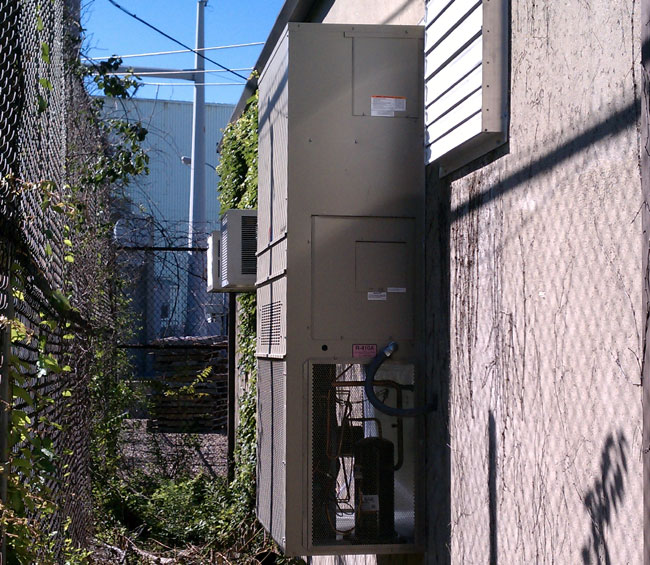
Bard 5 ton wall mount AC unit
Bard 5-ton wall mount AC unit and cooling fan shutter

The new ACs are five-ton wall-mount Bard units.  These are three phase and should be more than enough to keep the transmitters cool.  Here is how I arrived at that conclusion:

  • The entire building load when the main transmitter is running at full power, without the transmitter room air conditioning, is 60 KW.
  • All of the building loads except the transmitters go through a single-phase panel.
  • The load on the single phase panel is 10 KW, thus the transmitter load is 50 KW (this 10 KW is mostly the single phase AC units in the combiner room)
  • The TPO is 32 KW, therefore the transmitter is generating 18 KW of waste heat.
  • One watt-hour = 3.412 BTU of energy, thus
  • 18,000-watt-hours equals 61,416 BTUs
  • One ton = 12,000 BTU, thus
  • 61,416 BTU ÷ 12,000 BTU = 5.118 tons

That will take care of the main transmitter waste heat.  The HD transmitter generates another 4,000 watts of waste heat or 1.37 tons.  The combiner is in another room and doesn’t factor into the calculation.  The rest of the equipment is inconsequential, adding up to less than 100 watts.

The solar gain is more difficult to calculate, as it is based on the building structure, the type of construction, and the heat gain (loss) through the walls and doors.  This building is concrete block, insulated, and has no windows.  It is unshaded, however, it is painted a light color.  All in all, the solar gain should be less than two tons on a hot day.  Therefore the total AC load should be 8.25 tons or less.

Bard 5 ton wall mount AC unit

All that is left now was to install the things.  Just pull up the truck and use a crane to lift them in place, except, no; that plan won’t work.  This is the transmitter site at the power plant and the 138 KV lines overhead precluded any lifting with a crane.  We instead had to build ramps and move things around on large-hand trucks.  One unit is installed on the rear of the building, the other on the front.  It required several days to make the ramps and four people to muscle the things into place.

The bottom air intake holes needed to be cut out for the new units.  Cutting into the concrete block while the BE FM 35A was running proved to be another challenge.  We used several sheets of plastic, shop vacs, and extra air filters on the transmitters to keep the concrete dust out of the PA cavities and motor bearings.

Plan B cooling consists of a 4,292 CFM Venturi fan mounted on the rear wall of the building.  The fan is controlled by a ceiling-mounted thermostat set to 95 degrees.  If the AC’s fail, the ceiling temperature will rise and the fan will turn on.
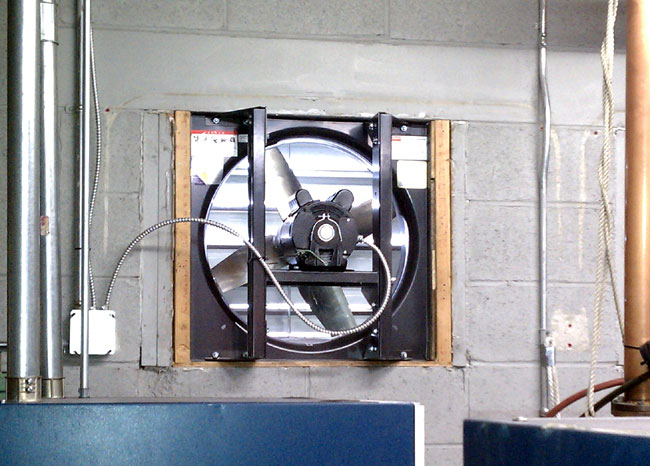
Transmitter site emergency cooling fan

The room volume is about 3600 cubic feet, therefore this fan will change the room air about once every 60 seconds or so. It is not the best plan to move humid, potentially dirty outside air through a building, but it it keeps the station on the air while the main AC units are being repaired, then so be it.

The entire system went on line last week and is working well.
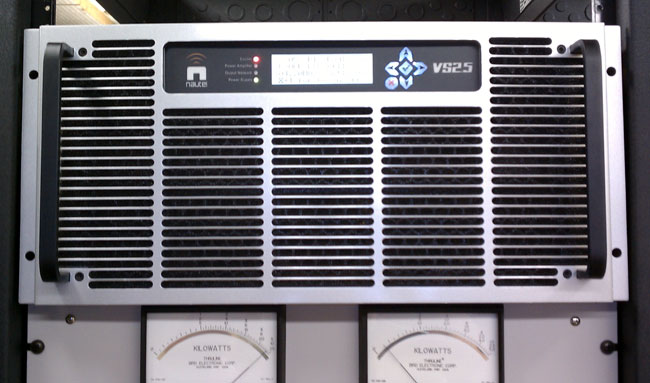
The Nautel VS-2.5 FM transmitter

This is cute. A small (VS allegedly stands for “Very Small”) integrated 2,500-watt FM transmitter.  This one we just finished installing as a backup transmitter for WSPK, on Mount Beacon, New York.

Nautel VS-2.5 FM Transmitter

This site has a Nautel V-7.5 as the main transmitter.  That unit is very reliable, however, this transmitter site is non-accessible 4-5 months out of the year due to ice and snow.  The last time we had an off-air emergency due to a crippling ice storm, it took an entire week to clear away all the downed trees so we could gain access to the site via snowmobile.  As such, every system needs dual or even triple redundancy.  The lack of said redundancy has led to several prolonged outages in the past.

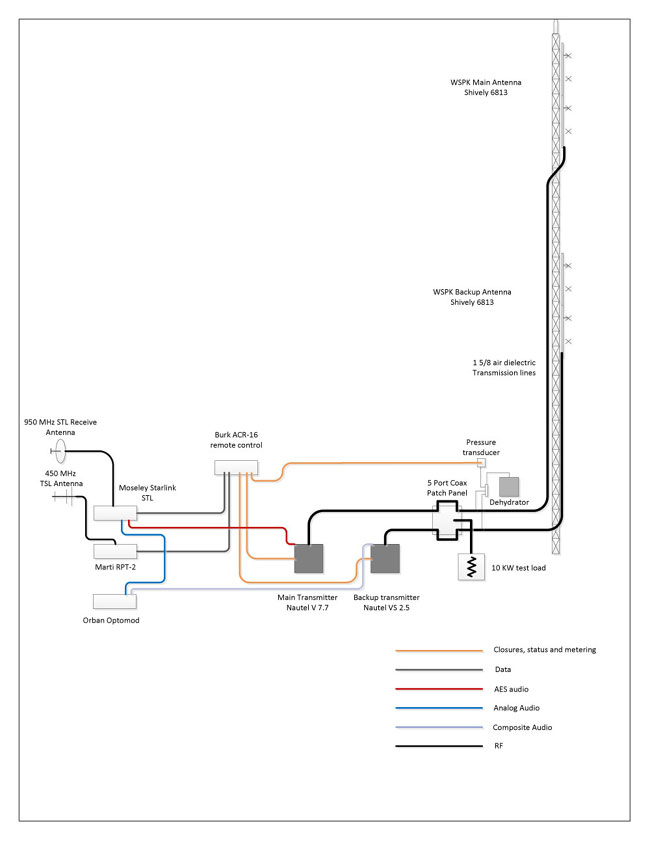
WSPK signal flow diagram

Last year, we were finally able to install a backup antenna after 63 years without one.  This year, it is time to upgrade the rest of the backup equipment.  The new auxiliary transmitter is connected directly to the auxiliary antenna via a five-port coax switch.  This allows for the use of the dummy load for testing when we are present, but removes a potential failure point in the coax switch.  There have been at least two incidences of the disk jockey accidentally transferring the transmitter into the dummy load when taking transmitter readings.  Hopefully, this configuration will be fairly idiot-proof.  I am making an interlock panel that will prevent both transmitters from being on the air at the same time.

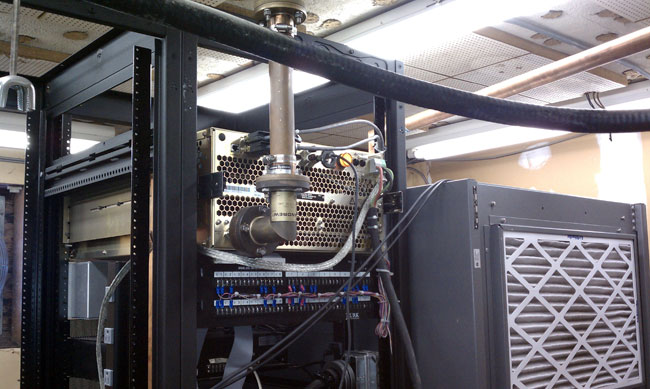
Nautel VS 2.5 connections

This site is a work in progress.

The backup processor is at the transmitter site, the main processor is in the rack room at the studio.  This works well because the main processor occasionally looses its mind and needs to be rebooted.  It would be a significant pain to drive all the way up to the transmitter site just to reboot the processor.  It might not happen at all during the winter.  The backup processor has no mind so it is not an issue.

The VS transmitter is attractive because it has a built-in exciter that accepts composite, AES, or IP audio.  The exciter also has a built-in Orban processor as an option.  Thus, if it really hit the fan, we could use the LAN extender to get the audio to the site.  Further, it could be addressed by any studio in the company WAN.  Which is cool, when you think about it.

Nautel continues to crank out innovative, dependable products and there is nothing wrong with that.

The Harris SX 5

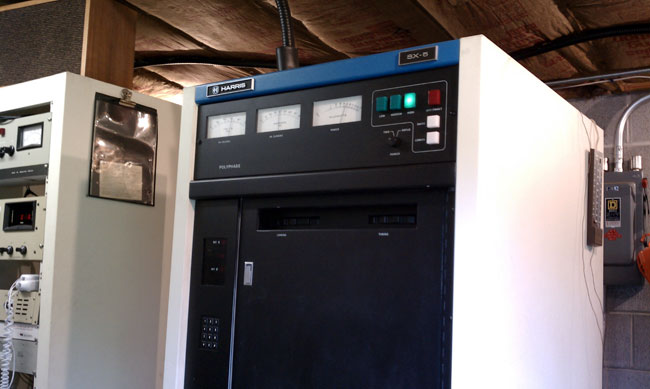
I give you joy, the unmitigated joy, and sheer pleasure of the Harris SX 5 AM transmitter. This particular unit dates from 1984 and is installed at WUPE in Pittsfield, MA.   It has a few issues of late.

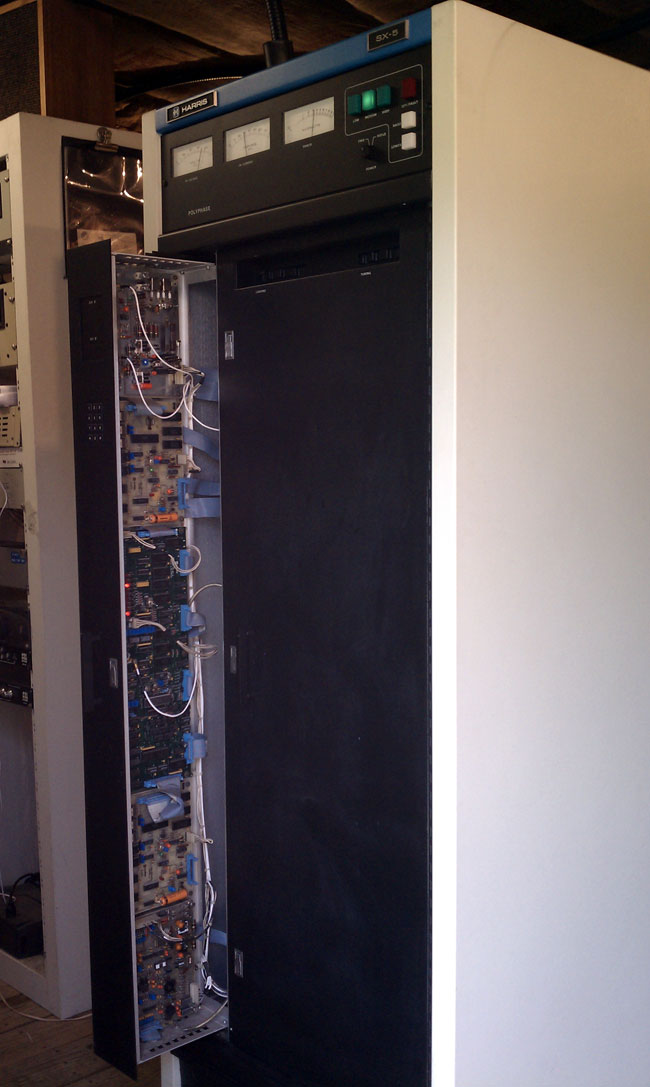
Harris SX 5 medium frequency AM transmitter

The first of which is the unbalanced or out-of-ratio condition of the PA current and voltage.  When changing power levels, the PA current, and voltage are supposed to track together.  When they do not, it is an almost sure sign that one or several of the MOSFETS in the PA are shorted.  Shorted IRF-350 MOSFETS are indicated by blown fuses on the PA boards and should be replaced in pairs.  The reason for the damaged devices also needs to be investigated.  It is entirely possible that the site receives a lot of lightning, which can cause this damage.  It could also be heat related, as the site is not currently air-conditioned.  The other possibility is under drive conditions.

The MOSFETS turn on and off at a rate of 1/(carrier frequency (hertz)) times per second.  If they are under-driven, they will go full-on and short-circuit.  The minimum drive is 27.5 volts peak to peak, anything less than that is marginal and can lead to the destruction of the PA devices.  Underdrive indicates an issue with the oscillator, which has its own set of peculiar failure modes.

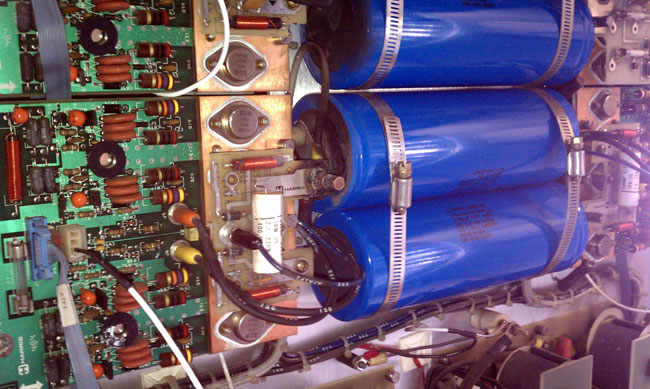
Since this is an older unit, all of the large electrolytic capacitors are also suspect and need to be replaced.  There are three power supply capacitors at the bottom of the transmitter, two 76,000 μF 40 VDC for low voltage and one 7500 μF, 350 VDC for high voltage.  The modulator section also has six 5100 μF 350 VDC capacitors, collectively known as “dynamite sticks” due to their explosive potential if installed incorrectly.

Harris SX 5 modulator section

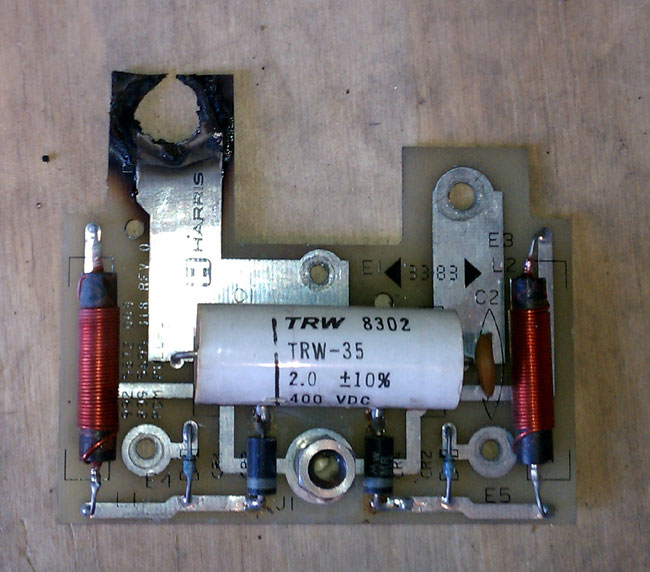
While replacing the dynamite sticks, I noticed this PDM pickup board has a whole burned through it.  This is a part of the modulator section and if it burned completely open, would likely cause all sorts of problems with this transmitter, likely spurs all around the dial, distorted modulation or perhaps overload and fail altogether.

Harris SX 5 transmitter damaged PDM pull up board
Harris SX 5 transmitter damaged PDM pull-up board

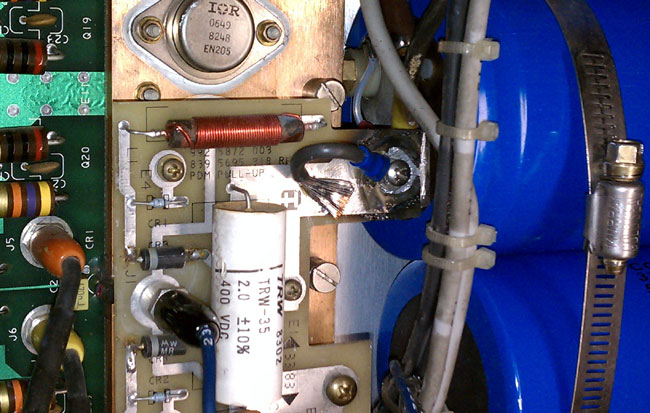
I managed to fix it with a jumper between what is left of the circuit board trace and the capacitor mounting bracket.  I soldered the jumper to the board face and soldered the wire lug.  After scraping all the oxidized metal off of the capacitor mounting bracket, I attached with a screw. The board itself needs to be replaced, if it is still available from Harris, which it may not be as support for this transmitter was dropped in 2008.

Harris SX5 PDM pull up board temporarily repaired with wire jumper

The worst, and I mean worst possible situation with these transmitters is some type of control malfunction.  The control boards and oscillator are in that large vertical pull-out drawer.  God protect and preserve the digital control and S and M boards, as they are a major headache to troubleshoot.  They have 7300 TLL (5-volt logic) that controls all functions and only a little problem will cause the entire transmitter to shut down.

Other SX series transmitter tips can be found here.

I didn’t get to replacing the blown devices because of a looming electrical storm, which precludes working inside of transmitters.  I’ll get back there next week and finish the job.

Update: I finished the repair job today 8/24.  There were 16 blown MOSFETS on the PA boards.  I checked the drive levels on the input side of the RF torrid load resistors and it is with normal range.  I also found this snake in the bottom of the transmitter across the HV shorting bar.

Small grey rat snake, electrocuted by Harris SX 5 transmitter

Could have been chasing diner.  Overall, the site needs help.  The air conditioner is coming next week.

Harris SX 5 transmitter fully operational

After repairs, the transmitter is back at full power and modulating +125% again.

What is this?

Or rather, what is the significance of this:

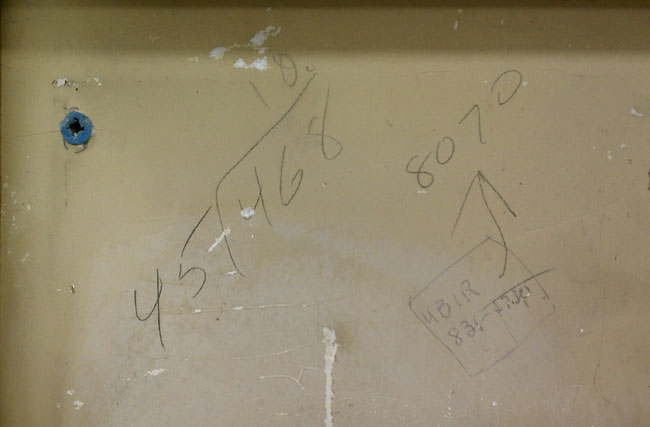
Wall Graffiti at a transmitter site
Wall graffiti at a transmitter site

A few hints; it was found (written on a wall) at an old, mountain top transmitter site. We are renovating this site and it was underneath an old old alarm panel from the 1970’s that I removed. It reads 468 ÷ 45 = 10.   and the 468 is significant.

Once upon a time, a person could go to the TELCO demark and get all of the inside numbers for the CO and any number of COs in the area.  They would be scribbled on the wall next to the equipment along with many other numbers.   This was especially helpful when doing emergency troubleshooting on a circuit that was down.  Try to do that these days and the most likely result is an unanswered phone.  Most of the smaller COs are not normally manned unless there is a trouble ticket in the process.