
While AM skywave is no longer considered when calculating listening area, there are, no doubt, many people who are still listening to skywave AM at night. I thought it might be interesting to do some data collection and analysis.
About a year ago, I synced the carrier of WABC to GPS. That was a relatively simple process.
A few weeks ago, I installed a very good receive antenna for Low and Medium frequencies at my house. The distance between this receive antenna and the WABC tower is 99,817 meters. This will become important later. Along with that antenna, I have installed an instance of UberSDR using a GPS locked RX-888 SDR. According to the manufacturer, the accuracy of the GPSDOs in use is +/- 0.0001 Hz.
I set up a program to measure the difference between received carrier and the frequency of the SDR and record it every minute. This allows me to collect Doppler Shift data on the WABC carrier frequency day and night. During daylight hours, there is a nice strong groundwave signal (about 89uV). The frequency difference is 0.004 Hz or less. When the sun goes down, the skywave starts coming in. That is when things get interesting.
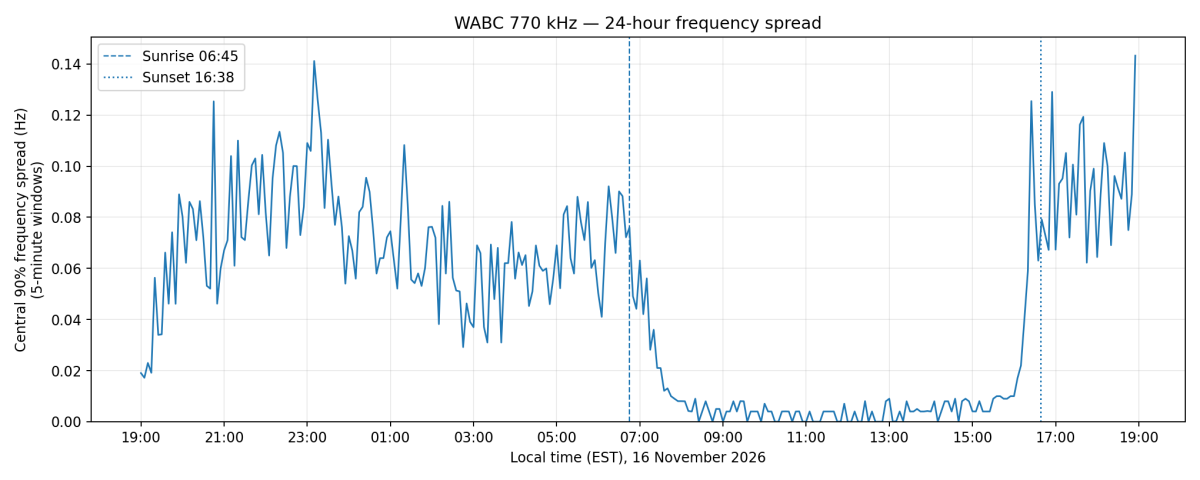
Here is the interpretation of the chart:
| Local time (EST) | What happens in your recording |
|---|---|
| 6:45 AM | Sunrise. Frequency spread is still characteristic of nighttime propagation. |
| ~7:00 AM | Frequency spread begins to collapse noticeably. |
| 7:45–8:00 AM | It reaches its very narrow daytime range. Groundwave is now dominant. |
| ~4:10 PM | Frequency spread begins increasing again, about 28 minutes before sunset. |
| 4:20–4:30 PM | The increase becomes pronounced. The skywave contribution is returning. |
| 4:38 PM | Sunset. |
The contrast is substantial: the typical central 90% frequency spread is around 0.06–0.08 Hz at night, compared with approximately 0.004 Hz during the middle of the day.
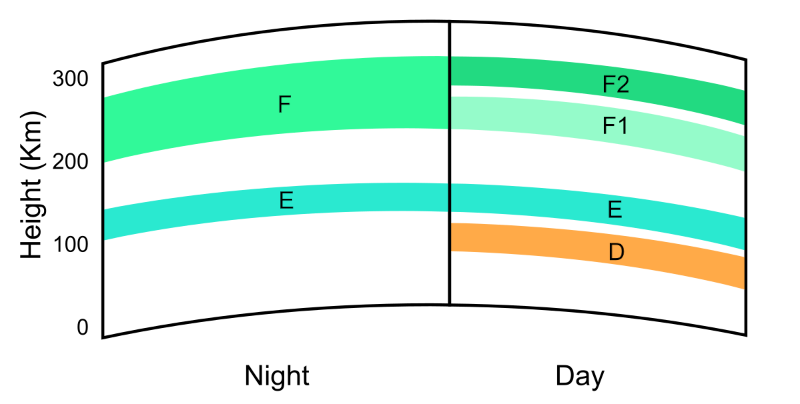
During the daylight hours, the D layer of the ionosphere absorbs all of the energy on Medium Frequencies (300 KHz to 3 MHz). Once the sun sets, the D layer dissipates and the E layer reflects Medium Frequencies back to earth. Based on the data, this happens about 45 to 60 minuets after sunrise and 45 to 50 minuets before sunset. This is because the height of the D layer above ground increases the time that the sun is effecting its ionization.
From ChatGPT:
Morning: The D region starts responding to sunlight before sunrise at ground level. The upper atmosphere receives sunlight while the Sun is still below the local horizon. A 2025 mid-latitude study found that the dawn transition begins when the Sun is approximately 7.5° below the horizon. Its effective D-region height then changes rapidly as sunrise approaches.
For your location and date, that puts the beginning of the physical dawn transition roughly around 6:00–6:15 AM. Your recording shows the much clearer suppression of the skywave beginning around 7:00 AM, with daytime conditions established by approximately 8:00 AM.
Evening: Your data shows the reverse process beginning around 4:10 PM, before sunset. The D-region ionization and its absorption effect decrease gradually; the region does not simply switch off at sunset. The skywave becomes increasingly visible as that absorption weakens. The 2025 study also documents the gradual change in effective D-region height through dusk.
The D region occupies roughly 50–90 km altitude. Its importance to your experiment is that it absorbs radio energy through collisions between electrons and neutral particles.
Why does the D layer effect Medium Frequency (including the AM broadcast band) but not HF (AKA Shortwave)? The D layer forms due to solar ionization; UV and X-ray radiation knock electrons loose from the gases (mostly nitrogen and oxygen) in the lower part of the ionosphere. This forms clouds of free electrons. Medium Frequency wavelengths are longer (1,000 meters to 100 meters), thus much more prone to strike free electrons which then vibrate back an forth colliding with gas molecules. That kinetic energy is dissipated as heat. HF wavelengths are shorter, while they still may strike some of the electrons, they generally make it through the D and E layers (depending on the frequency) to one of the two F layers that appear during the daylight hours.
At night, the D layer dissipates and the first layer of the ionosphere is the E layer, about 100 km above earth. Thus the carrier frequency Doppler shift is due to the longer path taken by the skywave reflected back to earth by the E layer. This leads to multipath as the two waveforms; groundwave and skywave meet at the receive antenna out of phase because to the different distances traveled.
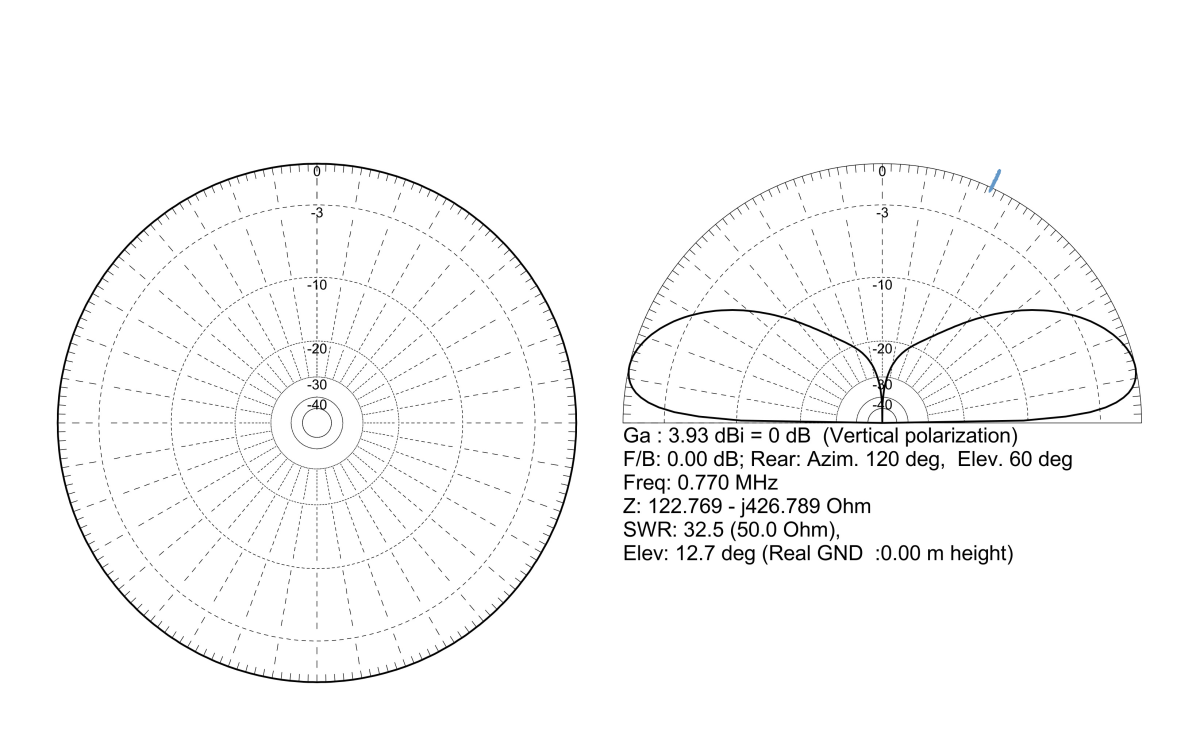
What is interesting that in this experiment; based on a E layer reflection point 100 km above the earth, the take off angle of the skywave signal being received from the WABC tower is about 65 degrees, which is higher than expected. Roughly 6% of the energy on a 1/2 wave tower is transmitted at that angle. Half wave (180 degree) towers are supposed to have lower take off angles; between 9 and 17 degrees and suppress higher angle radiation. This model shows the angle theta for maximum power is 12 degrees.
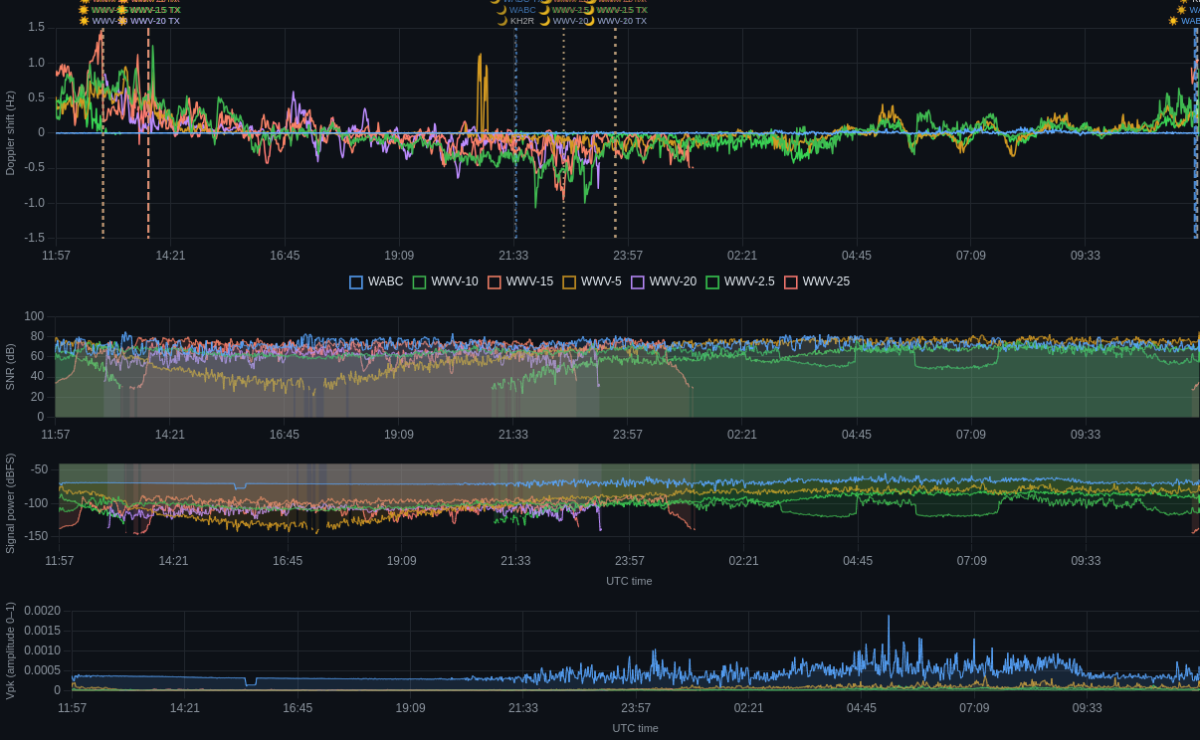
Above is a good representation of how Doppler Shift effects HF frequencies. The bottom chart is the peak amplitude of the carrier, showing the effects of multipath on WABC. The WWV frequencies vary quite a bit depending on the time of day and quality of HF propagation conditions. The distance to the transmitter site in Fort Collins is 2,554 km away. This shows one of the complexities of trying to broadcast digital audio (HD Radio and DRM) on medium and high frequencies.
