
Any radio station’s on air signal is its biggest marketing tool.
What sounds bad:
- Over use of compression (gain reduction)
- Over use of high frequency EQ
- Over “equalization” on all frequencies
- Over modulation
- Overly aggressive composite clipping
- Improper use of FM pre-emphasis
- Poorly tuned transmitters (tube type)
- Poorly matched antenna systems (all types)
- Poor quality audio input
- Over use of bit reduction on the STL
- Analog STL’s that are off frequency
- Playback of bad audio recordings
What sounds good:
- Moderate use of compression to bring up audio levels for in car listening
- Using equalization that suites format (e.g. more mid-range for all talk, more bass for urban, etc.)
- Properly adjusted processor output levels for the correct modulation levels
- Setting the pre-emphasis correctly
- Tuning tube type transmitters for minimum distortion
- Tuning antennas for adequate impedance and bandwidth
- Making sure that audio input levels are correct, the audio is properly distributed and terminated with the correct impedance
- Using STLs that have enough throughput that either no bit reduction or minimum bit reduction is used
- Regularly check analog STL frequencies and re-adjust as necessary
- Get rid of all bad audio recordings in the automation/playback system. Make sure that new files are from good sources and/or are re-recorded correctly
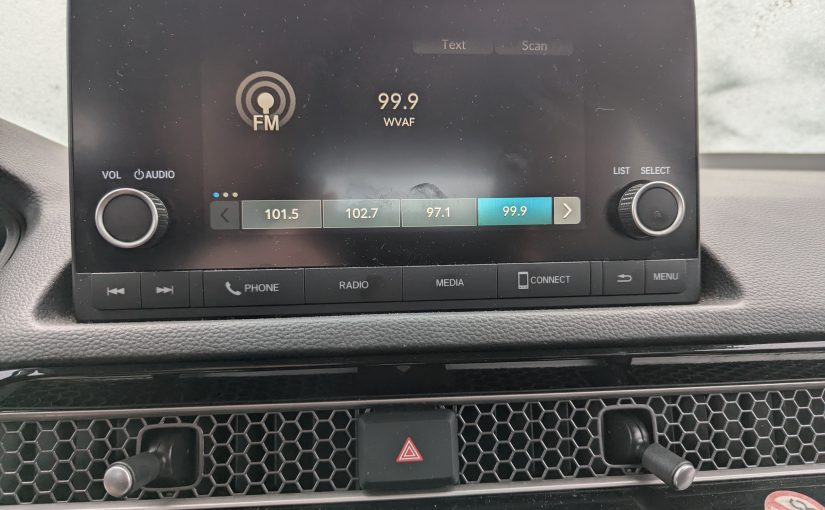
I took a little road trip between Christmas and New Years (Happy New Year!). I cannot help myself, I ended up tuning around the radio to see what was on. Suffice to say, I found the usual formats and a few locally focused stations. What struck me was the sound of some of the stations. While most sounded acceptable, if not somewhat generic, there were a few that had ear splitting, headache inducing audio. These stations were often over modulating and way over processed. It would have been better if there were no processing at all.
That got me thinking, what is or rather what should be the point of audio processing? Way back in the day, there were loudness wars. These were often program director ego induced efforts to sound louder than the competition because if you were louder, it meant you had more power. As listeners tuned their analog car radios from station to station, the signal that “jumped out” was mostly likely to attract more listeners. At least that was the way it was explained to me in the by a program director in the late 1980s.
We are no longer living in a listening environment where loudness is of huge importance. The number of audio sources has increased greatly; iTunes, Amazon Alexa, Spotify, Tune in, Pandora, YouTube Music, Sirius XM, iHeart, and AM/FM radio. Audio levels can be anywhere and listeners have gotten into the habit of raising or lower the volume as needed. Outside of program directors (or whatever they are called these days) offices, loudness means next to nothing. If you asked an average audio consumer how loud their program sounded, they would not likely know how to answer you.
I believe what most people are looking for is an enjoyable listening experience. The most important quality of any type of audio processing is that the product sounds good. The problem is “sounds good” is very subjective. Perhaps a better term would be technically sounds good. The audio should be free from distortion and artifacts of CODEC bit reduction. Overdone AAC or HE-AAC has this strange background swoshy platform behind everything which is headache inducing. Instruments should sound as they do when heard live. In other words, Susan Vega’s voice in the original Tom’s Diner should sound like Susan Vega.
Next would be compensating for difference levels in program material. A bit of gain reduction so that those in mobile listening environments can hear all of the program material. Finally, some format specific equalization can be useful. That is it. Moderate use of various audio processing tools can certainly accomplish those things. Like everything else, too much of a good thing is bad.














How do you respond to the idea that some stations crank the processing on purpose because they think it fits their brand or audience, even if it sounds harsh to people like us? In other words, is heavy processing always a mistake, or can it still make sense depending on who the station is trying to reach?
There was a station that deliberately “muddied ” up their audio called “the pirate.” It was to create the illusion that listeners were listening to a clandestine station, when in fact, they were listening to a legally licensed station.
It’s January 2026. Time to call Precision Communications (918-786-8084) and get your new free 2026 calendar. Lots of great tower shots, mostly FM and TV. Old call letters and home address is OK.
FWIW: I make a point to distinguish between “audio quality” and “audio fidelity.” The former I use as a more generic phrase that can cover a lot of situations. The latter is specifically about how “clean” the sound is; how much it sounds like the original source material.
Audio processing in the PPM era also has to include at least some headspace for ensuring that in a PPM market, your station is well-encoded. And for many of us (not all, but many) that means a Voltair. Although with the new SDK-based PPM encoders in the processor’s software, using a Voltair is expressly prohibited by contract (which I would LOVE to see that bullshit hold up in court).
People love to crap on Voltair because so many stations followed, as you so wonderfully put it, the PD’s ego in that if some is good, then way, way, WAY too much must be better.
That’s why I said, from very early on, that just buying a Voltair is stupidity on a level of being a fireable offense. Every Voltair MUST be paired with a TVC15 to dynamically adjust the VA’s processing level. When that is done, the “toilet farts” of VA’s processing should be completely inaudible or damn close to it. Or at worst, they’ll only be audible when the source material is exceedingly difficult to encode and will stop being audible when the source material changes.
It’s also worth spending some time thinking about “listener fatigue.” Overly processed audio may sound louder but a dynamic range that’s too squashed will actually be harder for the brain to process and “understand” what the content is. Do this for too long, and you literally make your listeners tired and irritable and they’ll tune out. Back in the day (2011-2012, the last time I was in SF with any regularity) KQED took this to an illogical extreme and ran their FM with barely any compression at all. They said they had to due to “listener fatigue” from listeners sitting in traffic for hours every day. There’s probably some truth to this, but it also meant listeners had to *constantly* adjust the volume on their car radios to “hear” anything at all as it was too loud when your car was going slow or stopped, and too quiet when at speed.
While you’re at it, convince those 50KW AM blowtorches to crank down that “wee-wEE-Wee-wee” coming from the Nielsen SW mentioned above? Trying to listen to a baseball game with crowd noise modulated by that cyclical “WEE-wEe-wEE-WEE” noise is just flat annoying. And, in the Festivus spirit of Airing of Grievances, what about those AM’s who have very nice (though reduced bandwidth, thanks lousy car AM receiver designer!) audio on AM, but terrible, distorted, overdeviated crud on their FM translator? We have one nearby, I listen to the AM signal because the FM signal is almost unlistenable.
Steve, in general I am somewhat of a minimalist so I would say no.
Lou, I’ll check out that calendar…
Aaron, as always, thank you for the thoughtful comment. I agree. One thing to note about the Volt Air, Nielsen states that the newer firmware and encoders make it unnecessary. Also, the Orban XPN unit will encode PPM right in the processor, which makes the whole process work better.
Crusty, unfortunately they think that setup gets them better ratings and thus more money…
Heavy compression is often added at the recording studio, so that consumers of downloads and streams get the ‘full crunch’.
It would be good to have dynamic range expansion available in broadcast audio processors. Would many Program Directors use it?
Live sporting event crowd noise + Voltair = wall of tinkling noise.
Anywhoo, Besides running square wave processed music from the producers through audio editing plug-ins, several radio processors have options to decompress & de-clip music. I haven’t played with it much (on the Omnia 9) but I couldn’t really tell what it’s doing. Not a golden ear I guess. The promotion they use is showing a songs waveform
before: square waves,
then
after: dynamic peaks & valleys.
I believe a big part of the issue is stations no longer have on-site engineering. It’s getting more and more common down here to have one company owning many stations, yet having one engineer, or worse, only a contract engineer to save their hides when things go seriously sideways.
The end result is what you described, crap sounding audio…