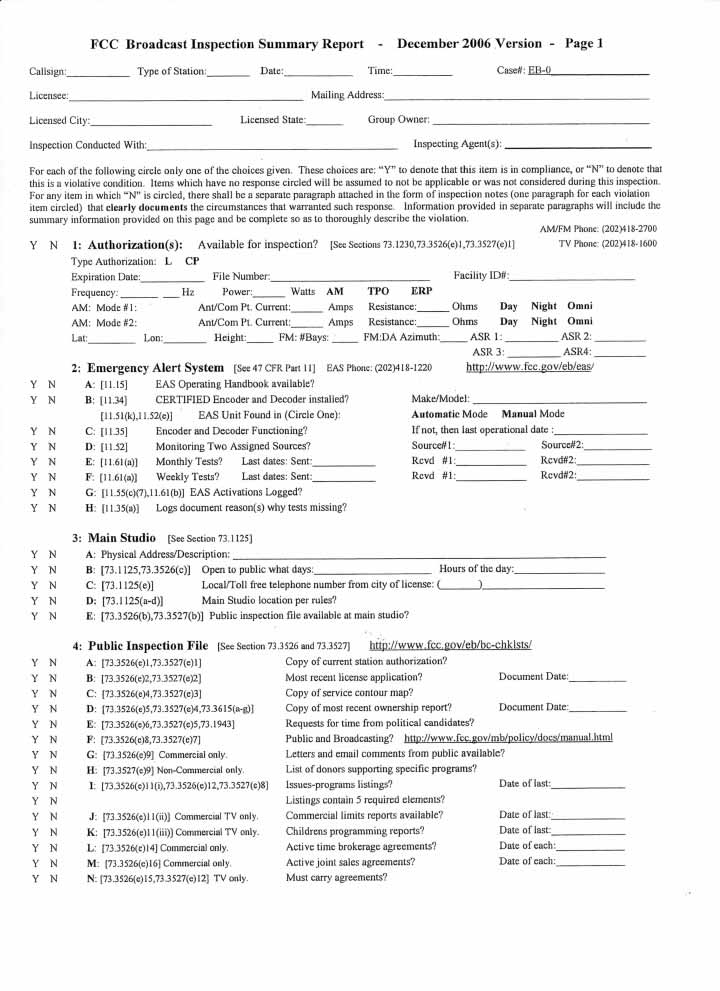

It’s time to start another cycle of radio station license renewals. From an engineering standpoint, there are a few things that may or may not fall under the engineering department:
- RFR exposure to the public
- Environmental impact of towers and buildings
- Technical aspects of public file
These items have not changed extensively from the last renewal cycle. A quick review is in order to make sure that all the FCC’s requirements are being met.
RFR exposure to public
Protecting the public from over exposure to RF has been an FCC hot button issue for the last 15 to 20 years. There are numerous places where radio station need be concerned about this. AM and FM transmitter sites, as well as mountain top tower farms are prime enforcement areas for the FCC when it comes to RFR. In a few well known incidents, the addition of RF generators to a location in the form of cellular or other wireless carriers contributed to the overall RF levels and uncontrolled areas were found to be over the exposure limit. Mount Wilson is one of these.
Single transmitter sites or sites that have only broadcast signals can usually be calculated using the FCC formulas provided in supplement a of OET-65. In other cases, the use of a NARDA meter to complete an on site measurement and a detailed report of findings will need to be completed by the licensee and attached as a part of the renewal. Mount Beacon (Beacon, NY), where two DTV stations, media flow and several cellular, 3G and 4G wireless transmitters have been added since the last license renewal in 2006 is a prime example.
In addition to certifying the public exposure is below the Maximum Permissible Exposure (MPE), tower workers and other site workers also need to be protected. This includes working on or near antennas under power.
Estimated power levels to comply with occupational/controlled limits for on-tower exposure of persons climbing AM broadcast towers.
FM antennas are a little more complicated. Section 2 of OET-65 supplement a gives the breakdown on how to compute the theoretical power densities for FM broadcasting. It can get a little complicated and as noted above, in highly used tower farms and tower sites, actual on the ground measurements will likely need to be made. Tables 5 and 6 give best and worst case scenarios for public and occupational exposure to RF.
Best and worst case scenarios for RF exposure in the FM broadcasting band for public exposure. The upper number is worst case, the bottom number is best number.
Environmental impact
Licensees have been required to certify that there stations comply with FCC 1.1307, to the effect that environmental assessments must be prepared for certain situations where:
- Facilities that are to be located in an officially designated wilderness area.
- Facilities that are to be located in an officially designated wildlife preserve.
- Facilities that: (i) May affect listed threatened or endangered species or designated critical habitats; or (ii) are likely to jeopardize the continued existence of any proposed endangered or threatened species or likely to result in the destruction or adverse modification of proposed critical habitats, as determined by the Secretary of the Interior pursuant to the Endangered Species Act of 1973.
- Facilities that may affect districts, sites, buildings, structures or objects, significant in American history, architecture, archeology, engineering or culture, that are listed, or are eligible for listing, in the National Register of Historic Places. (See 16 U.S.C. 470w(5); 36 CFR part 60 and 800.) To ascertain whether a proposed action may affect properties that are listed or eligible for listing in the National Register of Historic Places, an applicant shall follow the procedures set forth in the rules of the Advisory Council on Historic Preservation, 36 CFR part 800, as modified and supplemented by the Nationwide Programmatic Agreement for the Collocation of Wireless Antennas, Appendix B to Part 1 of this Chapter, and the Nationwide Programmatic Agreement Regarding the Section 106 National Historic Preservation Act Review Process, Appendix C to Part 1 of this Chapter.
- Facilities that may affect Indian religious sites.
- Facilities to be located in a flood Plain.
- Facilities whose construction will involve significant change in surface features (e.g., wetland fill, deforestation or water diversion).
- Antenna towers and/or supporting structures that are to be equipped with high intensity white lights which are to be located in residential neighborhoods, as defined by the applicable zoning law.
While these statements/conditions seem to point towards new licensees, I recall there being an “Environmental Certification” on past FCC form 303-s where the licensee had to certify that they where meeting the above conditions, or provide an environmental assessment. This seems especially true for AM stations existing in a flood plain.
Public file items (radio perspective):
- The License. Stations must keep a copy of their current FCC construction permit or license in the public file, together with any material documenting Commission-approved modifications to the authorization. The license or permit reflects the station’s authorized technical parameters (such as its frequency, call letters, operating power and transmitter location), as well as any special conditions imposed by the FCC on the station’s operation. It also indicates when it was issued and when it will expire.
- Applications and Related Materials. The public file must contain copies of all applications involving the station filed with the Commission that are still pending before either the FCC or the courts. These include applications to sell the station or to modify its facilities (for example, to increase power, change the antenna system, or change the transmitter location). If a petition to deny any application was filed, the file must contain a statement to that effect, and the name and address of the petitioning party. Applications must be maintained until “final” FCC action on them, when the action can no longer be appealed or reversed.The station must also keep copies of any granted construction permit or assignment or transfer application if its grant required us to waive our rules. Applications that required a waiver, together with any related material, will reflect each particular rule that we waived, and must be maintained as long as any such waiver remains in effect.Also, if the FCC renewed the station license for less than a full term, the station must keep that renewal application (FCC Form 303-S) in the file until grant of its next renewal application by final FCC action. We may grant such a short-term renewal when we are concerned about the station’s performance over the previous term. These concerns will be reflected in the renewal-related materials in the public file.
- Citizen Agreements. Commercial stations must keep copies of any written agreements that they make with local viewers or listeners. These “citizen agreements” may deal with programming, employment, or other issues of community concern. The station must keep these agreements in the public file for as long as they are in effect.
- Contour Maps. The public file must contain copies of any station service contour maps or other information submitted with any application filed with the FCC that reflects the station’s service contours and/or its main studio and transmitter locations. The Commission’s application forms require submission of contour maps only from stations that do not certify that their signals cover their city of license. These documents must stay in the file for as long as they remain current and accurate regarding the station.
- Material Relating to an FCC Investigation or Complaint. Stations must keep material relating to any matter that is the subject of an FCC investigation (including EEO audits) or a complaint that the station has violated the Communications Act or FCC rules. The station must keep this material in its file until the FCC notifies it that the material may be discarded. Since the FCC is not involved in disputes regarding matters unrelated to the Communications Act or FCC rules, such as private contractual disputes, stations do not have to retain material relating to such disputes in the public file.
- Ownership Reports and Related Material. The public file must contain a copy of the most recent, complete ownership report (FCC Form 323 for commercial stations, FCC Form 323-E for noncommercial educational stations) filed for the station. Among other things, these reports disclose the names of the owners of the station licensee and their ownership interests, list any contracts related to the station that are required to be filed with the FCC, and identify any interests in other broadcast stations held by the station licensee or its owners.
- List of Contracts Required to be Filed with the FCC. Stations must keep in the public file either copies of all the contracts that they have to file with the FCC, or an up-to-date list identifying all such contracts. If the station keeps a list and a member of the public asks to see copies of the actual contracts, the station must provide the copies to the requester within seven calendar days. Contracts required to be maintained or listed in the public inspection file include:· contracts relating to network service (network affiliation contracts);· contracts relating to ownership or control of the licensee or permittee or its stock. Examples include articles of incorporation, bylaws, agreements providing for the assignment of a license or permit or affecting stock ownership or voting rights (stock options, pledges, or proxies), and mortgage or loan agreements that restrict the licensee or permittee’s freedom of operation; and· management consultant agreements with independent contractors, and contracts relating to the utilization in a management capacity of any person other than an officer, director, or regular employee of the licensee.
- Political File. Stations must keep a file which contains “a complete record of a request to purchase broadcast time that: (A) is made by or on behalf of a legally qualified candidate for public office; or (B) communicates a message relating to any political matter of national importance, including: (i) a legally qualified candidate; (ii) any election to federal office; or (iii) a national legislative issue of public importance.” The file must identify how the station responded to such requests and, if the request was granted, the charges made, a schedule of time purchased, the times the spots actually aired, the rates charged, and the classes of time purchased. The file also must reflect any free time provided to a candidate. The station must keep the political records in the file for two years after the spot airs.
- EEO Materials. As noted earlier, licensees must submit certain forms containing EEO information and include copies in their station public files. Thus, all stations employing five or more full-time employees must put an EEO public file report in their station public file each year. We also require each radio and TV station licensee to file a Form 396 EEO Program Report with its license renewal application and to include the Report in its public file. Those licensees that file a Form 397 Broadcast Mid-Term Report must also include a copy in the public file. These materials must be retained in the file until final action on the station’s next license renewal application. A new station applicant or prospective station buyer, if it intends to employ five or more full-time employees, must file a Form 396-A Broadcast EEO Model Program Report with its new station assignment or transfer application and the Report must be included in the public file as a part of the underlying application and retained in the file until the grant of the underlying application becomes final.
- “The Public and Broadcasting.” Stations must keep a copy of the current version of this Manual in the public file and provide a copy, upon request, to any member of the public.
- Letters and E-Mails from the Public. Commercial stations must keep in their files, for at least three years, written comments, suggestions, and e-mails received from the public regarding their operation. (Noncommercial educational stations are not subject to this requirement.) This obligation is limited to comments, suggestions, and e-mails sent to station management or a publicized station address. Letters need not be placed in the public inspection file when the author has requested that the letter not be made public or when the licensee feels that it should be excluded from public inspection because of the nature of its content (such as defamatory or obscene letters). Moreover, although television stations that post their public file materials on their websites must include e-mails received from the public, they need not post letters from the public, as long as they include hard copies of such letters in their public files, and a notice on their website that the letters can be located in the file. As noted above, all or a part of a station public file may be maintained on a computer database, as long as a computer terminal is made available, at the location of the file, for members of the public who wish to review the file. Accordingly, as an alternative to maintaining hard copies of e-mails in the public file, a station may place the e-mails on a computer database, as long as a terminal is made available at the location of the public file to members of the public who wish to review the file.
- Quarterly Programming Reports. Every three months, each broadcast radio and television station licensee must prepare and place in its station public file a list of programs containing its most significant treatment of community issues during the preceding three months (“issues/programs lists”). The list must briefly describe both the issue and the programming during which the issue was discussed, including the date and time that each such program was aired and its title and duration. The licensee must keep these lists in the file until the next grant of the station renewal application has become final. Television stations will be required to file a Standardized Television Disclosure Form instead of these lists once that form is approved and made available. The form, which will also be filed quarterly, will require commercial and noncommercial educational television broadcasters to provide detailed information on the efforts of their station to provide programming responsive to issues facing their communities in a standardized format.
- Time Brokerage Agreements. A time brokerage agreement is a type of contract that generally involves a station’s sale of blocks of airtime to a third-party broker, who then supplies the programming to fill that time and sells the commercial spot announcements to support the programming. Commercial radio and television stations must keep in their public files a copy of every agreement involving: (1) time brokerage of that station, or (2) time brokerage by any other station owned by the same licensee. These agreements must be maintained in the file for as long as they are in force.
- Lists of Donors. Noncommercial educational television and radio stations must keep in their public files a list of donors supporting each specific program. These lists must be retained for two years after the program at issue airs.
- Local Public Notice Announcements. When someone files an application to build a new station or to renew, sell, or modify an existing station, we generally require the applicant to make a series of local announcements to inform the public of the application’s existence and nature. These announcements are either published in a local newspaper or made over the air on the station, and are intended to give the public an opportunity to comment on the application. A statement certifying compliance with this requirement, including the dates and times that notice was given, must be placed in the public file. The only exception to this public notice requirement is when the proposed station sale is “pro forma” and will not result in a change of ultimate control, or the modification application does not contemplate a “major change” of the station facilities.
These are from “The Public and Broadcasting,” which is available for download.
Now is the time to start looking at this, we all know what happens when these things are put off to the last minute.


Open Mic