May 2012
M T W T F S S
« Apr    
 123456
78910111213
14151617181920
21222324252627
28293031  

Archives

Categories

The Nautel VS-2.5 FM transmitter

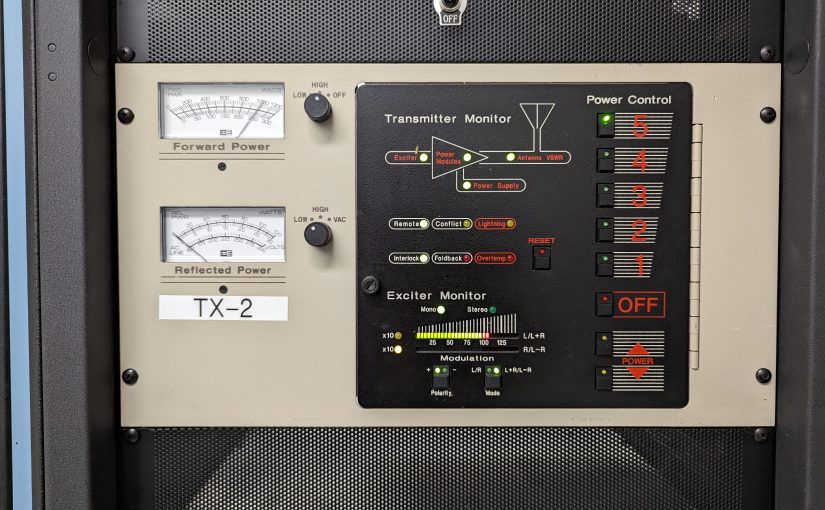
This is cute. A small (VS allegedly stands for “Very Small”) integrated 2,500 watt FM transmitter.  This one we just finished installing as a backup transmitter for WSPK, on Mount Beacon, New York.

Nautel VS-2.5 FM Transmitter

Nautel VS-2.5 FM Transmitter

This site has a Nautel V-7.5 as the main transmitter.  That unit is very reliable, however, this transmitter site is non-accessible 4-5 months out of the year due to ice and snow.  The last time we had an off air emergency due to a crippling ice storm, it took an entire week to clear away all the downed trees so we could gain access to the site via snowmobile.  As such, every system needs dual or even triple redundancy.  Lack of said redundancy has lead to several prolonged outages in the past.

WSPK signal flow diagram

WSPK signal flow diagram

Last year, we were finally able to install a backup antenna after 63 years without one.  This year, it is time to upgrade the rest of the backup equipment.  The new auxiliary transmitter is connected directly to the auxiliary antenna via a five port coax switch.  This allows for use of the dummy load for testing when we are present, but removes a potential failure point in the coax switch.  There have been at least two incidences of the disk jockey accidentally transferring the transmitter into the dummy load when taking transmitter readings.  Hopefully this configuration will be fairly idiot proof.  I am making an interlock panel that will prevent both transmitters from being on the air at the same time.

Nautel VS 2.5 connections

Nautel VS 2.5 connections

This site is a work in progress.

The backup processor is at the transmitter site, the main processor is in the rack room at the studio.  This works well because the main processor occasionally looses its mind and needs to be rebooted.  It would be a significant pain to drive all the way up to the transmitter site just to reboot the processor.  It might not happen at all during the winter.  The back up processor has no mind so it is not an issue.

The VS transmitter is attractive because it has a built in exciter that accepts composite, AES or IP audio.  The exciter also has a built in Orban processor as an option.  Thus, if it really hit the fan, we could use the LAN extender to get the audio to the site.  Further, it could be addressed by any studio in the company WAN.  Which is cool, when you think about it.

Nautel continues to crank out innovative, dependable products and there is nothing wrong with that.


Tube transmitters vs Solid State transmitters

I thought it would be interesting to do a comparison between the two types of transmitters, both AM and FM.  I have been doing this thing for 25 years and have quite a bit of experience working on all types of transmitters.  Some of the broadcast transmitters I have personally worked on over the years include:

  • Harris: FM-20H, FM-5G, HT-35, HT-10, HT-3.5, FM-25K, FM-5K, Z5-CD, MW-50A, MW-50B, MW-1A, MW-5A, BC-5H, SX-5, SX-1A, Gates 1
  • Broadcast Electronics: FM-5B, FM 3.5A, FM5A, FM30A, FM35A, FM30T, FM20T, FM10S, FM5C, FM1C, AM10A, AM6A, AM5E, AM1A
  • Continental Electronics: 816R-2, 814R-1
  • Collins Rockwell: 831F-1, 838E-1
  • Nautel: ND-1, ND-5, XL-60, V-40, V-10, V-7.5, NV-40
  • Gates: BC5P, BC1T, FM5B
  • General Electric: BTA-25
  • RCA: FM20ES1, BTA5J, BTA1-AR
  • CSI/CCA, Visual, Energy Onix, Bauer, McMartin, QEI, some Italian something or other, etc.  Various makes and models.

I think I have a fair amount of transmitter experience under my belt.  What I have found is that certain brands of transmitters are better than others, regardless of whether they are tube or solid state.  There are several differences in each type, obviously.  As to some blanket statement about which is better, solid state or tube, I don’t have one.  My statement would be “It depends.”

Tube transmitters are more rugged and will take more abuse than a solid state unit. Things like heat, lightning, EMP, mismatched antenna won’t phase a well designed, well manufactured tube transmitter.  On the other hand, they are less efficient AC to RF, have higher B+ voltages, have hard failure modes, and are more difficult to linearize, if that is required for some reason.

Solid state transmitters are more broadbanded, easier to change frequency, they have soft failure mode due to redundant amplifiers and power supplies. The voltages are lower, thus they are safer to work on.

Here is a complete list of advantages and disadvantages of each type:

Attribute Tube Solid State Comment
Ruggedness Very rugged, able to take heat, EMP, lightning, mistuned antenna, poor operating environment, etc Not heat tolerant, lightning and EMP can damage MOSFETS, switching power supplies sensitive to AC mains issues Advantage: Tube
Electrical Efficiency Less efficient More efficient Advantage: Solid State, however efficiency gain can be wiped out due to larger air conditioning requirement
Failure mode Hard, most often Soft, most often Advantage: Solid State, failure of a single module or power supply generally will not take unit off the air
Frequency agility Difficult Easy Advantage: FM Solid state transmitters can easily be moved.  AM transmitters still require extensive retuning.
Re-occurring cost More Less Advantage: Solid State, as tube changes are required every two to three years
Maintenance Same Same Advantage: neither
Servicing Requires skilled engineers to service and trouble shoot Modules and power supplies are often hot swappable and returned to manufacture for repair Advantage: Solid State, however either type requires occasional measurements with specialized test equipment
Servicing safety High voltages, contact will be fatal Lower voltages, but can still be fatal Advantage: Solid State
Redundancy Low High Advantage: Solid State, multiple power amps and power supplies give solid state units more redundancy
Cost Less More Advantage: Dependant on TPO, Higher powered solid state transmitters are much more expensive than there tube type counterparts
Availability Good used market, some new FM transmitters still being built Good new and used Advantage: Tube
 Reliability  Dependent on brand  Dependent on brand  Advantage: neither

For some reason, the latest Broadcast Electronics tube type transmitters seem to have very long tube life.  I installed an FM20T at WYJB in Albany, New York,  in early 2001 and it is still on the original tube, some ten years later.  Same can be said for the 2005 FM20T and FM30T installation at WHHZ/WKZY, Gainesville, Florida.   Those tubes shows no sign of giving up anytime soon.  I don’t know if that is an unusual trait of the transmitter or that particular tube.

WKZY, Gainesville, Florida

WKZY, Gainesville, Florida

The above comparison seems to heavily favor a solid state transmitter.  As a general rule, brand new solid state transmitters both AM and FM have advantages in almost every category except high power FM transmitters, where tube types still make sense.  From a used transmitter standpoint, there is nothing wrong with a tube type transmitter, provided it has a solid state IPA.  I have noticed the 4CX250B driver tubes most often used in FM IPA stages have markedly reduced reliability of late.  I would also tend away from transmitter makes and models where the manufacture is no longer in business or no longer supports the product.

New Nautel NV-40 at WVPS, Burlington, VT

Sorry for the prolonged absence. I have been, quite literally, out of reach for the last two weeks. In fact, for the entire month of July, I have spent just five days at home. Some if the travel was for work and some for pleasure.

On the work side of the equation, WVPS in Burlington, Vermont has a new Nautel NV-40 transmitter.  WVPS is the NPR affiliate for Vermont Public Radio and it’s transmitter site is located on top of Mt. Mansfield, in Stowe, VT.  I will do a separate article about the Mt. Mansfield transmitter site because it is an interesting place.  WVPS is a Class C FM on 107.9 Mhz.  They have one HD subchannel for the VPR classical music format.

The Nautel NV-40 transmitter is greatly updated from the V-40, which was installed at WHUD.  Basically, the V-40 is four ten kilowatt transmitter combined.  It is a novel approach and offers quite a bit of redundancy as entire transmitters can be switched off and worked on with the other three remain on the air at full power.

The NV-40 is a single large chassis with internal combining networks.  It uses different RF modules but the same power supplies.  The entire thing is controlled by a fancy GUI on the front of the transmitter, but also has the ability for manual control if the GUI fails.  That is a key feature not seen in other transmitters which simply won’t work without the fancy computer.  Other things that I like, the ability to control all of the biasing and other options via the GUI and things like a spectrum analyzer and lissajous display.  The ability to look at several graphic displays at once makes it easy to configure and monitor.

The transmitter arrived at the top of the mountain via a local moving company.  After unloading it on the loading doc, it took some amount of doing to get it down the hall into the transmitter room.  The thing weighs in at 1,600 pounds after being uncrated.

Nautel NV-40, Mt. Manchester transmitter site loading dock

Nautel NV-40, Mt. Mansfield transmitter site loading dock

Unpacked:

Nautel NV-40 uncrated and read to move down the hallway

Nautel NV-40 uncrated and read to move down the hallway

Moving into final position in the WVPS transmitter room.

Movers putting transmitter into final location and removing pallet jack

Movers putting transmitter into final location and removing pallet jack

The connections were made to the transmitter, including connecting grounding strap to the back, 200 amp electrical service and the RF output connection via 3 inch rigid coax.

Nautel NV-40 installed

Nautel NV-40 installed

The remote control consists of basic transmitter functions going to a dial up Gentner remote control and a Network connection going to the GUI.  The network connection allows persons on the network to use a web browser to look at the GUI.  The HD radio connections are made via a HD radio importer and exporter, located at the studio, which also uses the network, via a connection on the exciters, to send the HD subchannel.  The analog main channel is via an AES/EBU connection from the STL.

All connections go through large toroids to help isolate the transmitter from any lightning related surges.

Before I left, we tested it at full TPO into the dummy load.  All worked well, the only outstanding issue was getting the HD radio importer/exporters to work over the network, which was out of my jurisdiction.

Author and Nautel NV-40

Author and Nautel NV-40

Here is a rather blurry picture of your author standing next to the NV-40 with the exciter and GUI turned on. There are to IEC power connectors at the top of the transmitter that go to the GUI and exciters. This allows those part of the transmitter to run on UPS’s, which is nice, being that the GUI takes about a minute to boot up after power failure.

All is not well in paradise

If one considers paradise an FM35A. Going through another iteration of blown transmitter fuses for WEBE, Bridgeport, CT. Yesterday, I spent the afternoon examining the transmitter and found several interesting things:

  1. Fresh arc tracks on the PA cavity and PA loading capacitor
  2. The shoes and bars in the high voltage contactor were severely pitted
  3. One of the mains phases (middle) in the high voltage supply appears to be heating up, likely due to a loose connection.
Discolored wire on buss bar

Discolored wire on buss bar

I checked and re-tightened all of the mains connections.  Apparently, this is an old problem, as the Allen screw was tight.  Interestingly, the fuse that was blown was on the red phase, which is different from what it was last time.

I spent the afternoon filing and sanding off the arc track marks in the PA cavity.  It is very important to file flat all sharp points that where the result of arcing.  Any sharp points will induce corona.  I also filed down all of the contacts in high voltage contactor, which took a fair amount of time. These are soft copper shoes and bars which had so much pitting and carbon I wonder how they didn’t catch on fire.  I filed them flat.  We were back on the 35A transmitter at full power by 4:30pm.

If this happens again, I will bring my megger out and check the insulation on the wire between the disconnect switch and the HV power supply.

When I left the site at 5:30, I felt like we did some good work.

What happens next

It’s the middle of the night and the phone is ringing.  That is never good.  The transmitter is off the air.  You call the remote control and try to put the main transmitter back on the air.  No good.  The backup comes up, no problem.   Shaking off the sluggishness, you get dressed and head out the door.  The transmitter is about 30 miles away, but it’s the middle of the night, so there is no traffic.  While driving, you are thinking of all the things that could be wrong.  The blower motor was sounding a little loud last trip.  The exciter has some reflected power.  The PA tube is two and a half years old.

Upon arrival, there are several overload lights lit, including the driver plate.  An investigation is in order.  You turn everything off and open the doors.  The trouble seems to be a bad IPA power supply.  There are spares on the parts shelf, so you put one in.  Put the transmitter into the dummy load.  You turn on the filament and the transmitter comes to life again.  Reset the overloads.

Broadcast Electronics FM35A transmitter ready to be turned on

Broadcast Electronics FM35A transmitter ready to be turned on

Now you are standing there looking at the plate on button.  Was it really only the IPA or was that just a symptom?  Was there something else that took out the IPA power supply?  What will happen when I press the plate on button?  Will it come on normally or go BANG!  I hate BANG!  By the way, my tradition in a situation like this, if on a mountain top somewhere, I go outside and pee.  I give the situation one more run through the mental checklist, then come back inside and press the button.

Broadcast Electronics FM35A transmitter high voltage on button

Broadcast Electronics FM35A transmitter high voltage on button

Please excuse the blurry picture, it is hard to take a picture of yourself turning on a transmitter…

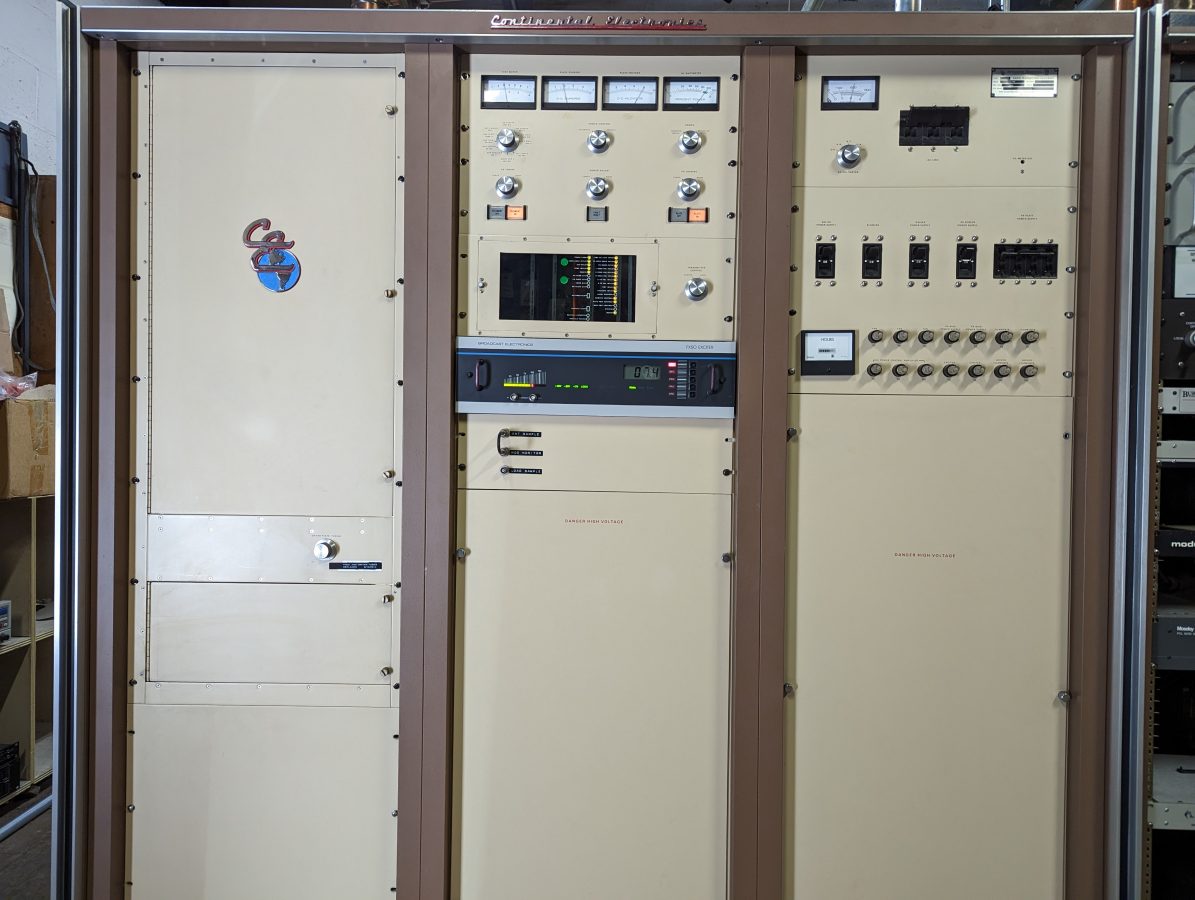
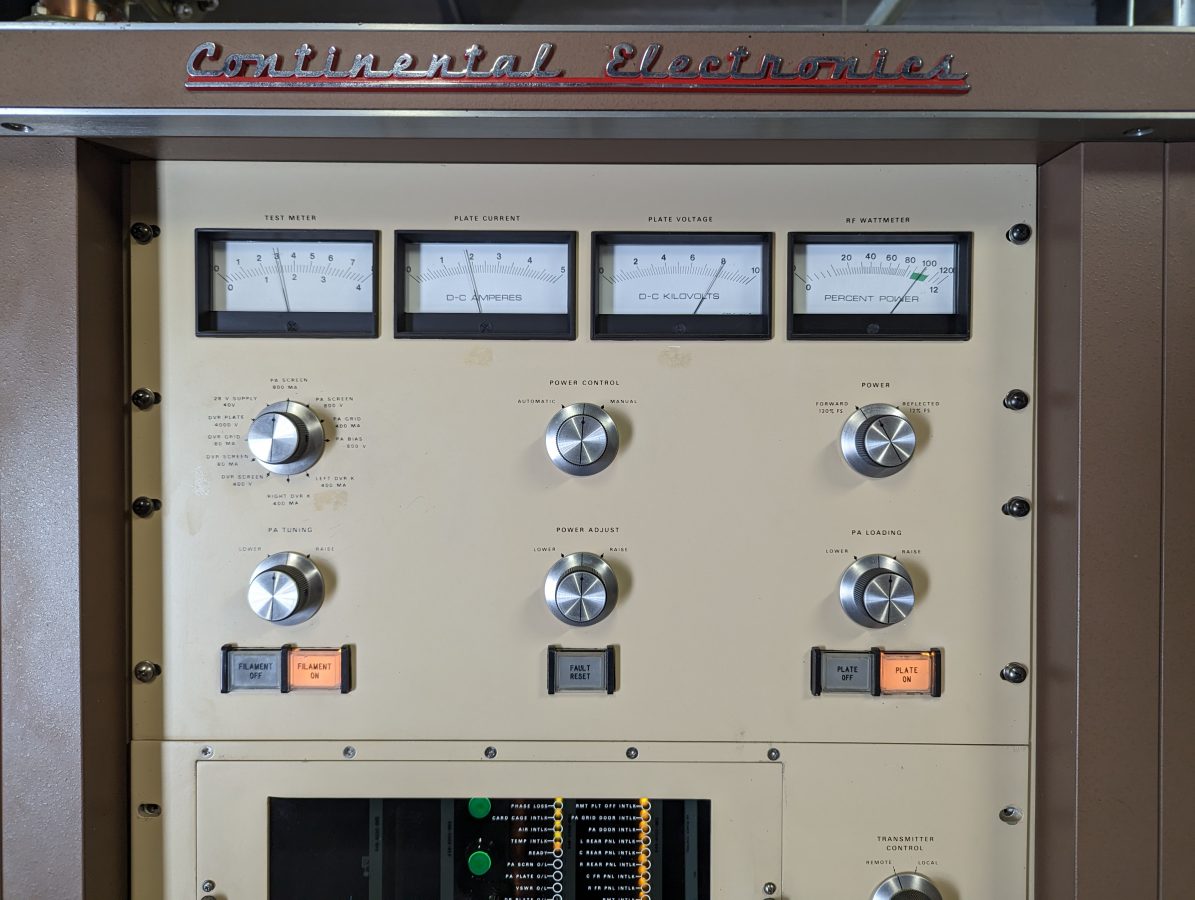
Continental 816R2 FM transmitter

This is perhaps my favorite model FM transmitter, the Continental 816R2:

Continental 812R2A FM transmitter

Continental 812R2A transmitter, on the air

I have known this particular transmitter for almost twenty years.  It was installed new at WFLY 92.3 MHz in August of 1986.  I was reflecting on that today, as I replaced the bad 4CX250B driver tube that caused the output power to drop to 10 percent.  The power control is via SCR‘s on the HV power supply, not the more common PA screen voltage adjustment.  That means the transmitter comes on with zero PA voltage and ramps up to full power.  It makes the whole thing “smooth” like driving a Mercedes.

I have experienced a few overloads, which usually are accompanied by the room lights dimming slightly and the plate voltage turns off.  Again, no theatrics;  no big blue flashes, no loud arcs, etc.  Simply turns off the high voltage and lights a LED on the overload board to tell the operator what happened.

Over the las 20 or so years, I think I have had three out of the ordinary problems with this transmitter:

  1. The power supply pass transistor in the 802 exciter failed.  This is a TO-3 case mounted on a heat sink, something like a 2N2225 I think.  It runs hot.  Anyway, the exciter had no 20 volt supplies, which was pretty easy to diagnose.
  2. The SWR foldback did not work during an ice storm.  This transmitter feeds an ERI antenna without heaters or radomes.  About once every 2-3 years there is an ice buildup, which will cause the transmitter to fold back.  In this case, the transmitter overloaded and went off the air instead.  Traced back to a bad/dirty connector on the directional coupler.
  3. One of the SCR’s exploded while running on generator.  Figured out this was caused by harmonics from the generator exciter.  Replaced the exciter with a different version, no SCR problems encountered after this fix.

I like the Continental tube type transmitters, they are solid units that perform well and have years of reliable service, if properly maintained.

FM antenna mounted on the side of a smokestack

If a person were to drive south down I-95 through Bridgeport, CT and look off to the left, they would see a 500 foot smokestack for a coal fired power plant.  Side mounted on that smokestack is a 6 bay Shively FM antenna.  The antenna is more visible when driving south.  That would be the antenna for WEBE 107.9 Mhz.  This is right down town, therefore, I would imagine this station has no problems with reception.

Bridgeport Power Plant smokestack, viewed from the west

Bridgeport Power Plant smokestack, viewed from the west

WEBE is a class B FM with a full 50 KW ERP.  Most FM’s around here take advantage of a nearby mountain to gain some altitude and thus reduce the TPO a bit.  There are several class B stations that run less than 5 KW into a relatively small antenna, but they are way up in the 900 to 1000 foot HAAT range.  In this case,  the power plant is located right on the Pequonnock River bay, so the AMSL at the base of the smokestack is only 10 feet.  This means lots of watts out and a fairly large antenna.

They are using Broadcast Electronics FM35A for the main and backup transmitters.  They were installed in late 1986 and are a little long in the tooth.

Broadcast Electronics FM35A transmitter

Broadcast Electronics FM35A transmitter

They run near 12 KV plate supply, about 3.8 amps making 34 KW TPO.  That goes into a six bay Shively 6 bay 6813 antenna centered at 475 feet, which makes the HAAT 117 meters.

One of the problems encountered with at site is the smokestack emissions.  It seems that a fair amount of mercury comes out to the top of that thing.  In the past, this has caused major problems with the antenna shorting itself out and burning up transmission line.  Because of this, the entire antenna system, radomes, and transmission line is supplied with Nitrogen from this liquid nitrogen tank:

Liquid Nitrogen Tank

Liquid Nitrogen Tank

The antenna then intentionally bleeds N2 into the radomes continuously, overpressurizing them,  to keep the smokestack emissions out.  This type of tank is needed because a conventional N2 tank would last about a day, whereas the liquid tank lasts about 20 days.

The BE FM35A decided to blow a 200 Amp fuse on Friday afternoon:

Blown 200 Amp fuse

I had a BE FM30A that would randomly trip the 200 amp main breaker every once in a while.  I could never find anything wrong with the transmitter, it would just come back on and run normally again after the breaker was reset.  I even replaced the breaker thinking breaker fatigue.  Still happened.  In the end, we replaced that transmitter.  In this case, I don’t see that happening anytime soon.

BE FM35A heavy iron:

Broadcast Electronics FM35A plate transformer

Broadcast Electronics FM35A plate transformer

I would not want to replace this thing, it must easily weight 1,000 pounds.

And rectifier stacks:

Broadcast Electronics FM35A rectifier stacks

Broadcast Electronics FM35A rectifier stacks

12,000 volts DC.  That will light up any dirt, dust, piece of fuzz, etc. in the transmitter.

It is one of the more unique FM transmitter sites I’ve ever been to.  Every time I see it, I am reminded of that song, Smokestack Lightning. My favorite version of that song is the live recording by the Yardbirds

Rebuilt tubes

As broadcasters, we don’t really hear that much about ceramic power vacuum tubes these days, as more and more broadcast transmitters migrate to solid state devices.  Once upon a time, however, power tubes where the engine that drove the entire operation.  Tubes had to be budgeted for, stocked, rotated and replaced on a regular schedule.  Some of those dern things were expensive too.

Take the 4CX35,000A which was used in the Harris MW50 transmitters.  The transmitter used two of these tubes, one in the RF section and one it the modulator.  As I recall, new tubes cost somewhere north of $8,000.00 each from EIMAC.  Plus, in the A models there were two 4CX1500A driver tubes.  All of which could add up to an expensive maintenance cost every two years or so.

The next best option was to buy rebuilt tubes.  Rebuilt tubes were about half the cost of brand new ones.  Some people complain that rebuilds don’t last as long, or only last half as long as the new tubes.  I never found that to be the case.  I often found other factors effected tube life far greater, such as filament voltage management, cooling and by extension, cleanliness.

I can say I never had a warranty issue with ECONCO tubes.  I cannot say that about EIMAC, as during the late 90′s and early 00′s (or whatever you call that decade) I had several brand new 4CX3500 tubes that were bad right out of the box.  These days, ECONCO and EIMAC are both owned by CPI.

I spoke with John Canevari from ECONCO who had a lot of information.  For example, as the tube ages, the filament gets more flexible, not less.  Most ceramic power tubes use a carbonized tungsten filament containing some small amount of thorium.  As the tube ages, the filament can no longer boil off enough electrons and the emission begins to drop off.  That is the normal end of life for a power tube.  Occasionally, some catastrophic failure will occur.

There are many steps in the rebuilding process:

  1. Dud is received from the field, the serial number is recorded and the tube is tested in.
  2. The tube is prepped by sand blasting the sealing rings
  3. It is opened
  4. Filament is replaced.  In 60-70% of the cases, the grid is replaced.  In those tubes that have a screen assembly, 20-60% of those will be replaced.
  5. Interior of the tube is cleaned
  6. Tube is resealed and tested for leaks with a gas spectrometer
  7. Tube is placed on the vacuum machine.  Tubes are evacuated hot, smaller tubes take 12 to 24 hours, very large tubes can take up to one week.
  8. The tube is nipped off of the vacuum while still hot.  When the tube is fully cooled the vacuum scale is normally around 10-12
  9. Exterior of tube is cleaned and replated.  Silver for tubes that are socketed and Nickel for tubes that have leads.
  10. Tube is retested to manufacture’s original specification or greater.

After that, the tube is sent back to its owner or returned to stock.  John mentioned that they are very proud of there vacuum tube processing machines, so I asked if he could send along a picture.  They certainly look impressive to me, too:

vacuum tube processing machine

Vacuum tube processing machine, photo courtesy of ECONCO

Not exactly sure which tube type these are, but they sure to look like 4CX15,000:

vacuum pump on rebuilt ceramic power tubes

Vacuum pump working on rebuilt ceramic power tubes, photo courtesy ECONCO

Econco has been in business since 1968 and rebuilds about 600-1,000 tubes per month.  In the past, broadcasters used most of the larger tube types.  However, with the majority of broadcast transmitters shifting to solid state, other markets have opened up such as industrial heating, military, research and medical equipment.

RCA BTF-20E

Does any one need any parts for one? Long time reader and commenter John has one that looks to be in good shape that he is willing to part with or part out.  I had three of these units in Harrisburg and my recollection is they were pretty solid units.  When tuned properly, they were low noise and sounded good on the air.

The one issue I had was with the small 100 pf pass through/by pass capacitors in the IPA.  Several went bad and were no longer functioning as bypass caps.  The result was the transmitter would self oscillate.  I think there were seven or eight of them and I replaced them all at once.  The exact model of that particular transmitter was a BTF-20ES1, which was one of the last FM transmitters off of the factory floor before the broadcast division went under.

RCA BTF-20E FM transmitter

Late model RCA BTF-20E FM transmitter

John says:

If anyone needs parts out there, I will probably cannibalize this unit as I have just too many. The separate power supply is inside the garage along with the latest version of the harmonic filter entirely made of copper.

I don’t know if the entire unit actually runs or if it is parts only.  It certainly looks like a clean unit.  As I recall, Comark bought out all the RCA broadcast parts and service. Comark was then sold to Thomcast, which was sold to Thales which I think spun off it’s transmitter division to Grass Valley Group.  Grass Valley started by making TV master control switchers, routers and other video equipment.

Anyway, if you are looking for RCA parts for FM transmitters, contact me, I’ll put you in touch with John.

Harris FM25-K

Old blue, I like to call them, the Harris 1980′s model transmitters with black faces, white cabinets and blue trim. I have yet to find one that I really like, the FM 25-K is, well okay. Sort of like that 200,000 mile jeep that works, most of the time, and it’s paid for.
This particular FM-25K transmitter is located at WIZN in Charlotte, VT.

Harris FM25-K transmitter

This transmitter was new in 1987.  It had a bad day yesterday, deciding to throw a temper tantrum and trip the HV power supply breaker.  Fortunately, the station has a back up transmitter.  When we arrived, we found the HV power supply feed through insulator at E1 arced over and broken.  Again, fortunately this station’s management believes in stocking spare parts and a replacement was on hand.

Harris FM25K HV power supply feed through insulator

This is part of the RF filter for the HV power supply. This happened once before, about two months ago. The replacement insulator then was used, so that might be a factor. Two months ago, both capacitors in the Pi filter and the HV power supply cable (RG-8 coax) was replaced all the way back to the rectifier stacks.

The FM25-K can produce spontaneous high frequency oscillations if not tuned properly.  We looked at transmitter output with a Rode Schwartz spectrum analyzer and found it to be clean.  Exactly why it blew out another feed through insulator is a bit of a mystery.  Since the first replacement was a used part, we surmise that it may have been cracked.  If this replacement insulator arcs, there needs to be a full investigation.

As I said in the beginning, I have found these transmitters to be okay, not the best, not the worst.  Most of the problems I have encountered with the K series FM transmitters had to do with the controller cards.  There are two, one analog and one digital.  That’s what Harris calls them anyway.  Like the SX transmitter, and the MW transmitter to a certain extent, the control circuits are way over complicated and full of +/- 5 volt CMOS logic.   Having that type of control logic connected to a radio tower (e.g. lightning rod) is asking for trouble.

Our Sponsors

Translate

Chinese (Traditional)DanishFrenchGermanItalianJapaneseRussianSpanishVietnamese

Axiom


Congress shall make no law respecting an establishment of religion, or prohibiting the free exercise thereof; or abridging the freedom of speech, or of the press; or the right of the people peaceably to assemble, and to petition the Government for a redress of grievances.
~1st amendment to the United States Constitution

Any society that would give up a little liberty to gain a little security will deserve neither and lose both.
~Benjamin Franklin

...radio was discovered, and not invented, and that these frequencies and principles were always in existence long before man was aware of them. Therefore, no one owns them. They are there as free as sunlight, which is a higher frequency form of the same energy.
~Alan Weiner

Everyone has the right to freedom of opinion and expression; this right includes the freedom to hold opinions without interference and to seek, receive and impart information and ideas through any media and regardless of frontiers
~Universal Declaration Of Human Rights, Article 19

Free counters!