
They say the first thirty years are the hardest, perhaps it is true. This Harris MW1A transmitter turns 31 this year:
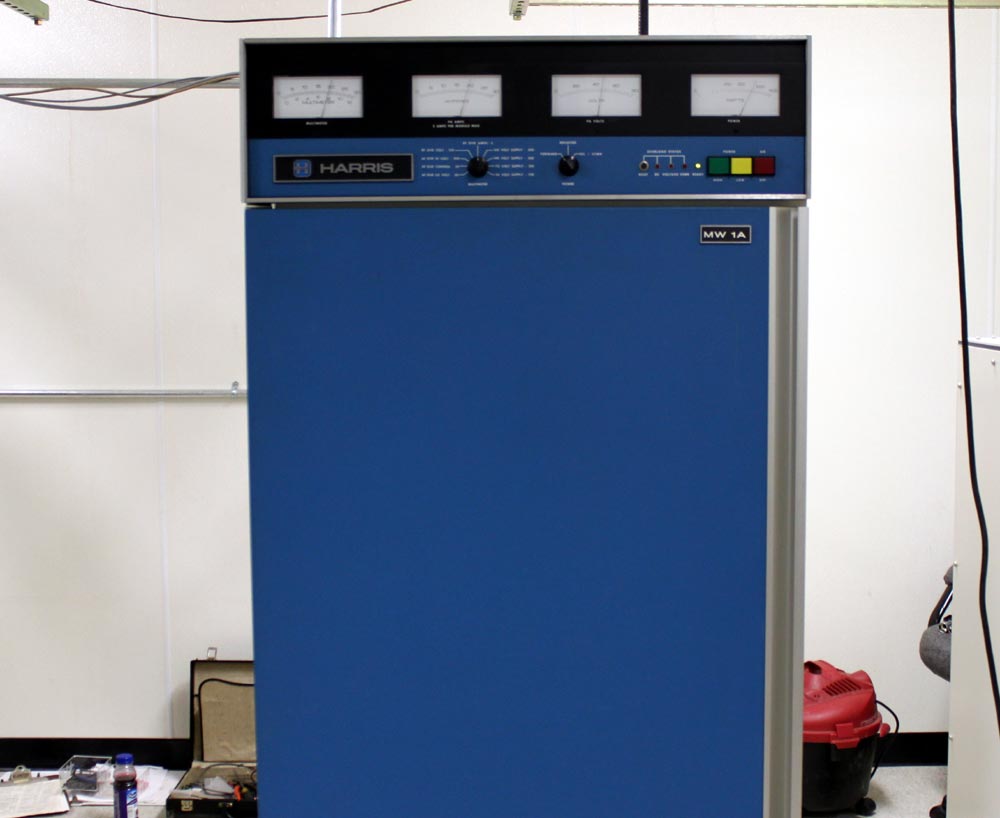
Truth be told, these are not bad units. They have some quirks, however, the overall circuitry is simple, the design is simple enough and parts for repair are readily available. They require regular infusions of RF transistors, but those are easy to change and are inexpensive to buy off the shelf from places like Mouser or Allied.
It is on the air as the main transmitter for WINE-AM in Brookfield, CT. This is Harris’s first solid-state AM transmitter design, based on the work of Himmler Swanson. This is not a PDM transmitter, rather, each module has RF transistors and audio transistors. The output of all twelve modules is combined for a carrier output of 1,000 watts with +125% modulation. Harris calls this PSM (Progressive Series Modulation), which is sort of high-level modulation.
This is also the only transmitter that I know of where blown fuses can cause damage to the RF devices.
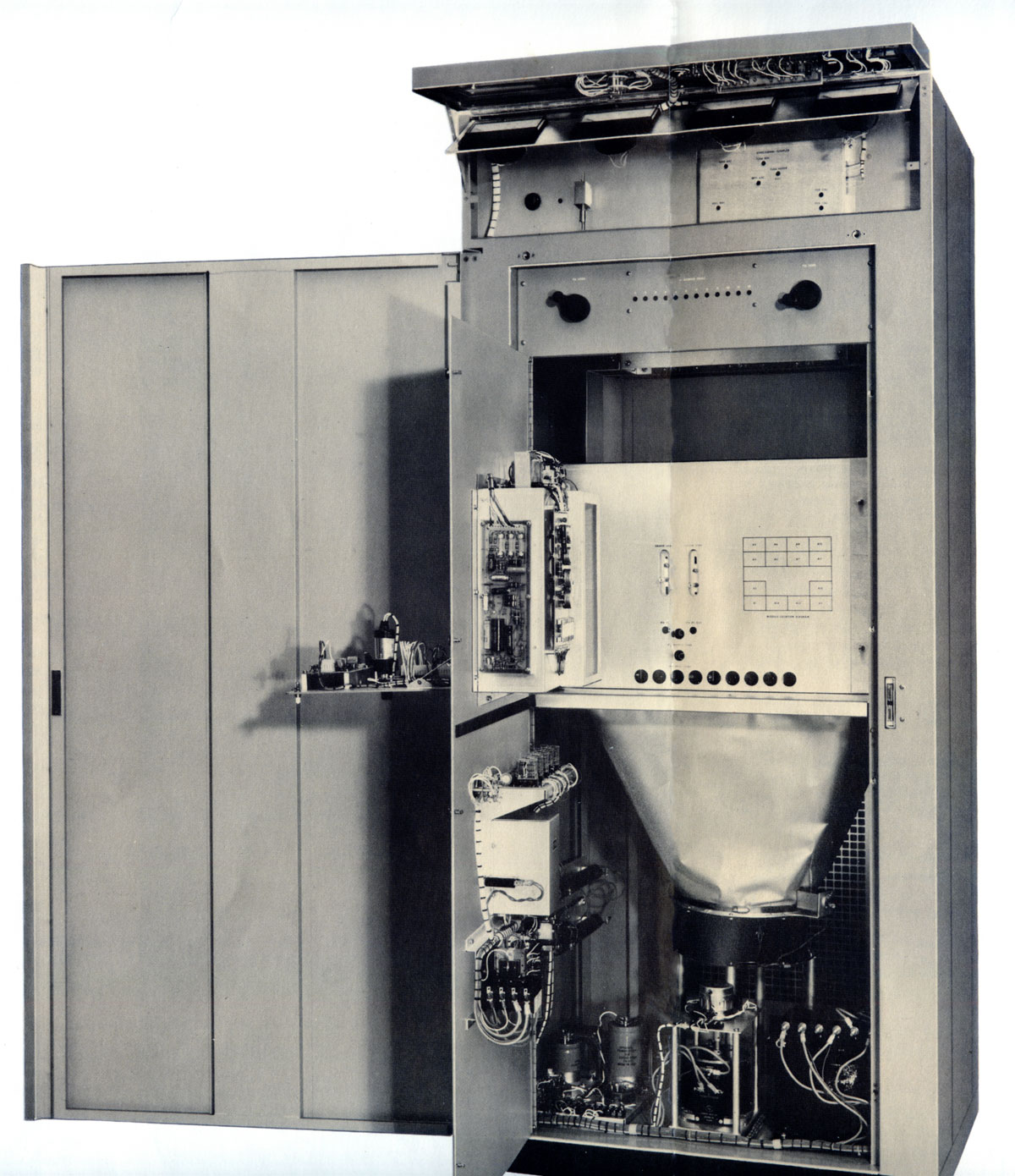
The RF output transistors and audio transistors are still available from Harris. Non-OEM parts for this include the 2N5038G for the RF transistors and the MJ15011 for the audio transistor. Inside the front of the transmitter is a row of incandescent light bulbs that glow increasingly as the various transistors go bad. At 1,000 watts carrier power, the ratio of PA volts to PA amps is 52.5/22.5 respectively. If that ratio is off by any measure, there is a problem.
Original sales brochure for the MW1 (no A):

Entire brochure is available here.
The other thing with this transmitter is it is very sensitive to any kind of VSWR. Any change in the output impedance will quickly make itself apparent. My Harrisburg MW1A had two ATU settings, one for winter and one for summer. It was a slightly tall tower on 1230 KHz, thus any change in the ground system (e.g. snow cover) would upset the tower base impedance.
The other thing that goes bad is the large Rotron fan at the bottom of the cabinet. They go bad about every 10-15 years or so.
The owner has spent some money on this particular unit, rebuilding and replacing several modules with new transistors, etc. Will it last another thirty years? Depends on if the RF and audio devices remain in production.

I had a Harris MW-1 (not the “A” updated version) when I was chief at the now defunct WMMM 1260 AM in Westport. Even when taking the greatest of care in using my Sencore Cricket to match the transistors in the rebuilt modules I would always be plagued with one of the module indicators glowing a small amount. Other than that the transmitter served the station quite well. If I recall correctly, their box was modified by the late Art Silver of Harris to add an additional power position for 50 watts in addition to the 500 and 1000 watt levels.
I have to agree with this transmitter being a bit fussy with high VSWR. One Saturday I was paged as the transmitter was popping itself off the air at random (but retuning to the air a second or so after it went off). This was caused by a number of ty wraps holding the RF lines for the STL antennas failing, allowing the lines to sway out away from the tower in the breeze. The RCA BTA-1R backup was pressed into operation until Pat Allen’s tower crew arrived since I didn’t have a climbing belt nor was I insured for climbing.
As far as I know the MW-1 transmitter is still in service at WSHU-AM’s Norwalk transmitter site.
I did this modification found in Radio World to the WINE MW1A transmitter when I worked for Cumulus. Do not know if it helped or not. at that time I did replace many of the audio output transistors.
http://radioworld.com/article/add-a-relay-save-a-transistor/2980
@Ed, I think the RF MOSFETS go regardless of this modification. I was not aware of the audio transistor issue. As I remember, this transmitter needed to be extensively modified to pass the original NRSC-2 requirements in the early 90’s (including removing the “modulation enhancer”). I am sure there are many other mods floating around for this transmitter
@Paul: I surprised anybody would have still been using the ME-1 modulation enhancer on there. Back in the 80’s on a tour of several different sites the MW-1/1a’s I saw had them out of service. I actually had the one from WMMM’s MW-1 connected to the LPB TX 2-20 for the 9 watt nighttime power to help match the levels between it and the Harris. To this day I still have one sitting on the shelf, mostly for nostalgia.
I do volunteer work at a radio station that had a MW-1A for backup. It had been replaced by a Harris The One, but they wanted the MW-1 to be refurbished so I set out to do so. Using a B & K transistor tester, I matches the two RF’s and the two audio transistors. Many of the resistors were out of tolerance, and were replaced. Being a ham operator for many years, I found a source for the toroids used as the wires were very brittle and would break off. Matching the wire size and copying the turns proved to work out well. The PA tuning rig needed lubrication and worked smoothly after work. The filter caps were changed in the power supply. As there was a whole bag of transistors for me to work with, I did not have to buy any but I checked on Mouser’s website and 2N5038’s go for 500 @ $504 and the MJ15011 are 500@ $234 which will keep you in business for a long time. I am going by memory, but there is a diode, that is no longer available, but I was able to find a replacement. I have packed away all the info but can dig it out if people need info. Contact me at K1MJP@Hotmail.com.
I, like Peter Russell, have done quite a bit of work at a few radio stations, one of which had an MW-1A. Also, myself as a ham operator, I tend to have to make clever cost effective solutions for repairs to broadcast equipment, the MW-1A being one of them.
Not that it matters much, but the 2N5038 is an NPN transistor, not a MOSFET. Unless there was some modification made to the MW-1A’s that I was not aware of, they always used bi-polar transistors. But you are right tho, those MW-1A’s need those modules rebuilt every so often.
I’d worked on one that had several ‘injured’ 2N5038’s and it just wouldn’t make very good modulation. I learned to NEVER overlook anything when checking those 2N5038’s. There were some transistors that tended to get a slight ‘leakage’ from emitter to collector. They’d still work, but they’d have problems. I got pretty good at spotting those transistors and I’d replace ’em.
Once I rebuilt the modules (using MJ15011’s as Pete did), that tranny worked excelent! It’d effortlessly make 125% positive peaks at full 1kW out. Alas, they would always have some module go bad during lightning storms. It’d take a few storms, but then there’s that one storm (usually) that’d take out a module. But, having plenty of replacement transistors on hand, made it fairly easy to repair modules and the tranny was good to go again.
73,
Bob, KD5MHQ
Thanks Bob. These are pretty reliable rigs, we have several spare rebuilt RF modules that can be installed quickly, if needed. You are correct, they are bipolar transistors, not MOSFETS. Now I have to go back and edit the post.
Among other transmitters, my firm rebuilds MW-1s, in our shop and in the field. We keep a working unit in-house and can rebuild and test any module from one, and we have a good inventory of used modules for sale. We can source any part from one of these rigs.
Among many other changes and improvements, we use MJ15024s for modulator transistors on the PA modules, and we don’t stuff the parallel transistor on the “high side” modulator; the 15024 can carry 20A, so it easily handles the 2A RMS/5A pk current each module pulls. The 15011 is underrated for voltage; this was a large cause of module failure over the years. The original transistor used here was an RCA 2N6254, which was tough enough, but when RCA got out of the semiconductor business, Harris recommended a switch to the 15011, which was not a good choice, as it turned out. Our upgraded modules have a very good track record in the field.
Also, we cut the wire harness to the “modulation enhancer” out completely, including bypassing the in/out switch, as that 4PDT switch gets flaky over the years.
Contact me if we can help you out. Look us up on the web if needed.
I normally take care of FM transmitter, but i have to deal with a Harris MW1A originaly tuned a 1260 then modified at 1610 i’m looking to bring it back down to 1040… Is it worthy ? expensive? anybodies did something similar ?
thanks
Pierre
Pierre….some parts from Harris may be difficult to obtain as the MW-1 is 20-30 years old already. I wouldn’t do it….unless you have no other choice.
Thanks for this site.
I have n.3 Harris MW-1 A and N.1 SX-5 (5 Kw poliphase),I found the MW-1A is a special very simple and efficient transmitter,I rebuilt some PA module installig as Final Modulator MJ-15003 that go quite well and very fine modulation.At the moment one of that transmitter is working here in Italy very close to Padova on 1368 Khz and it goes very well at 120% modulation depth an around 1 KW CW RF out,PA configurations is as final modulator :-Driver TIP 47 final MJ15015,as RF final I leave the optimum SJ3125.I tried to change RF final with 2N 6340 but all final sintony goes out of tune.In the official manual there is not the correct procedure to tune each PA RF stadium,someone of you have this procedure ? My radio name is CHALLENGER RADIO NORTH ITALY AM 1368 KHZ.I’m IZ3-GCI,thank you.
Alguien me pueda enviar algunas fotos
I operated one of these at a station in Trumann, AR — with the power backed down to 250 W — in the mid ‘80s. I remember it didn’t like something about the phasing of Arkansas Power & Light’s service and had to be modified initially. It was also really sensitive to tower lightning strikes no matter what you did to prevent it. Hard to say if it required less maintenance but it didn’t need to warm up and came on instantly when you were running late early in the morning. Lol.