
This is not really apropos radio broadcasting, but it is about radio and it has a lot to do with engineering. Back in the day, as a young man out to do whatever it was, I ended up being stationed on Guam, working at the Coast Guard radio station there. That was interesting work, to be sure, but every morning and evening, either on my way to or from work, I would drive by this, which looked very interesting:
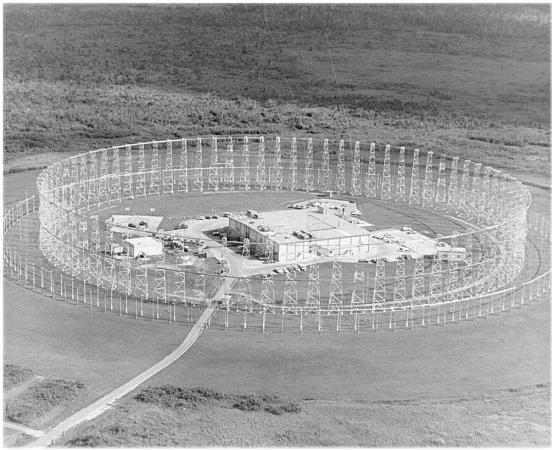
I had to lift the photo from a Navy Radio history site. Back in my day, aiming or even possessing a camera around this area or building would likely inflict the extreme ire of the Marines, who attentively observed the area and were ready to call down a painful lesson to all not obeying the “NO PHOTOGRAPHY ALLOWED” signs.
Nicknamed “The Elephant Cage” it is a Wullenweber antenna used for high-frequency direction finding (HFDF) and was part of a system called “Classic Bullseye.” There were several of these systems across the Pacific Ocean, and they all worked together using a teletype network. The Army-Air Force version was called a AN FLR-9, which was slightly larger.
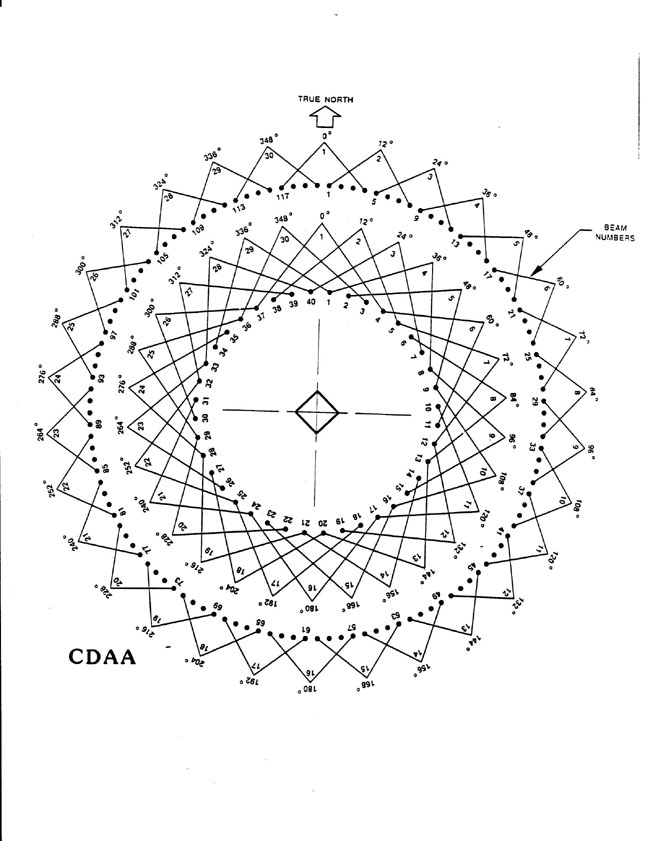
There were two concentric rings of antennas, the tallest being the closest to the center building and used for the lowest frequencies. It covered from about 1.5 to 30 MHz. The rings consisted of several individual antennas, all coupled to a Goniometer with coaxial cables cut to identical lengths. The outer ring had 120 vertical-sleeved dipole antennas, and the inner ring consisted of 40 sleeved dipole antennas. The inner ring of towers also contained a shielding screen to prevent the antennas on the other side of the array from picking up signals from the back of the antenna. A radio wave traveling over the array was evaluated and the Goniometer determined the first antenna that received the signal by comparing phase relationships. The ground system was extensive. Immediately under the antennas was a mesh copper ground screen. From the edge of the copper mesh, buried copper radials and extended out 1,440 feet from the building.
The effective range for accurate DF bearings was about 3,200 nautical miles, which equates to about two ionospheric hops with the angle theta between 30 to 60 degrees referenced to the ground.
It was quite effective, it only took a couple of seconds to get a good bearing. If the other stations on the network were attentive, a position could be worked out in less than 10-15 seconds.
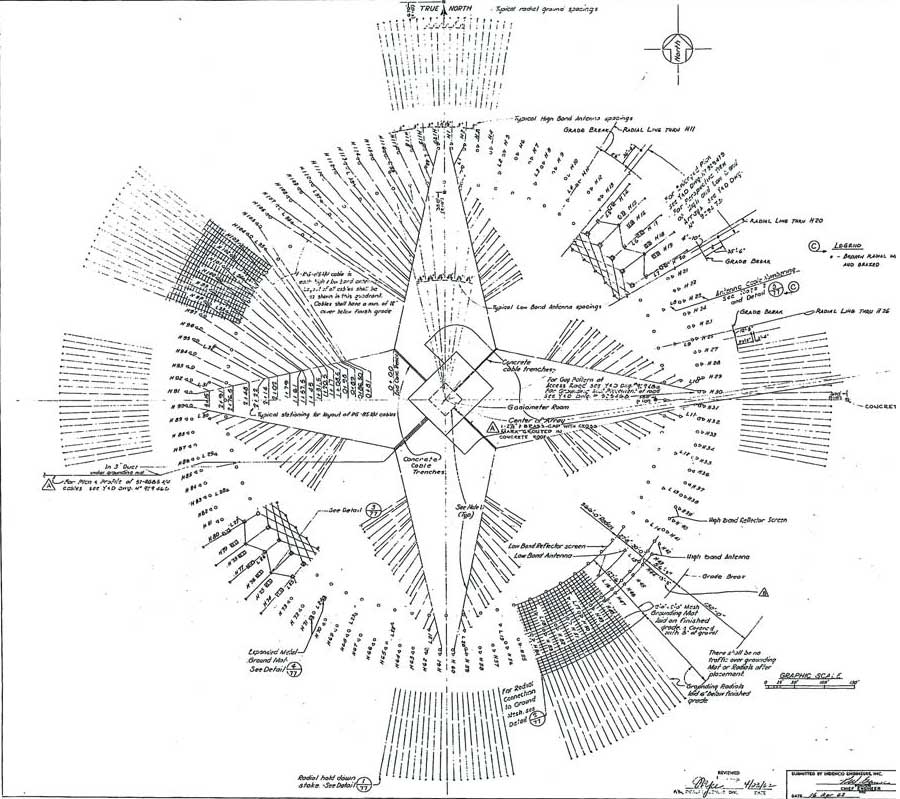
It is a little hard to read, but this is the ground layout of the AN FRD-10 CDAA. The transmission lines to each antenna are shown, along with the ground screen and building in the center of the array.
We Coast Guard types used this mainly for Search and Rescue (SAR) and the occasional Law Enforcement (LE) function. I believe we actually saved a few lives with this thing. I found the Navy operators to be very helpful, I think some of them enjoyed the change of targets from their normal net tripping.
The Navy operated AN FRD-10s at the following locations in the Pacific:
- Imperial Beach, CA (south of San Diego)
- Skaggs Island, CA (northeast of San Francisco)
- Hanza (Okinawa) Japan
- Waihawa, HI
- Finegayan, Guam
- Adak, AK
- Marietta, WA
The Air Force/Army installed AN FLR-9’s in the following Pacific Locations:
- Missawa AB, Japan
- Clark AB, Philippines
- Elmandorf AFB, AK
Basically, there was no corner of the Pacific Ocean that could not be listened to and DF’d. Some people look back nostagically at the cold war when we “knew who the enemy was,” so to speak. I am not one of those. They either didn’t really know the enemy or have conveniently forgotten some of the less endearing qualities of the Soviet Union.
I believe all of these systems have been decommissioned and most have been taken down and scrapped. The National Park Service studied the Waihawa, HI system as a part of their Historical American Building Survey (HABS HI-552-B2) (large .pdf file) before it was torn down. Good technical description and building pictures. Near the end of the report, it is cryptically noted that:
Beginning in the mid-1990s the NSG (ed: Naval Security Group), noting the absence of Soviet targets and wanting to cut costs and change the focus of its SIGINT collection, began closing FRD-10 sites… Undoubtedly, since the September 11, 2001 terrorist attack on the World Trade Center and the Pentagon, listening posts have gained importance and most likely increased in number and sophistication. The FRD-10 CDAA at NCTAMS Wahiawa ceased listening in August 2004; it can only be assumed the closure occurred because there was a better way to do it.
Indeed.
The Guam site has been stripped out and abandoned, the latest photo I can find is from 2008:
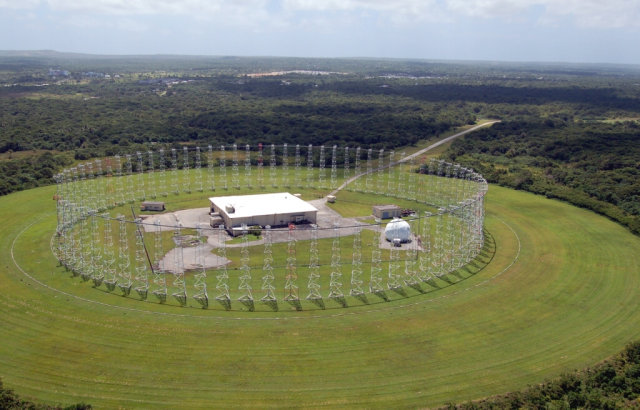
And people think AM broadcasting is expensive…

As a retired ISC (formerly photographic intelligence)(started USN as RM) in intelligence, enjoyed all the comments. Was once told by a CDR in intel to go to the local NSG site to sort out some kind of problem. When asked “why me?” he said I could work things out with them since I spoke “dit-dah”. Now only security problem here is keeping XYL from knowing how much time I spend in local pub.
73
Walt (N4GL) (ex-CS3AC, TF2WEB, KL7GGU, KL7ITU, G5EOW, KZ5CQ, A4XYO, HP1XCQ) and K4UDP
I worked at the Australian Navy HFDF site in DARWIN Australia. I probably chatted with you several times over the circuits. I absolutely loved that job. Best work I’ve ever done.
Ed Note: It truly was Andy.
Found the facility on Google maps – their aerial imagery shows that the antennas have been removed.
The FLR9 was an antique compared to the more relevant and late cold war when the FLR9 and the most effective FLR15 were scanning the 2-32 mc bands… Why no mention of the Atlantic and Mediterranian stations? There were as many or even more, as we called them in Rota, Spain “Bull Pens.”
I was a CTM2 in the mid 60’s to 1971. Stationed at Sidi Yahia, Morroco, Homestead Florida and Guam. All of these Wullenwebers are now gone.
Homestead was wiped out by Hurricane Andrew. My question is that with these direction finding antennas gone, what is replacing them? Curious!
You pretty much answered the question I was going to ask,….I was going to ask if these sites were still intact,or have been dismantled. Interesting read about military radio operations!
Great to be in touch with those that served this country while the nation slept comfortably during the Cold War Era and left in the hands of those that served with the ASA, NSG and USAFSS. I was an Air Force MIO assigned to USAFSS at Karamursel AS, Turkey, TUSLOG Det 94, Charlie Flight. 1965-1967. Would like to get in touch with an engineer(s) responsible for construction of the FLR9 facility at Karsmursel which was a former German base that from which I understand communicated with their submarines before the the Turkish and U.S. joint agreement. Given the FLR9 antenna array structure there, I am interested in the radio frequency emissions put out by these structures and the radiation impact they may have had on personnel stationed at these facilities from a longitudinal health perspective; especially Karamursel. Grateful for any feedback on health impact studies on any radio frequency exposures to the 202s, 203s, 292s, etc., that may have been encountered.
The string of conversations above brought back great memories of our contributions to this nation’s and global security back in the day. Thank all of you for your service. Best regards. TMACK
As a 292×1 stationed at Karamursel,Turkey, 65-67, (USAFSS), we had one of those FLR9s. Can anyone with an engineering background convey in layman’s terms what the radiation exposure to all that equipment was on those that worked in that environment?
Are there any environmental studies that anyone can recommend in layman’s terms that can be obtained?
Thank you for your service guys. We were the true cold war warriors and served with pride and distinction.
Tom, It is likely that your occupational exposure to non-ionizing radiation from this site is near zero. I don’t know about the Air Force, but I know that the Navy restricted any transmitters withing a 1/2 mile radius or greater so that the Wullenwebber array was not desensitized by local RF. I know that there is very small amounts of RF generated by local oscillators in various receivers, but this is so small it is almost undetectable.
Regarding other exposures; that would depend on where you were working. Repair shop areas often had solvents and other chemicals like PCB’s from capacitors and transformers, there may have been asbestos lagging on heating pipes, lead paint, mercury from switches and thermostats, etc. Military buildings from the 50’s through the 70’s and 80’s often had multiple environmental issues.
Hope that helps.
The Wullenweber arrays “Bull Pins”, “Elephant Cages”, “Dinosaur Cages” were receive only systems.
Steve Morris ex NSG CTR1(AC) 1964-72
San Miguel 1964-65
Karamursel 1967-69
Hanza 1965-67
Rota 1969
My Dad worked in these “cages” in Sabana Seca, Puerto Rico and in Rota, Spain. He is suffering now from Parkinson’s and Dementia. Has anyone here knows where I can find any empirical evidence to prove the constant exposure to strong radio frequency’s, surrounded from every angle , for long periods of time, with no windows or fresh air during a “normal” duty shift – could be responsible for his illness? Many thanks, Monique
Hello Monique, I am sorry to hear about your father’s condition. My father passed away many years ago after having dementia, you have my sympathies. Regarding the “cages,” those were receiver sites. Specifically, the ones that you mention. As such, the receiving apparatus were extremely sensitive, thus the Navy restricted high-powered RF in the vicinity of those antennas. The hazard from RF radiation is due to tissue heating, basically, the strong magnetic fluctuations cause water molecules to become excited. This is what happens in a microwave oven. The FCC has a manual called OET-65 which can give you more information. I am not saying that your father’s condition is not related to his service, however, the likelihood that it was caused by RF is minimal. I would suggest checking with various veteran groups with others who were stationed at those bases. Environmental factors such as contaminated water, exposure to cleaning solvents, and other chemicals can cause the illnesses you describe. Good luck, I am sorry to hear about your father.
The VA has designated Guam as an Agent Orange site for people from 1962 to 80 something. I was wondering if anyone knows if the DF site was cleared using agent orange and used to keep the ground plane of the antenna field clear of jungle plants?
I was in the navy from 1962 to 1966 and spent three years on Guam from 1963 to 1966. I was stationed at NCS and worked in the building in the picture as a CT(M) communication technician maintenance from the time the building was first opened in around 1964 or 1965 until I left in 1966. All of the people in the building worked for the National Security Agency (NSA) and collected large amounts of recorded data that was sent back to Washington or Maryland for analysis. We also had a communications section that sent encrypted teletype messages out of the building by wire cable to the communications building (COM) which sent it to a different base on the island to be transmitted to wherever it was destined to go. The encryption devices we had at the time were 37s, 26s and 7s. The 26s and 37s were discontinued after the USS Pueblo was captured because they were old tube type equipment. The 7s were transistorized and were still used after the capture, My division chief , my next door neighbor, ( I was married and living on base) was on the ship when it was captured in 1967.
A number of people I worked with spent time on a sister ship to the Pueblo the USS Banner that was home ported on Guam. I had visited it and seen the termite bombs that they had to destroy the crypt o equipment. Another sister ship was attach by Israel in 1967 off of Egypt and almost sunk. It was called the USS Liberty. This incidence was covered up by the media until the crew got too old to care and wrote a book about it. A large number of CT sailors were killed along with other sailors and some marines.
Has anyone who worked in, near and with Elephant Cage driven missions ever queried what herbicides and defolie nts were used to prevent vegetative growth?
I’m an X1 and was based at Karamursel AS 1965-1967.
Yes, I’m sending this again because no one has responded and we are
Potential candidates for VA medical claim support.
I worked inside the elephant cage for 2 years, 1985-1986.
I worked in that building. It was all Navy CTs, a couple Marines and an E5 SEABEE who maintained the diesel powered UPS. I was there from Sept 1975 to March 1977. I was a young CTO.
NSG mandated no strong HF emitters within a few miles of the CDAA.
Also remember these sites were exclusively receive ONLY. Periodic electronic inspections verified conformity!!!
I retired from the Navy in Feb 86. My last duty station was SECGRUDEPT Collection and HFDF Division Chief. I was the senior R-Brancher (CTRCS) responsible for all the CTRs, CTTs, CTIs, and AGs at the site, plus the COMSECers down at big navy. It was an interesting tour. I operated from Navy Housing just outside the gate. Betal Palm area. As K0AX/KH2
My father, Robert Totten, (CPO) was a CT “R-brancher” and did two tours in Guam. Late 1970’s and mid 1980’s. He finished his second Guam tour working at “Big NAVY’s” collection building near Apra Harbor. When I was growing up, I heard him say “Dinosaur Cage” more often than “Elephant Cage”. What that is his own term or did you guys say that too?
My father has since passed but let me tell you, he “really” LOVED his CT job quite a bit. He was also stationed in Homestead in their cage at Cardsound road and Pearl Harbor, Subic Bay and finishing at NSA in Ft Meade.