More HD radio news

Link to: HD RADIO™ GOES THE WAY OF THE LASERDISC PLAYER.

An interesting take from a non-broadcaster that gets it mostly right.    The premise for HD radio™, as the author states, was to serve two purposes; improve sound quality and add extra programming channels.  I have a few issues with this statement:

Regarding the improved signal, that still holds true, and can be especially beneficial for AM radio, which has struggled for some time with signal degradation.

I would argue the opposite. HD Radio™ has done nothing to improve the signal quality of the AM band. It has, in fact, degraded the band further by adding digital hash to adjacent channels, limiting the on-channel analog bandwidth to less than 5 KHz and creating on-channel background hiss.

Thus, HD Radio™ has done neither of those two stated goals.  In addition to that, from the radio station owner/operator’s perspective, it is expensive to install, expensive to license, expensive to operate, and has no audience.

Hat from here.

Ford begs Broadcasters: “Please install our wonderful HD Radio product.”

In an open letter to broadcasters, the entirety of which can be found here: Ford Exec Writes Open Letter to Broadcasters, Jim Buczkowski, whose official title seems to be “Henry Ford Technical Fellow and Director, Electrical and Electronic Systems Research and Innovation Ford Motor Company,” nearly begs broadcasters to install HD Radio technology at their radio stations.

One thing that seems to be missing from the open letter, is something mildly important called: Disclosure.  According to iBiquity’s own website, Ford Motor Company is an investor in the technology.  Other investors include:

  • Clear Channel
  • CBS Radio
  • Grotech Capital Group
  • J.P. Morgan Partners
  • New Venture Partners
  • FirstMark Capital
  • Harris
  • Texas Instruments
  • Visteon

Not an inclusive list by any means, but something to keep in mind when reading the letter or the latest iBiquity advertising in various trade magazines.

Back to the letter; the cliff notes version is this:

  • Through the use of HD Radio, AM/FM broadcasters can now embrace the digital age
  • Drivers now have many choices for in-car entertainment, including satellite radio (Sirius XM) and online services (Pandora, et.al) that offer “Crystal Clear” audio
  • Through Satellite radio, MP3 players, and IP streaming services, drivers now have extra features  like Title, song, and artist; Song tagging; iTunes; album art, etc which they have become accustomed to
  • Installing HD Radio will be a big upgrade and make AM/FM stations on par with those “digital age” services

For the first part, there is not a single broadcaster in the country that is not already aware of HD Radio.  Every radio station manager and owner knows that it exists, but most people in the general public do not.  Radio stations are hesitant to install HD Radio equipment because it is expensive, has a questionable return on investment, is unimpressive, and technically dubious.

Making the comparison to Satellite Radio and or IP streaming services, which all require subscriptions or data plans, is a bit of a stretch.   Someone who will pay a fee for in-car entertainment is usually a tech geek.  As the subscription rates for Sirius XM show, that works out to about seven percent of the US population (~20 million subscribers/~300 million people).  It is a bit harder to nail down those who listen to streaming products like Pandora, iHeartRadio, or other webstreams in their cars, but I’d estimate not more than ten percent do.

While 3G and 4G wireless services are great, it still does not have the same coverage as standard and FM broadcasting stations.  The last time I tried to listen to Pandora in my vehicle, it kept dropping out and was not easy to deal with.  With TuneIn radio, I had the same experience during urban, suburban, and rural driving.  Thus, the “Crystal Clear” reception is also a bit of a misnomer.

Further, fooling around with iPods, iPhones, TuneIn, Pandora, etc while driving is not the best idea.  Even on vehicles with built-in IP connectivity or satellite radio, looking for song titles and other information while driving is not recommended.  Thus, the value-added services of HD Radio are of questionable at best in a moving vehicle.

I hate to keep beating a dead horse, but for as long as the iBiquity crew continues to spout disingenuous bull sh!t about their failed technology, I’ll keep posting about it.

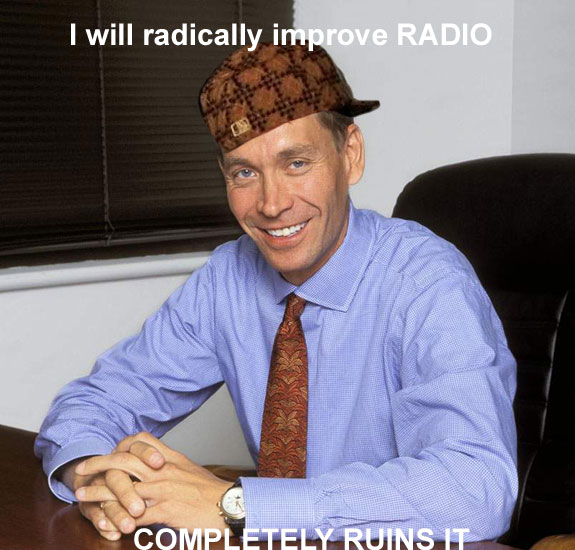
Developments on the digital radio fronts

I am still in awe of iBiquity and I have to hand it to them for stick-to-it-liveness. The newest “fix” for their FM IBOC system, colloquially known as HD Radio™, is in contour on-channel repeaters.  According to the article “Performance of FM HD boosters varies,” (Radio World online edition), the reason for such boosters is to “increase or fill in FM Digital footprint so that the digital coverage matches that of analog.”

The idea that IBOC is somehow an improvement over FM analog is becoming (or has become) untenable.  In order to make the new system cover the same area with the same reliability as the old analog system, on-channel bandaids boosters are now needed.  And what is with this extending coverage?  How much more expensive will radio station owners have to deal with to make this scheme work?  And I still don’t understand where the improvement over analog-only systems comes from.

As the article points out, however, all is not well in paradise; the IBOC booster signals interfere with analog signals close to the booster transmitter.  This becomes problematic if the receiver is an analog-only device.  As of this writing, most of the radios in this country do not have HD Radio™ capabilities.  Thus, radios that are currently working perfectly well will be cut out and can become useless around these repeaters.

For your reading pleasure, the entire NAB report can be found here.

Try as they may, neither the NAB, iBiquity or Greater Media can supplant the laws of physics.  Then there is that insanity definition floating around:

Insanity: doing the same thing over and over again and expecting different results.

Albert Einstein

AM radio sucks! It’s horrible, sounds terrible and should be turned off!

This is a youtube video of a Police song from the 1980s received via skywave and recorded off-air on an AM radio.

Video Description:

The classic 1983 #1 smash hit, as received in analog C-Quam AM Stereo… in Japan… via nighttime skywave in the Tokyo area, roughly 500 miles away from Sapporo (ed: where the station is located). The audio quality is among the best I’ve ever heard from analog AM radio, thanks in large part to an excellent wideband receiver, very quiet band conditions, and the Orban Optimod-AM 9100 audio processor being used by HBC Radio to its maximum extent: 12.5 kHz audio bandwidth with stereo enhancement added (above and beyond the amount naturally provided by the matrix processing used by AM Stereo).

Absolute trash, I tell you. Just awful.

Of course, I know several FM stations around here that wished they sounded as good. Naturally, Japan, they have sought to minimize night-time interference problems by limiting the number of stations on the air and enforcing the rules and regulations in place to protect those stations on the air. They also seem to allow greater bandwidth, out to 12.5 KHz in spite of the narrower channel allocations (9 KHz in ITU regions I and III, vs 10 KHz here in the US, ITU region II). One other thing to note, there is no digital buzz saw occupying several channels of the broadcast spectrum. Keep in mind, this was received in Tokyo, likely a very high noise environment.

I was trying to find out the power level of the transmitter, the call sign is JOHR in Sapporo Japan, frequency is 1287 KHz. HBC is the Hokkaido Broadcasting Company, a privately held company. The state-run radio outlets in Japan are NHK, which has several radio and TV stations throughout the islands.

Anyway, AM is dead. Killed by the very owners of the broadcasting companies themselves with help from the NAB. They are the ones that petitioned the FCC to loosen up the allocations and allow more and more stations to be crammed into the band. That is old news. The new news is same forces that killed AM radio are diligently working their magic on the FM band as well. More stations, translators, digital IBOC nonsense that doesn’t work, more of everything. After all, more is better. Until it is not. Then it’s too late.