Passive AM Monitor Antenna

At the place of my former employment, there is an issue with AM reception. The building is full of old, electrically noisy fluorescent light ballasts, computers, mercury vapor parking lot lights, and every other electrical noise generator under the sun.  The second issue is that one of the EAS monitor assignments for two FM class B stations is WABC in NYC.  Under normal conditions, WABC puts a fine signal into the area.  Listening to it is not a problem at my house, in the car, and whatnot.  However, at the studio, the station is audible but terribly noisy.  Every time one of those FM stations ran a required monthly EAS test originating from WABC, it was full of static and just sounded bad on the air.

The state EAS folks were inflexible as to the monitoring assignment.  “WABC is the PEP station for NY.  You should have plenty of signal from WABC at your location,” said they.

At one time, the studio had an active loop antenna (LP-1A) from Belar, which worked but also seemed to amplify the noise.  I decided that the best thing to do was go big and ditch the preamp.  I made a diamond-shaped receiving loop on two pieces of two-by-four by eight-foot lumber.  I wound four turns of #14 stranded wire around this frame and made a 4:1 balun to feed the unbalanced 75-ohm RG-6 coax.

That cured the noise problems and for eight years, WABC sounded pretty good on the EAS monitor.

Fast forward to about a week ago.  The roof at the studio building was being redone and all the monitor antennas had to be removed from the roof.  The homemade loop was not in good shape.  The balun box was full of water, the lumber was cracking and falling apart, the insulation was degraded by UV exposure, etc.  My boss asked, “How much to make a new one?”  So I said something like forty dollars and a couple of hours.  He then said, “Make it so we don’t have to ever make another one.”

Music to my ears.  I started by checking my assumptions.  I made a model and ran NEC to see what the electrical characteristics for that size loop were on 770 KHz.   It came out better than I thought, with about 1-ohm resistance and 282 ohms inductive reactance.  Fooling around a little more showed that roughly 1.3 uH inductance and 720 pF capacitance in an L network would bring this in line for a 50-ohm feed point.  Since this is a receive-only antenna, that is not a prime consideration.  I am more concerned with noise reduction and maintaining at least the bi-directional quality of a loop antenna.
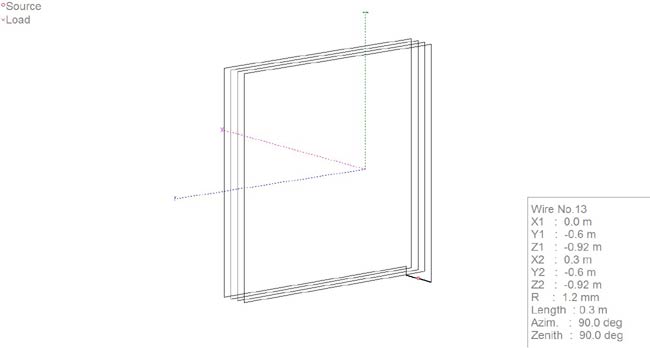
NEC 2 model AM receive loop

Then, I decided to get fancy.  What if the capacitance was put on the end of the loop to ground instead of the feed point?  That, in effect, should make the loop directional off of the unterminated side.  Driving the feed point with a 9:1 balun would also bring up the inductance on the feed point.  Finally, grounding the whole thing with a separate ground lead might also get rid of some noise.

The final configuration looks something like this, which is essentially a top-loaded vertical:
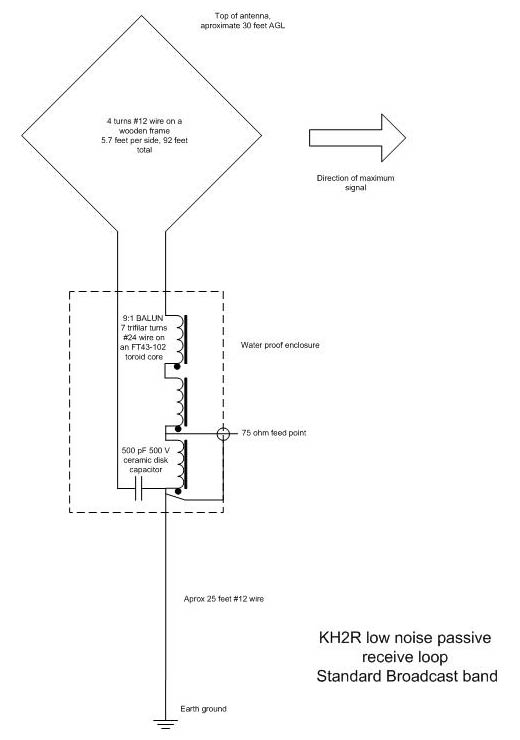
Low noise AM loop antenna

Now to build it.

Once again, I felt that a non-conductive support was needed, so I used two by four by eight-foot lumber, but this time I painted them with oil-based paint.  The side length worked out to be 5.7 feet per side, or 23 feet per turn for a total of 92 feet of wire.

I purchased 100 feet of PV (photovoltaic) wire (Alpha wire PV-1400), which is UV, heat, and moisture resistant and designed to last for 30 years in outdoor, exposed environments.

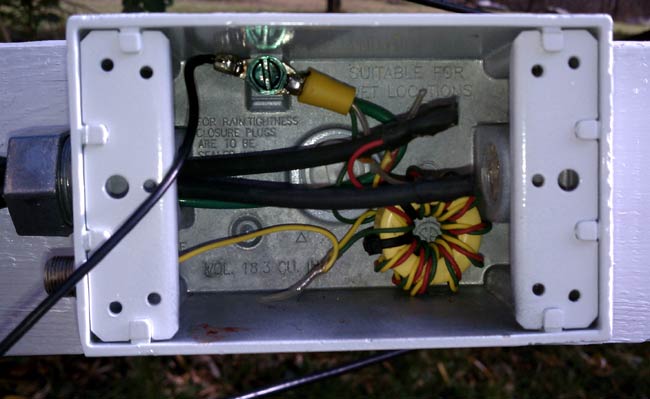
For the balun box, I used a metal outdoor electrical box with a metal cover.  I put a ground wire jumper between the box cover and the ground common to maintain shielding.  I used a water-tight bushing to feed the antenna wires and the ground wire into the box.  I drilled a 3/8 hole for a type F chassis connector.  Everything was given a little extra waterproofing with some silicone-based (RTV) sealant on all threaded junctions.

The spreaders for the wire windings are UV-resistant 1-inch PVC conduit.  I drilled four holes, three inches apart in each spreader to run the loop wires through.

The balun is 7 trifiler turn of 24 AWG copper wire on an FT-43-102 toroid core.  Trifiler means three wires twisted together before winding the toroid core.

I used all stainless steel screws and mounting hardware.

The loop is terminated with a 500 pF, 500-volt ceramic capacitor to ground.  Once in place, I am going to experiment with this by jumping it out of the circuit to see what effect it has on noise and signal strength.  I may also try replacing it with a 200-ohm resistor and or a 1000 pF capacitor.

The assembly was pretty easy, although time-consuming.  My four-year-old son helped me paint the wood and string the wires through the spreaders.

I soldered all wire connections with 5% silver-bearing solder.

When the whole thing was assembled, I tested it out with my Drake R8 receiver.  It performs much as expected, with low noise, directional away from the terminated wire loop.  It does not appear to be too narrow-banded either, as the stations on the high end of the dial were also received with good signal strength.

Next was loading it on the pickup truck, driving it in, and mounting it on the studio building.  I got some funny looks from my fellow travelers, then again, I usually do.

For the ground, I purchased an eight-foot copper-clad grounding rod and pounded it into the ground at the corner of the building.  This area is always wet as it is the lowest area around the building and all the gutters drain there.  This is not best RF ground, but for the purposes of this antenna, it should work fine.  I used about 28 feet of leftover #12 stranded wire from the ground rod up to the balun box and connected it to the common ground point inside the box.

The frame itself is mounted on a standard wall-mount antenna pole.  Stainless steel clamps hold the wood frame to the pole.

Once it was installed, I used my Kenwood R-2000 receiver to find the best mounting azimuth and locked everything down.  I also put a toroid on the RG-6 coax coming up from the rack room to keep any shield noise from getting into the antenna.
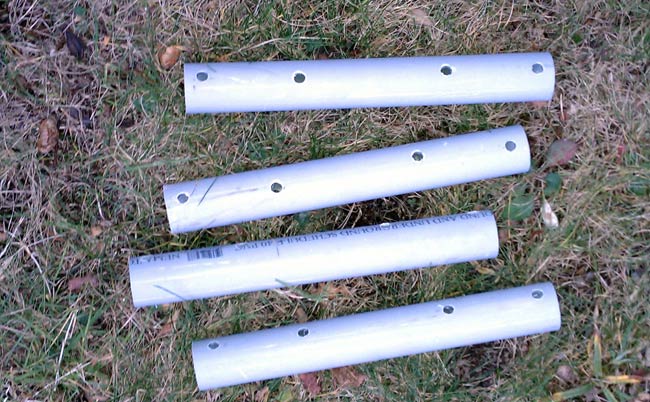

AM receive loop PVC wire spacers
AM receive loop wood frame
AM receive loop balun transformer

The tuning capacitor is in there too, behind one of the loop wires.
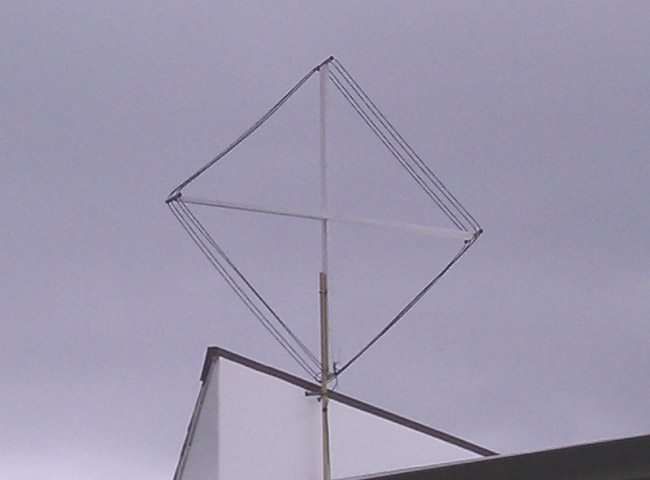
AM loop antenna installed on roof

Antenna installed.  I did try substituting the 500 pF capacitor with a 220 resistor.  The signal strength came up somewhat, but the noise increased more, therefore the capacitor is a good termination for this antenna.

With this antenna, the signal from WABC is nice and clean and sounds good on the FM station when a monthly EAS test is retransmitted.
WOWO EBS activation

An oldie, but a goodie, February 20, 1971, WOWO gets an EAN via AP teletype and follows the procedure:

Back in the days of EBS, there were weekly closed-circuit tests via AP and UPI teletype. In the event of a real Emergency Action Notification (EAN) there was a red envelope that contained a set of code words for each month. The test code words were on the outside of the envelope. If an EAN was received, the envelope would be torn open and the actual code words would be matched against the code words in the message. If it were authenticated, then the station would do just what WOWO did right then, send the two-tone EBS alert for 25 seconds and break into programming.

It is amazing that this did not happen more often, especially on a Saturday morning with a sleepy Airman in Colorado pulling the wrong message tape off the rack at the message center responsible for the whole system.

It happened more recently when an EAS message was sent to evacuate the entire state of Connecticut.  An EAN was sent in Chicago warning of a national attack when state officials were testing their new system.  I am sure that others have been sent as well.

I suppose the emergency notification has always left something to be desired.

Common Alert Protocol (CAP)

Since the FCC started the CAP clock ticking on September 30th, there has been a flurry of activity regarding the manufacture and installation of CAP equipment.  CAP is integrated into something called IPAWS, which stands for Integrated Public Alert and Warning System.  In other words, CAP is the vehicle that IPAWS uses to get information broadcast through radio, TV, Cable systems, etc.  IPAWS encompasses all alert types including cellphone, texting, e-mail, and landline phone calls.  Many states, including New York State, already do this.  FEMA spells out the reason for IPAWS:

The advent of new media has brought a dramatic shift in the way the public consumes information. IPAWS, as the next generation emergency alert and warning system, capitalizes on multiple electronic media outlets to ensure that the public receives life-saving information during a time of national emergency.

Historically, the public depended exclusively on radio and television to receive alerts, but current research shows that the reach of radio and TV is less than 40% of the populace during the work day. While less than 12% of the population is watching TV in the middle of the night, an even smaller number is tuned into the radio, at 5% of the populace. Television and radio will continue to be valuable sources of public information, but their reach is decreasing. Further, these information sources can only target a state or regional sized area and do not encompass alerting for people who do not speak English or those with disabilities, including the 29 million suffering from hearing impairment.

Today, the internet, including video and email, and cellular and residential phones are increasingly popular and therefore, valuable, sources of information. One study showed that the Internet has a 62% usage rate, averaging at 108 minutes a day. While television remains the most popular source for information, the Internet ranked either first or second at both work and home.

CAP figures into this by acting as a method to move data between IPAWS and EAS.  The basic CAP converter polls a CAP server, somewhere, for messages.  When a message for a geographic area is received, the CAP converter processes it and converts it to an EAS format, which is then sent via high-level audio to the station’s EAS encoder decoder unit.  The EAS unit receives the information and then has the final say (or station personnel if the EAS unit is in manual) as to whether the EAS message gets transmitted.

FEMA will be setting up a national CAP server in the next month or so, expect an announcement from them in November.  Each state can also set up a CAP server for state and local government use.  This will be implemented on a state-by-state basis.  Currently, there is no information on the New York State Emergency Management Office’s (NY SEMO) website, hopefully, they are aware of all of this and will be updating their system shortly.

The CAP converters installed in individual stations will access the CAP servers via secure HTTP connections.  They will also be able to download software updates from the manufacturers via the same method.

Ready for CAP? (AKA Common Alert Protocol)

Like any good government agency, the FCC in conjunction with FEMA is working on upgrading the acronym-heavy EAS system with CAP, which stands for Common Alert Protocol. CAP includes something that  FEMA has been working on something called IPAWS, which stands for Integrated Public Alert Warning System.

The FCC is still in the comment/response process (FCC Docket 04-296) which can get long and drawn out.  I would not expect to see any NPRM until late fall 2010 with any changes taking effect in early 2011 or so.

Basically, CAP looks like this:

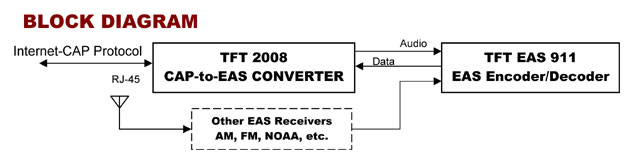
An EAS to CAP converter monitors a CAP source (think e-mail server) and when a CAP message is received, it converts it to EAS protocol and sends it to an input source of an EAS encoder/decoder.  The EAS encoder/decoder then passes that information through and broadcasts it.   Of course, the EAS encoder/decoder can still be programmed to pass through specific types of messages for specific areas and ignore all others.

Thus far, several manufacturers have designed CAP converters for use with existing EAS units:

Implementation would look something like this:

EAS CAP converter diagram

For a TFT-2008 system.  Others such as SAGE and Trilithic are integrated into the EAS encoder/decoder units.  Basically, the CAP part of the EAS system needs an ethernet port with access to an IP gateway to receive messages from the CAP server located off site.  That is the weak link in the system, as far as I am concerned.

It is not like some of our so-called trading partners have been trying to tinker with the inner tubes or anything.  It is also not like that same trading partner makes most of the cheap ethernet switches and routers found in many radio stations, hardware that can be easily configured remotely.  Configured to redirect certain IP addresses to new, exciting, and exotic locations such as Iran or Pakistan.

Perhaps I am paranoid, or not.  It falls back to my time in the military when somebody said “It’s good to be a little paranoid if everyone is out to get you.”