The BE FM20T transmitter

This is the main transmitter for WYJB in Albany, NY. The backup is the Harris FM20H3 on the right. I haven’t turned that unit on lately, but it normally makes quite a fuss the first time the Plate On button is pushed. The FM 20T on the other hand, is mellow and even-tempered.

WYJB 95.5 Mhz, class B, transmitter Albany, NY

One other thing of note; The FM20T is still on its original tube.  I looked up the maintenance records for this transmitter, it was installed in December of 2000.  Eleven years later, the 4CX15000A (ed note; 4CX12000A) is still cranking out 15 KW TPO, which is impressive.  I found that high-power ceramic vacuum tubes actually seem to last longer when run closer to their limits than those that are running at half power.

Judicious management of filament voltage is required to achieve this type of longevity.  There is a set procedure for installing a large ceramic vacuum tube:

  1. After the tube is in the transmitter, run it at a full filament voltage for at least an hour or so before turning on the plate voltage.  This allows the getter to absorb any stray gases in the tube.
  2. Once the plate voltage is applied, proper tuning should be completed as quickly as possible.  Tuning procedures vary from transmitter to transmitter, however, the general idea is to obtain the maximum power output for the least amount of plate current while keeping the PA bandwidth within acceptable limits.  Some transmitters can get narrow-banded at high efficiencies, which manifests itself as higher AM noise.
  3. After the tube has been in use for 90-100 hours, the filament voltage should be reduced gradually until a drop in the transmitter output power is noticed, then increased by 0.1 volts.

This maximizes the filament life for that particular transmitter and power output.  Once the filament can no longer boil off enough electrons, the tube power output drops and it is time to replace it.

This site also has two other radio stations, WZMR, 104.9  and WAJZ 96.3 , both class A using solid-state transmitters of less than 1,000 watts:
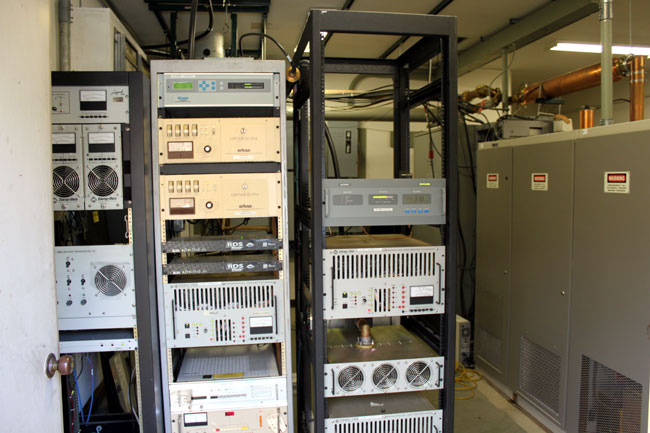
WAJZ and WZMR Energy Onix solid state transmitters
WAJZ and WZMR Energy Onix solid-state transmitters

Not the prettiest sight in the world, but it does stay on the air.  There is no money to go back and neaten up this work, unfortunately.

The tower supports all three antennas.  There was some discussion of a common antenna for all three stations, however, WZMR is a directional station, thus it would require its own antenna.  Doing a common antenna for the other two stations was cost prohibitive, so the tower supports three two bay antennas.
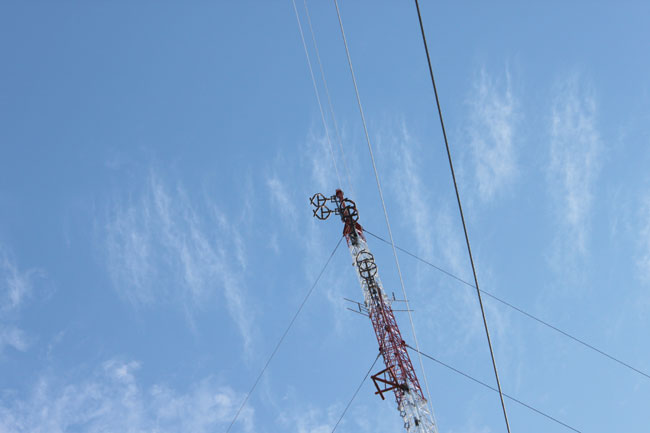
WYJB, WZMR, WAJZ FM antennas, New Scotland, NY

The stations are all located in the New Scotland, NY tower farm.  WYJB is licensed to Albany, WZMR is licensed to Altamont and WAJZ is licensed to Voorheesville.
At a crossroads

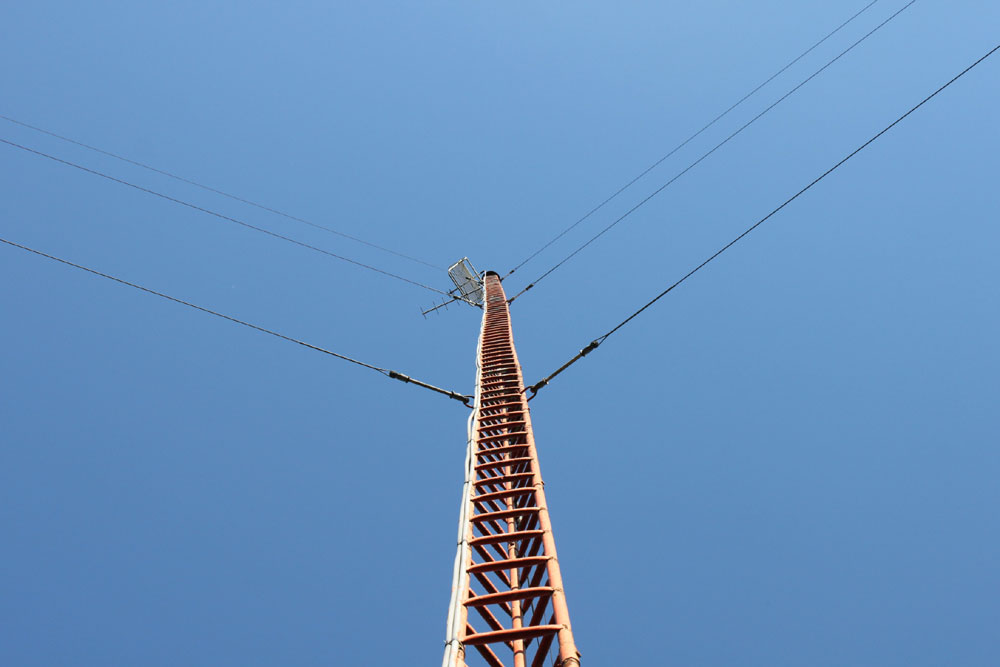
This is a situation that is and will be playing out over and over throughout the country as the decay advances. W*** signed on the air in March 1963. I believe this is the original tower:

W??? tower
W*** tower

As you can clearly see from this picture, this tower has several problems. Aside from the loose guy wires, the rust, and general structural decay, it is bent in several places.  Currently, the forces are in equilibrium, but for how long, no one knows.  It is certainly not safe to climb.  At 144 feet, it is no longer required to be marked or lit, thus, over the years, the paint peeled, the weep holes filed up, and the guy wires rusted and loosened, which leaves us with the situation today.

At the transmitter building, there are other issues with the basement flooding, mold, etc.  Truth be told, this station makes no money on its own.  It would cost several tens of thousands of dollars to fix all these issues, and for what; a high end of the broadcast band class D AM station which has not shown up in the ratings for fifteen years.  Once upon a time, it was a surviving, perhaps not thriving, local radio station. Those times have long since passed.

The question is; what to do with it?  Sign it off and surrender the license?  Fix all the problems and continue to broadcast?  Donate it?  If so, who would take it?  Or, more likely, wait until the tower collapses and deal with it then.

I’d imagine that there are many others just like it dotting the country.  On the whole, the AM broadcasters that are viable would be better off if this dead wood was cut away and discarded.

What is the deal with those FEMA/DHS AM backup transmitters?

Back last February, it was reported that FEMA/Department of Homeland Security was mysteriously constructing prepackaged AM transmitter buildings at various PEP (Primary Entry Point) transmitter sites across the country as something call “Primary Entry Point Expansion.”  These buildings contain a 5 KW Nautel AM transmitter, EAS gear, satellite equipment (the exact equipment list is undisclosed), and a backup generator all in a shielded (Faraday Cage), prefabricated building placed inside a fenced-in compound at the station’s transmitter site.  The buildings are being put in place, but not connected to anything in the outside world.  They are planning to have about 80 (the number keeps increasing) of these structures in place by when the project is completed in mid-2013.

FEMA/DHS IPAWS expansion project
FEMA/DHS IPAWS PEP expansion project

Why, inquiring minds want to know, would they do that?

The new buildings and equipment are, of course, not provided to the government for free.  I would estimate each unit costs at least $200,000 based on the following:

  • A new solid-state 5 KW AM transmitter costs $50-55K
  • A new 35 KW generator costs $23K
  • A new, shielded communications structure costs $70-85K
  • Misc racks, equipment, wiring, shipping, installation costs, fuel tanks, fencing, etc $40K
Those prices are roughly what a private company might pay, the government procurement costs would be higher.  Multiply by 80, which equals at least $16M, perhaps double that when project administration is considered. In the distant past, through something called the Broadcast Station Protection Program (BSPP), FEMA did provide generators, fuel tanks, transfer switches, and occasionally a bomb shelter to key EBS stations throughout the country.  In the recent past, FEMA and the government, in general, have been reluctant to fund even mandated changes in the EAS system, first in 1997 when EAS was first implemented and again in 2011 when the CAP modifications were required.  Why are they now spending at least $16M to provide EMP-hardened facilities for AM radio stations?

The rationale for this current wave of government spending, as reported in several industry periodicals, is simply a matter of supplying in-depth backup facilities in accordance with Executive Order 13407. The design of the structure and manner of installation seems to indicate the primary concern of FEMA is some type of Electromagnetic Pulse (EMP).  If an EMP were to happen and it took out the station’s main transmitters, these could be connected to the existing antenna system and switched on.  They would provide emergency programming and interface directly with FEMA’s IPAWS (Integrated Public Alert and Warning System).

The interesting thing about this is that there is a coincidence with the upswing of solar cycle 24.  Back in 2008, likely when this project was likely first dreamed up, the predictions were for a great number of sunspots in this cycle.  That has not happened and in fact, this cycle is now predicted to be the weakest solar cycle since 1823.  Even weak sunspot cycles can create problems, but does that warrant supplying 80 backup transmitters, generators, fuel tanks, and buildings to various AM broadcasting stations throughout the country?  Further, solar flares and Coronal Mass Ejections (CME) are fairly slow-moving events, the sun is well monitored; alerts would be issued and precautions are taken.

One other thing to consider: HEMP (High altitude Electromagnetic Pulse from a nuclear air burst).  AM transmitters are more robust when it comes to HEMP than FM transmitters.  This is because of their modulation type and frequency of operation.  A 5 KW AM transmitter can withstand RF voltages six or eight times its nameplate carrier rating.  Tube-type transmitters are even more robust than solid state.  The FM broadcast band falls right in the middle of the HEMP fast pulse frequency (72-225 MHz), which will likely resonate in the tuning circuits of the transmitter exposed to it and destroy all of the active devices.  Not so with AM transmitters.

A HEMP event would cause catastrophic damage to the electrical grid across wide areas of the continent (see also;  Starfish Prime). The voltages instantaneously induced on computer circuit boards and power supplies would be so high, they would likely burst into flames if they were close enough to the detonation.  The same for almost all other electronic devices with circuit boards.  It would set the country back one hundred or more years, technologically, causing massive disruptions in the food supply chain.  Such an act would surely be met with massive nuclear retaliation by the US.  The military has not only hardened all of its communications and command facilities, but they have also undergone rigorous EMP testing, finding and fixing design flaws.  Thus, the US military’s capacity to wage war would continue undiminished after a HEMP event, a fact that all other members of the nuclear club are surely aware of.

Nice work, if you can get it

I have been to many, many transmitter sites.  They range from mountaintop sites in NY and VT to flat fields with tall towers in Florida to coastal or wetlands AM sites.   One site in Massachusetts was located in a state park near Westover AFB.  It was formerly the microwave relay site for the Northeast Command and Control bunker, now reused as an FM site for WRNX, Amherst.   Access to that site required walking about a mile and a half on a hiking trail, often carrying things like a shop vac, garbage bags, or other stuff.  Walking in the woods carrying a shop vac will get you some funny looks by fellow hikers.

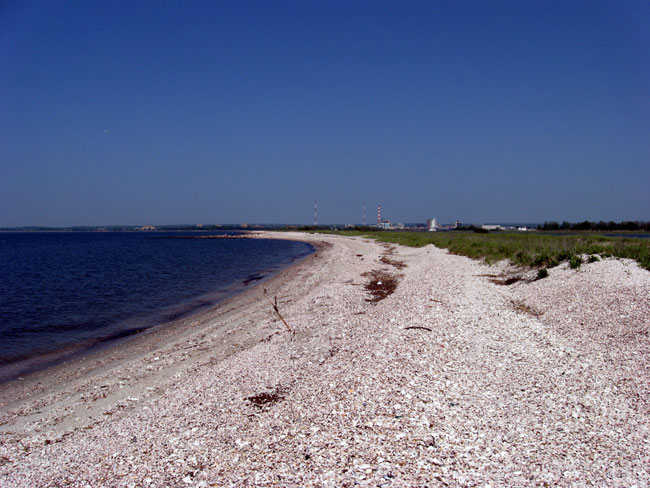
Yesterday was my Bridgeport, CT day and I took the time to head out to the WICC transmitter site.  There are two ways to get there, one can call the Bridgeport harbor master or harbor police and catch a ride via boat, which is fun.  Or one can walk down the beach from the long beach parking lot.  If it is not an emergency or nighttime access, I like to walk down the beach.  It is about one mile either way.  I normally bring my backpack with some basic tools, water, and a sandwich.

WICC towers in the distance

I have been working with another engineer who complains about this.

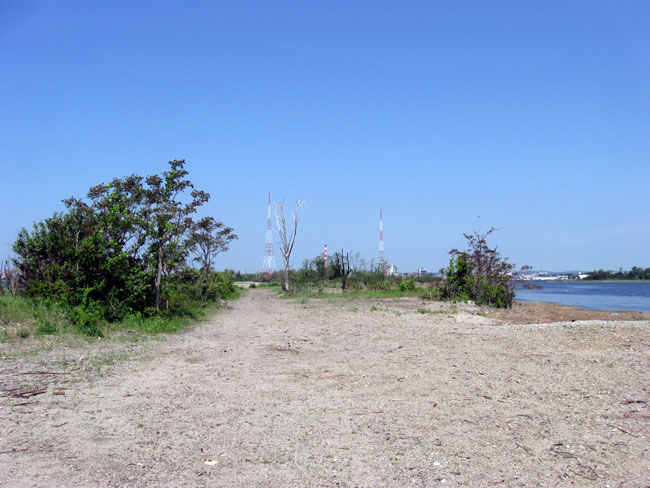
Pleasure beach former cottage area

Now that the cottages are gone, it is a very pleasant walk.

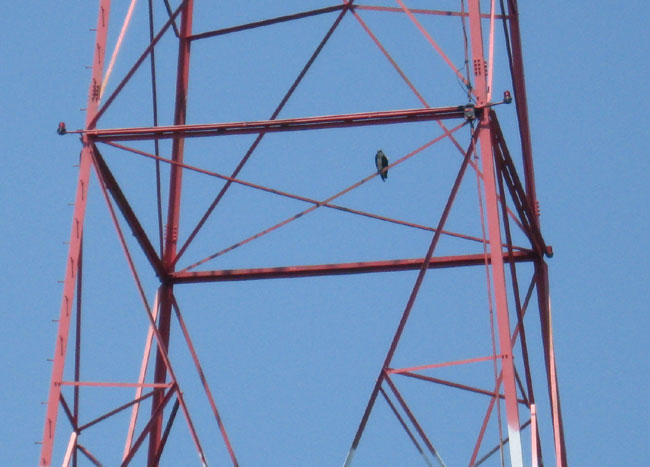
Osprey on WICC north tower

This Osprey apparently didn’t get the memo:  Radio towers are the arch-enemy of birds, actually sitting on one and using it as a good place to scout for lunch is akin to sleeping with the enemy.

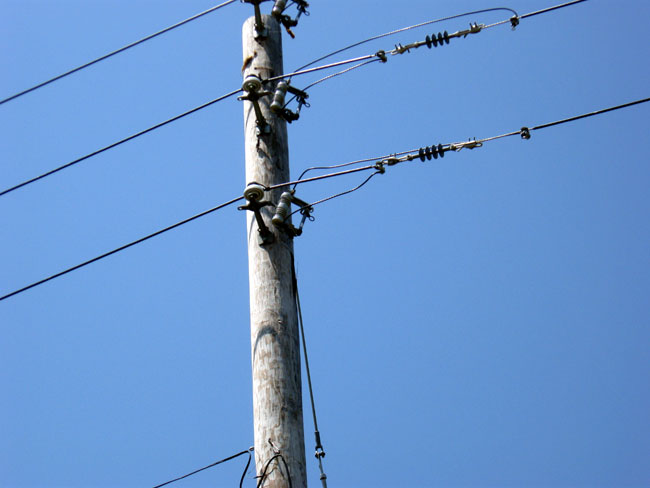
United Illuminating pole mounted circuit breakers
United Illuminating pole-mounted circuit breaker

Circuit breakers on new three-phase power circuit installed by United Illuminating last fall.

I wouldn’t want to hike down this strand of beach at night or in a thunderstorm, but on a nice day, it is a pleasant stroll.  There are far worse transmitter site access problems.  It is a pain if any equipment needs to be taken in or out, that requires some special equipment.