When I left my former place of employment and set out as a contractor, I also left my Radio World subscription behind. After I was let go, or quit or whatever it was, I was thinking that my days in radio were over or at least winding down and I had bigger things to worry about than trade magazine subscriptions.
I have been checking the Radio World website and find that it gets updated from time to time, usually several weeks behind the magazine. So the question is, what am I missing? As one commenter on the radio info board put it, the magazine keeps getting smaller and smaller, soon they’ll have to rename it Radio Pamphlet.
I’d like to stay abreast of things in the technical end of the radio business, but is Radio World the way? There was a time when it was a technical magazine full of good timely articles well written by fellow engineers. Occasionally I still find something interesting to read, and that is true. Interspersed with that are lots of advertisements, useless information, and many pro-HD radio articles. Is it worth the price? I don’t know, I am still pondering that one.
Radio studios involve quite a bit of wiring. Runs between the console and equipment are pretty straightforward, from whatever the connector required for the equipment to whatever the connector required for the console. When it comes to trunk runs between the rack room and the studio, however, some type of terminating block is required.
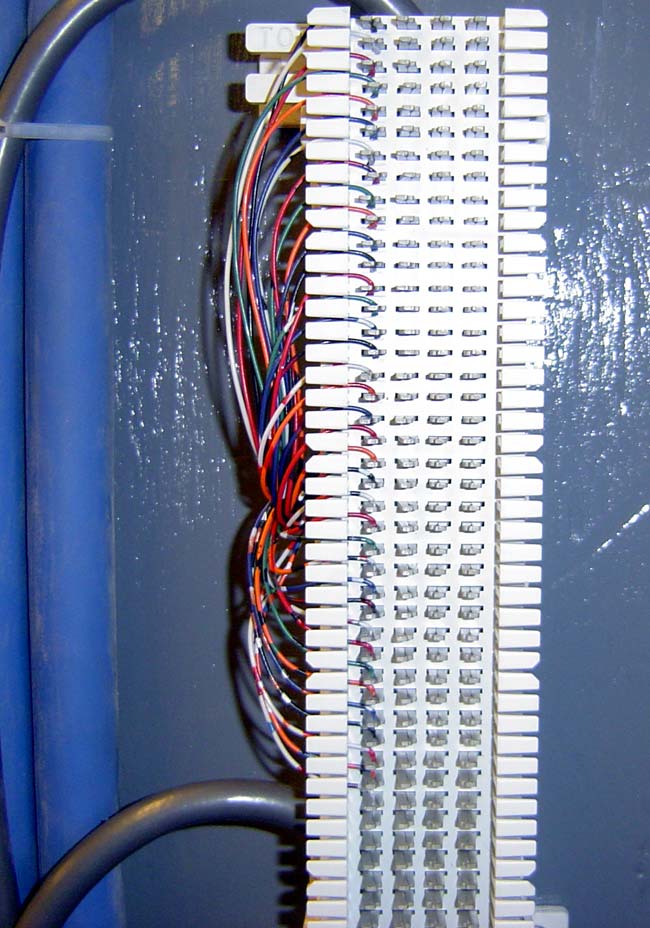
66 block or M block insulation displacement wire termination
This particular cabling installation is for low-level signaling, contact closures, and the like. It uses a Belden cable with 37 un-twisted wires which do not follow the standard Western Electric color code. The color code can be found here. If it were audio or data, the wires would be terminated differently. That color code can be found here. For more information on color codes and pinouts, see this post.
Many engineers use the venerable 66 block or M blockinsulation displacement termination. These terminal blocks were designed by ATT to terminate 25 pair 22 through 26 gauge solid wire. The original design was rated for category 3 (16 MHz or 10 mb/s) communications standards. Newer designs are category 5 or 5e compliant (350 MHz or 100 mb/s). Notice the part about the solid wire. Most audio wire is stranded and as such, the metal fingers on a 66 block will cause stranded wire to spread out losing contact with the terminating finger. This causes intermittent connections and audio dropouts, which I have experienced often (before I knew better, I used 66 blocks when building studios). The way to cure audio dropouts on a 66 block is to heat the termination fingers with a soldering iron. This melts the wire insulation and gets it out of the way. In the long run, it is better to use more suitable terminations.
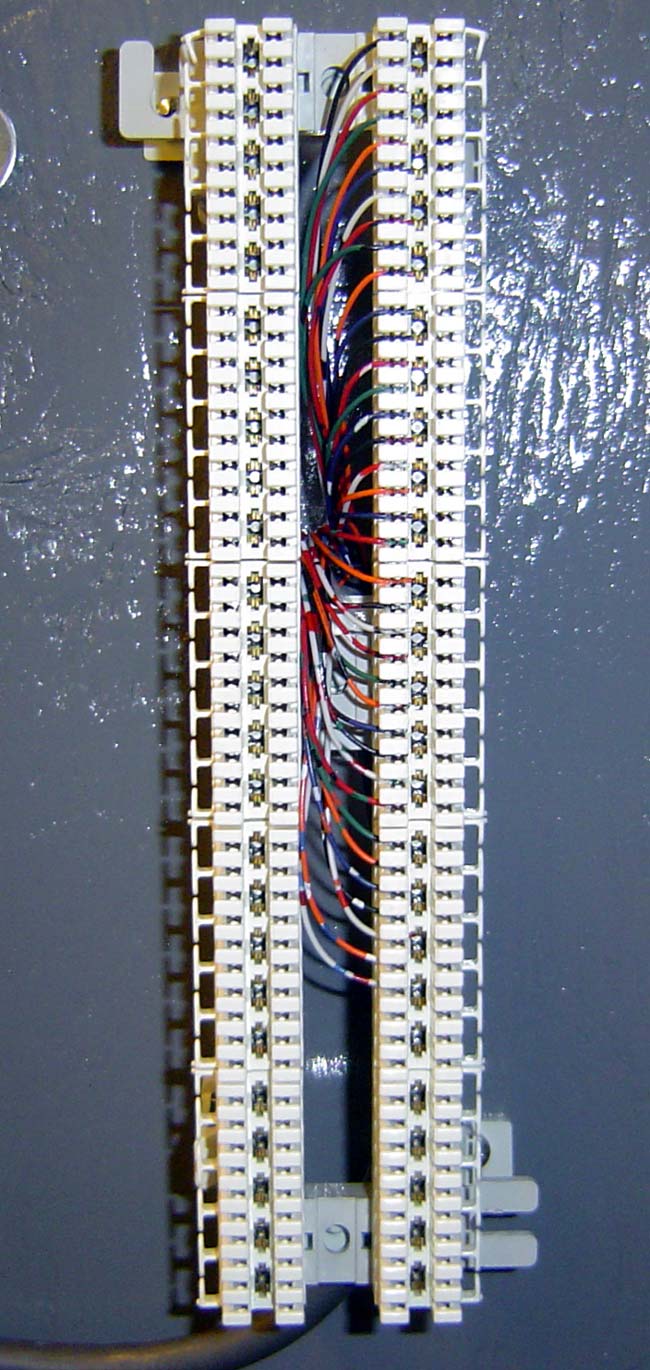
Krone LSA-PLUS 110 type wire termination block
The 110 block is an updated version of the punch block for high-speed networks. it is also designed for 22 through 26 gauge solid wire. This is the termination used on category 5, 5e, 6 patch panels and RJ-45 jacks. They are also formed into block-type terminations the size of small 66 blocks. The 110 block is designed for 500 MHz (1 gb/s) or greater bandwidth. Krone makes a version of a 110 block called LSA-PLUS which is an acronym that stands for: Lötfrei, Schraubfrei, Abisolierfrei, Preiswert, Leicht zu handhaben, Universell anwendbar, Sicher und schnell. This translates to: no solder, no use of screws, no insulation removal, cost-effective, easy to use, universal application, secure and fast. Unlike a standard 110 block, the Krone block is designed for solid or stranded wire. 110 blocks are acceptable for use with AES/EBU digital audio at sample rates greater than 268 KHz as well as gigabit networks and analog audio.
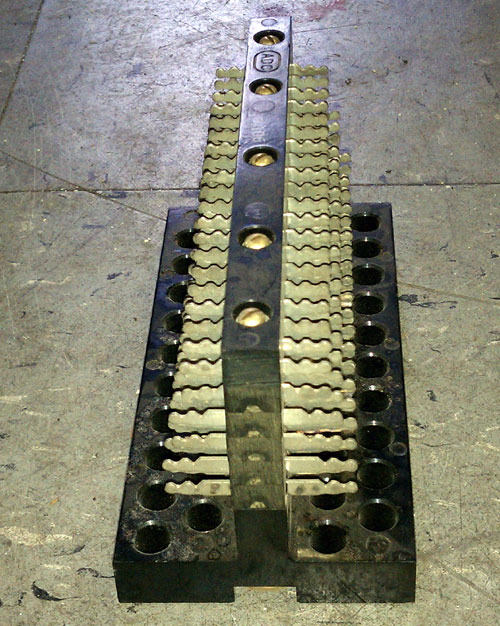
In very old installations, I have seen Christmas trees. This is a wire wrap system where wires are wrapped around metal fingers that form the shape of a pine tree, hence the name. They were very popular in the fifties and sixties and only work with solid wire. It is also time-consuming work and requires special tools and skills. Wire wrapping is a bit of a lost art.
Christmas Tree wire wrap termination block
Screw barrier strips have been used to terminate audio cables from time to time. I wouldn’t consider this method because it is too time-consuming, takes up too much space, and is difficult to label.
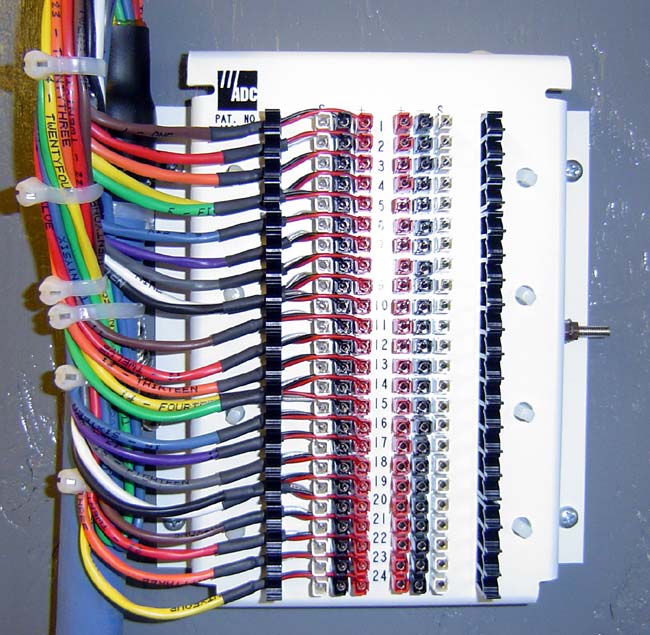
ADC ICON wire termination block
ADC makes a good termination block called ICON (Integrated Cable Organization Network) which uses QCP (Quick Connect Panel) connectors. the connectors are small square devices that are insulation displacement termination (like 66 and 110 blocks) but require a special tool to “punch down.” This particular type of connector is well suited for stranded wire from 22 through 26 AWG. QCP connectors are also used on some of ADC’s patch panels and other audio products. Like any other termination technology, they are only as good as the person punching down the wires. QCP connections are small high-density devices, I have seen them get mangled by someone in a hurry who got his punch-down tool across two of the terminals by accident. ICON blocks can be used for digital audio, however, they do not maintain the 110 ohms impedance of most digital-type audio cables (neither do XLR connectors, by the way). This can lead to some return loss, which on longer cable runs can cause problems.
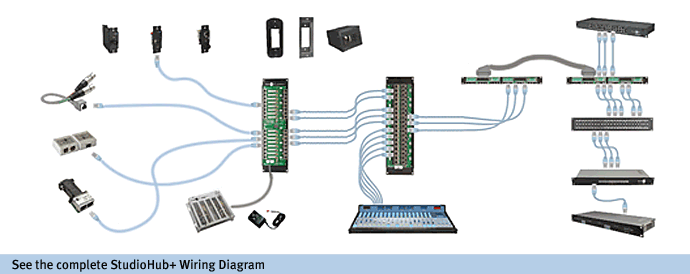
Radio Systems Studio Hub wiring diagram
Radio systems prefer RJ-45 connectors with Category 5 cable, something they call Studio Hub. These are 110 blocks as noted above, but designed primarily for computer networks. Radio Systems discovered that the impedance of most audio cables is very close to that of computer network cables, audio cable is designed for 110-ohm impedance vs. computer network cable which is designed for 100-ohm impedance. Therefore, RJ-45 connectors and shielded or unshielded twisted pair work well with balanced professional audio, either analog or digital.
For analog audio wires, ICON blocks seem to be the best, most secure high-density termination system. In all my years of using them, I have never had a connection go bad. 110 block and other category 5 or 5e systems also work well. For digital audio, Krone blocks or 110 blocks need to be used in order to maintain the full bandwidth characteristics of the cable being used. Using appropriate cable and or terminations in digital audio circuits often leads to impedance mismatches and high return losses in the system.
These were broadcast platforms that were usually anchored in international waters broadcasting popular music to several European Countries including Great Britain, Holland, France, and Spain in the late 1960s through late 1980s. The reason for these peculiar operations was strict government control of all broadcast outlets and programming in those particular countries. The BBC was known to be stodgy and repressive of new music, particularly rock music from bands like the Rolling Stones, the Beatles, the Who, the Kinks, and others.
At the time, there was no specific law preventing ships anchored in international waters from broadcasting to shore-based listeners, a loophole in the government control was found and exploited. That loophole has been closed in most places, so as they say, don’t try this at home.
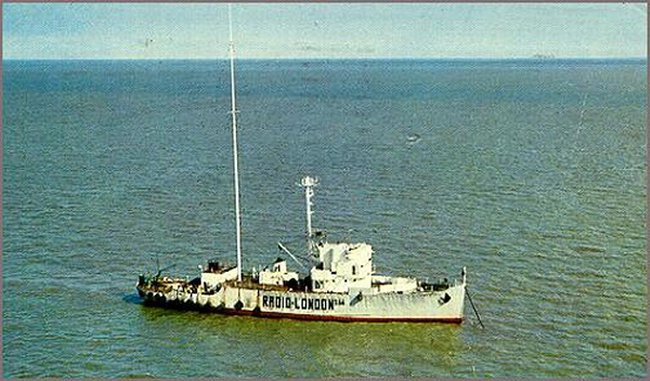
At one time there were several ships out there in the English Channel and coastal Denmark. The first and best-known of these was Radio London or “The Big L.” It broadcast on 1133 KHz from December 16, 1964, to August 14, 1967, using a 50,000-watt RCA ampliphase transmitter. The ship itself was the M/V (motor vessel) Gallaxy, a converted WWII minesweeper formerly known as the USS Density. After Radio London went off the air, the ship was transferred from port to port until it ended up in Kiel, Germany, where it was finally scrapped in the late 1990s.
Radio Caroline was the main offshore competitor, broadcasting on 1520 KHz and several other frequencies off and on from 1964 until 1990 or so using several different vessels to transmit from.
MV Galaxy with radio mast
One incident in offshore broadcasting that has always fascinated me was the burning of the Mebo II, then transmitting Radio Northsea International off the coast of Holland (this ship moved around quite a bit) in 1971. Later investigations revealed that the staff of an offshore competitor, Radio Veronica, was responsible for the firing of the ship. Apparently, in those days the competition was brutal.
I like the nice calm music with the increasingly frantic DJ (West, no East). In any case, the ship remained afloat and returned to the air the next day. The final European offshore broadcaster was something called Laser 558 on M/V Communicator. It broadcast using to CSI 25 KW AM transmitters on 558 KHz in 1983, again, off and on for several years until 2004. The CSI-grounded grid transmitters may have been inexpensive to purchase, but I’ll bet they cost a lot to run. This would be especially true if one were using diesel generators as the main electrical power provider. As a result, they were usually run at about 1/2 power. Eventually, M/V Communicator ended up beached in the Orkney Islands off of Scotland.
The only such attempt in the US was Alan Wiener’s MV Sarah, known as “Radio Newyork International” anchored off of Jones Beach on 1620 KHz. The owners figured 4 miles offshore was far enough to be in international waters, but the FCC felt otherwise, I believe at the time, 12 miles was (and still is) the territorial limit for the US. Four miles was not international waters, as the broadcasters claimed. These guys were arrested and sent to trial. After several years all charges were dropped.
Anyway, an interesting bit of radio history. Goes to show the lengths that some will go to when feeling repressed.
Aside from it hasn’t worked… Over the last several, the FCC has released no fewer than five proceedings regarding EAS. To date, few, if any meaningful changes have taken effect. The stated purpose of the Emergency Alert System (EAS) is to:
provide the communications capability to the President to address the American public during a national emergency.
may be used by state and local authorities to deliver important emergency information, such as AMBER alerts and weather information targeted to specific areas.
Seems pretty straightforward. Local weather emergencies would seem to be the most likely reason for EAS activation, followed by things like Amber Alerts, chemical spills, evacuations, etc. To meet those ends, the FCC mandates that radio (traditional and IBOC), television, cable, wireless cable, direct satellite TV, and satellite radio participate in some way or another. So far, it seems like a fair idea. Then comes the implementation, which is flawed. To start with, EAS still relies on a daisy chain relay system designed during the 1960s for CONELRAD. The over-the-air monitor assignments of other broadcast stations are the only mandatory information sources in the system. Other, more relative local sources such as the national weather service, local government, and so forth are optional. Next, the most used and most useful part of the EAS, local and state-level alerts are completely optional. Very little or no information is provided to local government agencies on how to access EAS in the event of an emergency. Then the issue becomes one of unmanned stations. The initial EAS message goes out over the airwaves, which takes about 2 minutes at most, then it’s back to the music. No amplifying information, check back for more information when it becomes available, etc. Nothing. It has occurred in several cases where a radio show is voice tracked, complete with a weather forecast, which is the opposite of real-time weather warnings. If one happens to miss the initial EAS broadcast because they were listening to another station or whatever, well, too bad. Finally, the National Weather Service itself over-activates. One line of summertime thunderstorms passing through the area can trigger 10 or even 20 EAS alerts. Over-activating, with the same digital tones (rrrrrrannk, rrrrrrank, rrrrrank) followed by the EBS tone than some computer-generated voice just gets annoying. To summarize:
The national EAS has never been tested, who knows if it will work
The EAS relies on unreliable over-the-air daisy chain relays for its mandatory monitor assignments
Local and State level EAS (including weather-related alerts, something that could be really useful) is optional
When connected to the NOAA weather radio system, the NWS overuses the EAS activations
Here is an idea: For at least ten years now, the idea of a CAP has been batted around. It seems like a good idea, let’s do that. Get rid of EAS, send emergency information to everyone’s cellphones or whatever, and stop fining broadcasters for missing a monthly test. The weak link in the EAS is the broadcaster’s themselves. History has shown (over and over again) that the current crop of radio station owners cannot be bothered to meet even the simplest of their public obligations. The FCC has shown it is only interested in collecting big fines for missed EAS tests, not actually making the system work. The system is broken. As terrestrial radio (and TV) goes terminal, the public will still need to receive emergency information, the CAP idea can fill this requirement. It is time to pull the plug on EAS once and for all.