The BE FM20T transmitter

This is the main transmitter for WYJB in Albany, NY. The backup is the Harris FM20H3 on the right. I haven’t turned that unit on lately, but it normally makes quite a fuss the first time the Plate On button is pushed. The FM 20T on the other hand, is mellow and even-tempered.

WYJB 95.5 Mhz, class B, transmitter Albany, NY

One other thing of note; The FM20T is still on its original tube.  I looked up the maintenance records for this transmitter, it was installed in December of 2000.  Eleven years later, the 4CX15000A (ed note; 4CX12000A) is still cranking out 15 KW TPO, which is impressive.  I found that high-power ceramic vacuum tubes actually seem to last longer when run closer to their limits than those that are running at half power.

Judicious management of filament voltage is required to achieve this type of longevity.  There is a set procedure for installing a large ceramic vacuum tube:

  1. After the tube is in the transmitter, run it at a full filament voltage for at least an hour or so before turning on the plate voltage.  This allows the getter to absorb any stray gases in the tube.
  2. Once the plate voltage is applied, proper tuning should be completed as quickly as possible.  Tuning procedures vary from transmitter to transmitter, however, the general idea is to obtain the maximum power output for the least amount of plate current while keeping the PA bandwidth within acceptable limits.  Some transmitters can get narrow-banded at high efficiencies, which manifests itself as higher AM noise.
  3. After the tube has been in use for 90-100 hours, the filament voltage should be reduced gradually until a drop in the transmitter output power is noticed, then increased by 0.1 volts.

This maximizes the filament life for that particular transmitter and power output.  Once the filament can no longer boil off enough electrons, the tube power output drops and it is time to replace it.

This site also has two other radio stations, WZMR, 104.9  and WAJZ 96.3 , both class A using solid-state transmitters of less than 1,000 watts:
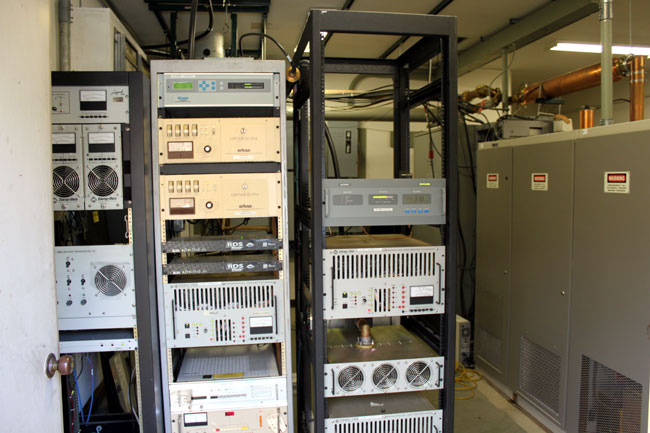
WAJZ and WZMR Energy Onix solid state transmitters
WAJZ and WZMR Energy Onix solid-state transmitters

Not the prettiest sight in the world, but it does stay on the air.  There is no money to go back and neaten up this work, unfortunately.

The tower supports all three antennas.  There was some discussion of a common antenna for all three stations, however, WZMR is a directional station, thus it would require its own antenna.  Doing a common antenna for the other two stations was cost prohibitive, so the tower supports three two bay antennas.
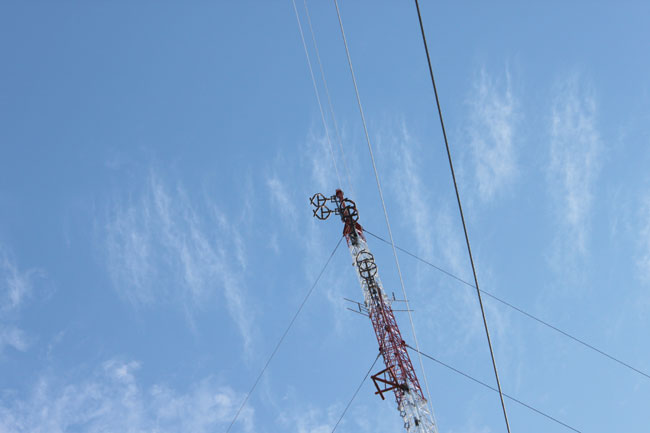
WYJB, WZMR, WAJZ FM antennas, New Scotland, NY

The stations are all located in the New Scotland, NY tower farm.  WYJB is licensed to Albany, WZMR is licensed to Altamont and WAJZ is licensed to Voorheesville.
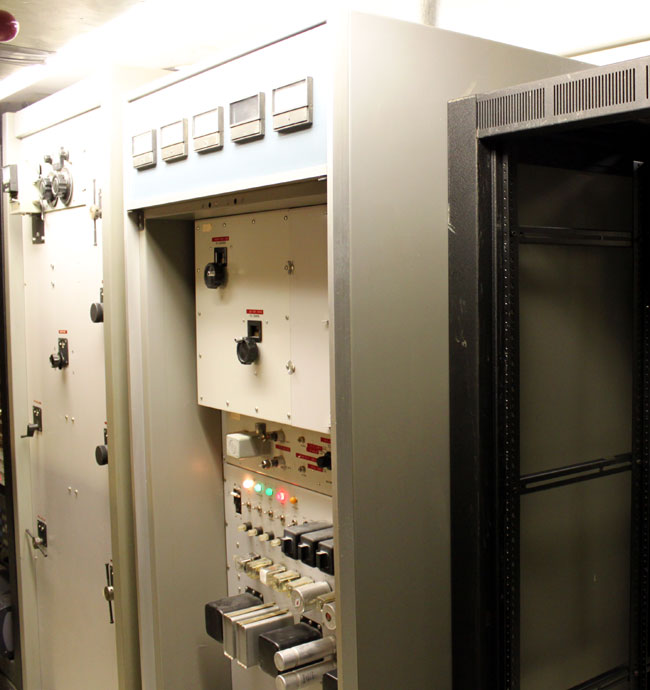
A look at the new Facebook Data Center

Very good article on the new Facebook Data Center in Prineville, Oregon via Wired.com.  One of the interesting aspects of the data center design is the energy efficiency aspect.  In a data center that services 800 million users, shaving a few percentage points off of the energy bill represents huge savings.

According to the article, the location was chosen for its climate.  The area has low humidity, thus allowing the use of evaporative cooling system verses the conventional refrigeration cycle systems most often used.

Another area is in the servers themselves. Facebook decided to design their own servers, using a stripped-down platform, larger heat sinks, slower fan speeds, etc to reduce the amount of electricity used.

All in all the article is well worth reading, as the future of broadcasting will be centered on data centers such as this one.

The CCA AM1000D

Still in use as the main transmitter after 42 years at WCKL 560 KHz, Catskill, NY.

CCA AM1000D transmitter, WCKL Catskill, NY

The last seven years or so, it has not had much use, the station being caught in some strange LMA with Clear Channel, then sold to the Black United Fund of NY something or another. They basically had it dark, turning it on for a few days each year to as not to lose their license.  Finally, they LMA’d it to Family Broadcasting (not to be confused with Family Radio).  There are rumors of a sale, but it remains to be seen.

They have been broadcasting an eclectic, free-form programming style which appears to be the work of mostly volunteers.

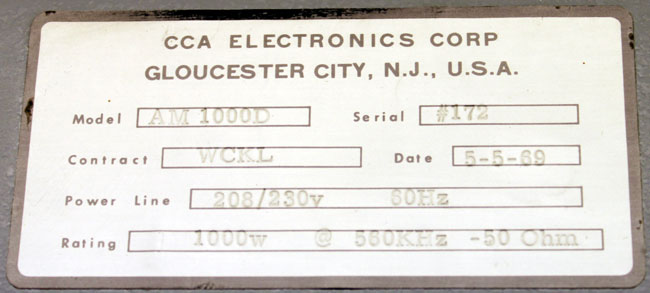
The station was first licensed in 1970, thus this is the original transmitter:

CCA AM 1000D name plate, WCKL Catskill, NY
CCA AM 1000D nameplate, WCKL Catskill, NY

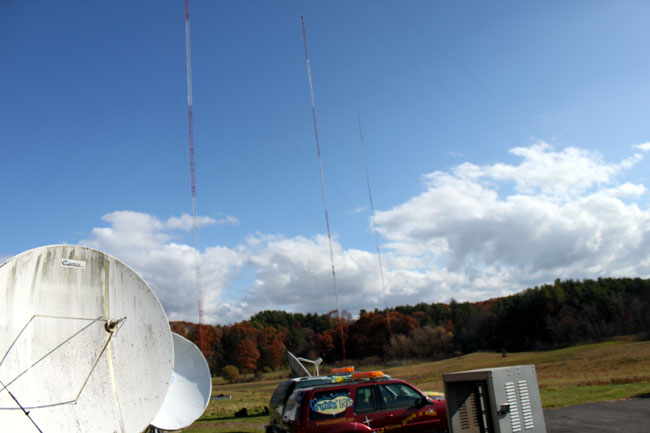
Towers are 446 feet tall, which works out to 90 degrees at 560 KHz.

WCKL 560 KHz antenna array

The station is licensed to Catskill, but the transmitter site is located in Hudson, across the river. With the current ownership situation in flux, I would characterize the operation as “tenuous.”

The transmitter itself is a pretty simple high level modulation tube type transmitter.  It uses 4-400 tubes, like the RCA-BT1AR transmitters, and is built around a similar design, which makes sense as they were designed and built by former RCA engineers.  One of the CCA principles, Bernie Wise, still makes Energy Onix transmitters about 10 miles away in Valatie, NY.

Parts are fairly generic and still available.  Things like the modulation transformer may be harder to come by, however, Goodrich Electronics, Harbach Electronics, Energy Onix and others will be able to steer one in the right direction. I’d put up a schematic if I could find one.

I find these older tube-type transmitters often sing with modulation, especially the higher frequencies.  That sound and the soft sound of the blower moving air is the sound of radio, at least to me.

The ERI LPX2E Rototiller FM antenna

This was in the back room of one of the radio stations we work for:

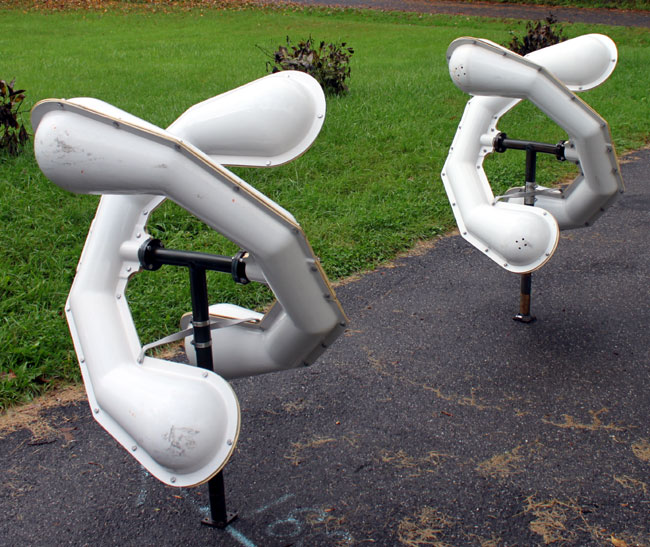
ERI LPX2E FM antenna on the ground
ERI LPX2E FM antenna with RADOMES on the ground

It is a burned-out ERI LPX2E antenna.  The manager was complaining that it took up too much space and he didn’t know what to do with it.  Could I get rid of it?  Sure, no problem.  I could at least cut it up and scrap it.

When I first looked at it, it seemed complete and undamaged, however, upon further examination it seemed that some of the inter-bay line had overheated and one of the tuning sections that goes from the power divider out to the bay was missing.  Therefore, I took it apart and separated the copper from the brass.  Most of the antenna is made from yellow brass, due to its hardness.  The inner line sections are copper and the mounting hardware is all stainless steel.  I will perhaps break even time-wise, but it is one of those projects that can be done on my time in between other paid work, so it will be fine.

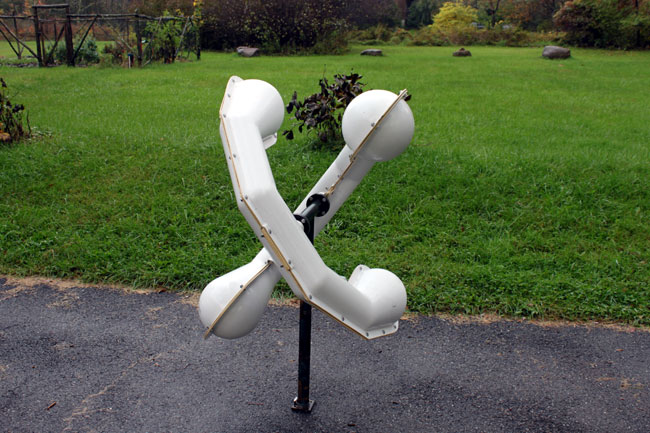
ERI rototiller antenna bay

I am going to keep one bay intact with the RADOMES on as some sort of modern art project.  My daughter thinks we should install it in the yard as a part of a fountain-fish pond-bird bath contraption.  The idea is to mount the bay facing up as in the picture above and run a hose up the inside of the transmission line to the T section.  A hole will be drilled there and some type of fountain head installed to spray water up over the RADOME.   The system will be run by a solar-powered pond pump.  I’ll have to take pictures when it is done.