Protective gear and worker safety

Safety at work is one of those things that is often overlooked for various reasons.  Sometimes we just get into a groove and are not thinking about it.  Other times, employers can put workers in a potentially dangerous situation by ignoring regulations or insisting employees do things contrary to common sense.

For a broadcast engineer working in the field, safety can be a matter of life and death.  Transmitters, in particular, have a host of potential safety issues; high voltage, thermal burns, RF burns, revolving mechanical parts, and external things like lightning.  Transmitter sites themselves can be critter magnets, anything from bees to raccoons, bears, and even the two-legged kind.

Good general practices can go a great way in reducing injuries and downtime.  Take this young fellow here:

improperly attired worker attempting unsafe operation

First of all, it appears he has gone to work in his pajamas, which is a no-no.  Secondly, he has the right idea, wearing safety goggles while undertaking the risky operation of cutting low-density polyethylene with a pair of hand shears, however, those look more like swim goggles.  They appear to be improperly donned.  He is using a right-handed shearing device with his left hand and the work area looks cluttered and unkempt.

Seriously, we are all responsible for ourselves.  While at work, it is important to use common sense.  I may be a wimp, but if I have a question on whether the breaker is on or off, I go check.  High-voltage power supplies offer no second chances.  Here is a list of things to be cognizant of while working at transmitter sites:

  1. Weather.  If the transmitter got knocked off the air by lightning, wait till the storm is over to fix it.  It is still coupled to the tower, even if the backup transmitter is on the air.
  2. Fall hazards.  OHSA requires fall protection for any worker working at an elevation higher than 4 feet.  Fall protection can vary CFR 29 subpart E 1926 has all the details.
  3. Falling object hazards.  Tower works have been known to drop a wrench from time to time.  A hard hat should be required whenever climbers are on the tower.  Also, I watched ice shedding from a 1000-foot TV tower practically destroy a fuel delivery truck in a matter of minutes.
  4. RF safety.  I require all tower climbers to wear personal RF alarms when climbing on any tower that has RF radiators active.  Do not work in hot ATUs or Phasors.  ATUs and Phasors should have provisions to make all necessary measurements with protective covers in place and minimally exposed RF parts.
  5. Electrical safety.  Never work alone at a transmitter site.  Turn off breakers before opening transmitter doors, do not defeat interlocks, and always discharge high voltage with a ground stick.  Hang ground stick on HV power supply output.  Tag out breakers if in a separate room from the transmitter.
  6. Critters.  Use bee spray on ATUs and other outdoor structures.  Be careful around wild animals, even mice, and mice droppings can spread disease, use hand cleaner after cleaning up mice nests.  Snakes love tuning houses, generator sheds or just about any building that is not inhabited.
  7. Generators and backup power.  Generators pose several hazards; fuel and batteries can be explosion risks, revolving parts, thermal burns, and high voltage.
  8. Access to the site.  In some areas where mountaintop transmitter sites are common, access during winter months can be tricky.

Much of this is common sense, remember, a radio station is a radio station, and there is only one you.

Al Fansome, Call your office

Shortwave Pirate broadcasting has been going on for years.  While it is illegal to transmit radio signals without a license, it is not illegal to receive those signals.  There is something sort of sneaky like you are hearing something you shouldn’t, part of some underground thing, listening to these guys.  I am almost remiss to write something about it because I don’t want anyone to get into trouble.

Anyway, on any given day or night, pirate broadcasters roam the shortwave airwaves.  Much of what they do is typical sophomoric humor, such as playing a song where the only lyrics are “god damn you” over and over again.  Some of it can be somewhat entertaining.  A lot of what they tell as jokes are inside baseball, you have to listen and do a little research to get it, the Al Fansome reference is one.  There are no set times or frequencies.  It is quite common to hear one guy tuning up and getting ready to go on the air when the current frequency occupant signs off (happens often on 6925 KHz).

Most of these guys build their own transmitters based on designs found on various websites.  Power levels vary, but 10 to 50 watts is common.  Because of this, a good low-noise receiving antenna is required to pull them out of the noise floor.  I have used, with good success, a K9AY terminated loop antenna.  We are in a rural area, so it is pretty low noise to begin with.  Even so, the coverage with a 50-watt transmitter is remarkable when propagation conditions are good.  Sound quality can be quite good for a homemade AM transmitter.

There is a lot of focus on FM pirates these days, that particular setup is likely the easiest to attain for most non-technical types.  There are a few AM pirates floating about, those are likely the most difficult to construct and conceal once they are on the air.  Both of those broadcast bands have the advantage that there are many kits and or instructions on how to build a pretty good-sounding transmitter.  Shortwave seems to be a small cadre of dedicated hobbyists that simply like to fool around on the radio.

In any case, with the FCC stretched thin, it is unlikely that a SW pirate will be busted but not unheard of.   One SW pirate station was busted in Florida about a month ago.  Even so, that was the first one in almost five years.

For the most part, the activity seems to center between 6850 to 6970 KHz or so.  Some others operate around 15055 to 15070 KHz.  Here is a brief selection of what one might find on the SW pirate frequencies:

  • WHYP on 6925 USB “Who Wants To Be A Pirate Radio Operator” at 0156z.
  • WMPR on 6925 AM “This is WMPR Dancy Party” ID at 0040z.
  • Captain Morgan Shortwave Radio on 6925AM “Positive Captain Morgan Shortwave ID, email, and twilight zone theme at 2209z.
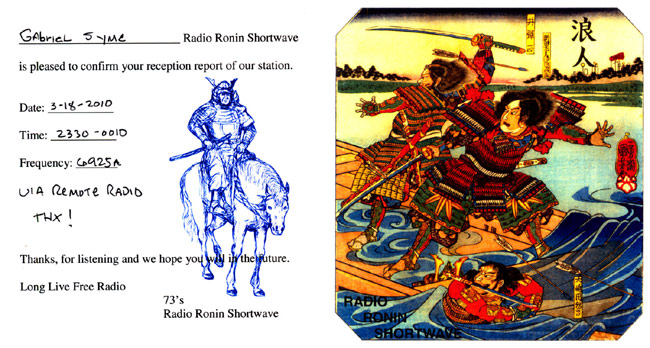
  • Radio Ronin Shortwave on 6950AM oriental-sounding interval signal, id at 01:04, Outer Limits intro, “She Blinded Me with Science”, strange version of “SOS”, anti-BP comedy skits, id at 01:19
  • Indira Calling  on 6925AM pop music that I can’t identify, “Rock-It”, Indian music, id at about 00:37, “Beach Party 2000” show, Calcutta mail drop, Beach Boys medley
  • WEAK Radio on 6925 Shout out to Voice Of Honor. 0048z “Godzilla” 0055z Sabbath.
  • Channel Z radio on 15067AM 2218z ID and contact info, must be an old show (Blue Ridge Summit maildrop)

And so on.  Those call signs are usually spoofs on something.  Occasionally, contact information is given out, usually in the form of a mail drop.  If so inclined, one might write a letter and receive a QSL card.

Radio Ronin QSL card

There is plenty of information floating around out there about shortwave pirate radio if one cares to look for it.  Two of the more popular discussion forums are HF underground and Free Radio Network Grapevines.

Moving the WKZE studio, Part II

The phone company came out and cut over the T-1 circuit on Wednesday, June 2nd. This really kicked things into high gear. By that afternoon we had moved the Prophet systems automation rack up to the new location and started broadcasting from there.

Unfortunately, the backup plan, which was to use the phone company’s DSL circuit to relay audio to the transmitter site, fell through at the very last minute.  I think the phone company mistakenly turned off the DSL service to the old studio ahead of schedule.  The net result was 2 hours off air in the middle of the day, which we were seriously trying to avoid.  Once it was done, however, there was no going back, so we worked extra hard to get back on the air from the new location.

Naturally, while all this is going on, the electrical inspector shows up to do the final electrical inspection for the town building department.

Here is a nice progression on the equipment racks:

Equipment rack with automation system

After the T-1 circuit was cut over, we began broadcasting from the new location with the equipment rack automation system using the production room as a studio for live elements and voice tracking.

Equipment rack, wired to both studios

The wiring on the equipment rack is completed.

Completed with phone system and network switch

The equipment rack is completed, the phone system is installed, and the computer network is wired and tested.  The yellow light on the top of the rack is a silence sensor.

The old WKZE studio
The old WKZE studio

The old WKZE studio was ripped out on Thursday.  The console was removed and rebuilt with a new control surface

New WKZE air studio completed, console is a Radio System millennium 12
The new WKZE air studio completed, console is a Radio System millennium 12

The production room was completed, speakers hung, etc.

The production room is long and narrow

All set and ready to be “customized” by the DJ’s.  Monday morning, the staff will roll into their new digs, which is always fun.  In comparison to most studio moves and built outs these days, this one was relatively small and simple.  The last studio consolidation project involved 5 radio stations and ten studios.  That one took place in steps over several months.

Filament Voltage Management

4CX35,000C ceramic vacuum tube

There are still many hollow state (AKA tube type) transmitters floating around out there in the broadcast world.  High power, especially high power FM transmitters are often tube types and there are many good attributes to a tube transmitter.  They are rugged, efficient and many of the well-designed tube units can last 20-25 years if well maintained.

The downside of a tube transmitter is tube replacement.  Ceramic tubes, like a 4CX20,000 or 4CX35,000C cost $6-9K depending on manufacture.  A well-maintained tube and last 3-4 years, I have had some lasting 8 years or more.  My personal record was for a 4CX35,000C that was a final PA tube in a Harris MW50A transmitter.  The tube was made by EEV (English Electrical Valve, now known as E2V)  and lasted approximately 84,000 hours, which is 9.58 years.  When it finally came out of service it looked like it had been through a fire, the entire metal plate body was dark blue.  I took it out because the power was beginning to drop a little and it was making me nervous.

This was not an accident, I did it by maintaining the filament voltage and keeping the tube and transmitter clean.  The tube filament supplies the raw material for signal amplification.  Basically, the filament boils off electrons, which are then accelerated at various rates and intensities toward the plate by various control grids.  The plate then collects the amplified signal and couples it to the rest of the transmitter.  When a tube goes “soft,” it has used up its filament.

I had a long conversation about this one day with Fred Riley, from Continental Electronics, likely the best transmitter engineer I have ever known.  At the time, the consensus was to lower the tube filament voltage by no more than 10%.  On the 4CX35,000C, the specified filament voltage is 10 volts, therefore, making it 9 volts was the standard procedure.  What Fred recommended was to find the performance “knee,” in other words, where the power began to drop off as the filament voltage is lowered.  Once that was determined, set the voltage 1/10 of a volt higher.  I ended up running that EEV tube at 8.6 volts, which was as low as the MW50’s filament rheostat would go.

The other important thing about tubes is the break-in period.  When installing a new tube, it is important to run only the filament voltage for an hour or two before turning on the plate voltage.  This will allow the getter to degas the tube.  New tubes should be run at full filament voltage for about 100 hours or so before the voltage is reduced.

Tube changing procedure:

  1. Remove power from transmitter, discharge all power supply caps to ground, hang the ground stick on the HV power supply.
  2. Remove the tube, and follow manufacturer’s procedures.  Most ceramic tubes come straight up out of their sockets (no twisting).
  3. Inspect socket for dirt and broken finger stock.  Clean as needed.  Finger stock, particularly in the grid section, is important for transferring RF.  Broken fingers can lead to spurs and other bad things
  4. Insert new tube, follow manufacturer’s recommendations.  Ceramic tubes usually go straight down, no twisting.
  5. Make all connections, remove grounding stick, half tap plate voltage supply if possible, close up transmitter
  6. Turn on filaments and set voltage for manufacturers’ recommended setting.  Wait at least 90 minutes, preferably longer.
  7. Turn on plate voltage and tune transmitter.  Tune grid for maximum current and or minimum reflected power in the IPA.  PA tuning should see a marked dip in the PA current.  Tune for dip, then load for maximum power.
  8. Turn off transmitter, retap plate supply for full voltage
  9. Turn on transmitter and plate supply, retune for best forward power/efficiency ratio.
  10. After the 100-hour mark, reduce filament voltage to 1/10 volt above performance knee.

Of course, every transmitter is slightly different.  There may not be a dip in the plate current if the transmitter is running near its name plate rating, in which case one would tune for maximum forward power.

This system works well, currently one of the radio stations we contract for has a BE FM20T with a 4CX15,000A that has 9 years on it, still going strong.