Simulcasting: The sound of broadcasters running out of ideas

There seems to be a growing trend lately;  Stations that had previously separate programming being simulcast. There are two big ones around here: WGY and WHRL and WPLJ and WXLM.

Lets begin with the first one: WGY, now WGY AM/FM.

WGY (Clear Channel Communications) has been the regional powerhouse since it’s inception in 1922.  It consistently ranks in the top 5 Arbitron ratings for Albany/Schenectady/Troy NY and is well-received in the community.  It carries the standardized Clear Channel talk radio format of Limbaugh, Beck, Hannity, etc.  As of September 20th, WHRL 103.1, class A licensed to Albany changed its call sign to WGY-FM and began simulcasting WGY 100%.  103.1’s 60 dBU contour is entirely within WGY 2.5 MV/M contour.

It would seem that radios, even bad radios, would have no problems picking up WGY’s signal within the 103.1 listening area.  According to Clear Channel Management:

The decision to simulcast our 24-hour news/talk format on the FM will open up our content to an even wider audience. Despite the huge audience we currently enjoy, the fact is a significant portion of the Capital Region audience never thinks to visit the AM dial.

There is some small amount of truth to that statement; the younger segment of the population generally never listens to AM. Yes.  The reasons, however, are not just because it is AM and they are prejudiced.  More likely, there is nothing on the AM dial that interests them.  Satellite-syndicated talk is not everyone’s cup of tea, so to speak.

The other side of the coin is the former WHRL had an alternative rock format, which never did all that great (I have a theory on why Alternative Rock, AAA, and other such formats never get good ratings, but not right now).  They also had a station staff, which by the time they pulled the switch, was down to one person.   The Capital District Business Review notes:

According to BIA/Kelsey, a media research firm in Chantilly, Va., WGY did about $2.8 million in revenue in 2009. WHRL took in about $875,000.

Which is really not bad for a class A FM in market #63, during a recession.  Apparently, not good enough, however.

The second example in our little story is that of WPLJ and WXLM.  WPLJ 95.5 (Citadel Broadcasting) is of course one of the heritage FM stations in Market #1. WXLM 104.7, now known as WELJ broadcast from the far eastern end of Long Island (Market #18), so the respective coverage areas do not overlap.  Prior to September 24th, that station was doing a News/Talk format.

That end of Long Island is pretty affluent, a local (unique) station might even prosper.  In fact, up until 2003 it did quite well for itself, then known as “The Beach.”  However, nothing lasts forever, and in 2003 Citadel Broadcasting purchased the station.

It has gone through a number of changes since then, most recently a syndicated news talk format.  Unless I am missing it completely, during the last ratings period, this station did not even show up in the book.  As of September 21, it began to simulcast the co-owned out-of-market AC station, likely for the drive-by PPM listeners in it.  Again, no word on the fate of the former radio station’s staff (if there was one).

So what gives?  Consolidators have already cut staff levels to the bone with voice tracking, syndication, and automation.  Even a voice-tracked syndicated station still needs some staff members; the occasional morning show, somebody to do promotions, and some form of program direction due to things like music logs and other such behind-the-scenes work.  Staff require salaries and salaries are expensive.  Anyone that has ever looked at a company’s P&L can tell you, salaries are the number one expense.  If, however, the entire format is blown out, and something can be plugged in to fill the void that costs nothing and has no overhead and no staffing, well, now they are really saving money.  That money from reduced expense is much better (far easier) than actually earning more money and it goes right to the bottom line.

This never-ending drive to reduce expenses at the expense of everything else drives programming quality and thus entertainment value down.  Who wants to listen to the radio and be bored?  Not I.  This continuing trend is what will ultimately spell the end of terrestrial radio.

Things that make you go, Hmmmm part II

I am not sure what the purpose of this is for, or who put it there:

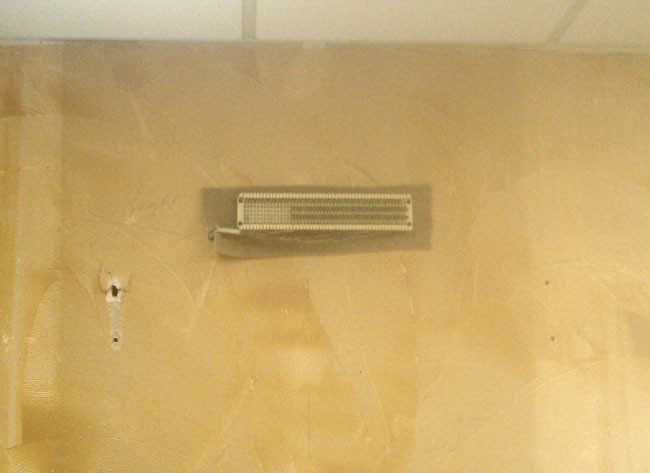
mystery 66 block
Mystery 66 block

The mystery type 66 punch block is mounted high up on the wall in the hallway.  The contractors are removing the carpeting on the wall and drywalling over it, when they reached this, they just cut around the block and kept going.  On one side is a Teflon jacketed 25-pair category 3 phone wire, which goes back to the rack room, somewhere.  The rack room is a little disorganized and it is difficult to mess around with the various bundles of wire without knocking a station off the air.

On the other side is a bunch of 1N1004 diodes punched down.  Perhaps some sort of door light circuit?  Or maybe a remote channel selector for one of those old Scientific Atlanta 7300 series satellite receivers?  I don’t know.

I used my big wire loppers and cut the cable.  There were no sparks and everyone stayed on the air.  I pulled the whole thing down and removed it, so the drywall contractor can finish patching the holes.

The entire facility is getting gutted and redone soon.

Vintage Texar Audio Prisms

I give to you, the original Texar Audio Prism:

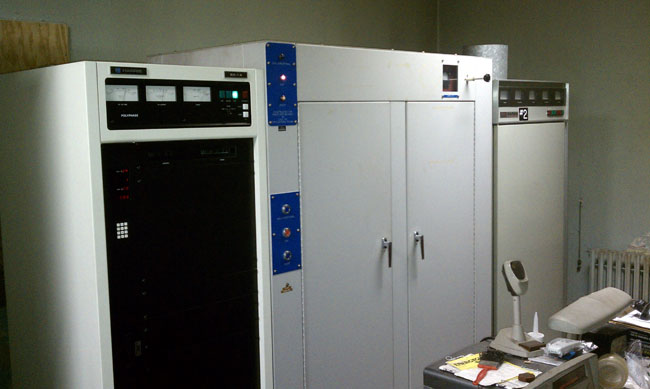
Texar Audio Prism
Texar Audio Prism

I love the sound of these units when coupled with an Optimod 8100A.  Many people have (or rather, had) difficulty setting these things up.  I found them to be very easy to deal with, just follow the instruction manual.  If that doesn’t sound good, then there is something wrong with the unit.  Over the years, there are only a few consistent problems.  The first thing is with the voltage regulators.  They have heat sinks attached with nylon screws.  The screws get brittle and fall apart, making the regulator overheat and go bad.  I have taken to replacing the nylon screws, and if the heat sink has fallen off, the entire regulator.  There are also a few electrolytic capacitors in the power supply and on the audio board, it is always a good practice to replace those.  Otherwise, unless the unit has been blown up by lightning, it should work.

As for set up, follow the directions in the manual:

  1. Bypass the units using the bypass switch
  2. Turn on the onboard pink noise generator
  3. Using the test ports on the front of the unit, plug a Simpson 260 VOM set on 2.5 VAC  important: use the ground port on the front of the unit, not the case
  4. For use with an Optimod 8100A, using the dB scale on the Simpson 260, set all the bands for a 4.0 reading.  Set the density to 3/4.
  5. Turn off the pink noise generator and switch out of bypass mode.
  6. Make sure the levels in the studio are where they should be.
  7. Adjust the input gain so the “Buffer Active” light does not come on during normal-level programming.
  8. Adjust the output levels so that the input buffer on the Optimod reads between -7 and -3 vu.

The rest of the settings are on the Optimod:

  1. Clipping = 0
  2. HF limiting = 5
  3. Release time = 2
  4. Bass coupling = 2
  5. Gate = 0
  6. Set the input attenuators for about 10 dB total gain reduction, with peaks around 15 dB or so.

Then set the L-R null.  To do this, make sure the program material is in mono, then adjust the L or R input attenuator for minimum reading.  Also, if the Audio Prism has PR-1 (phase rotators) installed, bypass the phase rotator in the Optimod.  There is also a replacement card 5 made by Gentner called the RFC-1  for the Optimod 8100A.  I notice little difference between a stock Optimod and an RFC-1 Optimod.

That is a good starting point.  Most people are quite happy with this, but if needed, the high and low settings on the Prism can be adjusted slightly to suit the station equipment.  When properly adjusted, this equipment rides gain, and adds a certain amount of loudness, while keeping the programming material natural sounding.  Further, unlike some “modern” air chain processors, it does not boot up and it does not occasionally lose its mind, requiring a reboot.

The best paragraph in the manual, or any broadcast equipment manual is this:

There is a wealth of information available in the LED display.  A few minutes of watching them in reduced light (emphasis added) while listening to a familiar program input will greatly help in understanding their action.

It will also greatly enhance your buzz, dude.  It was the 70’s.

Incredible Radio Tales

Richard Dillman, who is the driving force behind the Maritime Radio Historical Society (MRHS) has produced a show on KWMR called “Incredible Radio Tales.”  This is a show that talks about the various sounds heard on the radio, both natural and man-made.  Many of the shortwave frequencies are used for “utility” uses.

He does a great job explaining things like Skyking, numbers stations, and so forth.  It is a great show, I can imagine this story being told on Halloween.

You can listen to the first episode here, it’s about an hour long:

http://www.g4aqg.sussex.ac.uk/IRT.mp3

This is a great example of local radio doing local things. I have no idea if the other episodes are going to be put up online.