Archives

March 2010
M T W T F S S
« Feb   Apr »
1234567
891011121314
15161718192021
22232425262728
293031  

Categories

Money quote of the day

From here:

Unlike some attorneys, engineers know that the laws of physics are not subject to negotiation.

Music, pure music.

S.2881 – FCC Commissioners’ Technical Resource Enhancement Act

The house version of this bill is HR 4809.  It seems that in this day and age, as the country is becoming more and more technologically advanced, the communications regulation arm of the federal government is feeling a little left behind.  This is a fairly common thing these days, companies are run by accountants and lawyers while the engineers and technologists that actually do what ever technical thing the organization is supposed to be doing are “those funny guys in the basement” or corner or wherever.  The bill reads as such:

Section 4(f)(2) of the Communications Act of 1934 (47 U.S.C. 154(f)(2)) is amended by inserting after the first sentence the following new sentence: ‘Each commissioner may also appoint an electrical engineer or computer scientist to provide the commissioner technical consultation when appropriate and to interface with the Office of Engineering and Technology, Commission Bureaus, and other technical staff of the Commission for additional technical input and resources, provided that such engineer or scientist holds an undergraduate or graduate degree from an institution of higher education in their respective field of expertise.’.

That would be a step in the right direction.  Hopefully said engineer has several years of experience also, field experience would be even better.  As a radio engineer, I learned that theory is great and most of the time everything goes together exactly as it is supposed to.  There are those occasions, however, where theory has to be thrown out and a prove-fail/prove-pass approach needs to be taken.

In any case, the bill appears to be on the fast track and hopefully the FCC commissioners will choose and use their staff engineers wisely.

I-Buzz

Rumor has it that iBiquity is going to release a software upgrade for the AM IBOC system they peddle.  Allegedly it is going to improve the sound quality of the digital signal, allow the analog signal to increase it’s bandwidth to 10 kHz and provide data such as song titles.  No word on whether they will be providing software upgrades to consumers for the many HD radioTM receivers out there.

I have been following a discussion on AM quality over the last few days.  It seems many engineering types at least, acknowledge that analog AM can sound good, if not more natural that FM.  The addition of IBOC hybrid mode on AM station has created more noise and further degraded the station’s main signal by reducing the bandwidth to less than 5 kHz.

Tonight I am listening to WWVA on 1170 kHz, and there is this horrific white noise/hash over top of the station.  Same thing on 1190 kHz, all courstesy of WHAM 1180’s IBOC transmission.  It is one thing to trash your own station, limiting the analog audio response to 5 kHz.  It is quite another thing to trash the adjacent frequencies with noise making them unlistenable.

Here is a brief clip (recorded at 8:00 pm EDT, March 24, 2010):

Second clip, WWVA has faded out (recorded at 9:10 pm EDT, March 24, 2010)

The audio in these videos is adequate but not the best, still, it is pretty clear that there is a whole bunch of white noise on top of WWVA’s signal and on 1190 where no station is coming in. The only conclusion that I can draw is that WHAM is operating with their IBOC turned on. This was recorded at a location that is 197 miles from WHAM and 364 miles from WWVA.  I have made several better recordings directly into the computer without the video frequency readout reference.

In 1990, the FCC mandated NRSC-2 (73.44) spectral mask on all AM stations, requiring them to put in brick wall filtering to limit the bandwidth to 10 kHz or less.  They also require all AM station to do “equipment performance measurements” (73.1590) to verify that the stations are complying with FCC regulations.  This was done because of excessive sideband splatter by AM broadcasters creating interference to adjacent channel stations.  I agree in principle with the NRSC-2 standard, I think it serves a purpose.  Why then, are stations allowed to interfere with other stations with IBOC signals?  Even though Ibiquity has put up a spectral mask that complies with NRSC-2, it still creates interference.  Isn’t this a double standard?  A station in Pennsylvania gets fined $4,000.00 for operating past its sign off time (because operating after sign off might create harmful interference), yet, WHAM gets to generate noise all night and drowned out adjacent channel stations that are hundreds of miles away?

In the mean time, if the FCC inspector shows up at a station that has not made the required “equipment performance measurements” they will get a fine too.

Am I crazy, or is it hypocritical bull shit to fine one station for potential harmful interference, but then the FCC to ignores its own rules and allows another type interference?  Hint: I am not crazy.

I have recorded this in .wav format and I am sending it to the FCC with an interference complaint letter.  It is about time somebody made some noise about this noise.  Apparently, there are many engineers who feel the same way.  Will Ibiquity listen, or will they keep doing CPR on a corpse?

Somewhere in Utah, a phone company is missing it’s microwave site…

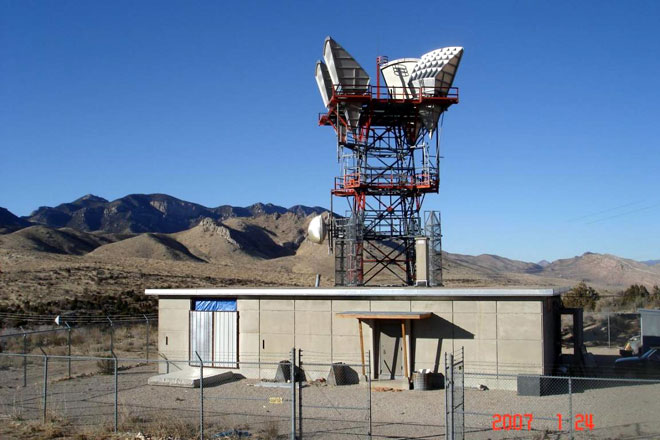
I followed this a link to this site called “SurvivalRealty.com” and saw this article about what looks to be a former ATT microwave relay site in Utah turned into a residence.  The site is much smaller than the former ATT site in Kingston that I profiled in this post.   Still, that is a Western Electric tower and those are KS-15676 antennas.

Former ATT microwave site turned into a residence

Former ATT microwave site turned into a residence

If I were that guy, I’d take those antennas down a scrap them.  Looks like the wave guides are already gone.  I might have tried to put some windows in while I was renovating it.  It would drive me crazy to live in a house without any windows.  I guess if one where waiting for the big one, windows might not be a desired feature of a survival bunker.

I wouldn’t really call it a “communications bunker” though.  I’ve been in communications bunkers, they are mostly underground and are much more robust than that building.  Still, it is built better than an ordinary commercial building or a regular house.   It would take a special person to live out in the middle of nowhere like that.

The Last Radio Station

WGU-20 logo

WGU-20 logo

Back in the cold war days, the federal government took emergency warning quite seriously.  So much so that they spent about $2 million in 1972 to build a LF (low frequency) radio station WGU-20,  in Maryland designed to integrate into the public warning system.  This was known as the “Last radio station” because it was designed to operate after nuclear armageddon.  Using the first all solid state AM transmitter designed by Westinghouse, the station transmitted on 179 kHz (power 50 KW) with a loop that stated:

“Good evening. This is WGU-20, a defense civil-preparedness agency station, serving the east central states with emergency information. Eastern Standard Time seventeen hours, twenty minutes, twenty seconds.”

The greeting would change to “Good Morning…” or “Good afternoon…” as appropriate.

One small problem arose from this system, no one had long wave receivers.  The government attempted to persuade manufacturers to market, and the public to purchase radios that would only receive periodic tests or that they were likely going to die in the next 15 minutes. It was a tough sell from the start.

Military planners decided that they might integrate the DIDS (Decision Information Distribution System) information gained from surface to air radar that would give the approximate impact areas of incoming ballistic missiles. The idea was, the public would then know which areas to “avoid.”   It may have appealed to the military mind, but most others didn’t quite see the value in it, especially since reaction times would have been 10 minutes or less.

Plans were to build several of these radio stations throughout the US operating on Low Frequency, which would have replaced the EBS over the air daisy chain system that remains in effect today with the current EAS.   Unfortunately, the public never bought into the concept and around 1990 or so, WGU-20 was turned off for good.  The nearest thing was have to it today is NOAA weather (or all hazards) radio.

EBS and EAS have never had to work in a time of emergency and if the circumstances are dire enough for someone to attempt to activate EAS, it is very likely the system would fail.

The lights are on, but we’re not home…

fcclogowordsFCC fines to broadcasters is nothing new.  Broadcasters have often tried to cut corners, hiring incompetent staff that cannot be bothered to report tower light outages, or simply not monitoring tower lights at all. Untrained operators who do not know the EAS rules, sloppy public files, unattended main studios, over power operation, etc.  Some AM stations have power changes as sunset and sunrise, most are now automated but who is checking the automation system to make sure the power changes?

The FCC does not have nearly enough field agents to monitor everything.  Most rules infractions never get discovered, like the translator operating at double its licensed power.  Or the FM station with the antenna at the wrong height on the tower.  It never ends.  When I first got into this business, I remember one FCC inspector that was going to issue a NOV (Notice of Violation) because the operator signed her name in red ink.  RED INK, by god!  It seems things have swung far in the other direction.

Fortunately for us, these infractions become public record, so we can all learn from other’s mistakes, right?

Here is the current crop of FCC fines being shuffled through the bureaucracy:

Clarion County Broadcasting Corp. the licensee of radio station WKQW in Oil City, Pennsylvania, apparently willfully and repeatedly violated Section 73.1745(a) of the Commission’s Rules by operating at times beyond the station’s post-sunset authorization. Clarion is liable for a forfeiture in the amount of four thousand dollars ($4,000.00). To determine whether WKQW was operating consistent with its authorization, an agent from the Philadelphia Office installed radio monitoring equipment in Oil City, Pennsylvania to record, on a continuous basis, the relative signal strength of WKQW’s transmission on the frequency 1120 KHz. The equipment was in place from October 28, 2008 to December 12, 2008.The agent reviewed and analyzed the radio transmission data recorded between October 28, 2008 and December 12, 2008, and found several violations. The agent determined that, between October 28, 2008, and October 30, 2008, the station operated after 8:30 p.m. local time, which is the end of the station’s post-sunset authorization during the month of October. The agent also determined from the recorded radio transmission data that, between November 1, 2008 and November 13, 2008 and between November 15, 2008 and November 25, 2008, the station operated past 7:00 p.m. local time, which is the end of the station’s post sunset authorization during the month of November. In response to an inquiry from Commission staff, the owner of Clarion confirmed that the station’s transmitter did not malfunction during the period between October 28, 2008 and December 12, 2008.

I find it interesting that the FCC has some sort of remote monitoring device that it can install and monitor an AM stations power levels. I wonder where they installed it.  I also have to wonder what it looks like.  Is it an outdoor unit, like something one might see attached to a utility pole, or an indoor unit, stashed away in an office somewhere.  Very curious, indeed.  If I were the station owner, I might ask to see the records that the automated recording device created.  That would seem to be a reasonable request.

Caron Broadcasting, Inc. licensee of station WKAT, in North Miami, Florida, apparently willfully and repeatedly violated Sections 73.1745(a) and 73.3526 of the Commission’s Rules by operating at times with power other than those specified in its license and failing to maintain and make available a complete public inspection file. Caron is liable for a forfeiture in the amount of eight thousand dollars ($8,000). We also admonish Caron for the failure of the station’s chief operator to review, sign and date the station logs on a weekly basis as required under Section 73.1870(c)(3) of the Rules.On January, 26, 2009, an agent from the Miami Office monitored WKAT’s transmissions from approximately 5:00 p.m. until 7:00 p.m. The agent made several field strength measurements of the station’s signal and observed no reduction in the transmissions’ field strength after sunset.On January, 27, 2009, an agent from the Miami Office monitored WKAT’s transmissions from approximately 5:25 p.m. until 6:45 p.m. The agent made several field strength measurements of WKAT’s signal and observed no reduction in the transmissions’ field strength after sunset. At 6:43 p.m., the agent made a field strength measurement of the station’s signal one block from the WKAT studio.

On February 5, 2009, at 11:01 a.m., an agent from the Miami Office made a field strength measurement of the station’s signal one block from WKAT’s main studio, which measured approximately the same level as the nighttime measurement that was made there on January 27, again indicating that WKAT was not reducing its power at night. The agent immediately conducted an inspection of WKAT’s main studio with the station’s general manager and designated chief operator. The chief operator stated that the station uses a remote phone monitoring system, which allows the caller to change from day mode (mode “2″) tonight mode (mode “1″). At 11:55 a.m., the chief operator called the transmitter using the remote monitoring system, which indicated that the daytime mode transmitter power was 4,758 watts. At the request of the agent, the chief operator switched the transmitter to nighttime mode, and the system indicated that the power was 316 watts. At 1:45 p.m., with the WKAT transmitter in nighttime mode, the agent made a field strength measurement near the WKAT studio which was much lower than the daytime mode measurement made earlier that day. This measurement confirmed that the station’s transmitter and transmitter remote control system were functioning properly.

Still on February 5, 2009, the agent inspected WKAT’s available daily transmitter logs, which showed that from December 4, 2008 until February 4, 2009, WKAT was not reducing power at night as required by its license. All the log entries made during the daytime and nighttime were in the range of approximately 4,600 to 4,900 watts, and indicated that the transmitter was in mode “2,” the day mode, at all times. The log entries for the early morning hours of February 5, 2009 indicated that WKAT was operating at nighttime power at that time. Neither the station manager nor the chief operator could explain why the power was not being reduced, or why or how the situation was corrected early that morning. The agent also found that none of the station logs were signed by the chief operator or by anyone else. There was apparently no verification of whether or not the station was operating with authorized power, and no initiation of any corrective action for the overpower condition that had been ongoing for several months. The agent also requested to inspect the station’s public inspection file and found that it did not contain the quarterly radio issues/programs lists for the 1st through 4th quarters of 2008. The station manager stated that he did not know where the issues/programs lists were, but that they may be in storage since WKAT moved its studio in August 2008.

They tracked that one down the old fashioned way, multiple visits at sunset to take field strength meter readings.  It seems like no one at this radio group knew anything about FCC requirements and rules. None of this is rocket science, really. These NAL’s are both over a year old.  I wonder why it is taking the FCC so long to get through this process?

History of the WGY broadcasting tower

To any who live in the capital region, the WGY tower near the intersection of I-90 and I-88 in the town of Rotterdam is a familiar site.  It is big, tall, and conspicuously marked with a huge “81 WGY” on the southwest face of the tower.   At night the call letters used to be lit up by a spot light but that may have been turned off in recent years.

In my time as chief engineer there, I found several file folders of memos and other materials about the building of the tower, which started in 1936.  Prior to that, WGY used a T top wire antenna, first from the General Electric plant in Schenectady (1922-25) then from the current tower site in Rotterdam.  Located with WGY were GE’s experimental shortwave stations W2XAF and W2XAD.

When the station increased power to 50,000 watts in 1925, may reports of fading were received from locations 20-50 miles away.  WGY engineers studied the situation by doing a full proof on the antenna.  They found an elliptical shaped pattern with nulls to the north and south.  This coincided approximately with the T arms of the T top antenna, likely due to the self resonating effect of the support towers for the ends of the T.

NBC, then owners of WJZ (now WABC) in NYC had studied this problem for years and came up with a new antenna design for Standard Broadcast, the uniform cross section guyed tower.  Starting in 1935, WGY began to investigate installing such a tower in South Schenectady, as the transmitter site was then known.  One report showed an efficiency gain of 430% over the T top antenna that was in use.  The General Electric construction and engineering department raised several objects to the standard triangular tower then and now commonly used for AM radiators.

WGY transmitting tower, Schenectady, NY

WGY transmitting tower, Schenectady, NY

Much mechanical planning and effort went into the design of the tower, which is a square tower, 9 foot face, 625 feet tall.   During the planning phase, KDKA was installing a simuliar tower, which collapsed when it was being erected in 1936.  An analyisis of the failure showed that one of the guy anchor cable sockets pulled out of the concrete (which was improperly poured).  This may also be the reason why the KDKA tower collapsed in 2003, although I never read the engineering report on that failure.   Nevertheless,  GE engineering felt that forging the members of a triangular tower weakens them and was too risky, thus, a square tower was the solution.

Further, every component of the tower was tested individually.  Often, two of a type where build, with one being tested to destruction.  Two base insulators were made for this specific tower.  The first was tested to destruction at the National Standards and Institutes laboratory in Washington DC.  It was found that the insulator withstood slightly more than 1,200,000 pounds of pressure.  The working load (tower dead weight) of the base insulator is calculated to be about 430,000 pounds, thus almost a 3:1 safety margin.

The wire rope used for the guy wires was also tested to destruction.  The working load on the upper guy is about 24,000 pounds, the wire rope broke at nearly 120,000 pounds.  The concrete, guy anchor sockets, T bars, and all other parts were likewise tested.

Base insulator, WGY 625 foot square faced transmitting tower

Base insulator, WGY 625 foot square faced transmitting tower

Electrically, the tower is 186 degrees (it was 180 degrees on 790 kHz, the former WGY frequency).  It had a 40 X 40 foot ground mat with 120 buried ground radials.  The ground radials were #4 hard drawn stranded copper.  When we investigated the system in 1999, it was complete and unbroken.  The radials, ground screen, strap and all other metal component showed no signs of deterioration.  It helps that the soil surrounding the tower is a sandy loam and well drained.

WGY open transmission line between transmitter building and tower base

WGY open transmission line between transmitter building and tower base

The tower was fed with 600 ohm open transmission line, 180 degrees long.  Initially, the system had been designed for high power operation up to 500 KW.  However, when the transmitter was replaced in 1980, a new Harris ATU was installed, which can only handle 50 KW.  I recall the base resistance to be 192 ohms with -j85 reactance.

A concrete wall surrounds the base insulator.  This was installed in early 1942 to prevent the base insulator from being shot out by sabbators during WWII.

Harris MW-50B, WGY Schenectady, NY

Harris MW-50B, WGY Schenectady, NY

When I worked there, the station had a Harris MW-50B transmitter.  This unit was in slightly better shape than its counterpart at WPTR across town.  I did find some of the same quirky things with it, however.  Our consulting engineer had a good line, “Harris, where no economy is spared…”

WGY transmitter site backup generator

WGY transmitter site backup generator

The site had a FEMA owned backup generator installed in the 60’s.  This was an Onan 225 KW diesel powered unit.  225KW is likely a conservative estimate as those units were way overbuilt.  The original fuel tank was buried out behind the building.  FEMA contracted for it’s removal in 1995 because of concerns of leaks and soil contamination.  When they dug it up, the primer was still on the tank.  After getting the tank out of the ground, the contractor cut a large hole in it and lowered a person into the tank to clean it out.  Something that should be profiled on the Dirties Jobs TV show.

Backup generator fuel tank

5000 gallon backup generator fuel tank

The new tank was installed in the old outdoor transformer vault.  It is a 5000 gallon double walled above ground tank with monitoring system.

It has been several years since I have been to this site.  I know they installed a Harris DX-50 sometime in 2001 or so.  They also may have replaced the open transmission line.  WGY now transmits in HD radio, which they are able to do because the tower was well designed and installed.

Glenn Beck says Glenn Beck is un-American

Glenn Beck criticised Glenn Beck for rocking out to Bruce Springstein’s song Born in the USA for twenty six years without ever listening to the lyrics.  Beck said of Beck:  ”What looser listens to a song for twenty six years and does not know what it means? I mean, this Bruce Springstein, who does he think he is writing a song like that?  Why would anyone listen to it?”

Then Glenn Beck said that listening to, singing, humming along, or simply owning a copy of “Born in the USA,” was un-patriotic, promotes the Communist, Socialist, Nazi agenda and might even be illegal in some states, including Glennbeckistan.   In fact, the two biggest things that are wrong with this country is the slow creeping communism from Cuba, and this song.  Well, perhaps not those exact words, but close enough.

Yep, sounds really, really bad to me.

Broadbanded AM antennas

Partly for my own edification, partly just because, here is some information about AM antenna systems and their bandwidth. An AM tower is a radiator which, simply by the physical constraints of the tower structure itself, is pretty narrow banded, even under the best conditions. Add to that, antenna tuning units, transmission line phasing, antenna phasing units, diplexing units and things can get very squished outside of the immediate carrier frequency. This seems to be a particular problem with directional antennas, which most AM stations employ.

WGY 810 kHz, Schenectady, NY transmitting tower w/open feed line

WGY 810 kHz, Schenectady, NY transmitting tower with open transmission line

As an engineer, you can get some idea of how narrow an antenna system’s bandwidth is by looking at the base impedance measurement.  Every AM station is required to keep the latest impedance measurement on file.  When looking at these measurements, there will be on curve which indicates base resistance (R) and another curve that indicates reactance ( X, although often noted as + or -j).  If the resistance and or reactance curve is slopped steeply at the carrier frequency and out to 20-30 kHz, it is a narrow tower.  Add to that the differing phase shifts of an ATU and or Phasor and things will be compounded.  That is why it takes a professional to design and tune up these things, a poor design will never sound right.

Another way to get some idea of bandwidth requires a field strength meter.  Modulate the transmitter with a 10 kHz tone at 50% modulation.  Then, away from the near field, measure the carrier and 10 kHz +/- the carrier frequency on the log scale.  The side bands should be symmetrical and about 1/4 the carrier level.

Generally speaking, antenna systems need to be designed for low VSWR across the entire side band range (+/- 10 kHz from carrier) as well as symmetrical distribution of radiated energy across the lower and upper sidebands.  Several factors influence these conditions:

  1. Electrical tower height, perhaps the hardest thing to change once a tower is constructed.  Short towers (less than 80 electrical degrees), or very tall towers, (taller than 200 electrical degrees) present problems.  If one where constructing an AM station and could choose any tower height, something between 120 to 190 electrical degrees would be ideal.  Existing towers can be top loaded to add electrical height for an additional 30 degrees or so.  Beyond 30 degrees it becomes difficult to physically attain and therefore impractical in most situations.  Top loading and bottom loading a tower can reduce bandwidth if done improperly.   Bottom loading an AM tower is almost never done due to the very high voltage and current as the electrical length approaches 180°.
  2. Antenna matching networks can greatly improve or degrade bandwidth, depending on how they are designed.  A T matching network has more parts and is more expensive, however, it allows for optimum control over the R and jX phasing.  This becomes much more difficult with directional antenna where phase considerations are a part of the stations antenna field pattern development.
  3. Phasors present the biggest challenge, particularly in the power divider sections.  A tank circuit power divider is the worst choice, a shunt circuit power divider is the best bandwidth choice, however, it is the hardest to conceptualize.

Obviously, the more complicated the antenna system, the harder it will be to keep the bandwidth open over 20 kHz of spectrum.  This is especially true on lower frequency AM signals, where the bandwidth is a much larger percentage of the frequency.   Multiple pattern, multiple tower DAs are a nightmare.  Single tower non-directional stations are the easiest to modify.

As far as the circuit itself, higher Q circuits have smaller bandwidths.  Simply stated, in an alternating current circuit, Q=X/R.  The better the reduction of X, which also has a lot to do with the relationship of the current and voltage phasing, the better the Q will be.  This is why a T network is the best design for an ATU.  With a 90° or 180° tower, this is relatively straight forward.  In towers that are shorter or taller than that, it becomes more difficult as the value of R becomes less friendly.

In most cases, some sort of L/C network can be deployed to decrease the Q of an antenna system at the base of the tower.  Directional stations also need to have the phasing equipment looked at, because, as noted above, certain designs can created bandwidth bottlenecks.  All in all, it is usually an expensive proposition for a multi tower directional station to broadband it’s antenna system.  This is another reason why IBOC on AM is destined to fail, many AM towers cannot pass the extended sidebands adequately.

I will miss the CBC when they turn off their last AM transmitter

200px-CBCRadioOne.svgI am listening to CBC Radio One’s Saturday Night Blues program.  Yet another good radio show that comes in here via skywave from CBE in Windsor, Ontario.   It is in the process of migrating to the FM band, channel 248B (97.5 mHz) after which the AM station will be turned off after a three month simulcast.  I know I can stream this program, but that is a pain because it slows my computer down, plus, it does not sound as good coming from the computer speakers as it does from the AM radio even with the occasional fade.

According to the FCC website (yes, the FCC has records of Canadian, Mexican, Cuban and Bahamanian radio stations), it is a class A station with a 2 tower directional, 1/2 wave towers with 10,000 watts, unlimited.  Pattern nulls to the south with a big fat main lobe north, east and west.

I wonder what they are going to do with the transmitter when they turn the station off.  I wonder what kind of transmitter it is, sounds like a tube unit to me.  Certainly sounds good with that old blues music tonight.