
I have been watching the LPFM proceedings with some interest. The FCC has not exactly promised to have a filing window by the end of 2012 but indicates that it might try to do that. In comparison to such evolutions in the past, this is moving pretty fast. Those that want an LPFM station need to start planning now. As in previous LPFM windows, the availability is for non-profit organizations only. This does not mean all hope is lost; NPR stations are all non-profits and most of them are very successful.
One of the biggest questions is: How much will it cost? Like all things, it varies greatly. If I were to put an LPFM or internet radio station on the air, there would be certain minimums, such as the use of professional audio equipment, a new antenna, and some type of redundancy.
Generally speaking, radio stations and internet stations both need some type of office/studio space. This can range from large and opulent to a closet. The costs for these would depend on the type and quantity of equipment installed, whether the equipment is new or used, the building, the area, etc. Those facilities also have monthly reoccurring costs such as rent, electricity, telephone service, internet service, etc.
Since internet radio stations and traditional terrestrial over-the-air radio would use the same type of studio equipment, those costs will be similar. Here is a breakdown of the studio equipment:
| Nomenclature | Cost new (USD) | Cost used (USD) | Comments |
| 12 Channel professional audio console | $6,000.00 | $2,500.00 | Used for call-in/on air |
| Studio Furniture | $5,500.00 | $1,000.00 | Can also be fabricated locally |
| Microphones, RE-20 or SM-7B | $250-350 | $100-150 | Per unit, several required |
| Monitor Amp | $250.00 | $100.00 | Can also use consumer version |
| Monitor speakers | $500.00 | $200.00 | Can also use consumer version |
| CD Player | $500.00 | $200.00 | Professional unit with balanced outs |
| Computer w/ professional sound card | $1,500.00 | $500.00 | For automation and sound file storage |
| Computer, general use | $700.00 | $300.00 | General information web browsing |
| Computer, Streaming w/sound card | $900.00 | $400.00 | Sound card should be good quality |
| Studio Telephone system | $1,900.00 | $300.00 | Used for call in/on air |
| Barix remote box | $240.00 (x2) | N/A | Used for IP remote broadcasts |
| Comrex Matrix POTS codec | $3,200.00 | $700.00 | Used for telephone line remote broadcasts |
| Misc wiring, hardware, ect | $1,000.00 | $800.00 | Connectors, mic booms, wire, etc |
| Total | $21,780.00 | $7,930.00 |
Some equipment is not available used such as Barix boxes. Of course, not all of this is required for a radio station, however, most local radio stations would want the capability to do remote broadcasts, take phone callers on the air, have multiple guests in the studio, etc.
For a traditional LPFM station, the transmitting equipment would entail:
| Nomenclature | Cost New (USD) | Cost Used (USD) | Comments |
| 300 watt transmitter and exciter | 4,400.00 | 2,000.00 | Smaller transmitters with higher gain antennas can also be used |
| 2 Bay ½ wave spaced antenna | $1,900.00 | $700.00 | |
| 125 feet ½ inch coax | $350.00 | N/A | |
| 100 foot guyed tower and installation | $4,000.00 | $3,500.00 | Not needed if station is on tall building or leased site |
| STL; IP radio w/ barix boxes | $850.00 | In lieu of standard 950 MHz STL | |
| STL standard 950 MHZ | $6,500.00 | $3,500.00 | Used in lieu of IP STL |
| STL antennas, transmission line | $2,500.00 | $1,500.00 | |
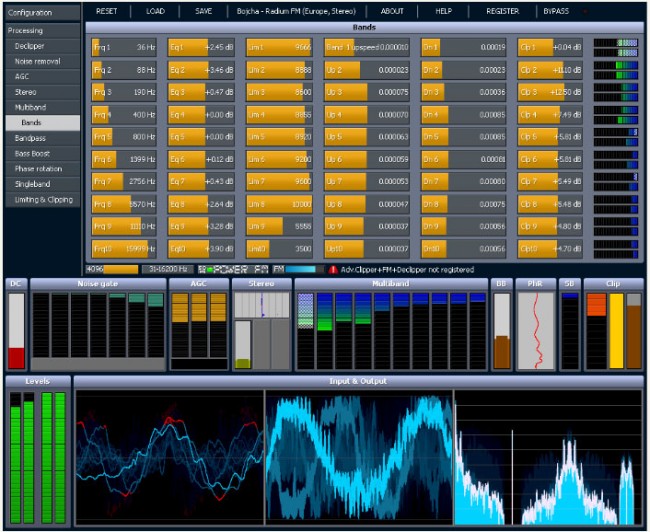
| FM Processor | $10,000.00 | $1,200.00 | Can also use software such as Breakaway Broadcast |
| Misc connectors, grounding kits, etc | $1,100.00 | N/A | |
| EAS unit | $1,900.00 | N/A | Fully operational CAP compliant |
| Processing software, Breakway broadcast | $200.00 | N/A | In lieu of standard FM processor |
| Total | $12-24K | $8-12K |
This is a generic station, most will be somewhat different due to antenna supporting structures, transmitter powers and antenna types. For the best possible signal, a circularly polarized antenna should be used. A two bay, 1/2 wave spaced antenna will give the maximum signal density, while minimizing downward and upward radiation. The upward radiation is simply wasted energy, as no one in space is listening to FM radio. The downward radiation reduction is key if located in congested areas.
For internet radio station, the following would be required:
| Nomenclature | Cost New IUSD) | Cost Used (USD) | Comments |
| Streaming Server | 2,100.00 | 1,100.00 | Includes professional sound card |
| Audio processing software | 200.00 | N/A | Recommend software such as Breakaway Broadcast |
| Audio Processing, outboard hardware | 650.00 | 400.00 | In lieu of software |
| Audio Streaming aggregator | 1,200 to 2,400 | N/A | Annually |
While LPFM’s are much more expensive than internet only stations, LPFM’s have the advantage of built in marketing, which is the on air signal. If it is broadcasting on the air, word will get out. On the internet, some other type of marketing will be needed to spread the word. Also, LPFM’s should also be streaming, which would incur the same costs above.
The long and short of it is, to put a technically viable LPFM on the air is not an inexpensive proposition. It is worth the effort, however, because the advantages of an LPFM over an internet only station are great.













You wrote this
You told us the start-up costs but what about the ongoing operating costs – those costs will come every month and anyone putting up a station would have to plan for them.
For example, on the LPFM side, what about infrastructure maintenance, energy costs, engineering personnel, and anything else. On the internet station, what would be the bandwidth costs of streaming and how to these costs escalate with the number of simultaneous listeners?
The great advantage of having a streaming capability is the ability to replay programming on demand. With a radio-only station once the programing is transmitted – it’s gone. If someone invests heavily in programming then it would be of great value to retain this investment in talent and time through archives and on-demand availability of programming to the listener base.
If you are recommending streaming for LPFM’s… “Also, LPFM’s should also be streaming, which would incur the same costs above” then you would incur the operating costs of both the RF-based distribution and the internet distribution.
So, bottom line. After I have this station up and running (start-up costs which you provided) what would be the estimated costs in operating this station that I would put in my plan?
Operating costs are much more difficult to pin down. Other than potential employees, the single greatest operating cost for an LPFM would likely be the lease of studio and or transmitter space. Each situation is different, however. Some LPFM’s can be located in their sponsor’s building, e.g. a school or church, which would cost nothing. Others may need to rent tower space, which is very expensive.
Other operating costs are utilities (Electric, heating, telephone service, high speed internet service), programming material and sources (most public radio content providers will supply LPFM’s, but there is a cost associated with it), office expenses, fund raising, marketing, streaming services, ASCAP/BMI (if music is broadcast), equipment repair and maintenance, ect.
The short answer is, all of these things will vary with the size of the operation and location.
Not as drastic of expense? Are you paying attention to those numbers in your chart?
Those figures are not exactly average budget numbers. Yes yes they are still lower than trying to fund a larger commercial station, but still you sound off like its pocket change during this economic depression we are all going through.
Don’t dress the facts of reality up with ohh ahh ok. Even for a group of people forming a non profit organization will find out real quick how low cost turns into considerable expense..especially for this case in LPFM when there are 3000 plus applicants who have been waiting and waiting for years to get into the door. Ya let’s not forget about the first come firs served basis format the FCC adopted years ago. And it is still the same as for commercial applications…got the bucks…pick a bid number and have a seat..the auction will begin shortly.
RFB
@RFB, you seem upset. What I actually said was “it is not an inexpensive proposition,” which means it is expensive. There are many, many groups waiting to apply for licenses who may not have the wherewithal to actually put a station on the air. Better for them to know ahead of time that it is expensive and time consuming.
LPFM is not, nor should it be, somebody’s hobby station or ego gratification system.
Can it be done for cheaper? You bet, with consumer grade audio equipment, cheap computers, cheap sound cards and free software downloaded from the internet. But, at what cost to reliability? There is also the possibility that some equipment may be donated to an LPFM, but those opportunities are few and far between and cannot be used for planning purposes.
That being said, my premise for this post was that some sort of reliable, functioning studio would be built where the public can come in and a radio show without too much difficulty. That requires durable, reliable equipment. What I outline above should be considered as a minimum starting point, especially where the studio is concerned.
I am not sure what to make of your comments about the FCC, they have said that LPFM applications would be free.
Consumer grade was common when I had some involvement with community radio.
I remember pre recorded shows going to air from hifi vhs video tapes wile on air presenters put their muscle behind a studio relocation doing building, installing studio furniture and equipment, wiring and so forth. The tape was long enough to do the job after which it was down tools announce the next track then go on with building.
As computers and audio were still coming of age cassettes and LPs and CDs were all played on air. The logger was a vhs videos in long play mode.
At the TX site there was a professionally built low power exciter driving a home brew power amp into 4 bay ½ wave array fed via some ex commercial castoff 2 inch heliax. The tx building was a tin shed that was not even bird proof. When the STL rx died someone hacked an icom scanner for super wideband mpx output. It wasn’t pretty but it worked.
These are the things that happen when its run by volunteers and funded by sponsors and donations.
@Rob, that sounds pretty typical for a volunteer station. If there is somebody who can play the part of MacGyver, that’s great. I find the choice of a 4 bay 1/2 wave spaced antenna interesting.
I believe the theory was that power saving were had with more gain up top. They had no mains at the TX site and I believe thats still the case to this day. In case I have the terminology wrong what I mean is something visually like this:
http://www.hi-tec-aerials.co.nz/Images/FMD6-SA.jpg
Rob, that is also interesting. How did they generate the power for their transmitters, wind or solar? I am working on a mountain top transmitter site where we may use a 48 volt battery bank to run the transmitters in place of the switch power supplies and recharge the bank with solar panels.
We’ve been on the air as an LPFM since ’06. We spent way more than we thought we ever would. IF I knew what the heck I was doing in the beginning, I could have save a lot of money, but that’s all hindsight. We are a church, so it is purpose that has kept us going (not a hobby or ego gratification). As far as antennas, consider the dominator. It is a vertical antenna, but we output about 35 watts from the transmitter and get 100 watts at the antenna, line loss considered. It only cost about $400 and has been a great antenna.
Setup an LPFM in western Montana…front to back cost with Harris Stereo 80 board, Dell desktop, PCS transmitter, 40 ft tower, PCS 500 W transmitter, cables, roto-tiller 2 bay antenna = $3100. Bare bones, but functional.
Your mileage may vary and this is the second I’ve outfitted for less than $5K.
Those who have plan to start a new LPFM will be worried to know this information. 😀
There is something that has been completely overlooked in the comparison: The Music MAFIAA’s draconian rules for Internet stations. I don’t know if there is a 1’st Amendment issue when an over-the-air station is being streamed, vs an Internet-only station, but the MAFIAA’s rules are very restrictive concerning the music you play.
For example: You cannot play more than THREE songs by a given artist within a 3-hour window. There are other, similar restrictions, like YOU CAN *NOT* take LIVE listener requests, (by ANY means) and you *CAN NOT* let listeners know when a song is coming up. (Like, “We will hear Jane Doe’s latest hit, right after the news…” big no-no.)
Then you also have the ever-reaching, money-grubbing hands from the other arms of the MAFIAA: ASCAP, BMI, SESAC. CHA-CHING!!!
Actually, I think you can front sell an artist, but perhaps not the specific song as Willie said. The point was to discourage people from recording off a digital stream = digital copy of music.
Thanks you for the information, I will like you to give me the estimate amount of used traditional LPFM STATION AND TRANSMITTING EQUIPMENTS There are some equipments that I may not need in Africa all that I need is the basic equipment to startup with small community. Please send me the pictures the equipments Thanks.