|
|
By Paul Thurst, on February 27th, 2012
Several months ago, I drove up to an FM transmitter site, looked up at the utility pole and saw this:
 Three Phase open delta transformer bank
Three phase open delta is a bad hombre. Most, if not all, transmitter manufactures will void the warranty of any transmitter connected to a service like this. What is perplexing is it appears that all three phases are available on the primary side, why would this be necessary? Perhaps it was not always so at this location. Regardless, this was the source of power for 20 KW FM transmitters since 1958 until we moved it to a new building last month.
According to a GE publication on transformers, open delta 3 phase power is undesirable because:
Although this connection delivers three-phase currents which are approximately symmetrical to a three-phase symetrical load, the currents flowing in the high voltage circuit are not equal nor are they 120 degrees apart. The maximum safe output of the bank operating in this manner is 58% of a 3 pot Wye/Delta bank. The system is grossly unbalanced, both electrostatically and electromagnetically.
Schematically, it looks like this:
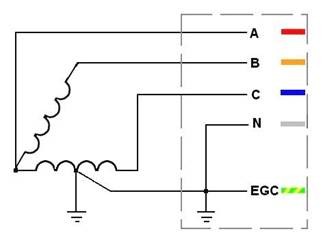
 3 Phase open delta power
Regular 3 phase delta looks like this:
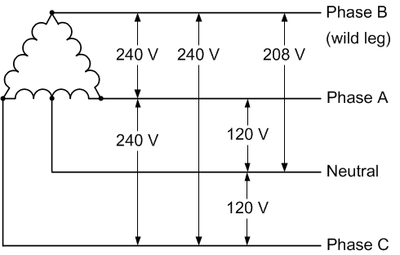
 3 phase delta power
Most utility companies will not hook up 3 phase delta on the customer side anymore because the the “high” or “wild” leg, which as shown in the diagram runs a good deal higher than 120 volts to neutral. Hook up a high leg to a single phase 120 volt piece of equipment and wait for the power supply to blow up. Also true with 277 volt lighting circuits, as my assistant once found out with the Coke Machine in the break room. New 3 phase service will almost invariably be 208 wye unless there is some very compelling reason, which is fine.
There are many ways to get around three phase open delta, perhaps the best is a rotary phase converter. This piece of equipment will take a 240 volt split phase and add a third leg. These legs will not be 120 degrees apart, as they would be in a true three phase, however, they will be close enough that 3 phase motors and transformers will be happy.
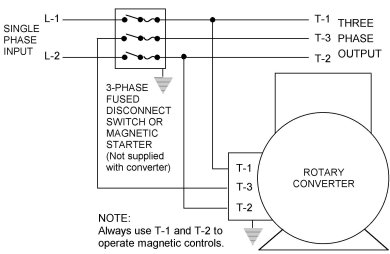
 Rotary Phase converter
This leads to an unbalanced voltage/current condition which needs to be accounted for in the design of the unit. The second way to do this is to power a three phase generator with a split phase motor. This will completely isolate the 3 phase equipment from the utility service and provide for true three phase power.
The downside to any motor/generator or rotary converter is moving parts and conversion inefficiencies. At any transmitter site that uses this type of equipment, either a backup power converter or a lower power split phase backup transmitter should be installed. With all mechanical things, eventually this will need to be repaired and it would suck to be off air while that is happening.
Regardless of any of that, this particular service is about to be disconnected permanently. Good riddance.
By Paul Thurst, on February 26th, 2012
Sometimes there is just no way around it, especially with some modern equipment:
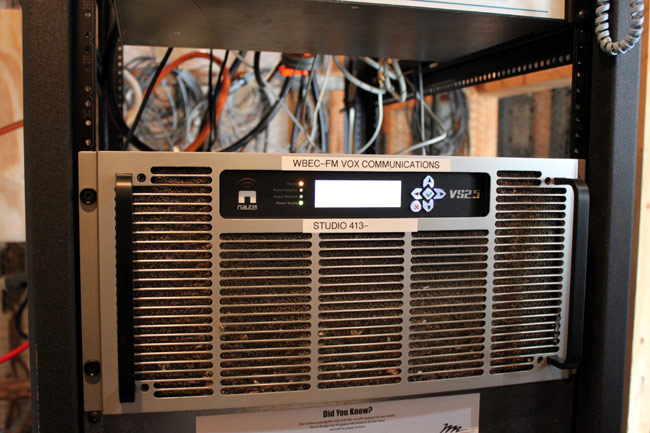
 Hard restart, Nautel VS2500 transmitter
This Nautel VS2500 transmitter got all cranky after lightning struck the tower (or nearby) on Friday night. Thunderstorms in February are not unheard of, but they are unusual, at least in the Northeastern United States.
 Nautel VS2500 FM transmitter, WBEC-FM, Pittsfield, MA
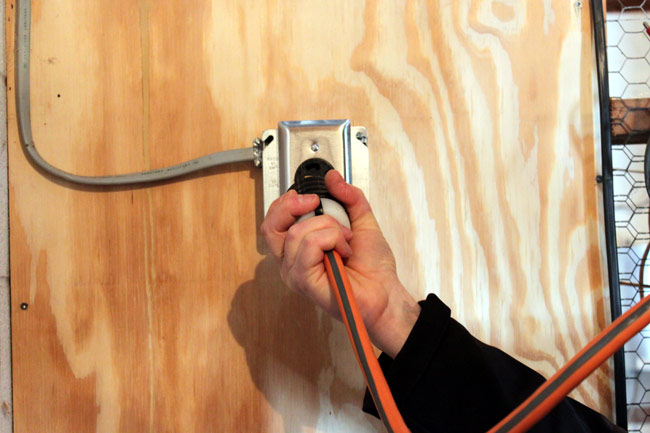
Anyway, the transmitter would not reset or restart via remote control, therefore, we had to ride the chair lift to the top of the hill and pull the plug to reset its logic and start over again.
 Bousquet Ski Area Chair lift
At least the trip up to the transmitter site was scenic. We had to wait a day for the winds to calm down, but all in all, not a terrible day. Did I mention the scenery?
By Paul Thurst, on February 23rd, 2012
Some people work in offices and make lots of money. Others work outside, oblivious to the world going on around them. A fortunate few, myself included, get to work in many different environments, an appreciate them all.
A week or so ago, at the end of the day, I was carrying my tool bag back to the truck and was surprised to see this view:
 View looking west from the WRKI transmitter site, Brookfield, CT
The picture really does not do justice. A much wider view is required to get the full effect. It looked like the sky was on fire, something out of a science fiction movie.
Then again, yesterday, I spent the day in a dank, smelly basement tracing out telephone wires. In the end, it all evens out.
By Paul Thurst, on February 17th, 2012
An issue I had to deal with recently; an unstable generator/UPS relationship. When the generator was running under load, it surged repeatedly causing the UPS to drop out and not recharge. Eventually, the UPS ran out of juice and shut down, killing the power to the Sine Systems remote control and telephone system. Of the two, the remote control was the biggest pain to fix, as it lost it’s timed commands and would not reduce power at sun set for the associated class D AM station.
What went wrong? This is a chart of typical problems with generators operating UPS loads:
| Symptom |
Potential Problem |
| Fail to “lock on” to generator power |
Improper generator frequency or voltage
Poor generator regulation
Unrealistic performance requirements |
| Instability of generator |
Voltage regulator sensitivity
Control loop compatibility
Filter/control interaction
Governor or AVR problem |
| Fail to sync bypass |
Frequency or voltage out of range
Poor frequency stability
Unrealistic performance requirements
Changes to total load on the system
Generator output voltage distortion |
| Instability at specific load levels |
Control loop compatibility |
| Instability at load changes |
Control loop compatibility |
| Metring errors |
Generator output voltage distortion |
| Loss of voltage control |
Excess capacitance in filters vs. load |
Table courtesy of Cummins Power Generation.
Generator excitation methods can be the culprit in many of these situations. Generators often use one of three types of excitation for their field coils:
- Shunt excited SCR (silicon controlled recifier)
- Shunt excited PWM (pulse width modulation)
- PGM (permanent magnet generator)
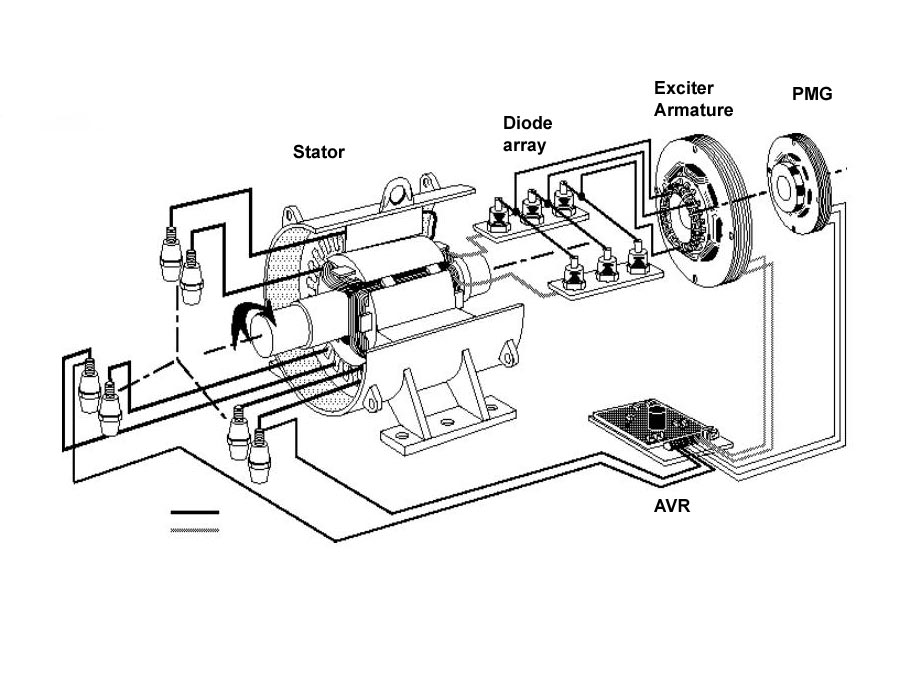
Of the three, permanent magnet generator is the most stable since the AVR (automatic voltage regulator) is powered by a separate small generator which is unaffected by the load on the main generator output. SCR and PWM both use the generator output windings, which makes them susceptible to load inducted voltage distortion brought on by non-linear loads. Therefore, in locations where large UPSs are known to be part of the load, PGM excited generators are the best choice.
 PMG generator diagram
Sometimes, the generator is already in use before the UPS is installed. In that case, there are some remedial steps that can be taken. The speed which the voltage regulator reacts to changes in the load is often the culprit in many of these situations. It may seem counter intuitive, however, the faster the AVR reacts, the more fluctuations there will be in the voltage and frequency. A UPS can operate under a wide range of voltages and frequency, provided they do not rapidly change.
Depending on other loads, it may be necessary to dampen the gain on the AVR to slow it’s reactions down. This will work if there are not large intermittent starting loads on the generator such as air conditioning compressors.
Another method would be to delay the UPS transfer to generator power until after all the other loads have been satisfied. This will ensure that the generator voltage and current fluctuations are damped by the existing load.
The generator’s size needs to account for the equipment attached to the UPS and the battery charging load. With a larger UPS, the battery charging load can be significant. Generators that are improperly sized will not be made to work under any circumstances, hence the “unrealistic performance requirements” noted in the chart above.
You can read the entire Cummins Power white paper on generators powering UPS loads here.
By Paul Thurst, on February 16th, 2012
I found this manual from 1946 in the drawer at the WICC transmitter site, which is a sort of time capsule due to its inaccessibility. I figured I would bring it home and scan it, then return it to the file drawer out on the island. Step one is done:
 Raytheon RM-10 Monitor Amp
This is a cool little monitor amp, capable of driving line level or speaker outputs up to about 10 watts or so. It could be used as a front or input stage for a larger audio amp. By the way, 10 watts is a lot more than it seems, if using efficient speakers to convert that power into sound waves. Specs show total harmonic distortion is between 0.6 to 2 percent depending on power and frequency. Lower power output levels net less distortion.

Schematic is pretty simple, a pair of 6L6′s in push-pull for the output. Inverse feedback into the previous stage via the output transformer. Click on image for higher resolution.
Full manual and parts list is available here.
Now I just need to get the manual back out there.
By Paul Thurst, on February 10th, 2012
Celebrated on February 13, 2012. Who knew about this? In any case, the purpose of World Radio Day is to:
…raise awareness about the importance of radio, facilitate access to information through radio and enhance networking among broadcasters. Radio has to be recognized as a low cost medium, specifically suited to reach remote communities…
And:
Furthermore, radio has a strong and specific role in emergency communication and disaster relief.
Which is true enough. The fact that this is sponsored by UNESCO, the UN being one of my least favorite organizations, makes me slightly suspicious. While radio can be used for good purposes, like any media, it can also be corrupted. It is up to the listeners to know the difference and act accordingly.
Radio is still the greatest mass media ever known to man kind, larger audience than the internet and TV. Over the last eighty years or so, radio has had an incalculable impact on society as a whole. Therefore, it is right to reflect on this and to honor radio history and those that develop and facilitate radio broadcasts past and present.
Some interesting statistics on radio: Statistics on Radio
By Paul Thurst, on February 9th, 2012
I have been watching the LPFM proceedings with some interest. The FCC has not exactly promised to have a filing window by end of 2012, but indicates that it might try to do that. In comparison to such evolutions in the past, this is moving pretty fast. Those that want an LPFM station need to start planing now. As in previous LPFM windows, the availability is for non-profit organizations only. This does not mean all hope is lost; NPR stations are all non-profits and most of them are very successful.
One of the biggest questions is: How much will it cost? Like all things, it varies greatly. If I were to put an LPFM or internet radio station on the air, there would be certain minimums, such as the use of professional audio equipment, a new antenna, and some type of redundancy.
Generally speaking, radio stations and internet stations both need some type of office/studio space. This can range from large and opulent to a closet. The costs for these would depend on the type and quantity of equipment installed, whether the equipment is new or used, the building, the area, etc. Those facilities also have monthly reoccurring costs such as rent, electric, telephone service, internet service, etc.
Since internet radio stations and traditional terrestrial over the air radio would use the same type of studio equipment, those costs will be similar. Here is a breakdown of the studio equipment:
| Nomenclature |
Cost new (USD) |
Cost used (USD) |
Comments |
| 12 Channel professional audio console |
$6,000.00 |
$2,500.00 |
Analog, 4 buss, telephone mix minus |
| Studio Furniture |
$5,500.00 |
$1,000.00 |
Can also be fabricated locally |
| Microphones, RE-20 or SM-7B |
$250-350 |
$100-150 |
Per unit, several required |
| Monitor Amp |
$250.00 |
$100.00 |
Can also use consumer version |
| Monitor speakers |
$500.00 |
$200.00 |
Can also use consumer version |
| CD Player |
$500.00 |
$200.00 |
Professional unit with balanced outs |
| Computer w/ professional sound card |
$1,500.00 |
$500.00 |
For automation and sound file storage |
| Computer, general use |
$700.00 |
$300.00 |
General information web browsing |
| Computer, Streaming w/sound card |
$900.00 |
$400.00 |
Sound card should be good quality |
| Studio Telephone system |
$1,900.00 |
$300.00 |
Used for call in/on air |
| Barix remote box |
$240.00 (x2) |
N/A |
Used for IP remote broadcasts |
| Comrex Matrix POTS codec |
$3,200.00 |
$700.00 |
Used for telephone line remote broadcasts |
| Misc wiring, hardware, ect |
$1,000.00 |
$800.00 |
Connectors, mic booms, wire, etc |
| Total |
$21,780.00 |
$7,930.00 |
|
Some equipment is not available used such as Barix boxes. Of course, not all of this is required for a radio station, however, most local radio stations would want the capability to do remote broadcasts, take phone callers on the air, have multiple guests in the studio, etc.
For a traditional LPFM station, the transmitting equipment would entail:
| Nomenclature |
Cost New (USD) |
Cost Used (USD) |
Comments |
| 300 watt transmitter and exciter |
4,400.00 |
2,000.00 |
Smaller transmitters with higher gain antennas can also be used |
| 2 Bay ½ wave spaced antenna |
$1,900.00 |
$700.00 |
|
| 125 feet ½ inch coax |
$350.00 |
N/A |
|
| 100 foot guyed tower and installation |
$4,000.00 |
$3,500.00 |
Not needed if station is on tall building or leased site |
| STL; IP radio w/ barix boxes |
$850.00 |
|
In lieu of standard 950 MHz STL |
| STL standard 950 MHZ |
$6,500.00 |
$3,500.00 |
Used in lieu of IP STL |
| STL antennas, transmission line |
$2,500.00 |
$1,500.00 |
|
| FM Processor |
$10,000.00 |
$1,200.00 |
Can also use software such as Breakaway Broadcast |
| Misc connectors, grounding kits, etc |
$1,100.00 |
N/A |
|
| EAS unit |
$1,900.00 |
N/A |
Fully operational CAP compliant |
| Processing software, Breakway broadcast |
$200.00 |
N/A |
In lieu of standard FM processor |
| Total |
$12-24K |
$8-12K |
|
This is a generic station, most will be somewhat different due to antenna supporting structures, transmitter powers and antenna types. For the best possible signal, a circularly polarized antenna should be used. A two bay, 1/2 wave spaced antenna will give the maximum signal density, while minimizing downward and upward radiation. The upward radiation is simply wasted energy, as no one in space is listening to FM radio. The downward radiation reduction is key if located in congested areas.
For internet radio station, the following would be required:
| Nomenclature |
Cost New IUSD) |
Cost Used (USD) |
Comments |
| Streaming Server |
2,100.00 |
1,100.00 |
Includes professional sound card |
| Audio processing software |
200.00 |
N/A |
Recommend software such as Breakaway Broadcast |
| Audio Processing, outboard hardware |
650.00 |
400.00 |
In lieu of software |
| Audio Streaming aggregator |
1,200 to 2,400 |
N/A |
Annually |
While LPFM’s are much more expensive than internet only stations, LPFM’s have the advantage of built in marketing, which is the on air signal. If it is broadcasting on the air, word will get out. On the internet, some other type of marketing will be needed to spread the word. Also, LPFM’s should also be streaming, which would incur the same costs above.
The long and short of it is, to put a technically viable LPFM on the air is not an inexpensive proposition. It is worth the effort, however, because the advantages of an LPFM over an internet only station are great.
By Paul Thurst, on February 3rd, 2012
Eventually, you will get caught, odds dictate. The local engineer for Cumulus Broadcasting in Cincinnati found this out earlier in the week. Of course, innocent until proven guilty, so I won’t assume anything.
Broadcast engineering, especially radio engineering is a small field. Sadly, when something like this happens it makes all radio engineers look bad and there is no good reason or excuse for it.
I have seen several cases where an engineer or technical person has taken advantage of their position to pilfer from a radio station. These vary from cashing in on dud tubes from a transmitters site to taking high value equipment and selling it on eBay. I recall on recent instance of backup transmitter and STL systems being sold. I cannot imagine what these people are thinking. A transmitter, STL system, console or even a dud tube has a serial number and is traceable. Anything with a serial number is likely part of a station inventory list and or will have some record of manufacture and sale.
There are instances when old equipment is getting thrown out. In that situation, I always get permission before removing anything, even from the dumpster.
I have made several trips to the scrap yard with old transmitter chassis, wire or left overs from transmitter installations. In those circumstances, I always get a receipt and write the source of the scrap on the back. This way, a record is kept and if there is any questions, I can refer to it.
Generally speaking, it is better to be overly cautious.
By Paul Thurst, on February 1st, 2012
This transmitter is in service at WSBS, Great Barrington, MA as a standby. It was new in January of 1975.
 Gates BC250GY transmitter, WSBS Great Barrington, MA
This was running into the dummy load for testing, which we try to do periodically.
 Gates BC250GY AM transmitter audio section
The audio section is a pair of 8008′s 810′s running in parallel. This goes through a modulation transformer to the RF section.
 Gates BC250GY RF section
The RF section consists of another pair of 8008′s 810′s running a parallel. The plate voltage for these tubes is 1,250 VDC which is fairly tame, all things considered. The transmitter is dirt simple 250 watt carrier power, 125% positive peak capable. It is not the most efficient unit under the sun but it can still be repaired with off the self parts.
 Gates BC250GY Schematic
This is a somewhat faded schematic. The schematic shows a single 833A as the final, however, this particular transmitter has a pair of 810′s for the final, as shown in the above picture. Ham radio operators love these things as they are easy to convert to 160 or 80 meters for AM phone use. The bigger brother to this unit is the Gates BC1G, which is also pretty simple unit using 833A tubes in parallel with 3,500 VDC plate voltage.
|
Axiom
Congress shall make no law respecting an establishment of religion, or prohibiting the free exercise thereof; or abridging the freedom of speech, or of the press; or the right of the people peaceably to assemble, and to petition the Government for a redress of grievances.
~1st amendment to the United States Constitution
Any society that would give up a little liberty to gain a little security will deserve neither and lose both.
~Benjamin Franklin
...radio was discovered, and not invented, and that these frequencies and principles were always in existence long before man was aware of them. Therefore, no one owns them. They are there as free as sunlight, which is a higher frequency form of the same energy.
~Alan Weiner
Everyone has the right to freedom of opinion and expression; this right includes the freedom to hold opinions without interference and to seek, receive and impart information and ideas through any media and regardless of frontiers
~Universal Declaration Of Human Rights, Article 19
|
Heard in the clear